Technical Details
I acquired two Rock Exotica TactiGrab RG20s from RubiconGear in 2018.
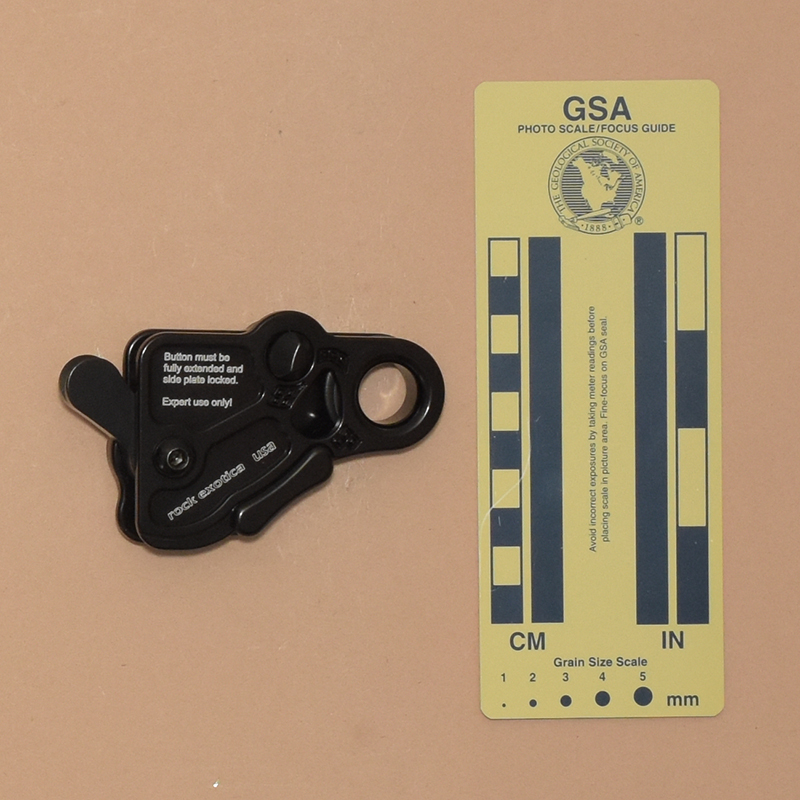
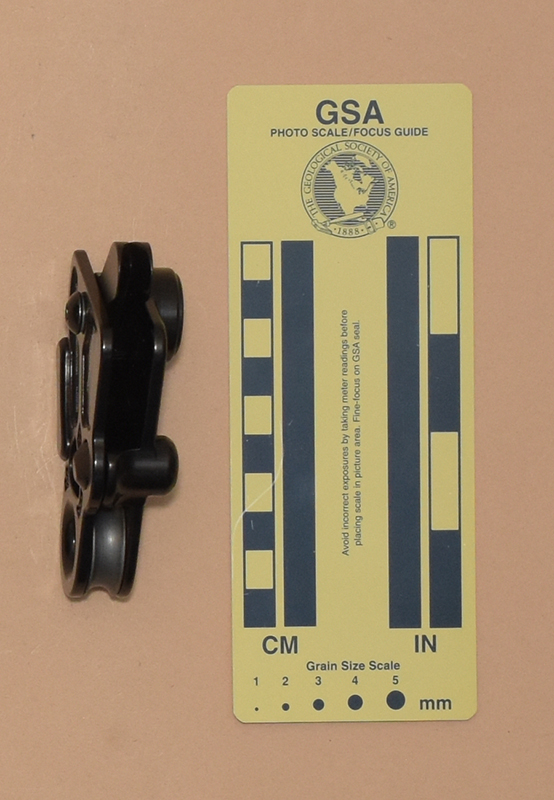
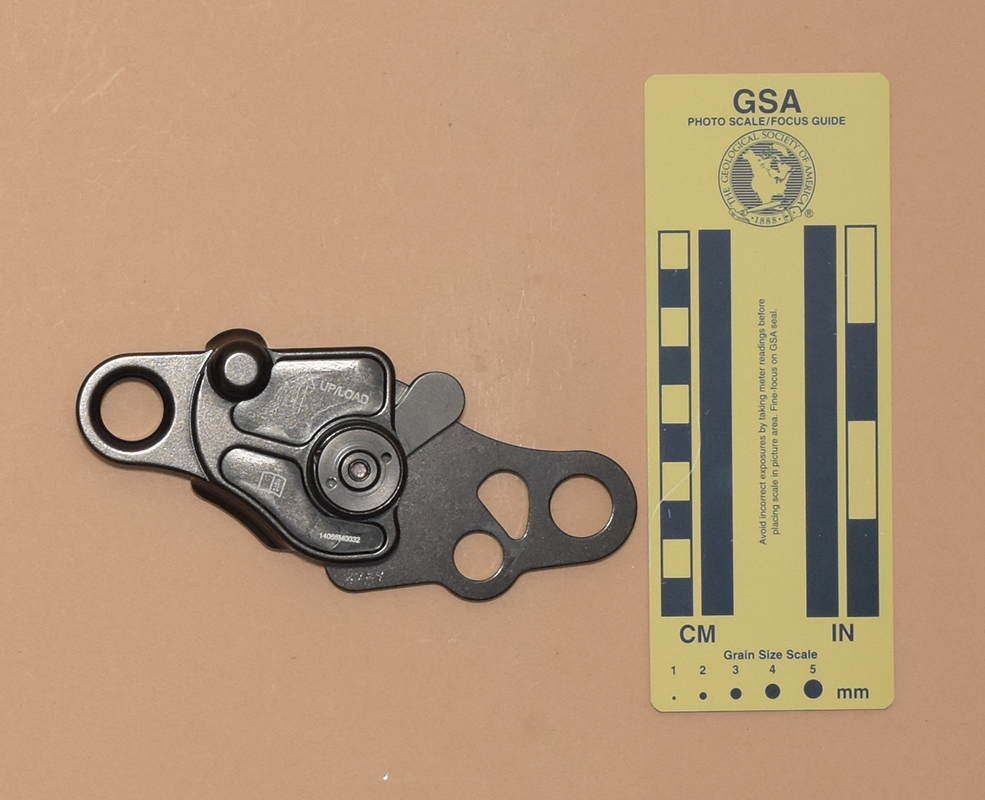
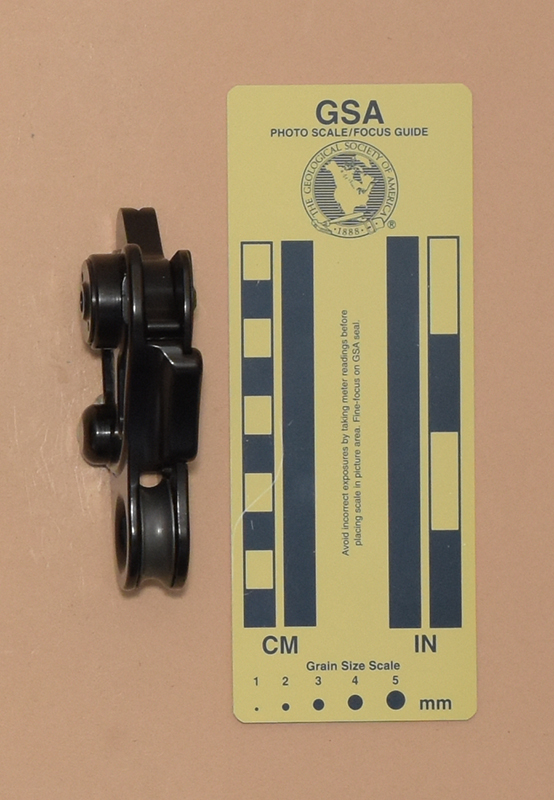
Each Rock Exotica TactiGrab RG20 is 98 mm. long, 59 mm. wide, 29 mm. high, and weighs 101 g.
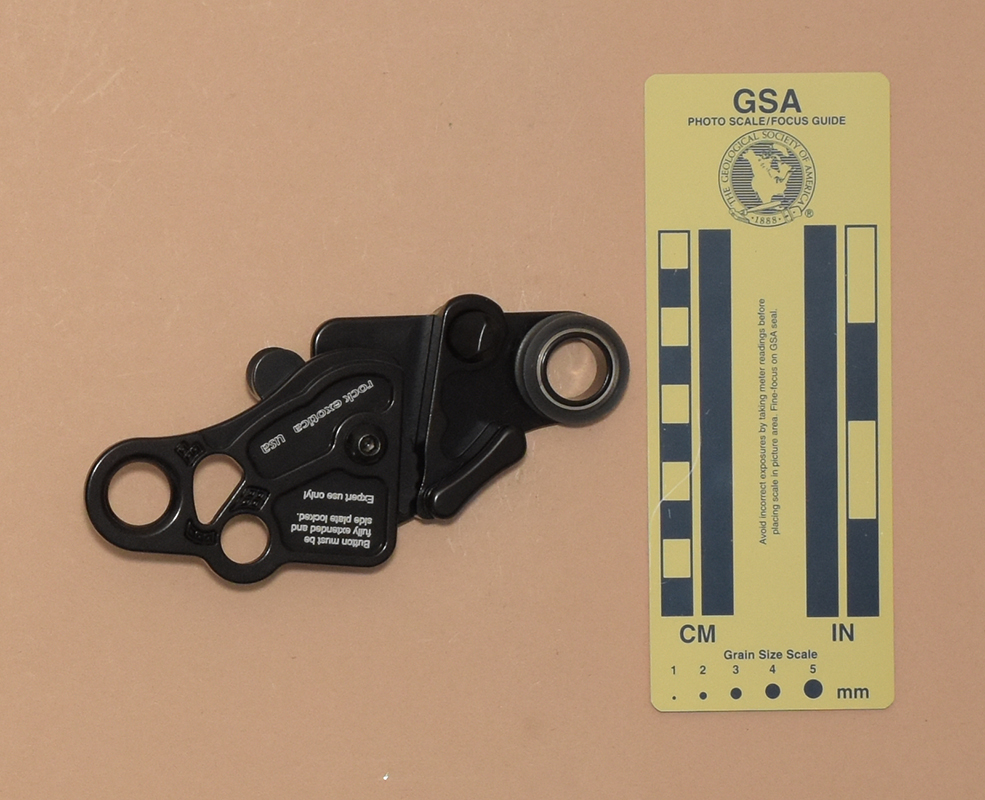
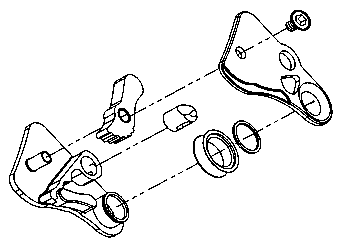
 The Rock Exotica TactiGrab RG20consists of milled aluminum front and rear plates, a spring-loaded milled aluminum cam, a spring-loaded latch, and a plastic pulley sheave.
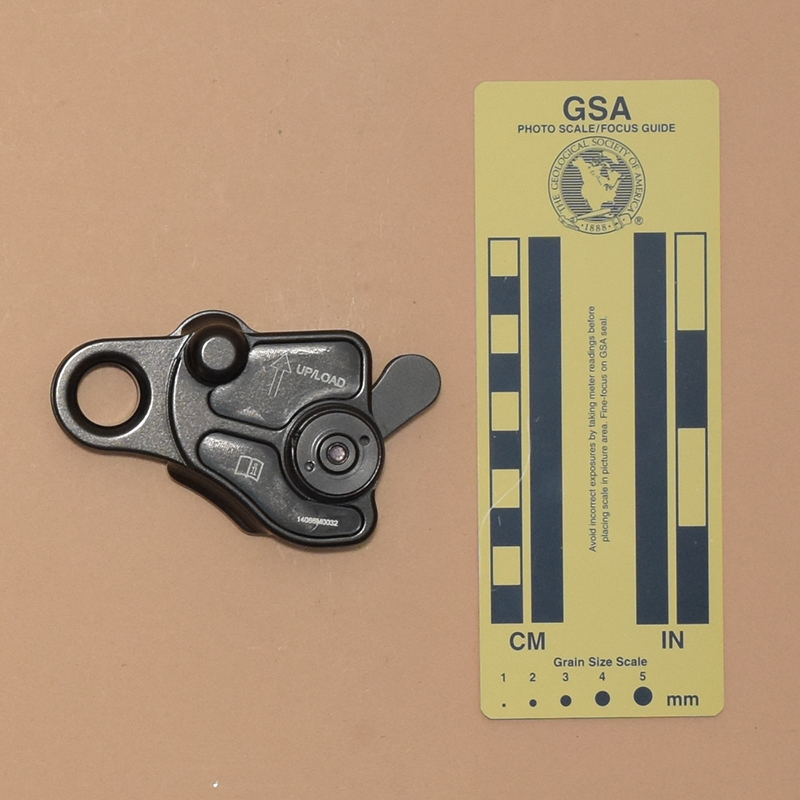
The rear plate is the main structural element of the RG20. It is milled from aluminum alloy and then hard anodized. It has a raised post on the inside that acts as the cam axle, a raised anvil to support the rope opposite the cam, and a raised cylinder that doubles as the sheave axle and the ascender eye. The anvil has a planar face that runs against the rope, with a slight depression opposite the cam. The resulting rope channel is 9 mm. wide. The upper portion of the anvil houses the latching button, which is secured by a set screw. This portion of the anvil also acts as a rope guide for the pulley sheave, as does an extension extending from the bottom of the anvil. The rear of this plate has a cylindrical extension that houses the cam spring assembly, and a circular boss that houses the latch spring.
The front plate is also milled from aluminum alloy and hard anodized. It pivots around a bolt that secures it, the cam, and the cam spring assembly to the rear plate. The lower portion of the plate slides through a notch in the rear plate anvil's lower extension, receiving support against lateral loads. A round cutout engages the latch when the ascender is closed for use. A teardrop cutout provides a backup latching position. An eye opposite the cam aligns with the central hole in the rear plate eye. The outer edge of the eye is rounded, as is the corresponding edge on the rear plate.
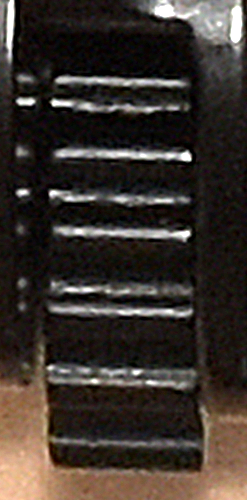
The cam is milled from aluminum alloy and hard anodized. It has six rounded transverse grooves forming six rounded teeth. The cam radius increases from 11 to 21 mm. over an angle of 83°, giving a 24° cam angle. The upper portion of the cam has a V-shaped groove to guide the rope when the ascender is loaded.
The front plate is printed with "Button must be fully extended and side plate locked.," "Expert use only!," and "rock exotica usa." the rear has "⇑" with "UP/LOAD" beside it, a book-with-an-"i" icon, and "14066M0032."
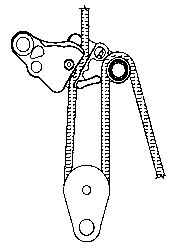
Rock Exotica uses the"RG" designation for "Rope Grabs/Misc" so sensibly I could call the RG20 a Rocker-Arm Rope Grab. Although sold and described as a "rope grab," this is using the term differently than the more common use for that term that I followed on my Rope Grabs and other pages at the time. The RG20 is the same device as the The CTOMS Quickie Ascender™. The RG20 resembles other Rocker-Arm Ascenders, but it also functions as a Hauling Pulley. Since it did not fit cleanly into one of these categories, I originally decided to place it with my other Most Miscellaneous devices, where it remains – at least for now.
I believe that Rock Exotica discontinued this product, as I cannot find it or any instructions online. The eBay listing included the following information:
The unique design of this rope grab allows it to be used as either a ’conventional’ rope grab - whereby the rope grab is attached to the rope and tension is applied to a carabiner clipped into the rope grab - or it can be integrally rigged as a combination rope grab and traveling pulley within a 3:1 mechanical advantage pulley system.
The Mini Ascender with Sheave is a specialized device for emergency use in situations where full-size rope and equipment is not available. It requires careful and expert use and must not be used unless the user has practiced with their system in a controlled situation.
Rope Size Caution: This device was designed for 6.5mm rope. This size is smaller than normally used and it is easier to cut or break than normal rope. Special caution and experience is required. Use only for light loads. Maintain tension, NEVER shock load! Make sure it works properly with the rope you are using.
Ascender Caution: This ascender has a spring providing tension for the cam to help it lock on the rope. But dirt, ice, damage a failed spring, etc. may prevent it from locking on the rope and instead it may freefall down the rope, dropping you or your load. You must guard against this. Grabbing the device or the rope above the device will pull it down, dropping you or your load.
NEVER allow this to happen! It Must ALWAYS Be Closed:The sideplate has a button that must be pushed twice to fully open it. The sideplate MUST be fully closed and the button MUST be fully extended or it will not be strong and it may break and/or the rope may come out. NEVER use it if the sideplate is open. NEVER use it if the sideplate is only closed to the first button hole. It must only be used when it is FULLY closed. Mandatory Sideplate Closing Procedure: Every time you use it, close the sideplate confirming it is fully closed and that the button is fully extended.
Rope Size: 6.5 mm. (i.e. dyneema, kevlar ropes from Bluewater, Sterling ropes or other trusted manufacturers).
There are quite a few warnings here and the user would be well-advised to heed them.
I wonder, though, why the design includes two button holes if we are warned "NEVER use it if the sideplate is only closed to the first button hole." This appears to be a design flaw.
The inventors Kirk Martin Mauthner and Rocke P. Thompson applied for a patent in 2011. They received U. S. Patent No. 8733739 on May 27, 2014.
This is a highly specialized device and given the rope sizes it is designed for, does not have a place in routine caving or climbing.
History
CTOMS CEO sent me the following history of the Rock Exotica TactiGrab RG20 / CTOMS Quickie Ascender:
"The history of the device is not well known, nor straight forward. I’m going to try to make a very long story short. Back in about 2009, I engaged Kirk Mauthner to develop a small diameter rope egress system for military applications. He started with his Escape Artist and without getting into too much detail, that evolved into the PDQ, was abandoned for our application and continued to evolution into the current Quickie Descender.
"Concurrently, Rock was working with… [others on a similar project]. They were using a 6.5mm Bluewater Technora sheath Dyneema Core rope with a micro-8, they had a small double pulley, a complicated device that I have never seen reference or a picture of on the internet called a SLRP, and a rope grab. Rock had these on his site on a page called Other Exotic Devices, but they were not for sale to the public.
"I was aware of them from that web page, so I asked Kirk if it was possible to reach out to Rock and ask him if we could put a sheave where the carabiner eye was on his rope grab. I still have one of the original prototypes of that. Rock and Kirk designed the sheave and the locking plate and updated the device through a number if iterations. Later I asked them to add a spring to the cam, which was also eventually included.
"Rock made them for us, and a few for himself he marketed as a TactiGrab, though I don’t think he ever advertised them. We called it the Quickie Ascender to go with the Quickie Descender. Rock and Kirk would apply and receive a patent for it.
"Rock would eventually sell I believe majority shares in his company. The QA as we call it, was low volume and not a priority or interest to make, especially with the new management and focus on higher volume growth products. The QD was being made in Canada by a company called Performance Manufacturing in Kelowna, BC. Manufacturing of the QA (though not the patent) was transferred from Rock to Performance quite a few years ago. With that shift we fixed a sticky spring issue and changed the plastic sheave to bronze.
"In 2025, CTOMS purchased Performance Manufacturing and moved it to Edmonton, and here we are now. Rock and Kirk still own the patent."