Technical Details
I acquired this CTOMS Quickie directly from CTOMS in 2026.
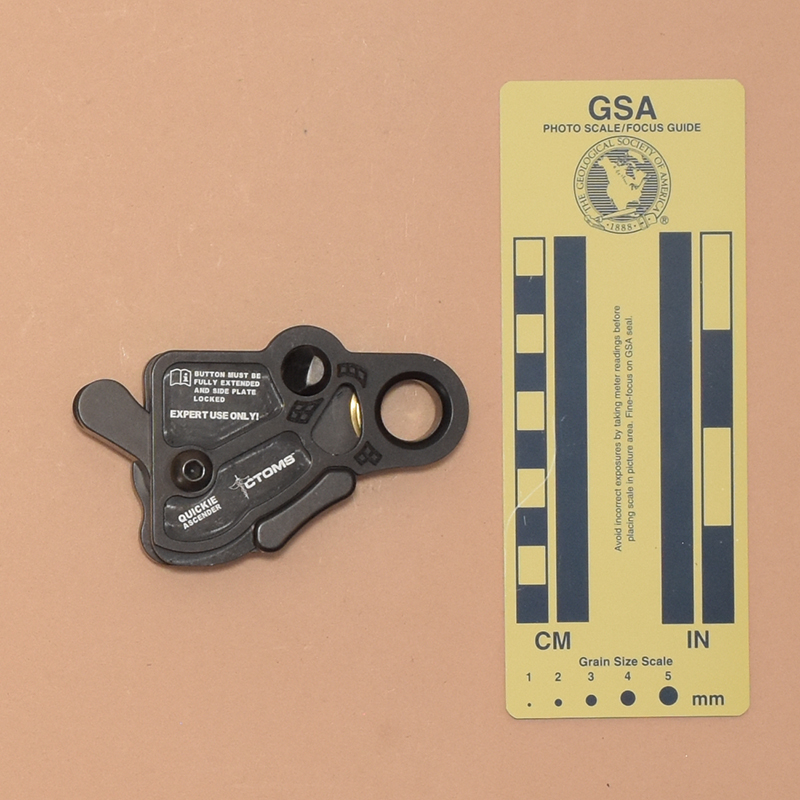
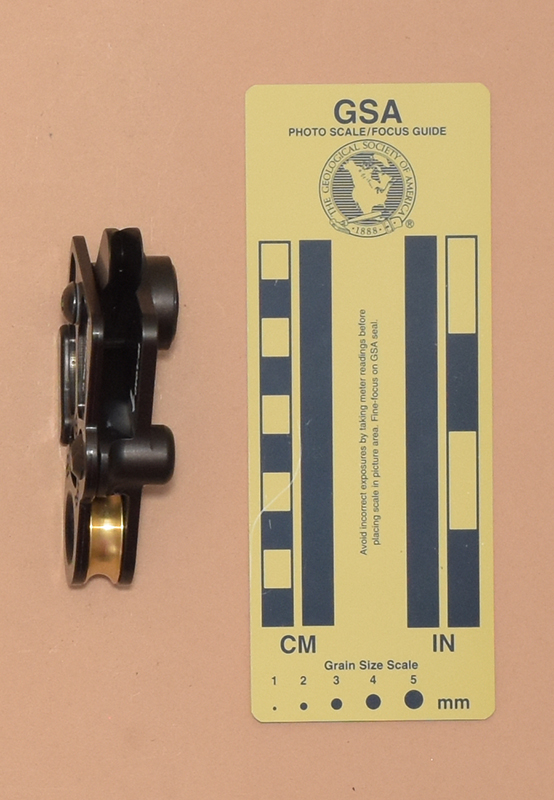
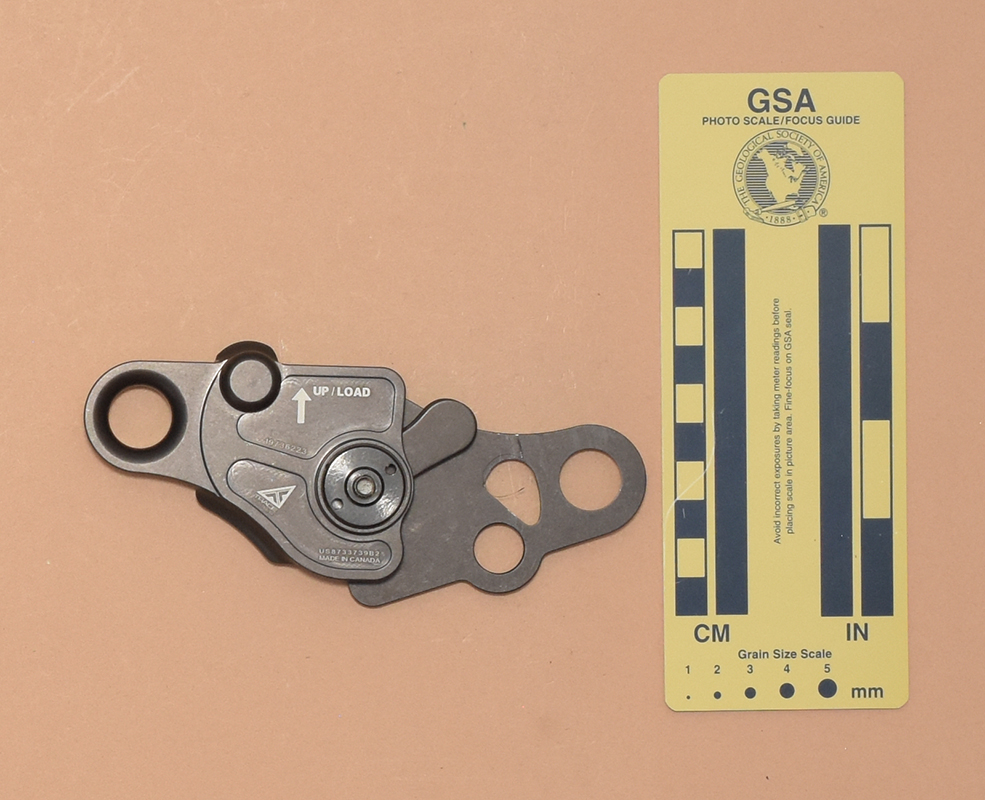
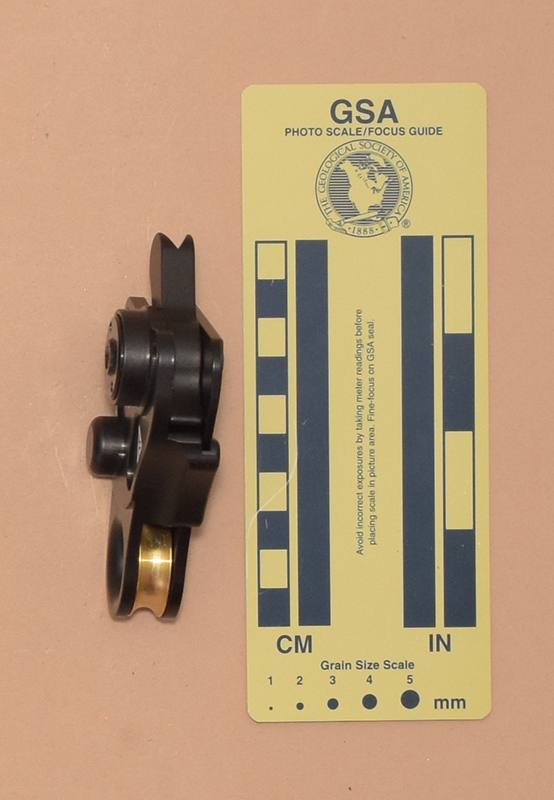
The CTOMS Quickie Ascender™ is 59 mm. tall, 100 mm. wide, 29 mm. thick, and weighs 108 g.
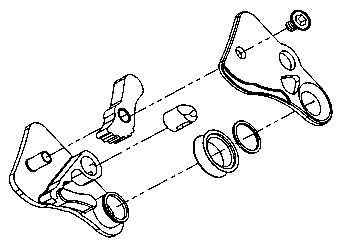
 The Quickie Ascender™ consists of milled aluminum front and rear plates, a spring-loaded milled aluminum cam, a spring-loaded latch, and a bronze pulley sheave.
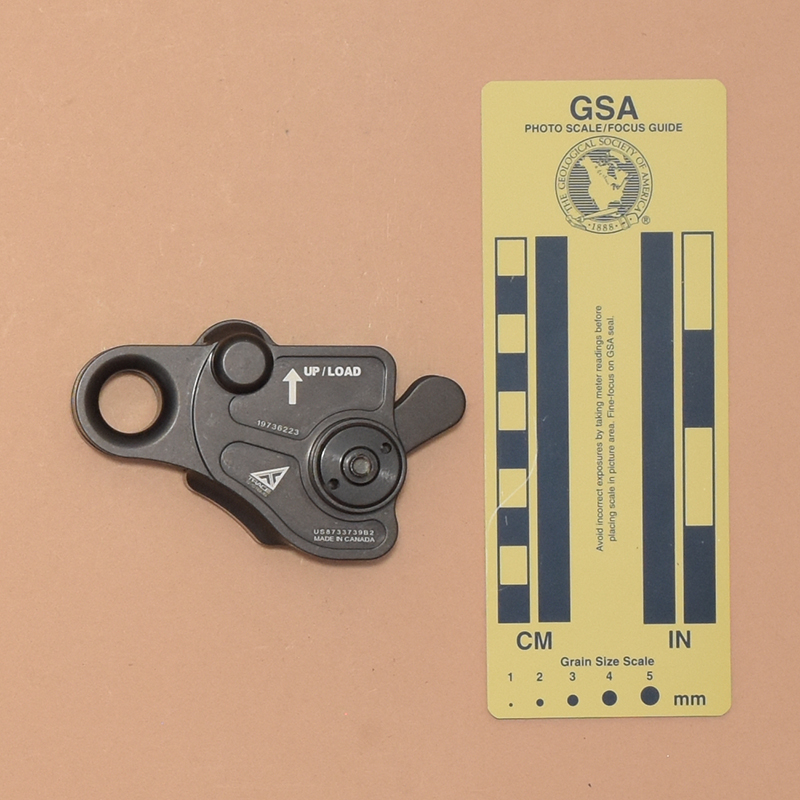
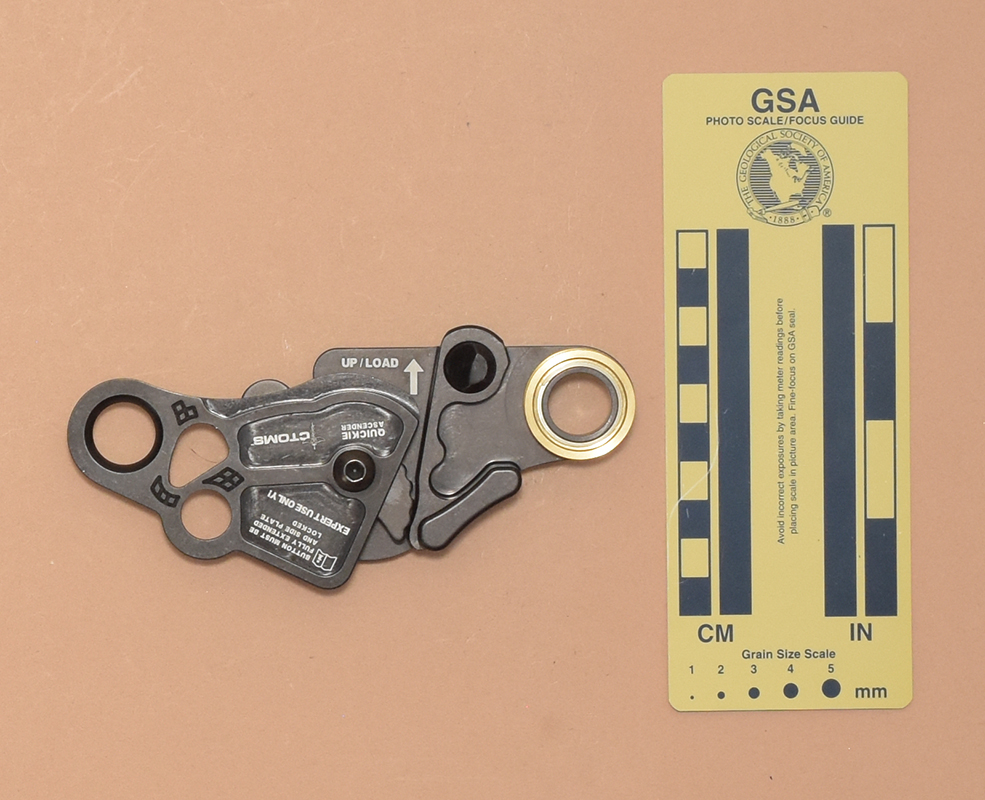
The rear plate is the main structural element of the ascender. It is milled from aluminum alloy and then hard anodized. It has a raised post on the inside that acts as the cam axle, a raised anvil to support the rope opposite the cam, and a raised cylinder that doubles as the sheave axle and the ascender eye. The anvil has a planar face that runs against the rope, with a slight depression opposite the cam. The resulting rope channel is 9 mm. wide. The upper portion of the anvil houses the latching button, which is secured by a set screw. This portion of the anvil also acts as a rope guide for the pulley sheave, as does an extension extending from the bottom of the anvil. The rear of this plate has a cylindrical extension that houses the cam spring assembly, and a circular boss that houses the latch spring.
The front plate is also milled from aluminum alloy and hard anodized. It pivots around a bolt that secures it, the cam, and the cam spring assembly to the rear plate. The lower portion of the plate slides through a notch in the rear plate anvil's lower extension, receiving support against lateral loads. A round cutout engages the latch when the ascender is closed for use. A teardrop cutout provides a backup latching position. An eye opposite the cam aligns with the central hole in the rear plate eye. The outer edge of the eye is rounded, as is the corresponding edge on the rear plate.
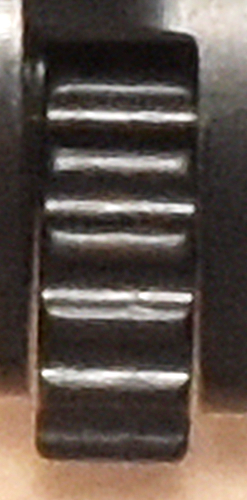
The cam is milled from aluminum alloy and hard anodized. It has six rounded transverse grooves forming six rounded teeth. The cam radius increases from 11 to 21 mm. over an angle of 83°, giving a 24° cam angle. The upper portion of the cam has a V-shaped groove to guide the rope when the ascender is loaded.
The front of the ascender is printed with a book-with-an-"i" icon, "BUTTON MUST BE FULLY EXTENDED AND SIDE PLATE LOCKED, "EXPERT USE ONLY!", "QUICKIE ASCENDER, and the CTOMS logo. The inside is printed with "UP/LOAD" and a filled up-pointing arrow. The rear is printed with a filled up-pointing arrow, "UP/LOAD," "19736223," a TRACE SYSTEMS logo, "US8733739B2," and "MADE IN CANADA."
CTOMS provides training and equipment for tactical, medical, and rescue personnel. T Hey will only sell their Quickie Ascender™ as a component of their TRACE™ Systems kit as the ascender can only be used with authorized TRACE™ Systems rope. I was able to buy one separately only because I had previously purchased their Quickie Descender™ and TRACE™ Systems rope from them.
The TRACE™ Systems rope is a 5 mm., nylon core, technora sheath, kernmantle rope. This is not a standard caving or climbing rope, and in my opinion, is not an appropriate substitute for general caving and climbing use. Since I do not interfere with natural selection and do not admit to having a need for a tactical ascender, I will not discuss the Quickie Ascender's use in those application.
The CTOMS Quickie Ascender™ is the same device as the Rock Exotica TactiGrab RG20. The inventors (Kirk Martin Mauthner and Rocke P. Thompson) applied for a patent in 2011. They received U. S. Patent No. 8733739 on May 27, 2014. The patent summary begins as follows:
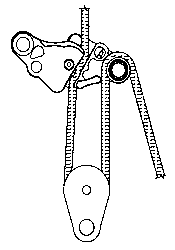
"The unique design of this rope ascender with integrated pulley block, allows it to be used as either a conventional rope ascender to raise oneself by utilizing the rope clamp alone, or with a foot loop attached and it can be used in a 3 to 1 mechanical advantage pulley block configuration such as when lifting oneself, and or when an assistant helps raise a person or a load.
"The device can also be used to raise a person in a rescue without the help of the person being raised, as with the rescue of an incapacitated climber."
There are several reasons that I would not choose the Quickie Ascender™ as my primary ascender for recreational caving or climbing. First, it requires a nonstandard rope. Second, like most rocker-arm ascenders, the Quickie Ascender™ pivots when loaded, resulting in lost motion and inefficiency. Third, I cannot open the ascender if there is something passing through the eye, meaning that I would need to add a carabiner (unnecessary weight) or tie/untie my slings on each climb (needless hassle). Since I both the physical ability stand up without needing a 3-to-1 mechanical advantage system and the knowledge of how to do so, the pulley provides no real advantage for ascending caves and cliffs.
There are times where a 3-to-1 hauling system is useful for caving and climbing. In those situations, something like the Quickie Ascender™ might prove useful, especially if it fit normal ropes.
The inventors designed the Quickie Ascender™ for people whose needs differ from mine. I'm not planning to tell them what they should be using. That path leads to the flame war side.
History
CTOMS CEO sent me the following history of the Rock Exotica TactiGrab RG20 / CTOMS Quickie Ascender:
"The history of the device is not well known, nor straight forward. I’m going to try to make a very long story short. Back in about 2009, I engaged Kirk Mauthner to develop a small diameter rope egress system for military applications. He started with his Escape Artist and without getting into too much detail, that evolved into the PDQ, was abandoned for our application and continued to evolution into the current Quickie Descender.
"Concurrently, Rock was working with… [others on a similar project]. They were using a 6.5mm Bluewater Technora sheath Dyneema Core rope with a micro-8, they had a small double pulley, a complicated device that I have never seen reference or a picture of on the internet called a SLRP, and a rope grab. Rock had these on his site on a page called Other Exotic Devices, but they were not for sale to the public.
"I was aware of them from that web page, so I asked Kirk if it was possible to reach out to Rock and ask him if we could put a sheave where the carabiner eye was on his rope grab. I still have one of the original prototypes of that. Rock and Kirk designed the sheave and the locking plate and updated the device through a number if iterations. Later I asked them to add a spring to the cam, which was also eventually included.
"Rock made them for us, and a few for himself he marketed as a TactiGrab, though I don’t think he ever advertised them. We called it the Quickie Ascender to go with the Quickie Descender. Rock and Kirk would apply and receive a patent for it.
"Rock would eventually sell I believe majority shares in his company. The QA as we call it, was low volume and not a priority or interest to make, especially with the new management and focus on higher volume growth products. The QD was being made in Canada by a company called Performance Manufacturing in Kelowna, BC. Manufacturing of the QA (though not the patent) was transferred from Rock to Performance quite a few years ago. With that shift we fixed a sticky spring issue and changed the plastic sheave to bronze.
"In 2025, CTOMS purchased Performance Manufacturing and moved it to Edmonton, and here we are now. Rock and Kirk still own the patent."