Felix Ralling was a blacksmith in Fulpmes, Tyrol, Austria. He began forging ice axes and crampons near the beginning of the 20th century. Early axes are stamped FELIX RALLING or F. RALLING. After World War II, they operated as a company and changed their inscription to F. RALLING HAMMERWERK and later to just RALLING. The Ralling company closed in the late 1970s.
Ice Axes
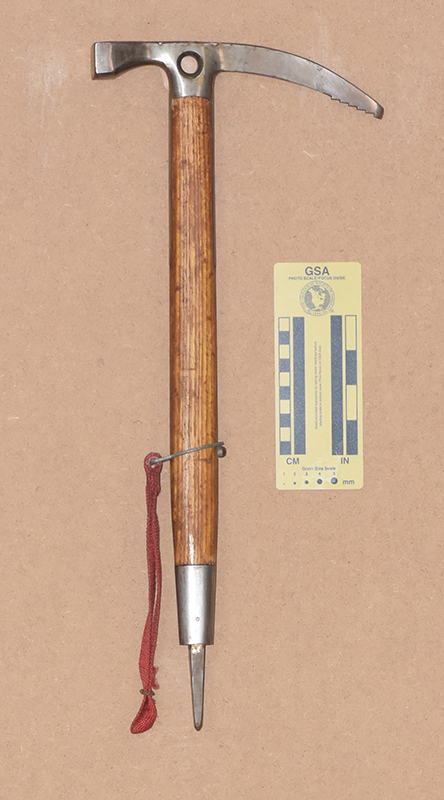
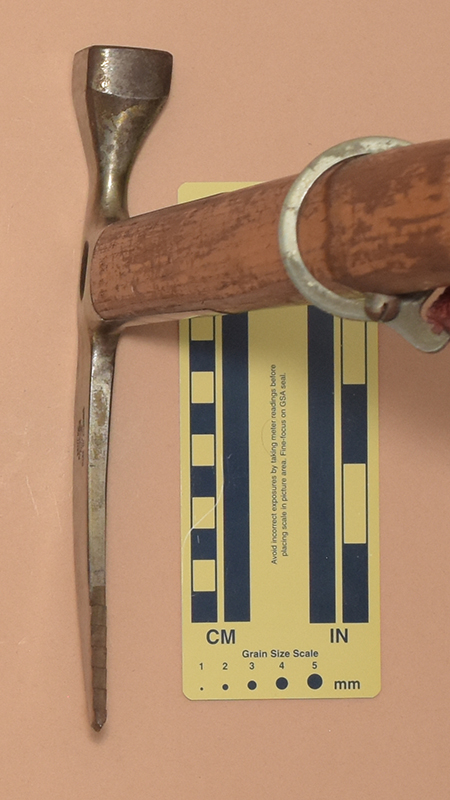
Akademiker Pickel Meister
In 1925 Ralling and the Academic Section of Vienna began working together to design the "Academiker Pikel." This was available in 1926. After WWII, Ralling marketed these with "Meister" added to the name.
This axe's original owner added fiberglass to improve the strength of the wood shaft. I removed the fiberglass to restore the axe.
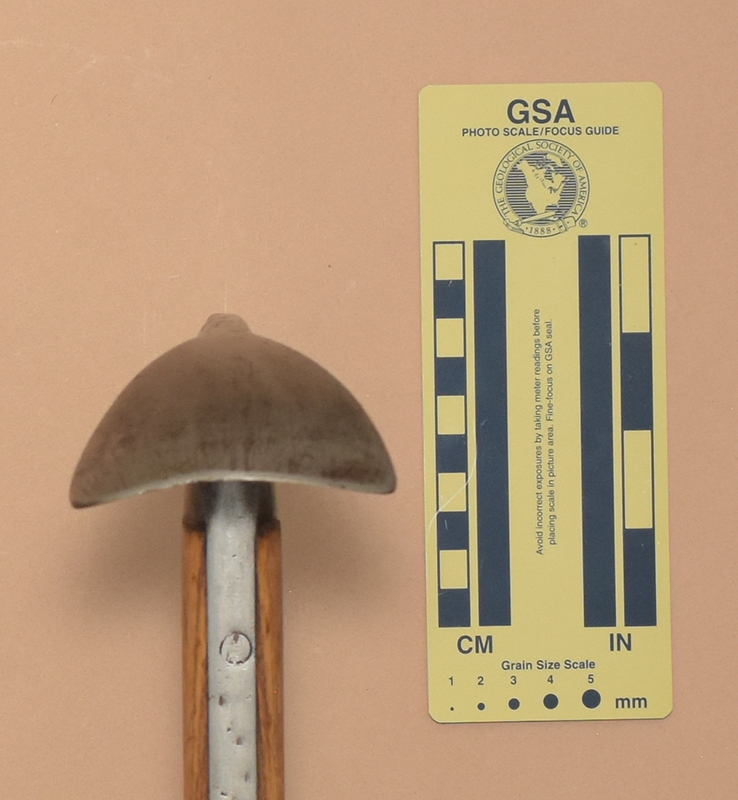
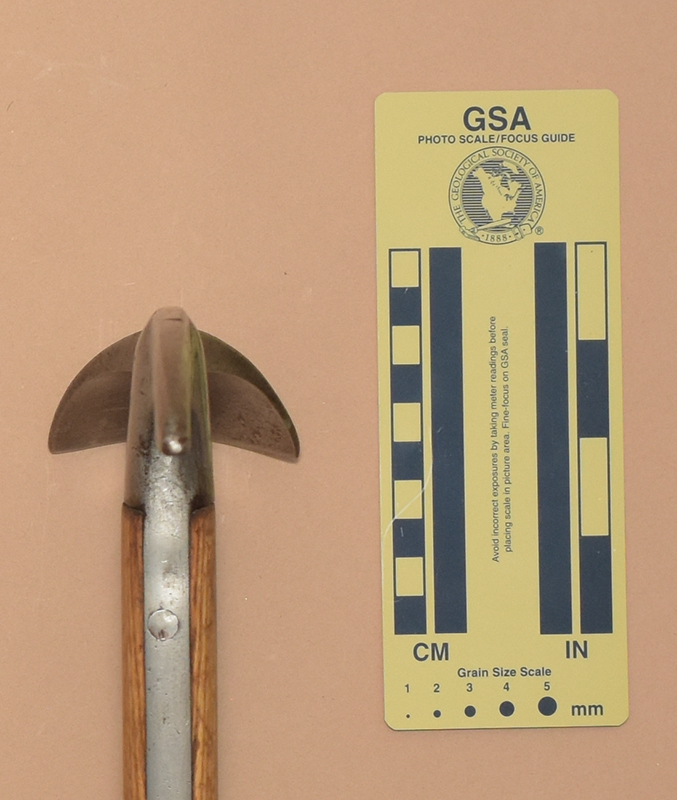
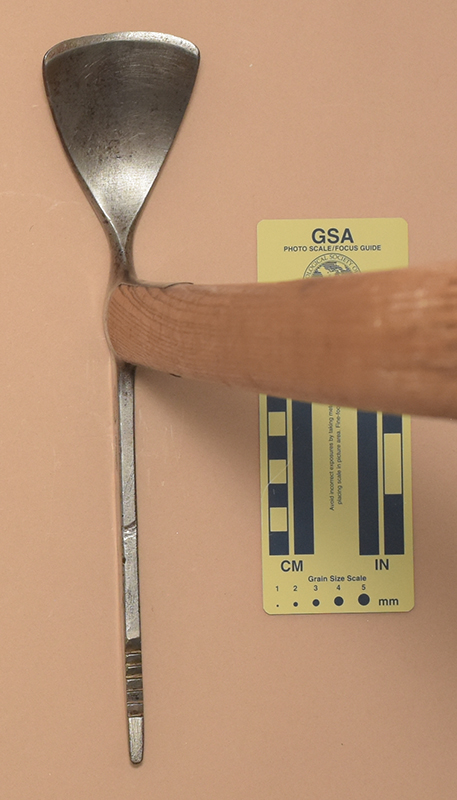
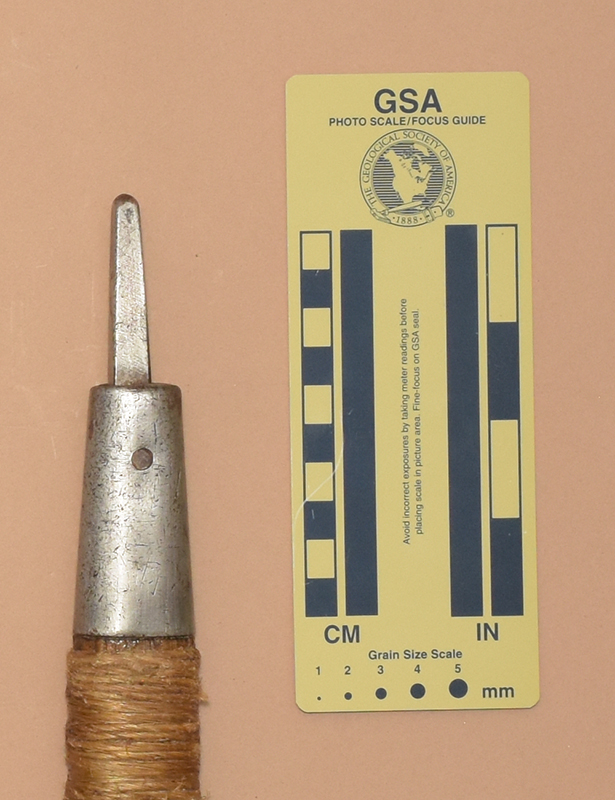
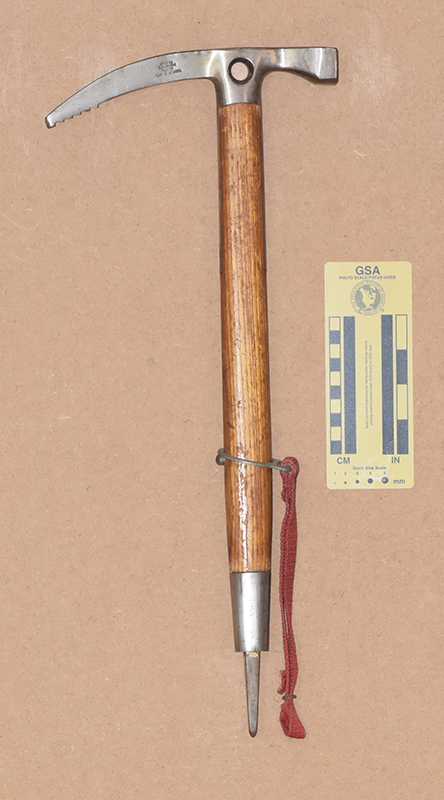
↑ 125: Felix Ralling Akademiker Pickel Meister
- Made in Austria [1970s].
- 900x305 mm.
- Weight: 940 g.
- Wood Shaft.
- Shaft: 33x23 mm.
- Fixed Head.
- Straight adze with a straight edge and no arch.
- Adze: 90(l)x63(w)x0(arch) mm.
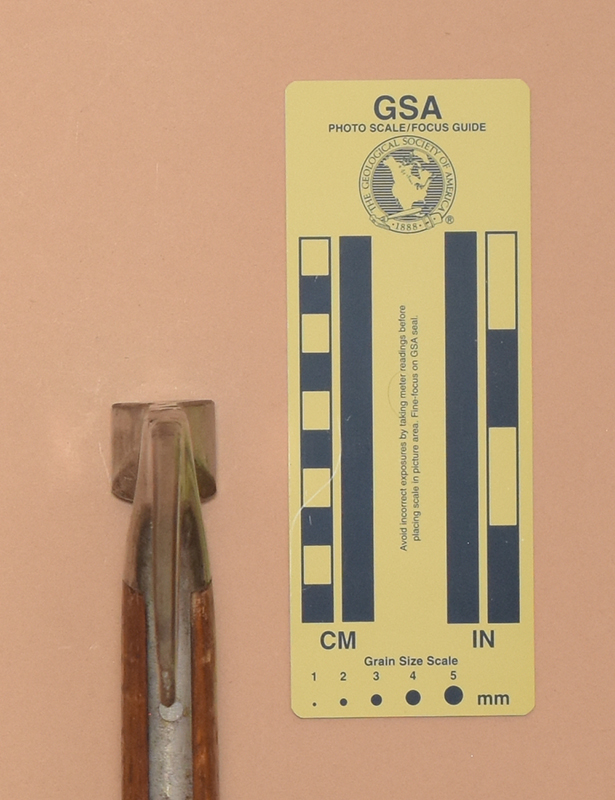
- Straight alpine pick with a neutral-clearance chisel tip and with 5 ventral teeth.
- Pick: 165(l)x21(h)x7(t) mm.
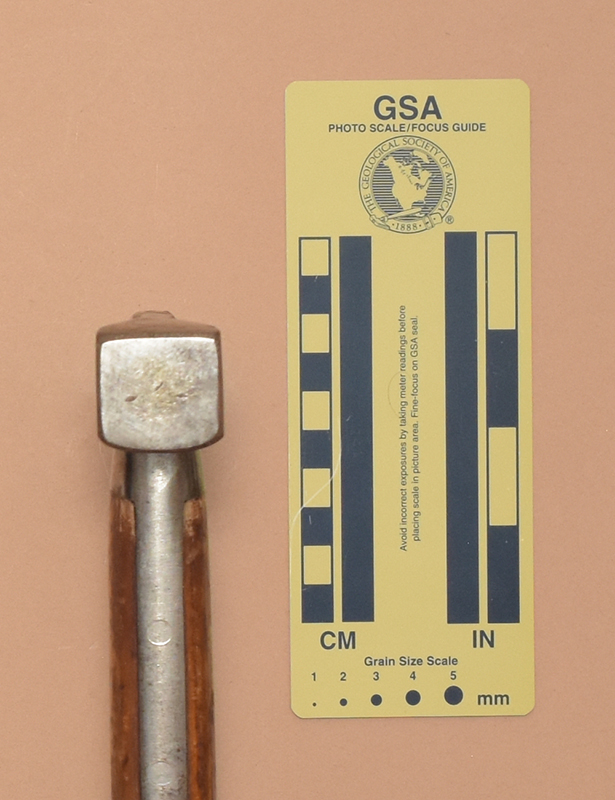
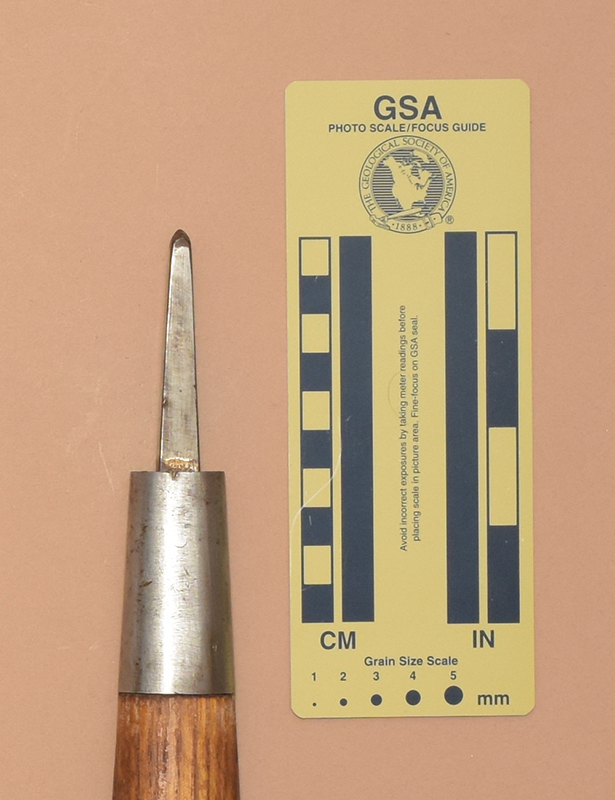
- Square spike.
- Spike: 52(l)x10(w)x11(t) mm.
- Glide ring with adjustable web strap.
- The original owner added fiberglass to improve the strength of the wood shaft.
- To restore the axe, I removed the fiberglass with a heat gun. Some resin penetrated the wood too deeply to be removed.
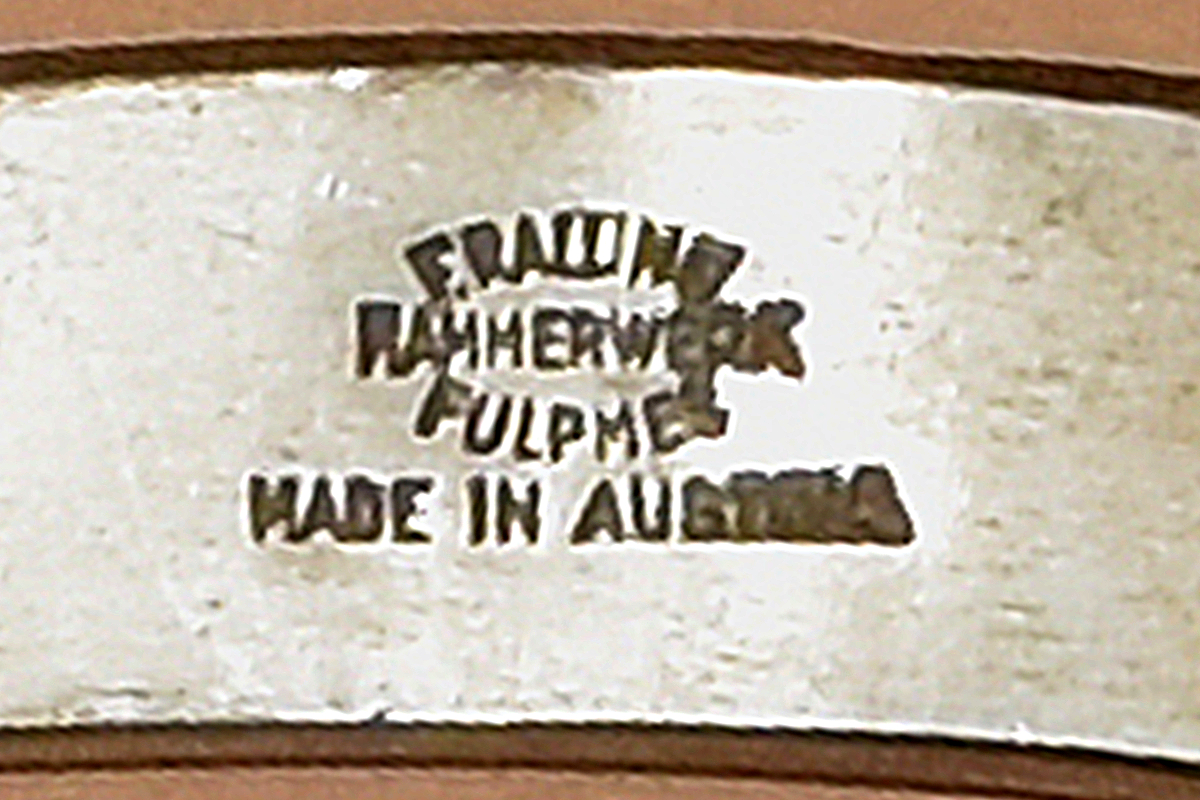
- The stamp reads "Akadem Pickel Meister F Ralling Fulpmes.".
Salewa/Felix Ralling Akademiker Pickel Meister
This Salewa/Rawling axe has two faint stamps. One includes F RALLING FULPMES, showing that the axe was made in Fulpmes, Tyrol, Austria. The other, double stuck, says SALEWA MADE IN W GERMANY. These suggest that the axe was made when Austria and West Germany were united. If so, it narrows this axe’s production to between 23 May 1949 and 15 May 1955.
↑ 262: Salewa/Felix Ralling Akademiker Pickel Meister
- Made in Austria [1949–1955].
- 860x270 mm.
- Weight: 840 g.
- Wood Shaft.
- Shaft: 34x23 mm.
- Fixed Head.
- Straight adze with a straight edge and no arch.
- Adze: 75(l)x53(w)x0(arch) mm.
- Straight alpine pick with a rounded tip and with 5 ventral teeth.
- Pick: 145(l)x18(h)x8(t) mm.
- Square spike.
- Spike: 58(l)x11(w)x11(t) mm.
- Glide ring and stop are missing.
- This Akademiker Pickel Meister has a smaller head than my Felix Ralling version #125.
- One stamp reads "Akadem Pickel Meister F Ralling Fulpmes," showing that it was made in the Stubai Valley, Tyrol, Austria.
- A second stamp, double struck, reads SALEWA MADE IN W Germany.
- The stamps may date this axe to between West Germany's formation in 1949 and Austrian independence in 1955.
Everest-Pickel
↑ 290: Ralling Everest–Pickel
- Made in Austria [1960s–1970s].
- 850x285 mm.
- Weight: 920 g.
- Wood Shaft.
- Shaft: 34x24 mm.
- Fixed Head with carabiner hole.
- Curved adze with a scalloped edge and no arch.
- Adze: 60(l)x58(w)x0(arch) mm.
- Curved alpine pick with a neutral-clearance chisel tip and with 6 ventral teeth.
- Pick: 145(l)x22(h)x8(t) mm.
- Square spike.
- Spike: 54(l)x19(w)x9(t) mm.
- Glide ring with adjustable nylon strap.
- A solid axe with a plated steel head
- A previous owner filed the pick tip and cut "MESSNER" into the shaft.
Himalaya Kuno Ranier
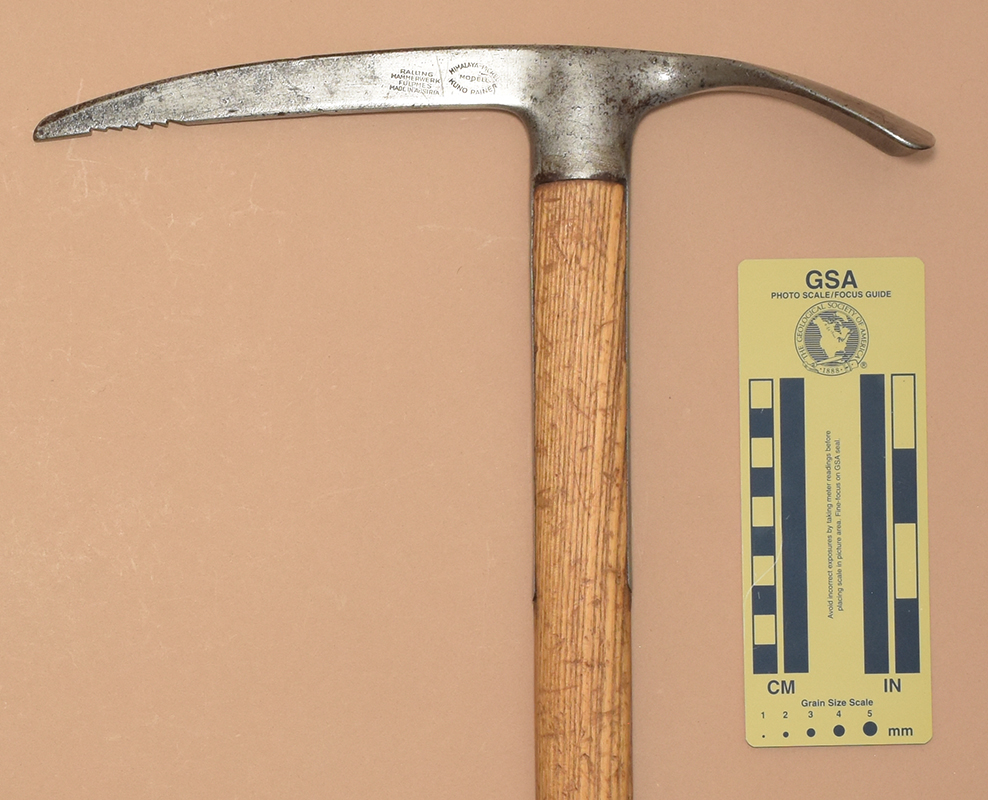
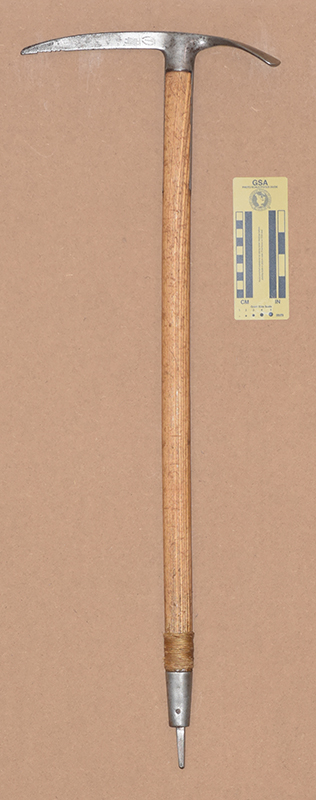
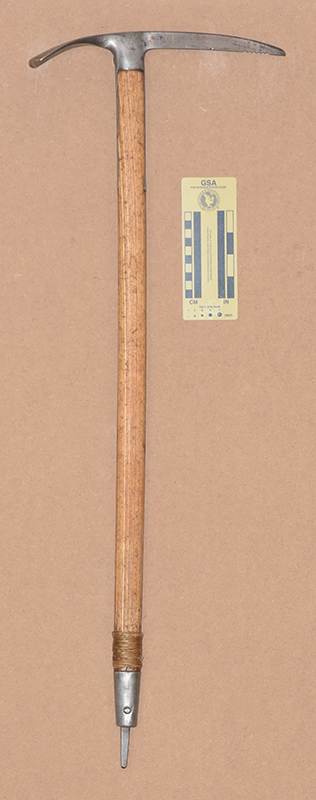
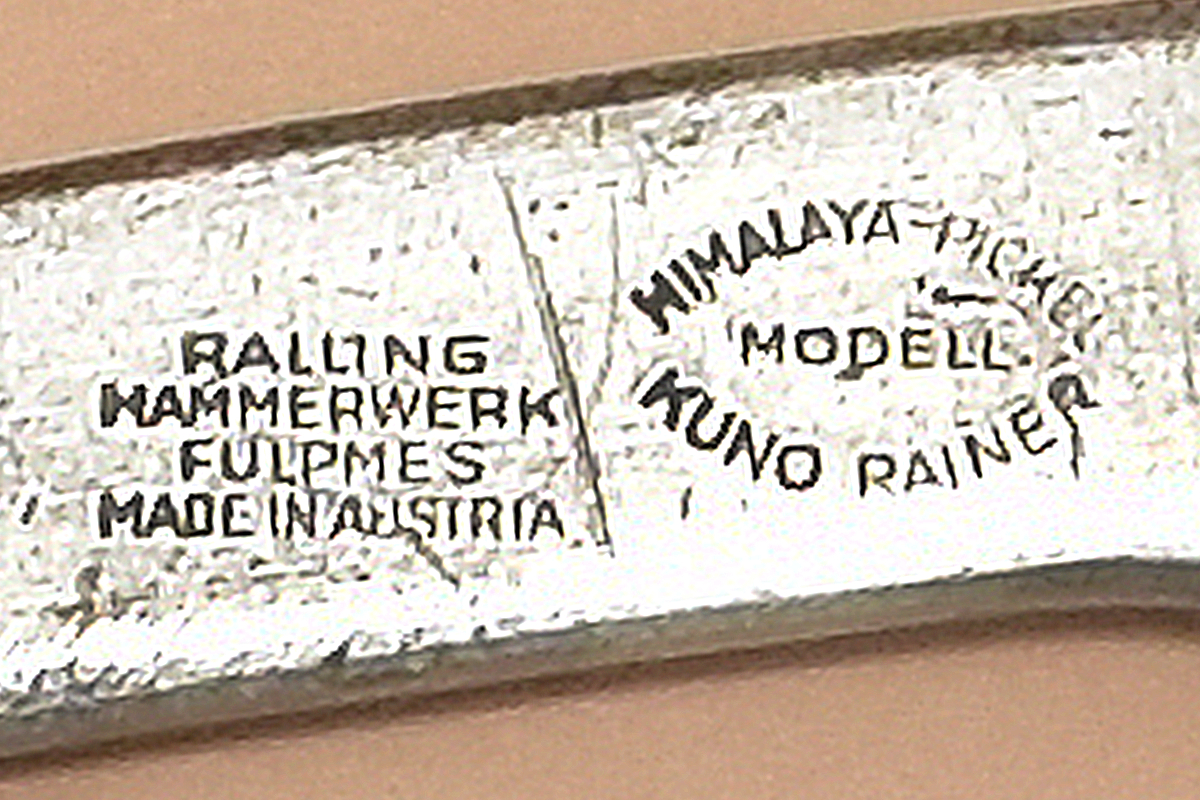
Kuno Rainer was an Austrian Mountain Guide and amember of the first expedition to climb Nanga Parbat in the Himalaya.
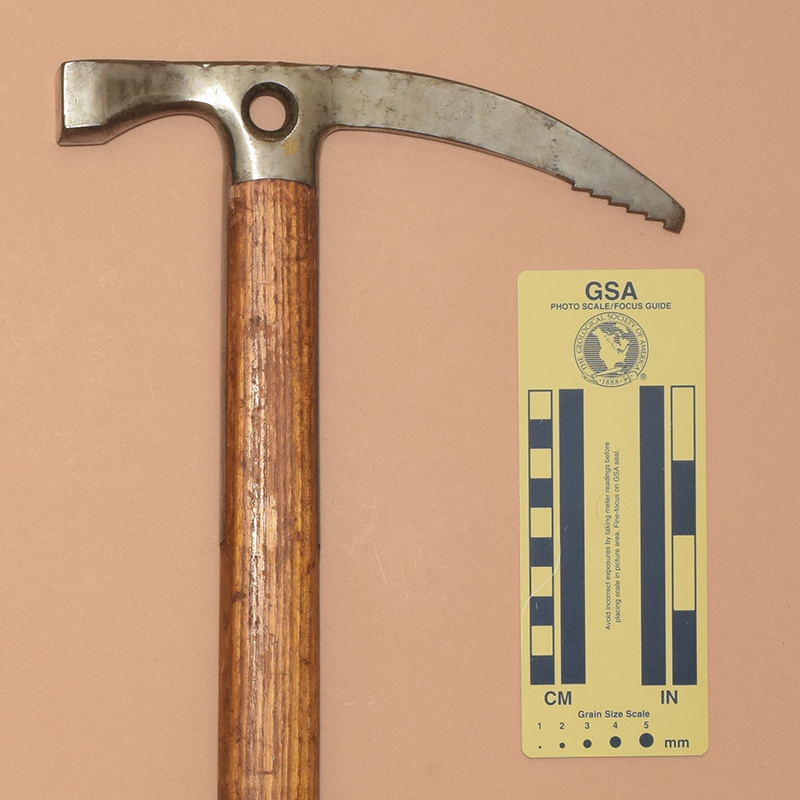
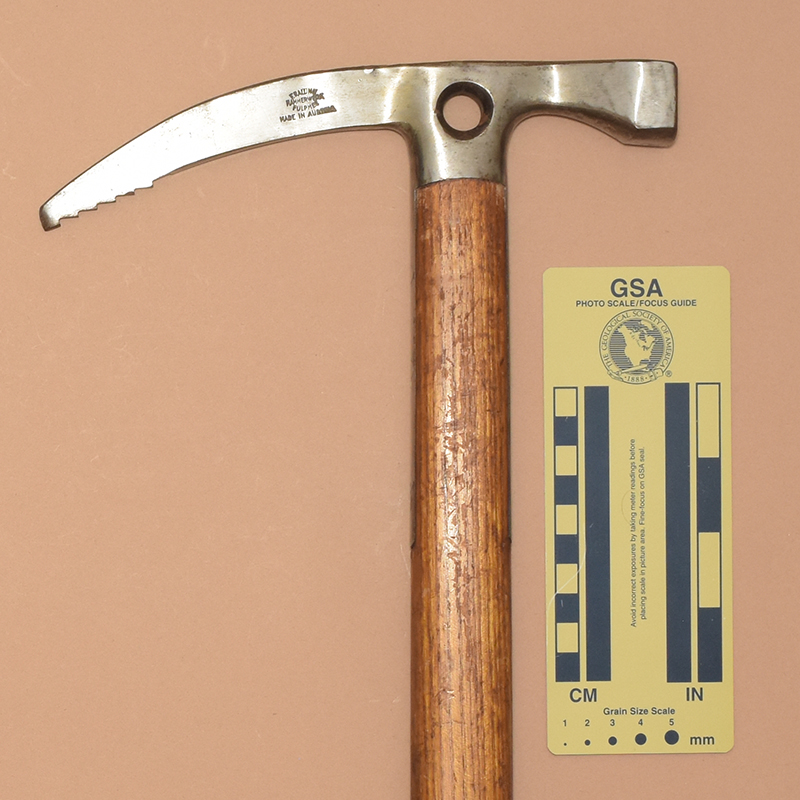
↑ 136: Felix Ralling Himalaya Kuno Ranier
- Made in Austria [1970s].
- 800x270 mm.
- Weight: 845 g.
- Ash Shaft.
- Shaft: 32x22 mm.
- Fixed Head.
- Adze is strongly curved in both directions and a strong arch.
- Adze: 75(l)x60(w)x7(arch) mm.
- Angled alpine pick with a negative-clearance chisel tip and with 6 ventral teeth.
- Pick: 140(l)x19(h)x8(t) mm.
- Square spike.
- Spike: 60(l)x11(w)x11(t) mm.
- Glide ring with adjustable web strap.
- This is the lightweight model with the 27 cm. head (vs. the standard 30 cm.).
- Curved and arched adze edge with rounded corners is not ideal for cutting flat steps.
Gerry/Ralling Himalaya Kuno Ranier
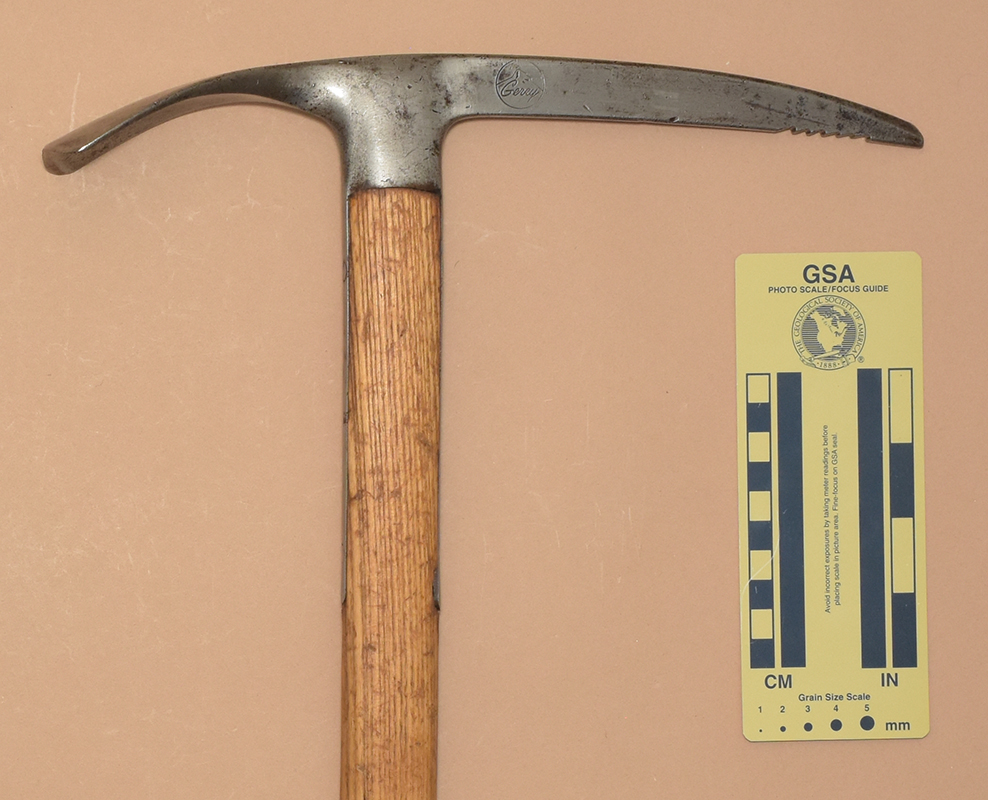
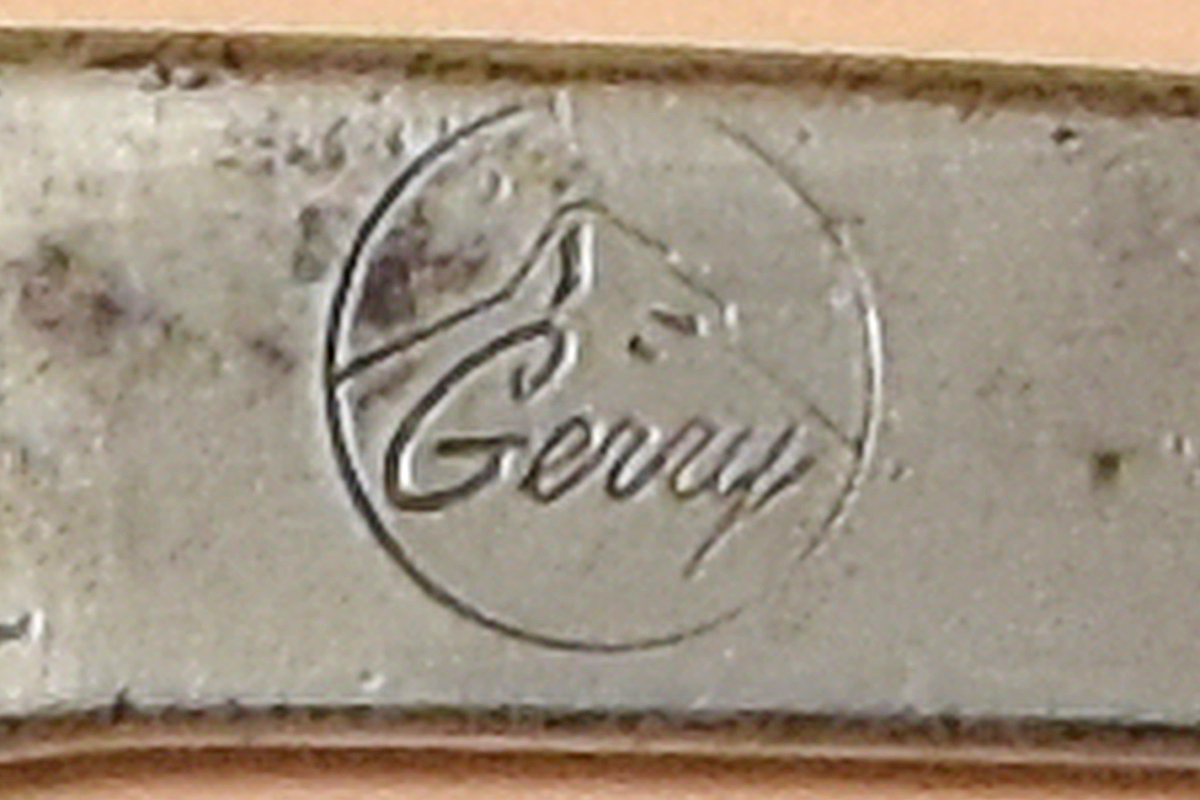
Gerry marketed Ralling Himalaya Kuno Ranier ice axes in the U.S.A. and included their own logo stamped into the pick.
↑ 426: Gerry/Ralling Himalaya Kuno Ranier
- 850x300 mm.
- Weight: 900 g.
- Ash Shaft.
- Shaft: 32x22 mm.
- Fixed Head.
- Adze is strongly curved in both directions and a strong arch.
- Adze: 85(l)x64(w)x7(arch) mm.
- Angled alpine pick with a rounded tip and with 6 ventral teeth.
- Pick: 160(l)x21(h)x8(t) mm.
- Square spike.
- Spike: 47(l)x10(w)x10(t) mm.
- This is the model with Ralling's standard 30 cm. head. Compare this to the lightweight head on Felix Ralling axe #136.
- Curved and arched adze edge with rounded corners is not ideal for cutting flat steps.
- From Mike Gerbman, 2026.
SIXT
SIXT appears to have been a retailler in Insbruck Austria for whom this axe was made.
↑ 236: Felix Ralling SIXT
- Made in Austria [1970s].
- 770x300 mm.
- Weight: 970 g.
- Wood Shaft.
- Shaft: 35x21 mm.
- Fixed Head.
- Straight adze with a curved edge and a slight arch.
- Adze: 85(l)x60(w)x2(arch) mm.
- Angled alpine pick with a rounded tip and with 6 ventral teeth.
- Pick: 165(l)x21(h)x7(t) mm.
- Square spike.
- Spike: 92(l)x11(w)x11(t) mm.
- Glide ring with adjustable web strap.
- One side is stamped with a logo with "SIXT," mountains, and "INNSBRUCK." I presume that SIXT was a retailer who sold these axes with their own logo added.