This page will not fit into a tiny viewport. Please choose a full-size monitor with a full-width window or select the abridged New Wave pages.


|
|
 |
 |
| Front View | Rear View | Side View |
 |
 |
| Front View: Open for Rigging | Rear View: Open for Rigging |
I acquired my Skylotec Mark 1 from Martin Keight in 2012.
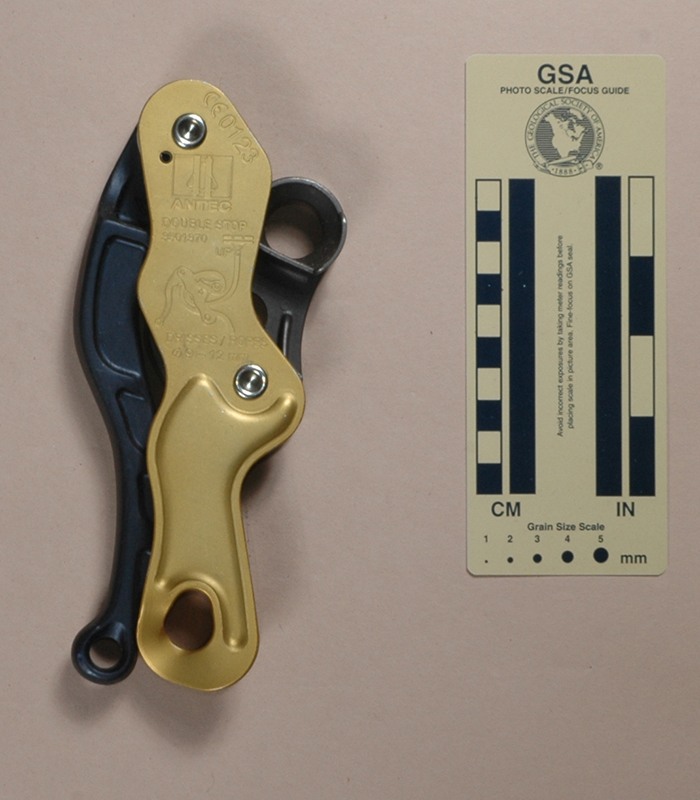
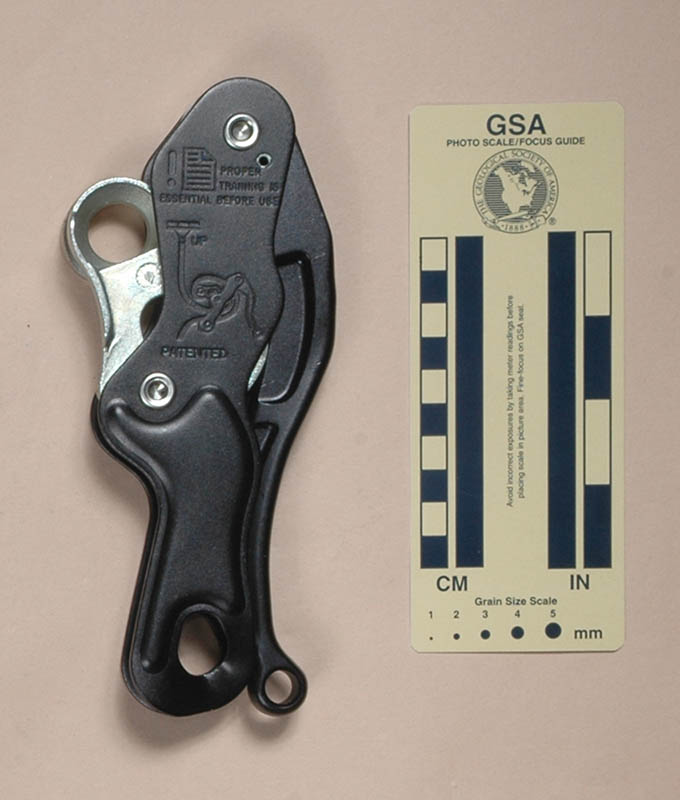
My Skylotec Mark 1 is 190 mm. tall, 81 mm. wide, 27 mm. thick, and weighs 345 g.
The Skylotec Mark 1 consists of a control handle/upper bollard assembly and a lower bollard casting, each pivoting between two 3 mm. stamped aluminum side plates. The side plates have raised portions in their lower half to provide some rigidity. Each plate has a 15.7 by 19.2 mm. pear-shaped hole at the base for attaching to one’s harness. The two plates are compressed toward each other at the lower side of the hole. The control handle pivots from a rivet near the top of the side plates. The upper bollard is a 32 mm. aluminum turning mounted on the same rivet as the control handle. The pivoting bollard assembly is a steel casting with integral lower bollard, upper bollard and guide pin. It mounts midway on the frame with a rivet that passes through the approximate center of the lower bollard.
One side plate is printed with "CE0123," "0412-135," the Skylotec logo, "SKYLOTEC," "MARK 1," "(233317)," a figure showing the normal rigging, "30-150kg," "max 200m," "EN 341 CLASS A ROPE • 11mm," "* 10≤Ø≤12 mm," and "EN12842 Type C and "• 10≤Ø≤12 mm.". The other plate is stamped with a page icon with an explanation mark beside it, "PROPER TRAINING IS ESSENTIAL BEFORE USE," another figure showing the normal rigging (a mirror of the other side - one is looking at the reverse), and "PATENTED." The handle has the Anthron logo forged into it. The back of the pivoting bollard assembly has a symbol with the numbers 1 though 12 arranged in a circle, an arrow pointing toward the 9, and a "1" on each side of the arrow. This symbol indicates that this descender (or at least this part) was manufactured in September 2011.
The Skylotec Mark�1 descender is one of the following variations of the same basic design:
|
||||||||||||||||||||||||||||
With the exception of the MagiDeal, which I obtained from China, these were all made in Europe by the same company, operating under different names and owners. I could not find any significant dimensional differences between the European versions in the table, and certainly none that justify different rope diameter limits (those merely reflect the rope sizes tested for certification). The Singing Rock DSD Plus is a later modification that has some significant changes, but what is the difference between the, say, the DSD-25, DSD-30, and DSD 30+25? In despair, after seeing a related comment on one of their YouTube videos, I asked the following question:
A historical question: What is the difference between the DSD-25, DSD-30, and DSD DSD 30+25? I'm holding all three and digital calipers as I write this, and there do not seem to be any significant dimensional differences between those three models. The DSD plus is obviously different. What, if anything, am I missing? Thanks in advance!?
Anthron replied as follows:
The differences between them are about European norms development. At the time DSD-25 came to market there wasn't any norm for descenders yet. After EN 341 was published it was decided to rename the device to DSD-30. It was not a very intuitive move, but after the publication of EN 12841 and DSD demonstrating conformity with it, the same descender became DSD 30+25 (now conforming to both EN 341 and EN 12841 C). In 2011 an update to the norm EN 341 was issued. This was much stricter in terms of requirements and an update to the device was necessary. Thus the DSD plus and DSD pro were developed. The DSD 30+25 currently keeps conformity with EN 12841 C (with a valid certificate) but is obsolete according to EN 341:2011.
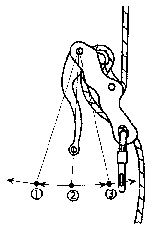 These descenders are designed for single ropes. The bollards are on a pivoting frame. When the handle is released, the rope tension pulls the bollards inward, squeezing the rope between the upper bollard and a third bollard (not visible) mounted on the handle pivot. This stops the rappeller, although it doesn't work unless there is tension on the rope below the rappeller (i.e.,don't count on it working at the end of a drop). Squeezing the handle forces the bollard assembly to rotate outward, allowing one to descend. Squeezing the handle further squeezes the rope between the handle and an auxiliary bar on the bollard assembly, again causing the rappeller to stop. The entire system relies on squeezing the handle enough, but not too much (position 2),so that if the rappeller either lets go (position 1) or panic sand over-squeezes (position 3), they will stop. I find these types of systems take getting used to, and in my mind are somewhat oaf nuisance, but that is a personal preference that some others don't share. For a variety of reasons, I prefer not to rely on auto-stop features in any descender.
Note that the tail end of the rope is trapped instead of hanging free from the upper bollard like it does on many other bobbins. This eliminates the need to add a second maillon or rapide as shown on the Bobbins: General Comments page.
Eduard Kaufmann founded his small business in Kirchhundem in 1947 and initially began manufacturing and selling safety harnesses for mining and rescue baskets for mine rescue. The company quickly developed in the early years of the economic boom of the 1950s. Wolfgang Rinklake bought the firm, converted it into a limited liability company, and began operations as Eduard Kaufmann GmbH in 1983. Eduard Kaufmann GmbH experienced a further boost in the wake of the reunification of Germany.
After 1996 the market for personal fall protection equipment in Germany changed with the harmonization of the PPE guidelines in Europe. Competitors from other countries were trying to gain a foothold in the lucrative German market, where the DIN standards had previously applied.
Kauffman and Rinklake had different ideas and opinions of the two shareholders about the future of the company, Kauffman left the firm, and in 2000 Walter's son Kyle took over his shares. In 2005, Eduard Kaufmann GmbH reorganized and became Skylotec. The new name emphasized the international nature of the company, was easy to remember and also worked well online.
Skylotec took over the Slovenian family company Anthron in 2016. Anthron was an important manufacturer and developer of special hardware and safety devices for industrial fall protection and primarily rope access. Later in 2016 the company rounded off its product range with another takeover, the rescue equipment products of the US company Deus. With the purchase of the Swedish company ActSafe AB in 2020, Skylotec achieved complete coverage in the product area of innovative rope access. Skylotec took over the well-known and renowned Climbing Technology brand from the Italian manufacturer Aludesign S. p. A. in 2021.
Today, Skylotec offers a wide range of personal fall protective equipment and fall protection. The range extends from harnesses, ropes and hardware to abseiling devices, height safety devices, attachment points to protective clothing, special products for fire departments, and sets for typical work situations.