This page will not fit into a tiny viewport. Please choose a full-size monitor with a full-width window or select the abridged New Wave pages.


DSD 30+25

DSD plus
|
|
|
| DSD 30+25 | DSD plus |
Singing Rock is a climbing equipment manufacturer in the Czech Republic. The headquarters, production, training and testing centre is located in Poniklá. Our textile production plant is situated in Semily. The production of metal products and components is placed in Sudkov. The Kladno training centre for work at height is just 20 min from Prague. Singing Rock supplies products to more than 65 countries worldwide through its network of distributors and agents.
The Singing Rock company was founded in 1992. Before starting Singing Rock, one of its founders, Vladimír Křapka, was earning his living by sewing the backpacks and sandals which became very popular in former Czechoslovakia under the name Tucan. The Tucan brand was at the very beginning of the new company's activities, from the backpacks and sandals to the climbing harnesses. After founding Singing Rock in 1992 and starting the partnership with Jan Goddefroy from Belgium, a new company name and logo were chosen in cooperation with a British advertising agency. Thus the "Tatrman" who was the initial representative of the Singing Rock's identity was brought to life. It showed an Indian during the traditional Sun dance at the place where the rock really does sing thanks to the wind – and that is where the name Singing Rock came from.
The "Tatrman" logo was in use until 2000 when it was replaced by the "arrow." The company logo got this unique shape by accident – their longterm graphic designer Jiří Mělnický from the H.R.G. printing house used the symbol of an American road sign on the cover of the catalogue. Vláďa Křapka liked this idea so much that he had a new company logo created using this sign. Like the "Tatrman," the "Singing Rock arrow" is inspired by Western culture and stands for a clear, straight direction, sense of purpose and, most of all, the vertical – a direction connected with everything that Singing Rock creates.
The private financial fund ARX Equity Partners bought Singing Rock in 2009. At the same time Singing Rock s.r.o. and Lanex a.s. merged. The successor company had the business name Lanex a.s. They acquired Raveltik s.r.o. in 2011 to extend the portfolio with the metal products; expansion to the market with products for ice climbing and mountaineering. Two years later, in 2013, the Singing Rock division split from Lanex a.s. and reorganized back to Singing Rock s.r.o.
The Singing Rock DSD Near Bobbins were made by Anthron.
Anthron was a family-owned company in Slovenia founded in 1989. They produced various handleless, handled, and chest eccentric cam ascenders; descenders; pulleys; and similar devices. Some of their products sold under Antec, DMM, LucKY, MSA, Singing Rock, VauDe, and perhaps other markings. Skylotec bought Anthron in 2016.
|
|
 |
 |
| Front View | Rear View | Side View |
 |
 |
| Front View: Open for Rigging | Rear View: Open for Rigging |
I acquired my Singing Rock DSD 30+25 from Inner Mountain Outfitters at the 2009 UIS/NSS Convention.
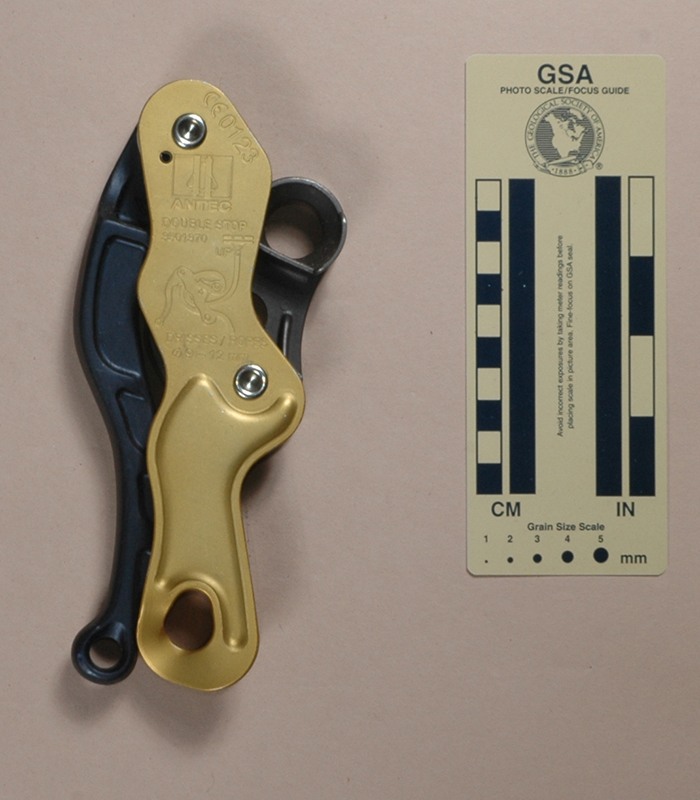
The Singing Rock DSD 30+25 is 191 mm. tall, 81 mm. wide, and 28 mm. thick, and weighs 347 g.
The Singing Rock DSD 30+25 consists of a control handle/upper bollard assembly and a lower bollard casting, each pivoting between two 3 mm. stamped aluminum side plates. The side plates have raised portions in their lower half to provide some rigidity. Each plate has a 15.7 by 19.2 mm. pear-shaped hole at the base for attaching to one’s harness. The two plates are compressed toward each other at the lower side of the hole. The control handle pivots from a rivet near the top of the side plates. The upper bollard is a 32 mm. aluminum turning mounted on the same rivet as the control handle. The pivoting bollard assembly is a steel casting with integral lower bollard, upper bollard and guide pin. It mounts midway on the frame with a rivet that passes through the approximate center of the lower bollard.
One side plate is printed with an up-pointing arrow, "CE0123," "singing rock," "DSD 30+25," "0909-017," a figure showing the normal rigging, "30-150kg," "max 200m," "EN 341 CLASS A ROPE • 11mm" and "* 10≤Ø≤12 mm." The other plate is stamped with a page icon with an explanation mark beside it, "PROPER TRAINING IS ESSENTIAL BEFORE USE," another figure showing the normal rigging (a mirror of the other side - one is looking at the reverse), and "PATENTED." The handle has the Anthron logo forged into it.
The Singing Rock DSD 30+25 descender is one of the following variations of the same basic design:
|
||||||||||||||||||||||||||||
With the exception of the MagiDeal, which I obtained from China, these were all made in Europe by the same company, operating under different names and owners. I could not find any significant dimensional differences between the European versions in the table, and certainly none that justify different rope diameter limits (those merely reflect the rope sizes tested for certification). The Singing Rock DSD Plus is a later modification that has some significant changes, but what is the difference between the, say, the DSD-25, DSD-30, and DSD 30+25? In despair, after seeing a related comment on one of their YouTube videos, I asked the following question:
A historical question: What is the difference between the DSD-25, DSD-30, and DSD DSD 30+25? I'm holding all three and digital calipers as I write this, and there do not seem to be any significant dimensional differences between those three models. The DSD plus is obviously different. What, if anything, am I missing? Thanks in advance!?
Anthron replied as follows:
The differences between them are about European norms development. At the time DSD-25 came to market there wasn't any norm for descenders yet. After EN 341 was published it was decided to rename the device to DSD-30. It was not a very intuitive move, but after the publication of EN 12841 and DSD demonstrating conformity with it, the same descender became DSD 30+25 (now conforming to both EN 341 and EN 12841 C). In 2011 an update to the norm EN 341 was issued. This was much stricter in terms of requirements and an update to the device was necessary. Thus the DSD plus and DSD pro were developed. The DSD 30+25 currently keeps conformity with EN 12841 C (with a valid certificate) but is obsolete according to EN 341:2011.
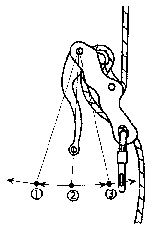 These descenders are designed for single ropes. The bollards are on a pivoting frame. When the handle is released, the rope tension pulls the bollards inward, squeezing the rope between the upper bollard and a third bollard (not visible) mounted on the handle pivot. This stops the rappeller, although it doesn't work unless there is tension on the rope below the rappeller (i.e.,don't count on it working at the end of a drop). Squeezing the handle forces the bollard assembly to rotate outward, allowing one to descend. Squeezing the handle further squeezes the rope between the handle and an auxiliary bar on the bollard assembly, again causing the rappeller to stop. The entire system relies on squeezing the handle enough, but not too much (position 2),so that if the rappeller either lets go (position 1) or panic sand over-squeezes (position 3), they will stop. I find these types of systems take getting used to, and in my mind are somewhat oaf nuisance, but that is a personal preference that some others don't share. For a variety of reasons, I prefer not to rely on auto-stop features in any descender.
Note that the tail end of the rope is trapped instead of hanging free from the upper bollard like it does on many other bobbins. This eliminates the need to add a second maillon or rapide as shown on the Bobbins: General Comments page.
|
|
 |
 |
| Front View | Rear View | Side View |
 |
 |
| Side View | Open for Rigging |
I acquired my Singing Rock DSD Plus from Amazon.com in 2015.
My Singing Rock DSD Plus is 198 mm. tall, 86 mm. wide, 33 mm. thick, and weighs 430 g. The following description is modified from the DSD 30+25 description, with differences shown in black
The Singing Rock DSD plus consists of a control handle/upper bollard assembly and a lower bollard casting, each pivoting between two 3 mm. stamped aluminum side plates. The side plates have raised portions in their lower half to provide some rigidity. These are shaped differently than those on the DSD 30+25. Each plate has a 15.3 by 20.1 mm. pear-shaped hole at the base for attaching to one’s harness. The two plates are compressed toward each other at the lower side of the hole. The control handle pivots from a rivet near the top of the side plates. There is a stainless steel wear block screwed to the underside of the handle where it contacts the rope. The upper bollard is a stainless steel block mounted on the same rivet as the control handle. The pivoting bollard assembly is a steel casting with integral lower bollard, upper bollard and guide arm. It mounts midway on the frame with a rivet that passes through the approximate center of the lower bollard.
One side plate is printed with an up-pointing arrow, "singing rock," "DSD plus," a figure showing the normal rigging, "CE0123," and "0514-002." The other plate is printed with an up-pointing arrow, "singing rock," another figure showing the normal rigging (a mirror of the other side - one is looking at the reverse), "EN12841-C," "•," "9 mm, 130 kg," "10 - 12 mm., 200 kg" and a book-with-an-"i" icon. The lower bollard has a date indicator that shows that it was made in November 2013.
The EN 341 standard changed in 2011, requiring more demanding testing. The DSD plus was designed to pass the new version of the standard. The resulting Rock DSD plus is 24% heavier than the DSD 30+25. The lower bollard casting is more massive than the one on the DSD 30+25, and there were minor changes to the rope channel. Although I like the steel insert in the handle.
 |
 |
[ Top | DSD 30+25 | DSD plus ]