This page will not fit into a tiny viewport. Please choose a full-size monitor with a full-width window or select the abridged New Wave pages.

Version A

Version B

Version C
|
|
|
|
| Version A | Version B | Version C |
 GM Climbing was founded in 2009 by a team of people passionate about outdoor life. They work with manufacturing companies worldwide to distribute quality products. Online selling started in 2012, cutting the expenses of running a brick-and-mortar store.
 My GM Climing items show two different logos. The early logo was a swirl. In 2017 they switched to a capital "G."
I purchased my GM Climbing items from various eBay sellers except for one purchased from the GM Climbing store on Amazon.com. Most of the eBay purchases were shipped to me from China. None of these mentioned GM Climbing in the listing.
[ Top | Version B | Version C | Return to Belay Tubes ]
|
|
 |
 |
| Front | Rear | Top |
 |
 |
 |
| Left | Right | Bottom |
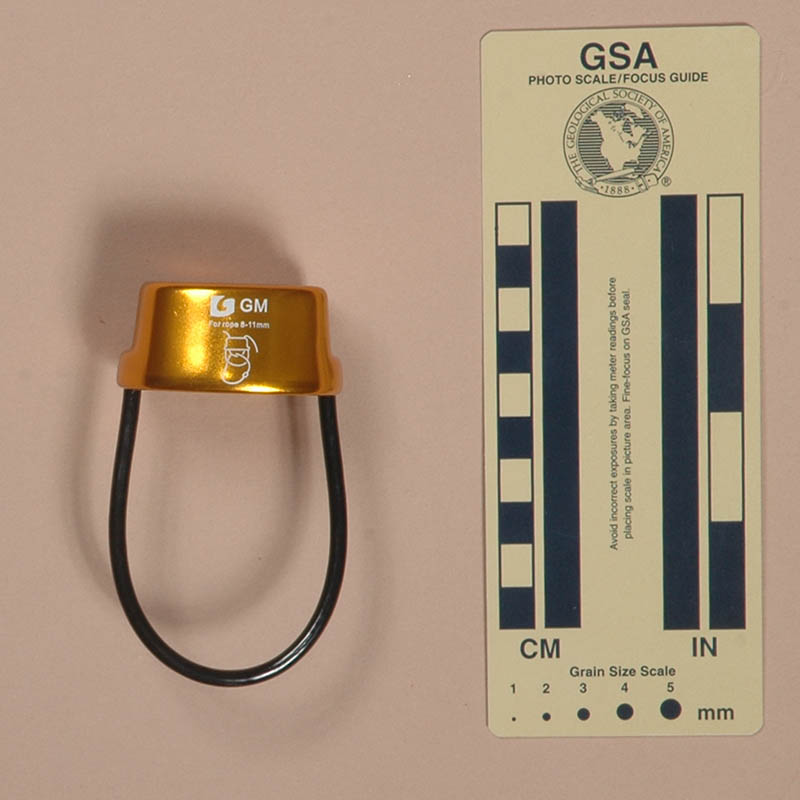
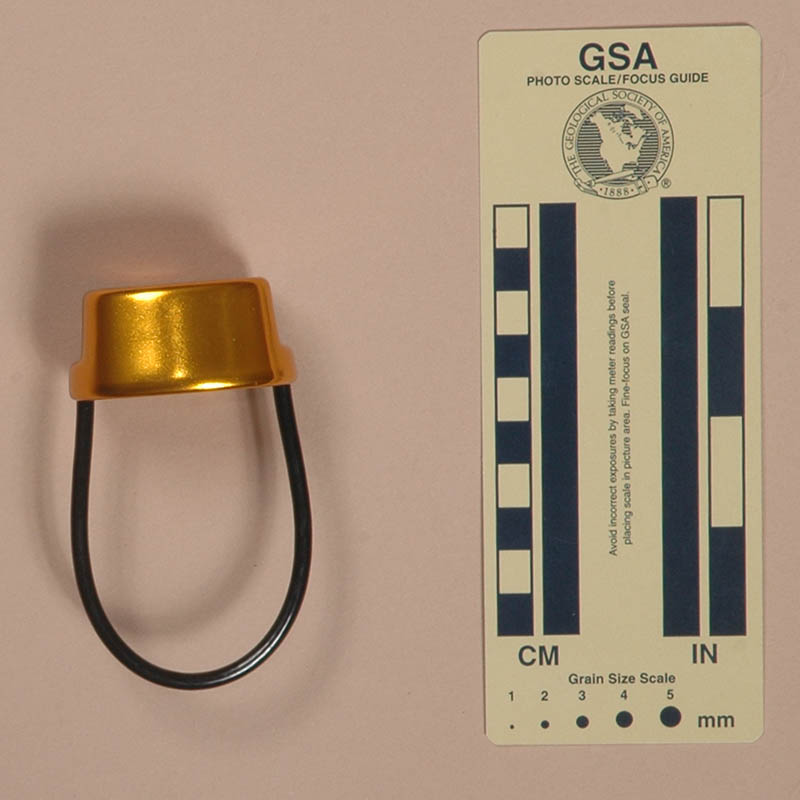
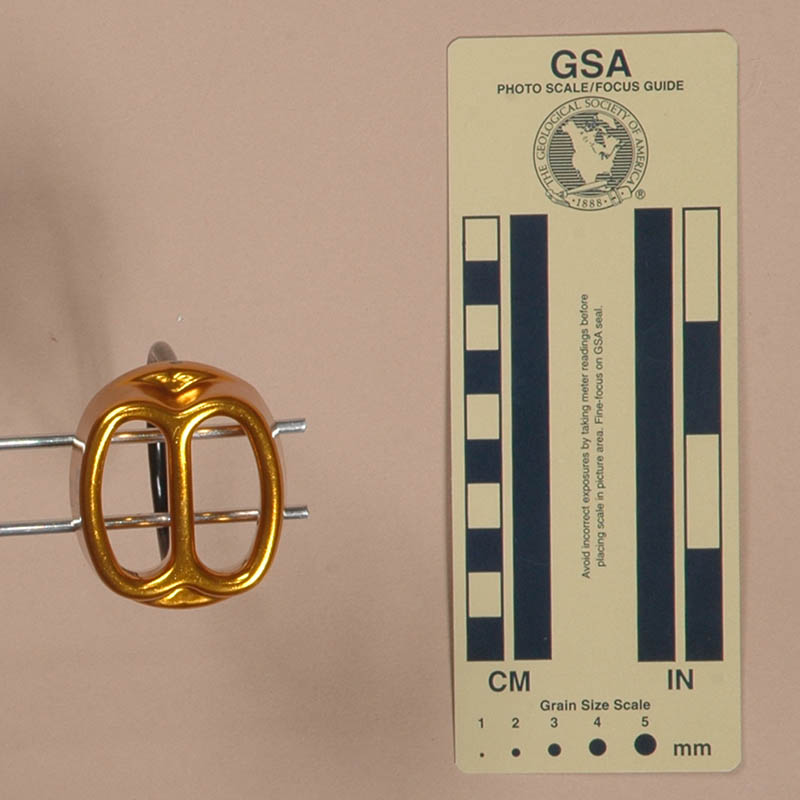
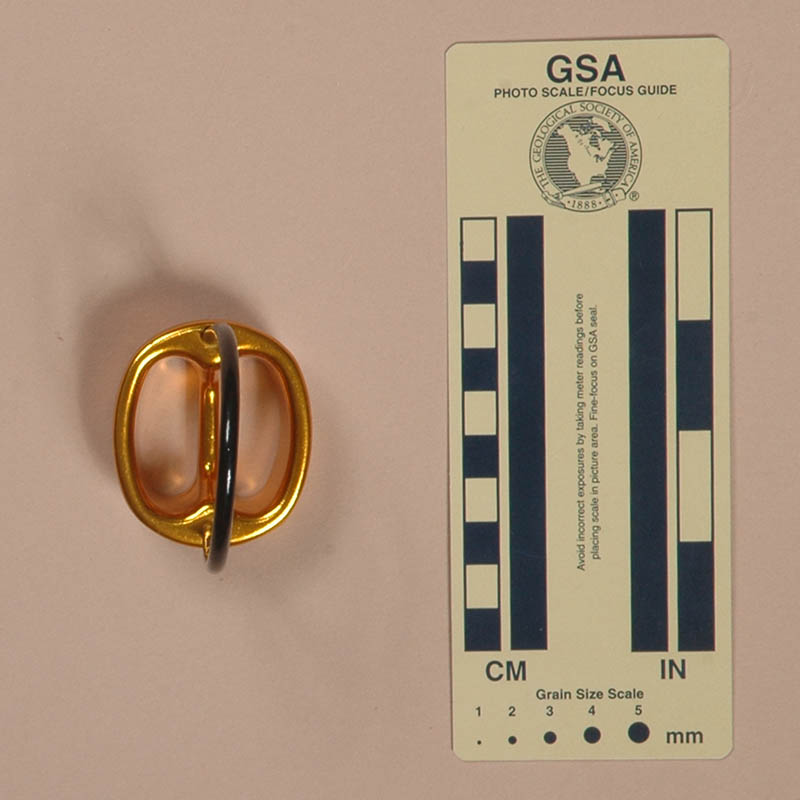
I acquired this GM Climbing belay tube from Joyce Fabric in 2014.
This is a plain belay tube. Mine is 52 mm. long, 46 mm. wide, 92 mm. high, and weighs 60 g. It is forged from aluminum alloy and then soft anodized. It has two slots and a plastic-covered cable keeper. The slots are 33 mm. long and 14 mm. wide. The top of the Omega oval carabiner that I use for comparing belay tubes sits 16 mm. below the ends of the slots.
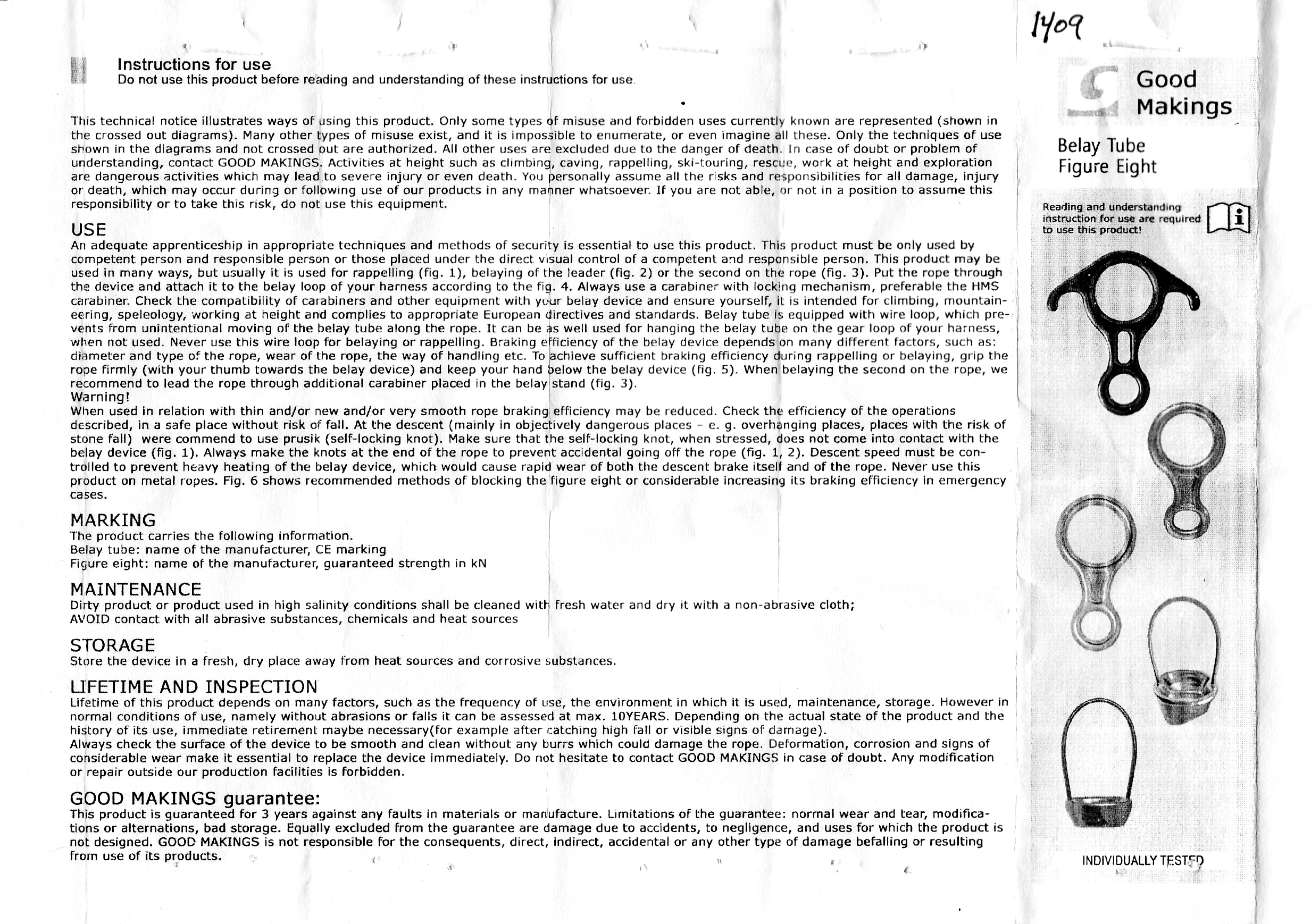
One side is printed with the GM Climbing logo, "GM," "For rope 8-11 mm," and a rigging diagram.
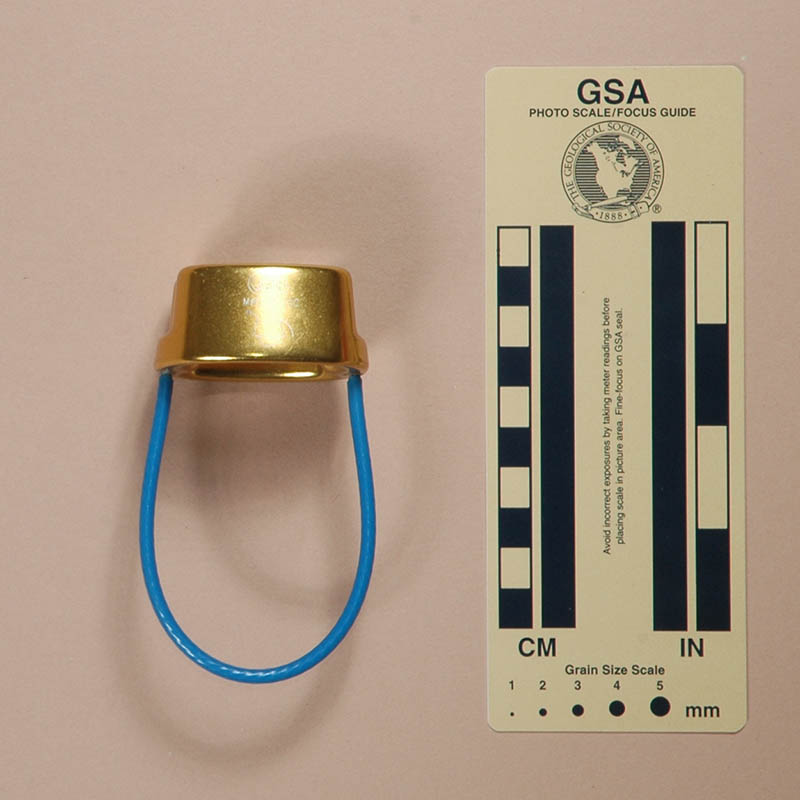
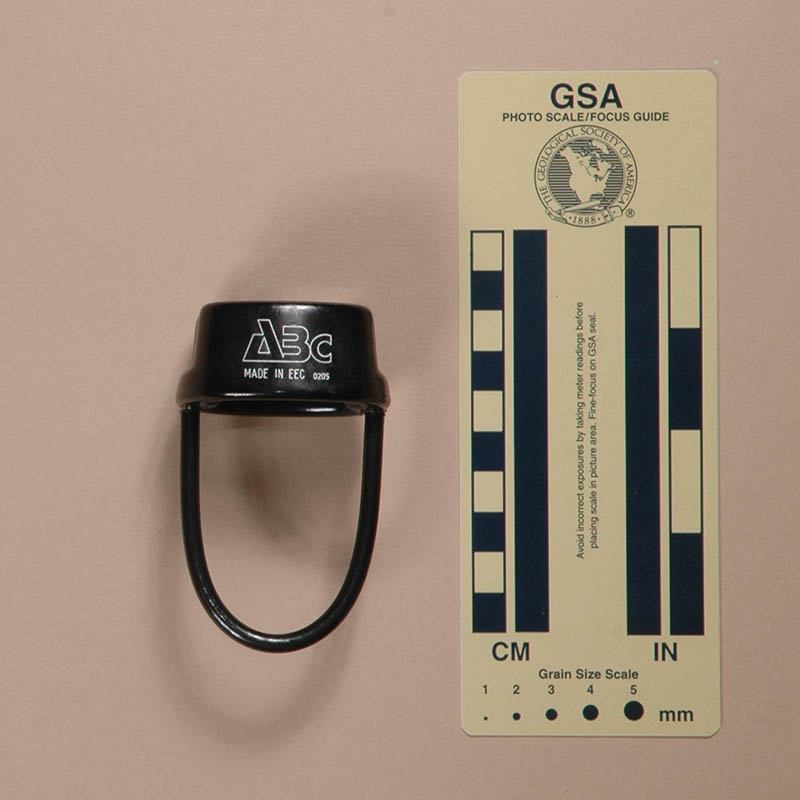
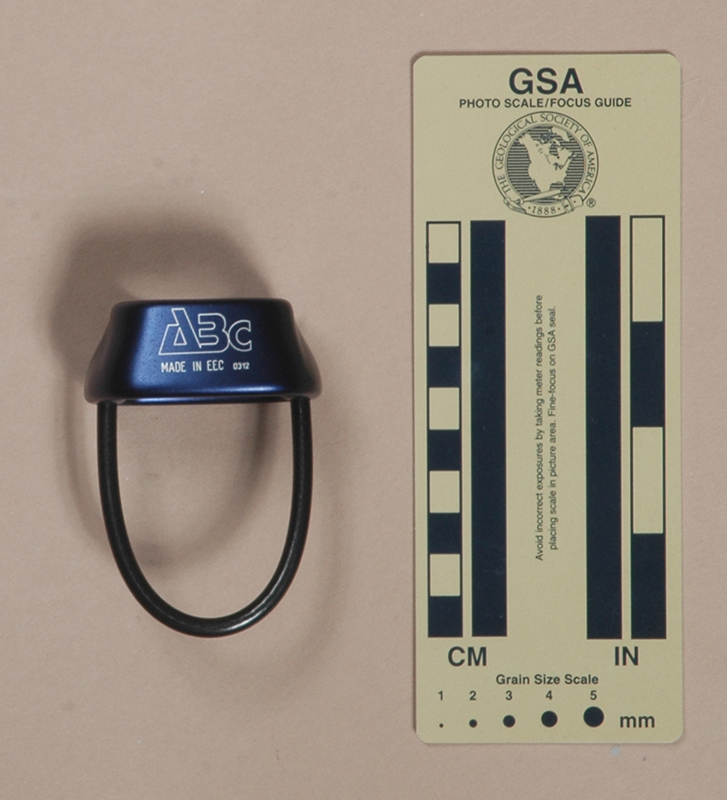
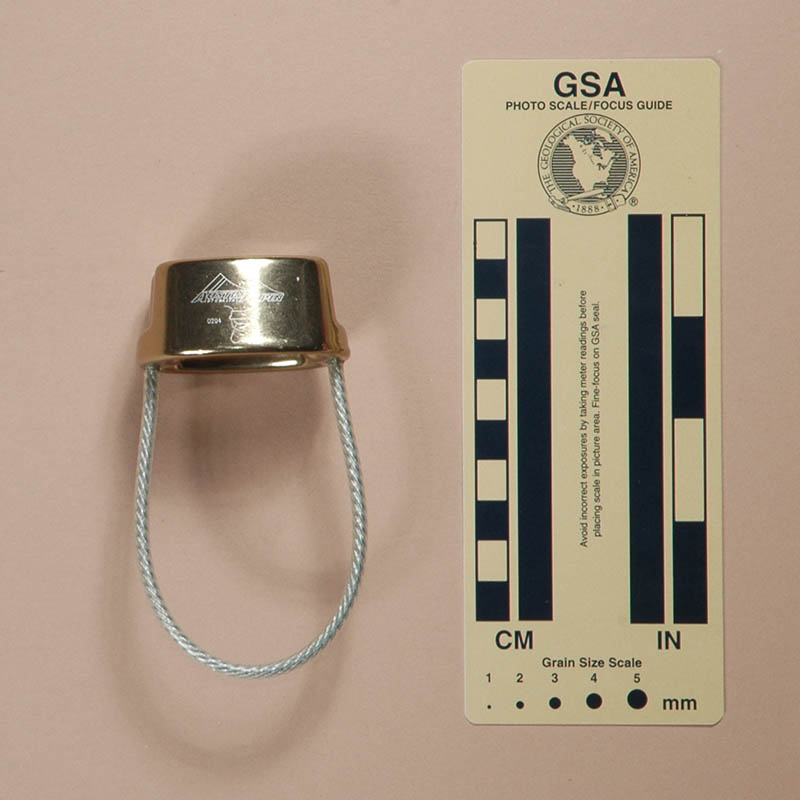
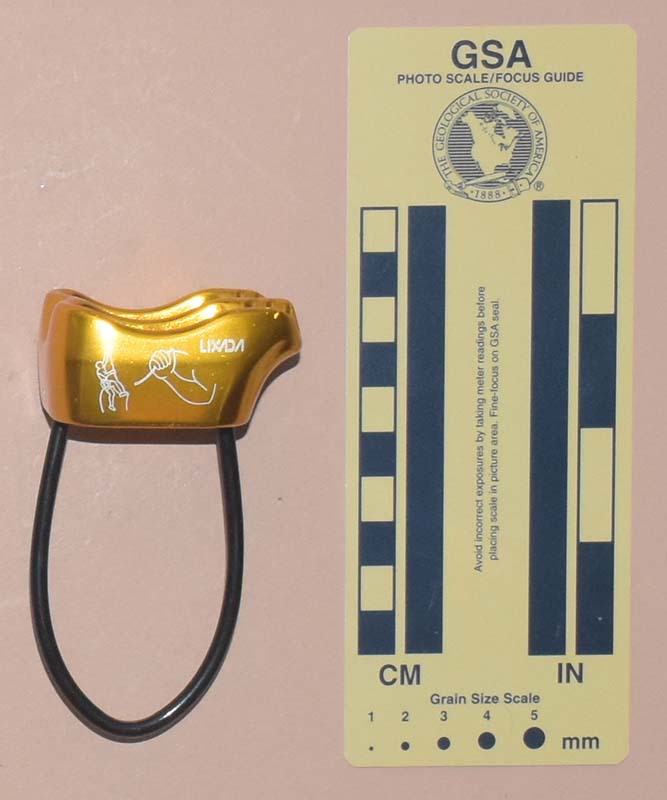
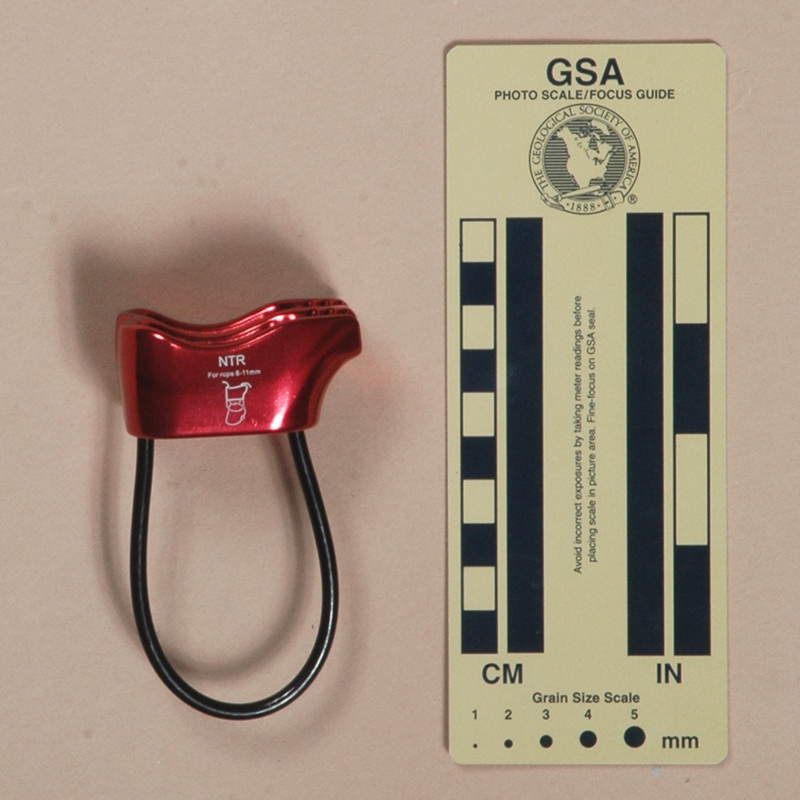
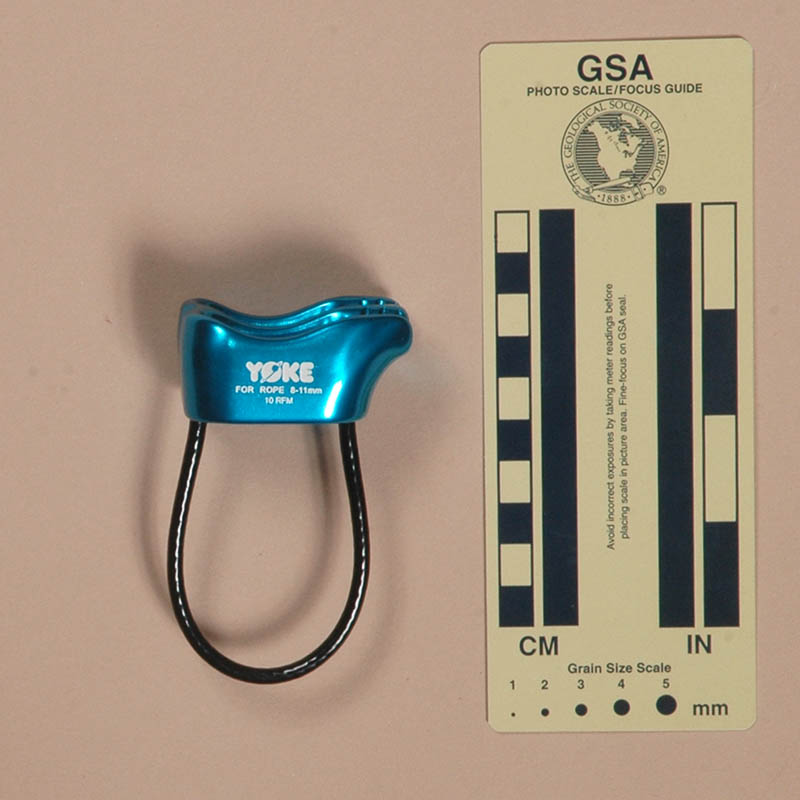
The GM Climbing, Version A is one of the following closely-related belay tubes, all called "ATCs" after the original Black Diamond Air Traffic Controller:
Each of these is 54±3 mm. long, 46±1 mm. wide, and weighs 59±9 g. Their slots are all 32±1 mm. long and 14±1 mm. wide. They all have plastic-covered cable keepers.
The Black Diamond ATC was the first of these to appear, by many years. The basic design evolved and similar devices appeared from others.
The ATC is a lightweight,popular belaying device among climbers. Rigging is simple: insert a bight of operand clip it with a suitably anchored carabiner, making sure that the rope is not running over the keeper. Two-rope rigging is similar. On thinner ropes, adding another carabiner helps.
My biggest complaint is that none of these give me enough friction when rappelling with a heavy load on fast 9 mm. rope. I also prefer more friction while belaying, unless my partner is particularly lightweight. For these reasons, I prefer using a Trango Jaws or one of its equivalents.
Any of these will overheat badly on long rappels. Overheating is not an issue when belaying, but can be a concern when lowering someone more than a short distance.
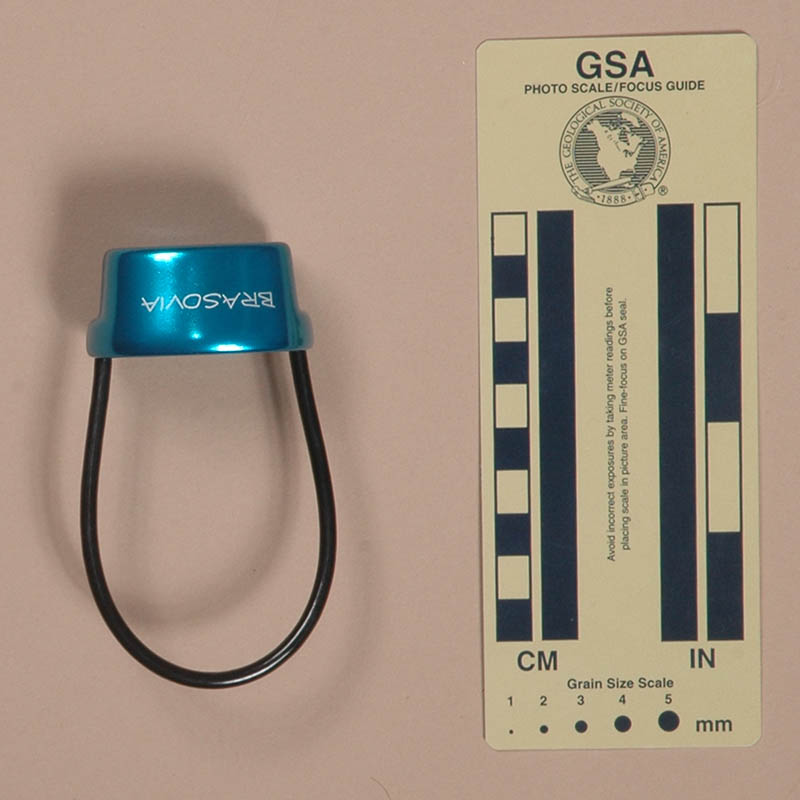
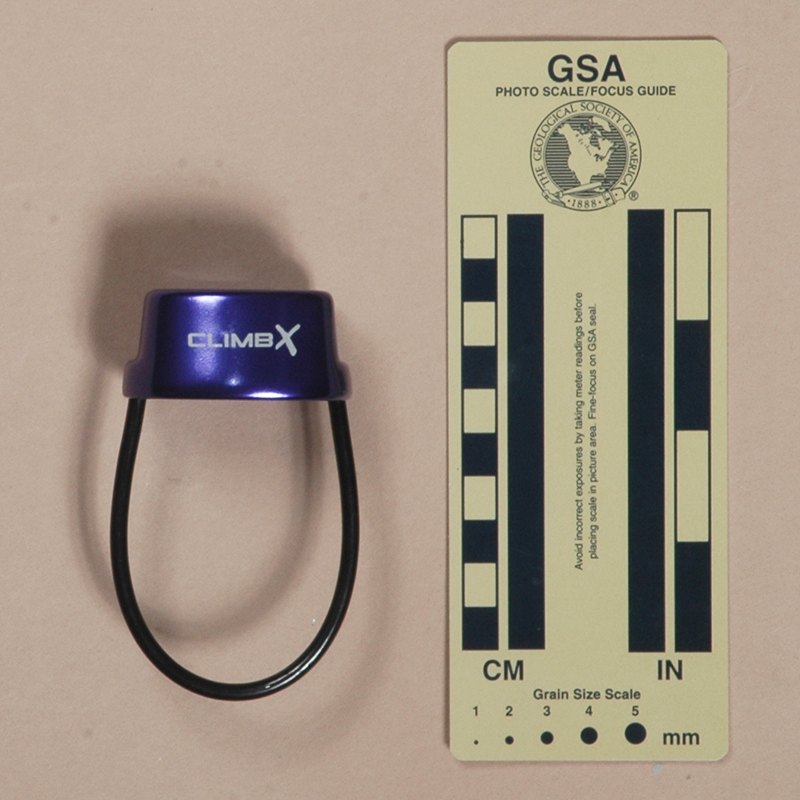
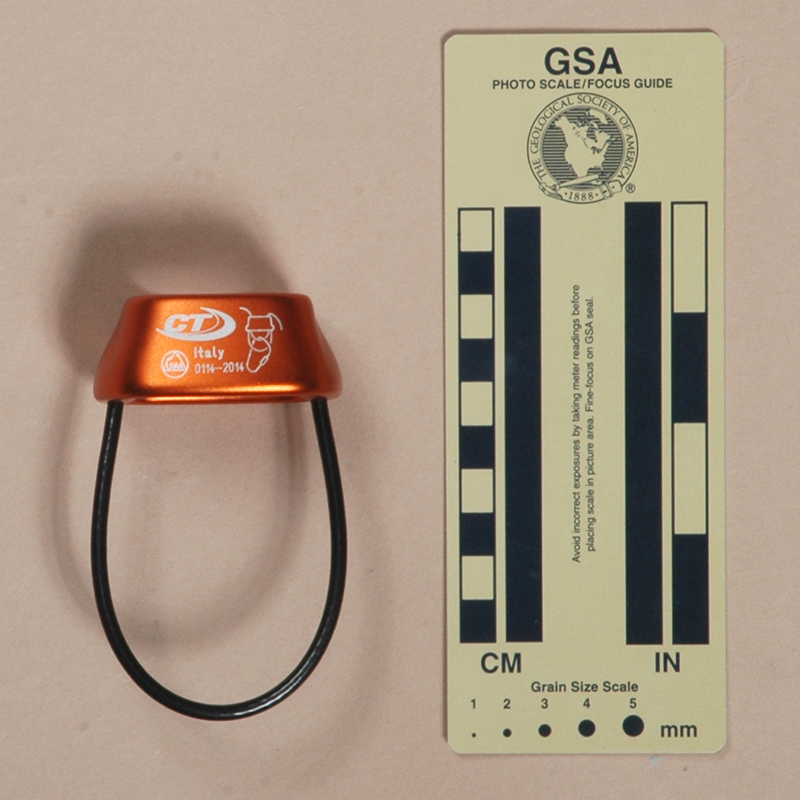
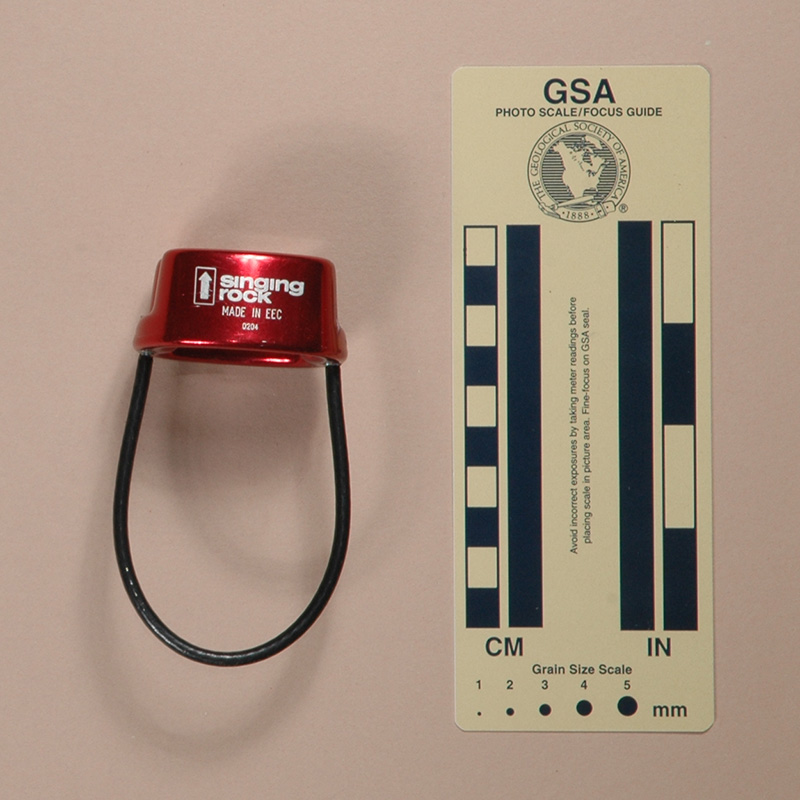
There are four different shell styles in use::
The differences between the styles are cosmetic rather than functional.
None of the keepers-to-shell are strong enough to support body weight, so don't be stupid enough to rely on a keeper to protect you.
There are also several different diameter keeper cables used on these. Cable keepers are a compromise between a cord that stows easily but tends to get tangled in use, and a rigid rod that stands up to the rope running over it (by accident,of course). I prefer a stiff keeper, but any of these are stiff enough to be used without significant problems.
 |
|
[ Top | Version A | Version C | Return to Belay Tubes ]
|
|
 |
 |
| Front | Rear | Top |
 |
 |
 |
| Left | Right | Bottom |
I acquired this GM Climbing belay tube from Joyce Fabric in 2014.
This is a notched belay tube. It is forged from aluminum alloy and soft anodized. Mine is 55 mm. long, 46 mm. wide, 94 mm. high, and weighs 65 g. It has two slots with ribbed v-grooves and a plastic-covered cable keeper. The slots are 34 mm. long and 15 mm. wide. The top of the Omega oval carabiner that I use for comparing belay tubes sits 16 mm. below the ends of the slots.
One side is printed with a GM Climbing logo, "For rope 8-11 mm," and a rigging illustration.
The GM Climbing, Version B is one of the following essentially identical notched belay tubes:
|
|
|
|||||||||||||||||||||||||||||||||||||||||||||||||||||||||||||||
Each of these is 54±1 mm. long and 45±1 mm. wide, and has a weight in the 60±7 g. range. Their slots are all 35 mm. long and 16 mm. wide.
The shallow V-notches used in this design do not seem to be very effective at increasing the braking force. The notches do not have the narrow angle found on the Trango Jaws and its equivalents, so they do not create the same wedging action. Spreading the friction helps with heat dissipation, but like all belay tubes, these can get quite hot when used for rappelling.
[ Top | Version A | Version B | Return to Belay Tubes ]
|
|
 |
 |
| Front | Rear | Top |
 |
 |
 |
| Left | Right | Bottom |
I acquired this GM Climbing belay tube from Aaron Marcus in 2021.
This is a notched belay tube. It is forged from aluminum alloy and soft anodized. It has 2 slots with ribbed v-grooves and a plastic-covered cable keeper. Mine is 55 mm. long, 44 mm. wide, 93 mm. high, and weighs 63 g. The slots are 35 mm. long and 16 mm. wide. The top of the Omega oval carabiner that I use for comparing belay tubes sits 15 mm. below the ends of the slots.
One side is printed with a rigging illustration, "GM 1005", a book-with-an-"i" icon, "0420," "EN 15151-2:2012," "UIAA," the GM Climbing logo, and "For rope 8-11mm."
The GM Climbing, Version C is one of the following essentially identical notched belay tubes:
|
|
|
|||||||||||||||||||||||||||||||||||||||||||||||||||||||||||||||
Each of these is 54±1 mm. long and 45±1 mm. wide, and has a weight in the 60±7 g. range. Their slots are all 35 mm. long and 16 mm. wide.
The shallow V-notches used in this design do not seem to be very effective at increasing the braking force. The notches do not have the narrow angle found on the Trango Jaws and its equivalents, so they do not create the same wedging action. Spreading the friction helps with heat dissipation, but like all belay tubes, these can get quite hot when used for rappelling.
[ Top | Version A | Version B | Version C ]