Technical Details
I acquired my ASAT RD2 from Doris Yasifbara in 2026.
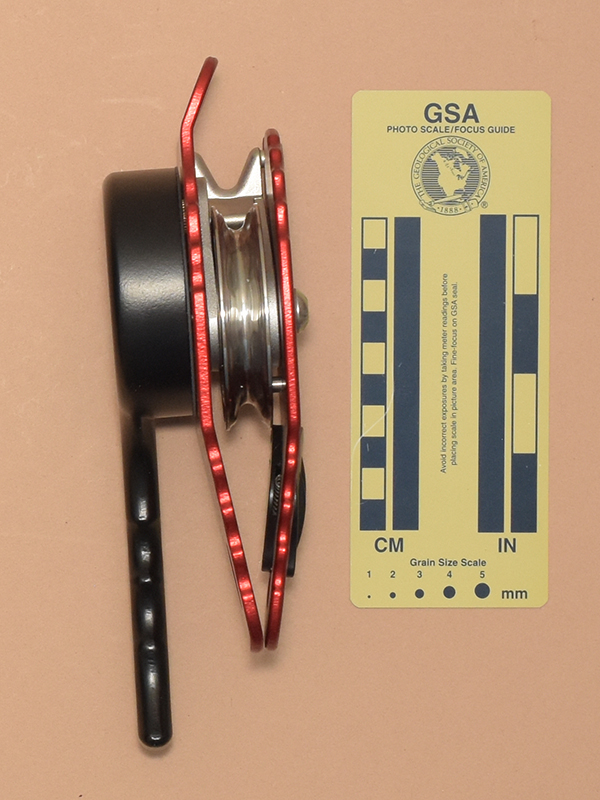
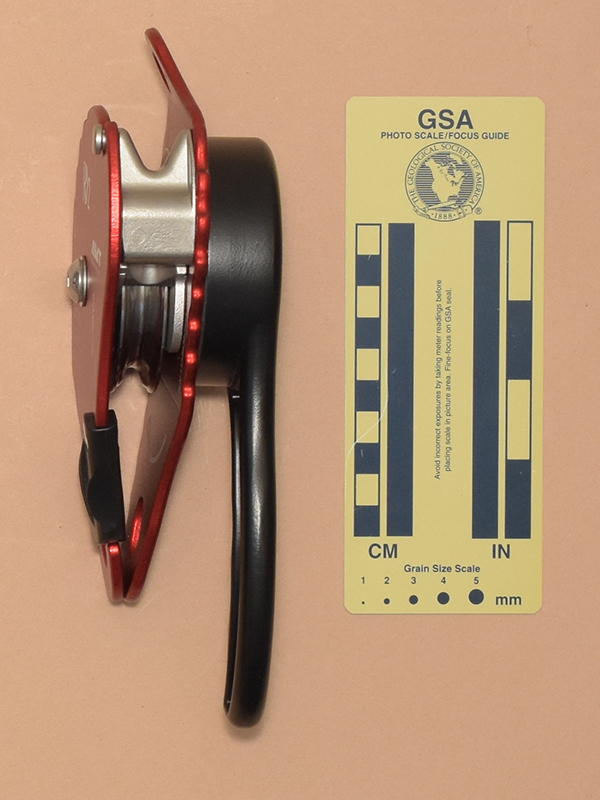
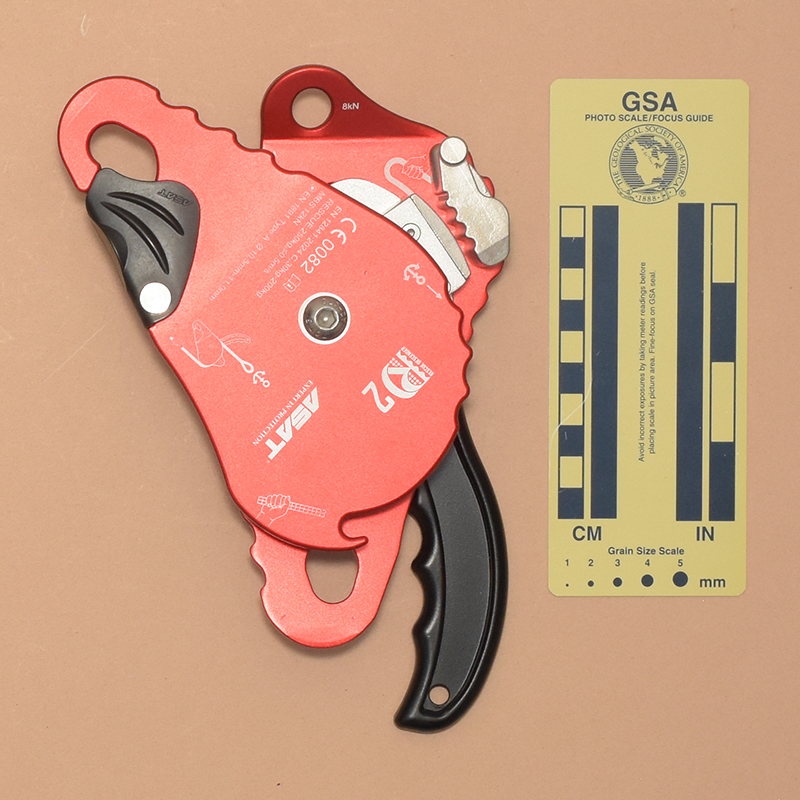
My ASAT RD2 is 216 mm. tall, 102 mm. wide, 59 mm. thick, and weighs 833 g.
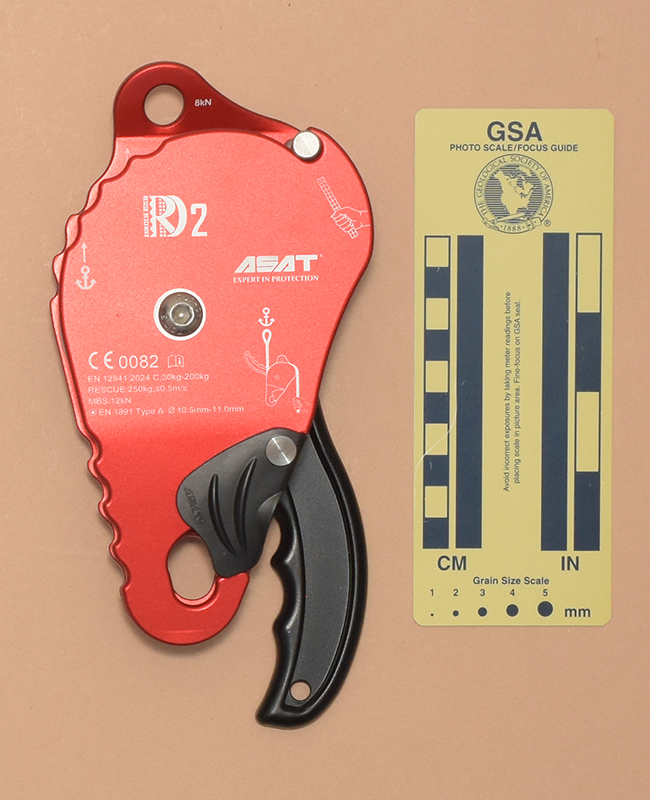
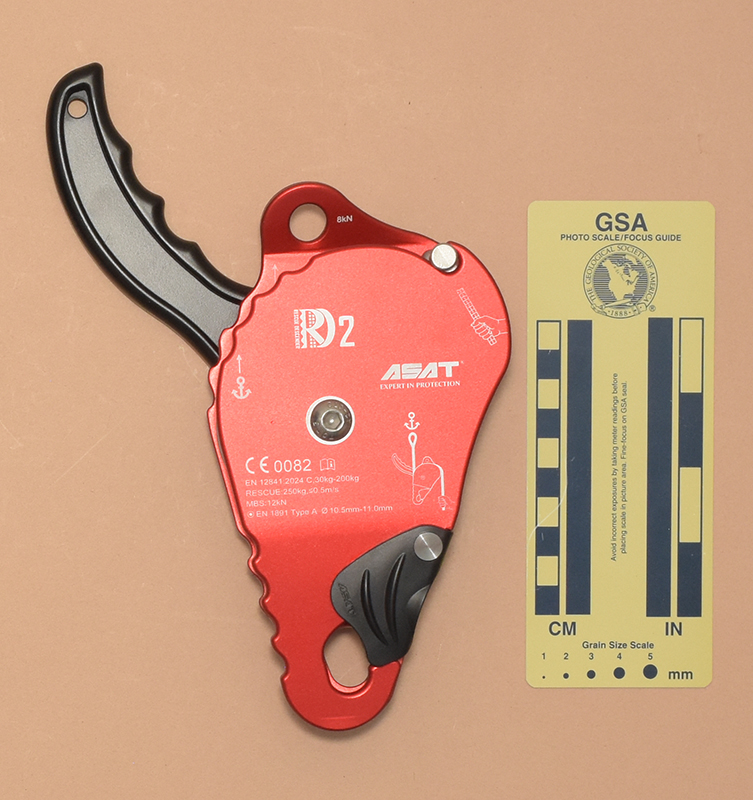
The RD2 is shaped like an inverted pear (or perhaps an avocado) with a handle on the back. There are two 4 mm. stamped and anodized aluminum plates with a variety of other parts attached.
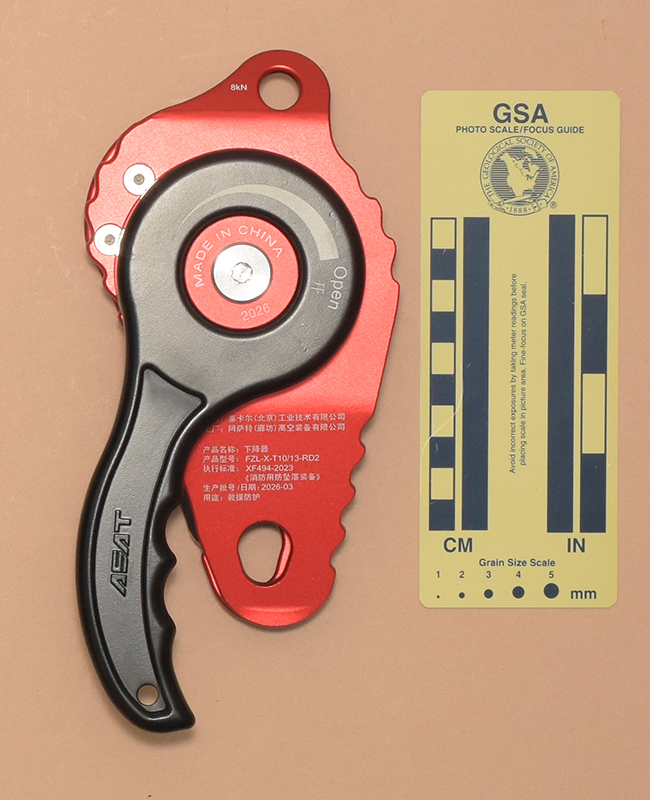
The rear plate serves as the main frame. There is a 13 mm. eye at the top. The lower portion of this plate is bent forward, and a 15 by 19.6 mm. pear-shaped hole serves as the clip-in eye. There is a toothed stainless steel anvil mounted at the upper right. A mushroom-shaped protrusion engages the slot on the front plate when the latter is closed. The main braking assembly, described later, is mounted through the center of the rear plate.
The front plate is mounted and pivots on the bolt holding the braking assembly. The fit is loose. A small notch at the upper right, mentioned earlier, engages the anvil's protrusion when the plate is closed. A J-notch on the lower portion of the front plate lines up with the oval hole on the rear plate. The notch admits the seat maillon. A plastic safety catch helps keep the front plate from accidentally opening.
The main braking assembly consists of a yoke and rotating sheave between the plates and a handle assembly behind the rear plate. The sheave has a v-shaped groove with 12 alternating flats and ribs on each side. It is free to rotate counterclockwise (e.g., when moving the RD2 upwards), but locks against clockwise motion (e.g., during descent). The clutch is not visible without destroying the device.
The Yoke has a block at the upper right. This block has a v-shaped rope groove that squeezes the rope against the anvil. Moving the handle rotates the Yoke to provide additional clearance between the block and the anvil, reducing friction. A light spring opposes this motion, but when used on rope the rope friction completely overpowers the spring. As a result, the behavior of the device on rope is quite different than one would expect after examining the device in the hand. Unlike the Petzl I’D, there is no double-stop action.
The normal rigging path is to bring the rope down the left side, under the main bollard , and up between the main bollard and the anvil, then out the top and over the anvil. The rope path is much like the classic bobbin rope path.
The front plate is printed with an RD2 RESCUE DESCENDER logo, "↑" above an anchor icon, a hand-holding-a-rope illustration, "ASAT®," "EXPERT IN PROTECTION," "CE0082," a book-with-an-"i" icon, "EN 12841:2024 C,30kg–200kg," RESCUE:250kg,≤0.5m/s," "MBS:12kN," "•EN 1981 Type A," "Ø 10.5 mm–11.0mm," and a rigging illustration. The inside or the rear plate is printed with "8kN" near the upper hole, "↑" above an anchor icon, two lines showing the rope path (one with a loop for the anchor and one with a hand holding the line), and "S/N 11A84360443." The rear plate is printed with "8kN" near the upper hole and eight lines of Chinese text below the handle. The rear handle is printed with an elongated curved triangle pointing counter0-clockwise, "Open," and a #hinese character. The handle retaining washer is printed with "MADE IN CHINA" and "2026." The handle has "ASAT" in raised letters inside the recess on the rear side.
I'm not a fan of control handles, and the one on the RD2 doesn't impress me. The light plastic handle does not inspire confidence. To be fair, if it breaks, the yoke will return to the maximum friction position. There is no forced braking until the handle is rotated to the 4-o'clock position, which is impractical in emergencies.
When the handle is in the normal rappelling position one stops by releasing the handle, but I find it easier to brake as one does with more traditional devices. Locking off involves moving the handle toward 3 o’clock (or farther), but if you need your hands free I recommend either tying off or clipping an ascender on as a backup.
The eye slot is not large enough or shaped properly for using redundant seat carabiners instead of the safer maillon rapide links.