Overview
History
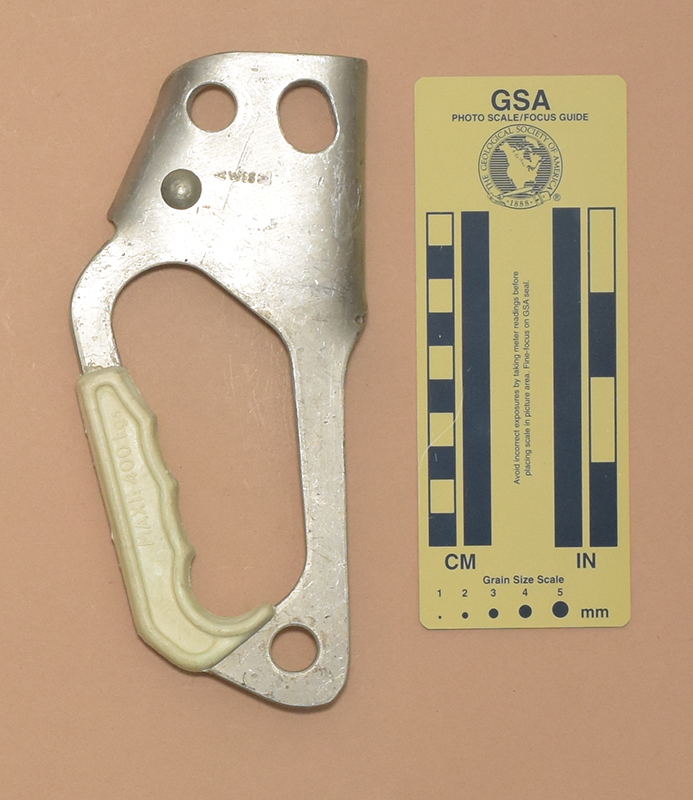
These ascenders are stamped with "<WIS> as the only identifying mark. "WIS" stands for "Walkosz i Spółka" ("Walkosz & Co." in English). They are from Bielawa City in Poland. Thanks go to Mikołaj Miętek for providing this information. They made copies of Petzl Ascenders under Soviet rule when Petzl products were not commercially available in Poland.
[ Top
| Version B
| Return to H.E.C. Ascenders
]
Version A
(#3679)
Technical Details
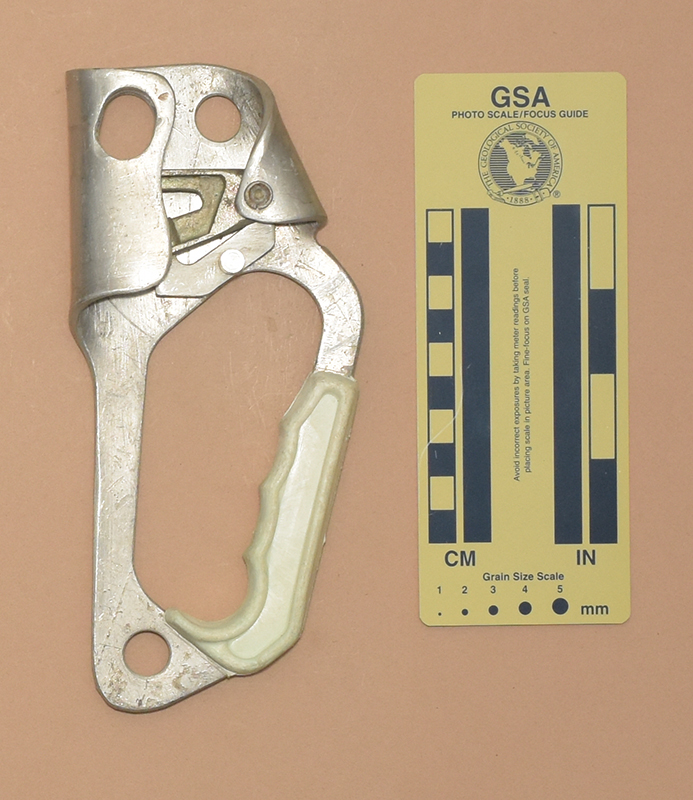
Krzysztof Kamiński sent me this Walkosz i Spółka ascender in 2026.
This ascender is 193 mm. tall, 88 mm. wide, 26 mm. thick, and weigh 187 g.
The shell is a tall irregular shaped stamping made from 3.8 mm. aluminum alloy sheet metal. A 16 mm. wide rope channel is formed in the upper portion of one side and a smaller cam channel lies opposite the first. A hole drilled through both sides of the cam channel accepts a 6 mm. truss-head semi-tubular rivet. The rivet is centered 49 mm. from the inside of the rope channel. The cam and cam spring are mounted on this rivet.
The handle below the cam has a white plastic hand grip molded into place. The hand grip has four finger grooves. A 13 mm. sling attachment hole is punched below the handle opening. This hole is slightly beveled. A 21 by 15 mm. hole through both sides of the rope channel provides an attachment point just above the cam. A second 13 mm. hole above the cam provides a second top attachment point.
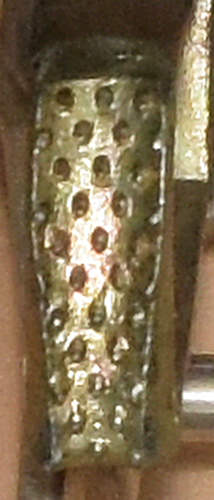 The cam is a skeletonized steel casting. The cam radius increases from 40 to 53 mm. over an angle of 33°, giving a 27° cam angle. The cam has number of small conical teeth, all of which have their axes approximately parallel to the lower surface of the cam. The cam face is divided by a vertical slot designed to provide clearance for mud. The tooth pattern is (F)(3.4)^3(3.2)^2(3). The F stands for a short flat area designed to allow the user to cant the ascender and slide it down the rope without opening the cam. Like many other ascenders, the inner cam face radius reduces from top to bottom to accommodate various sized ropes.
A spring-loaded manual safety bar is mounted on the bottom of the cam with a steel rivet. The normal action of the spring holds the safety against the cam. When the cam is opened, the shell interferes with the safety bar, thus preventing opening the cam. If the safety bar is moved away from the cam (opposing the spring), it will clear the shell and the cam will open. At full open the safety can be released and the spring will hold the safety against the back of the shell. This provides a means of locking the cam open. A pin on the safety bar assists in operating the safety mechanism.
The rear of the shell is stamped with with "<WIS>." The rear of the hand-grip has "MAXI: 400 kgs" molded in raised letters.
This ascender copies features of Petzl Ascension ascenders from the late 1970s and early 1980s. The cam and cam safety copies earlier Petzl cams and safeties than the following version does, so I believe that this version is the earlier Walkosz i Spółka ascender version as well.
The overall quality of this ascender is reasonable for its time.
[ Top
| Version A
| Return to H.E.C. Ascenders
]
Version A
(#2104)
Technical Details
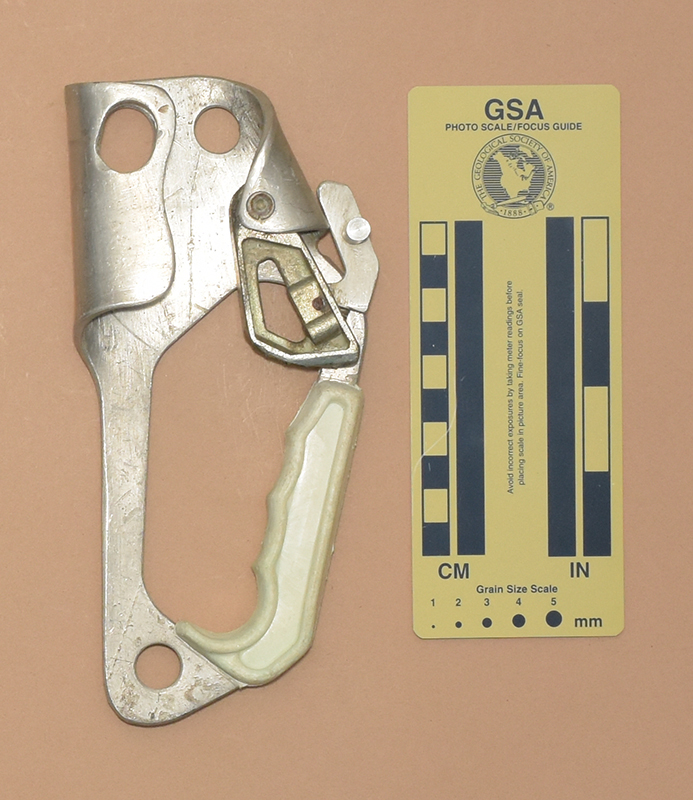
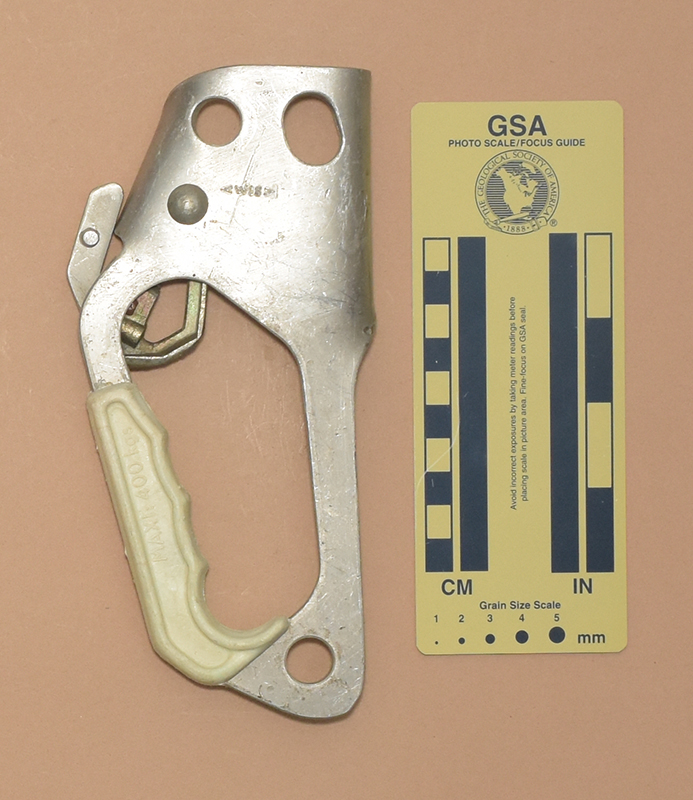
I acquired these Walkosz i Spółka ascenders in 2017 as part of Bob Thrun’s collection.
These Walkosz i Spółka ascenders are 196 mm. tall, 88 mm. wide, 25 mm. thick, and weigh 199 g.
The shell is a tall irregular shaped stamping made from 3.7 mm. aluminum alloy sheet metal. A 16 mm. wide rope channel is formed in the upper portion of one side and a smaller cam channel lies opposite the first. A hole drilled through both sides of the cam channel accepts a 6 mm. double-ended semi-tubular rivet. The cam and cam spring are mounted on this rivet.
The handle below the cam has a green plastic hand grip molded into place. The hand grip has four finger grooves. A 13.8 mm. sling attachment hole is punched below the handle opening. This hole is slightly beveled. A 20.1 by 15.0 mm. hole through both sides of the rope channel provides an attachment point just above the cam. A second 13.7 mm. hole above the cam provides a second top attachment point.
 The cam is a skeletonized steel casting. The cam radius increases from 39 to 53 mm. over an angle of 36°, giving a 27° cam angle. The cam has number of small conical teeth, all of which have their axes approximately parallel to the lower surface of the cam. The cam face is divided by a vertical slot designed to provide clearance for mud. The tooth pattern is (2.3)(2S2.1S1)^2(1S1)^3(1.2), where the "S"s stand for the single longitudinal mud removal slot. Like many other ascenders, the inner cam face radius reduces from top to bottom to accommodate various sized ropes.
A spring-loaded manual safety bar is mounted on the bottom of the cam with a steel rivet. The normal action of the spring holds the safety against the cam. When the cam is opened, the shell interferes with the safety bar, thus preventing opening the cam. If the safety bar is moved away from the cam (opposing the spring), it will clear the shell and the cam will open. At full open the safety can be released and the spring will hold the safety against the back of the shell. This provides a means of locking the cam open. A knob on the safety bar assists in operating the safety mechanism. The knob is a two piece mechanism consisting of a threaded rivet fixed to the safety, and a knurled cylinder which screws onto the rivet. This allows the cylinder to be screwed down against the safety where it does not project very far, or unscrewed about 5.3 mm. to make it easier to operate with gloved hands.
The rear of the shell is stamped with with "<WIS>" and "MAX 400 kG." The front of the left and rear of the right hand-grips have "MAXI: 400 kgs" molded in raised letters.
These ascenders are direct copies of one of the Petzl Ascension ascenders in my collection that dates from the late 1980s. The cams and safeties copy later Petzl cams and safeties than the previous version does, so I believe that this version is the later Walkosz i Spółka ascender version as well.
Although there are tool marks on the shells, the overall quality is reasonable for the time this ascender was made.
[ Top
| Version A
| Version B
]

For far more content, use a larger monitor and a full-width window.
Hundreds of cell phone users complained and asked me to for a simpler, mobile friendly site. In particular, they wanted me to limit each page to a small number of pictures and minimize my use of text. This new site provides what they asked for.