

This page will not fit into a tiny viewport. Please choose a full-size monitor with a full-width window or select the abridged New Wave pages.


Capewell
RopeRider
|
|
|
 Capewell |
RopeRider |
Horace Varner and Richard H. Frost filed for a patent on the Rope Rider in 1990, and received U.S. Patent #5,038,888 in 1991. They assigned the Patent to Frost Engineering Development Corp. of Englewood, Colorado.
Richard Frost worked for various aviation firms until 1960, when he became the founding president of Frost Engineering Development Corporation, Englewood, Colorado. The company specialized in the manufacturing of life support equipment for military and civilian aircraft and crew.
Capewell Components acquired Frost Engineering in 1994.
Capewell Components, LLC is comprised of three unique manufacturing business units; each serving a specific market. One of these was Capewell Systems, LLC who provides engineered products and tactical gear for aerial delivery, life support, military, law enforcement and humanitarian agencies worldwide. Founded in 1881, Capewell is in Connecticut. Capewell Components was recently acquired by CapitalWorks, LLC.
Capewell apparently transferred or licensed the rights to Tech Safety Lines of Dallas, TX sometime no later than 2013. Tech Safety Lines was founded in 2002. They provide industrial safety training, technical rescue training, specialized rescue and fall protection equipment, rescue consulting, and on-site rescue services.
[ Top | RopeRider | Return to Vertical Spools ]
Capewell
 |
 |
|
 |
| Left | Front | Right | Rear |
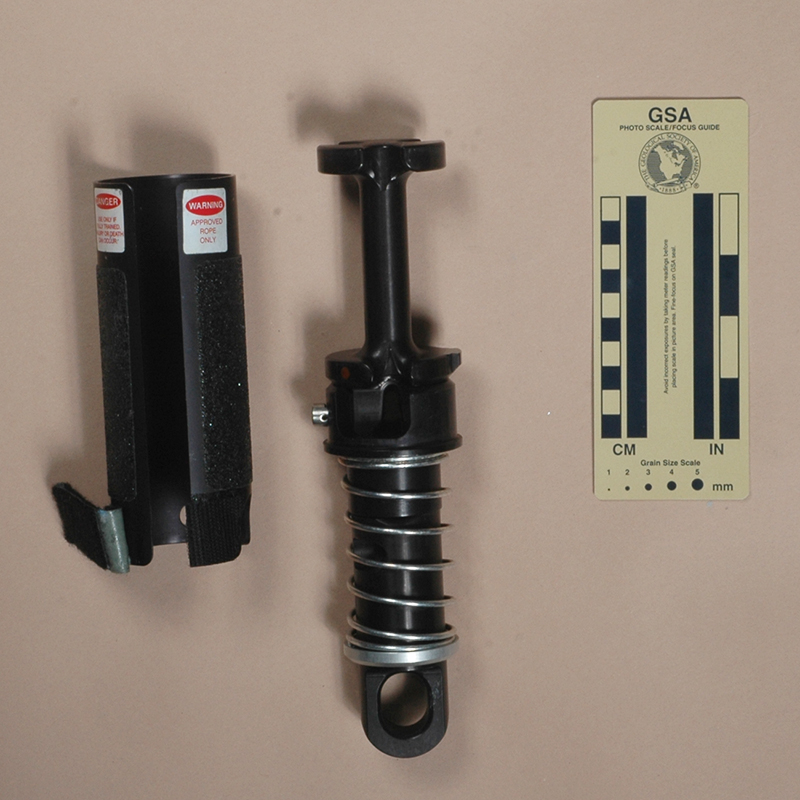 |
| Open for Rigging |
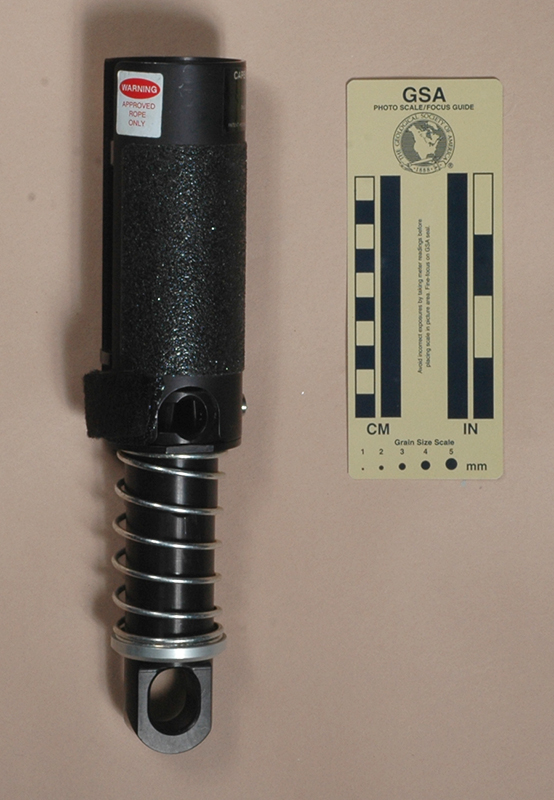
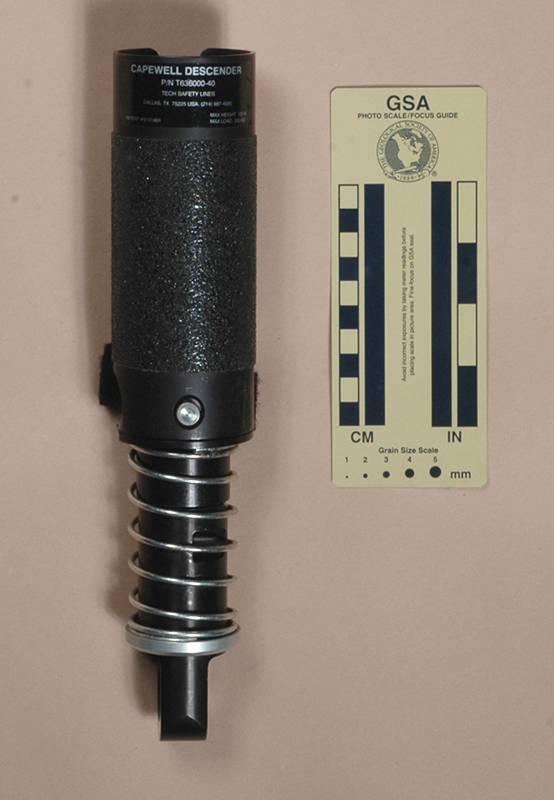
I acquired my Tech Safety Lines Capewell Descender from RecyclingIt Inc. in 2015.
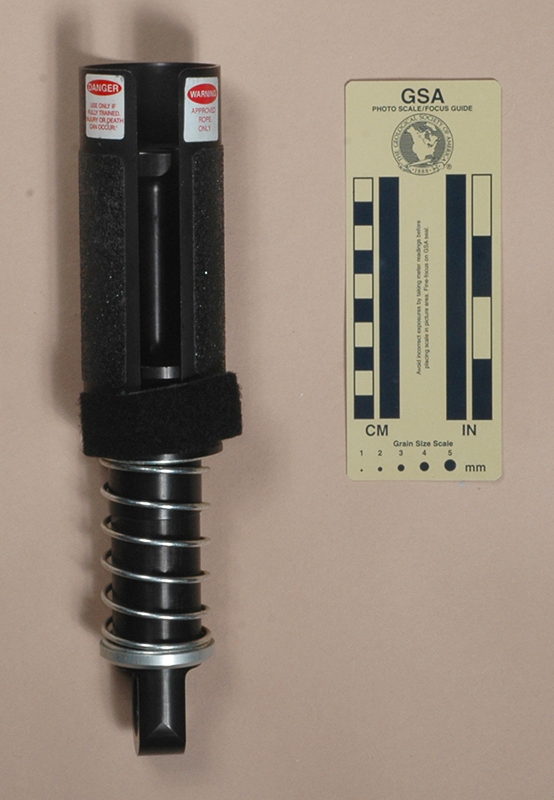
My Capewell is 283 mm. tall, 57 mm. wide, 53 mm. thick, and weighs 742 g. It consists of a central vertical shaft (reminiscent of the Sky Genie) with a spring-loaded V-slot stop mechanism, and a detachable cylindrical cover plate. There is a Velcro™ closure on the cylinder.
The top is engraved with "S/N 6372." There are also three stickers attached. The first has "DANGER" and "USE ONLY IF FULLY TRAINED, INJURY OR DEATH CAN OCCUR."
The second has "CAPEWELL DESCENDER," "P/N 636000-20," "CAPEWELL," "S. WINDSOR, CT 06074 USA, (860)-610-9700,"
"Patent #5131491," "MAX HEIGHT:100 M," and "MAX LOAD: 300 KG." The final sticker has "WARNING" and "APPROVED ROPE ONLY."
The following ascenders are variations of the same basic design, made successively by several companies under various names:
 |
 |
|
|
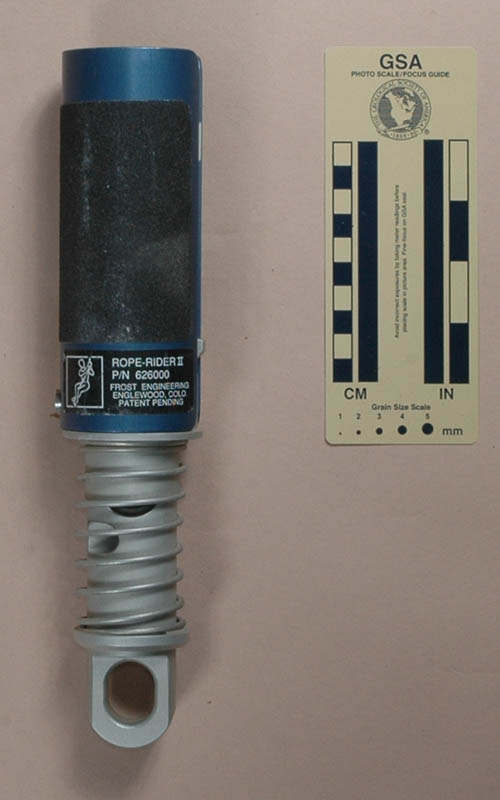
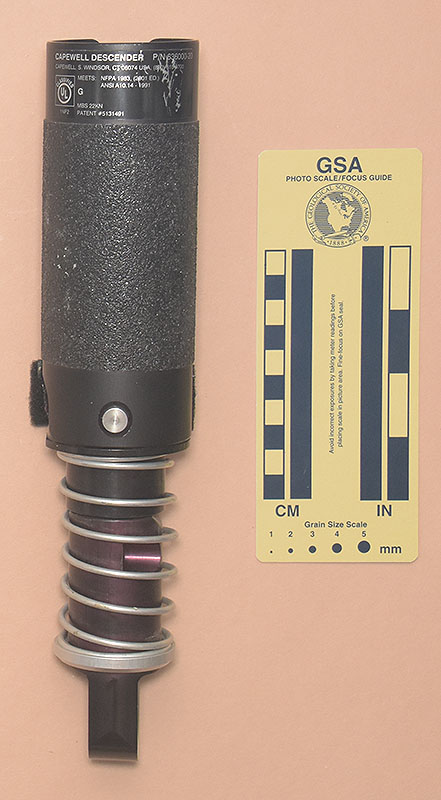
| Frost Rope Rider II | Capewell Descender | Tech Safety Lines Capewell Descender |
Tech Safety Lines RopeRider |
The first of these was the Frost Rope Rider II, made by Frost Engineering Development Corporation out of Englewood, Colorado. Next, Capewell of Windsor, CT acquired the rights and added Velcro™ to the design. I have no idea why. Finally, Tech Safety Lines of Dallas, TX acquired the rights and produced the Capewell Descender before renaming it as the Rope Rider These are protected by U.S. Patent #5,038,888.
Not only is this a clever design, but these have excellent workmanship as well. Although these are not the cheapest devices around, they definitely deserve a star .
Rigging is simple: Press the release button and slide the cover off the top. Pull the sliding collar downward and press the button to latch it in the open position. The V-slot is now exposed. Slide it over the rope, then twist the collar and slide it back up, catching the rope in the slot on the collar. Rotate the collar until it is aligned as shown in the lower photo. Now wrap the rope the required number of turns (usually 3 to 5, depending on the rope material, diameter, construction, condition, and phase of the moon) around the rod, slide the cover back on, and make sure that the release button engages the hole in the cover.
Clip in, and get into a normal rappelling position. Prudes should stop here and find another device to read about. Grasp the cover with one hand, and pull it down. This slides the collar down, and moves the rope to a wider part of the V-groove. To slow down, move your hand up, to go faster, pull it down. The whole process works very smoothly…except it is still a vertical spool, and on a free drop, you will spin.
 |
Warning: These are not complete instructions!! Obtain proper training before using this device. |
|
This will not replace the rappel rack as the preferred deep pit device, nor is it light enough for serious consideration in rock climbing, but in an industrial environment, it may provide some more idiot protection than some other options would.
[ Top | Capewell | Return to Vertical Spools ]
RopeRider|
|
 |
 |
 |
| Front | Right Side | Rear | Left Side |
 |
 |
 |
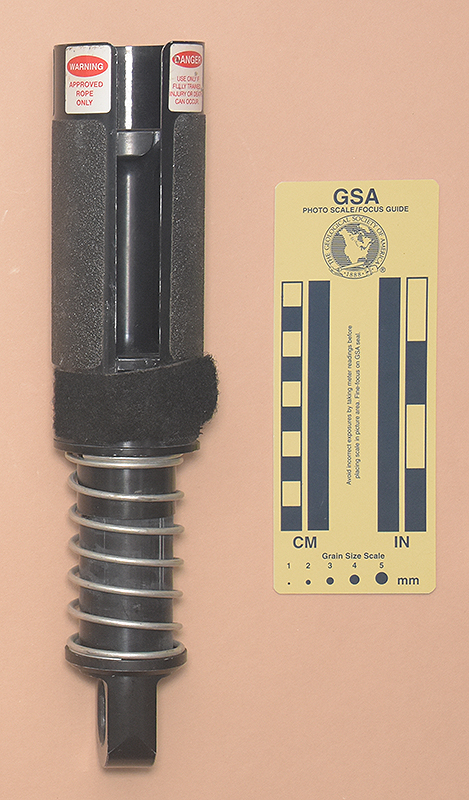
| Front: Open for Rigging | Rear: Open for Rigging | Left: Open for Rigging |
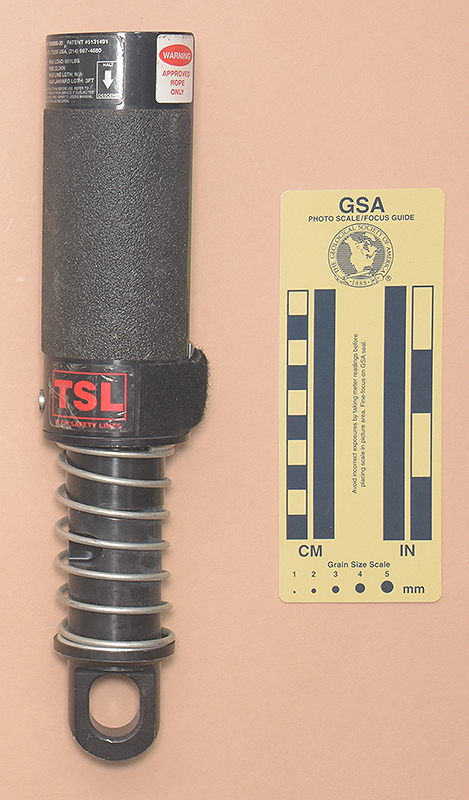
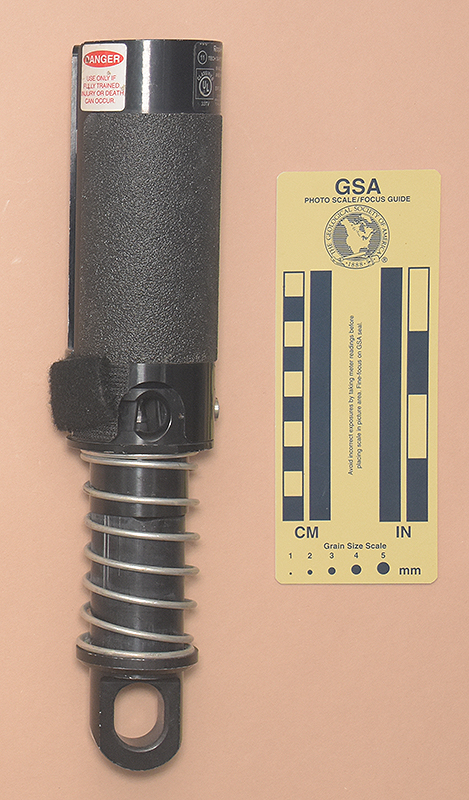
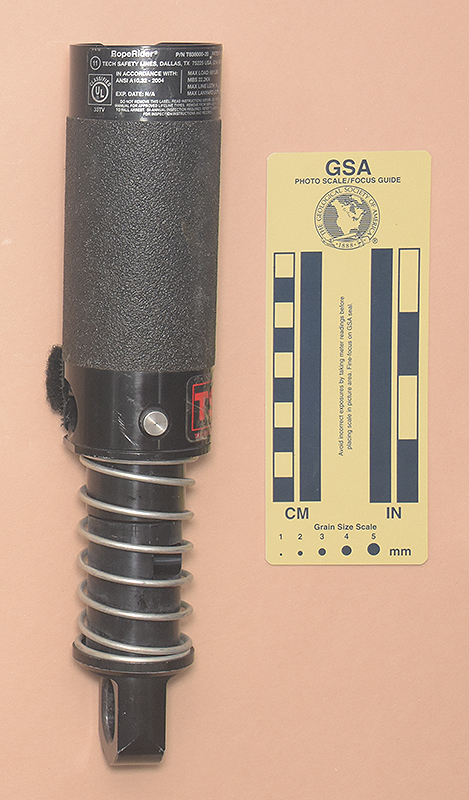
I acquired my Tech Safety Lines RopeRider from Michael Record in 2021.
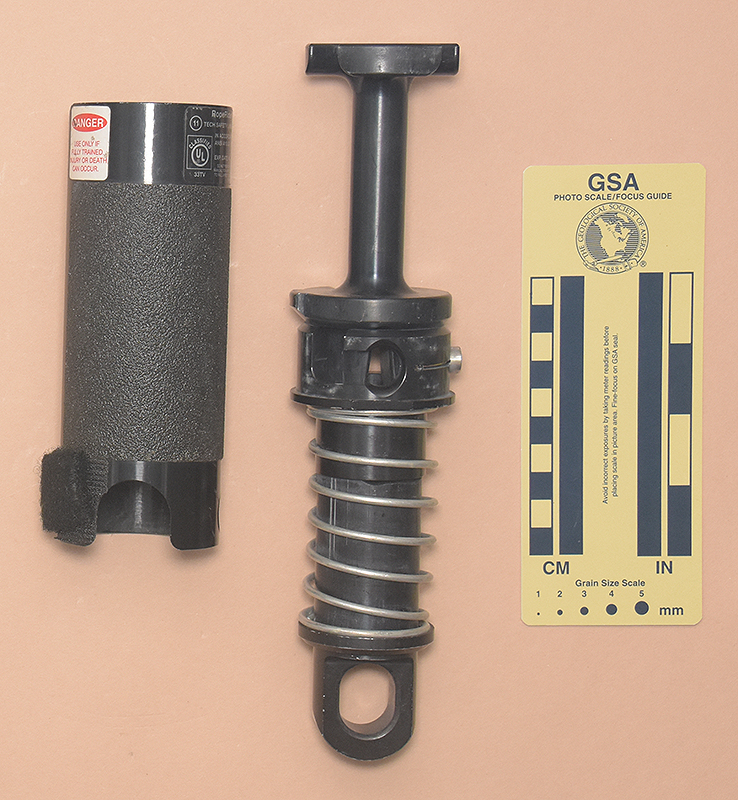
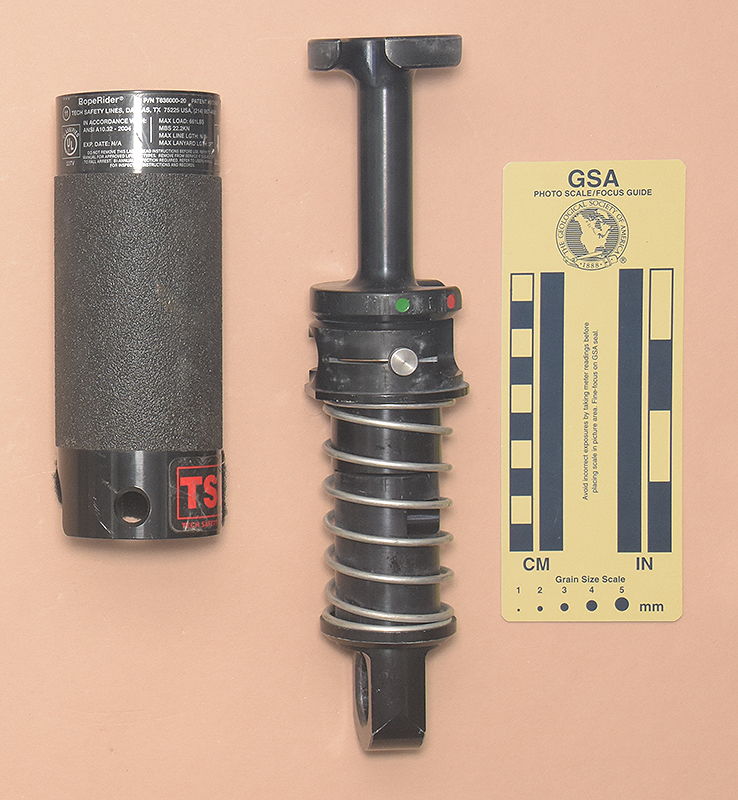
My RopeRider is 283 mm. tall, 60 mm. wide, 59 mm. thick, and weighs 732 g. It consists of a central vertical shaft (reminiscent of the Sky Genie) with a spring-loaded V-slot stop mechanism, and a detachable cylindrical cover plate. There is a Velcro™ closure on the cylinder.
The top is engraved with "S/N3386,"09/13," "USE APPVD 1/2" - 3/8" ROPE ONLY," and "USE APPVD 11-13 mm ROPE ONLY."
There are also four stickers attached. The first has "DANGER" inside a filled ellipse, "USE ONLY IF FULLY TRAINED," and "INJURY OR DEATH CAN OCCUR. The second has "RopeRider®," "P/N T636000-20," "PATENT #5131491," "11" inside a circle, "TECH SAFETY LINES," "DALLAS, TX 75255 USA, (214)-987-4680," the UL Classified logo with "33TV" underneath, "IN ACCORDANCE WITH: ANSI A10.32 - 2004," EXP. DATE: N/A," a vertical line, "MAX LOAD: 661LBS," "MBS22.2KN," "MAX LINE LGTH: NA," MAX LANYARD LFTH: 3FT," "DO NOT RAMOVE THIS LABEL. READ INSTRUCTIONS BEFORE USE. REFER TO MNUAL FOR APPROVED LIFELINE TYPES. REMOVE ROM SERVICE IF SUBJECTED TO FALL ARREST. BI-ANNUAL INSPETION REQUIRED. REFER TO USERS MANUAL FOR INSPECTIOIN INSTRUTIONS AND RECORDS.", and a rectangle containing a"HALT," a down-pointing arrow, and "DESCEND." The third sticker has "WARNING" inside a filled ellipse and "APPROVED ROPE ONLY." The final sticker has "TSL" inside a rectangle with "TECH SAFETY LINES" below.
The following ascenders are variations of the same basic design, made successively by several companies under various names:
|
|
|
|
|
| Frost Rope Rider II | Capewell Descender | Tech Safety Lines Capewell Descender |
Tech Safety Lines RopeRider |
The first of these was the Frost Rope Rider II, made by Frost Engineering Development Corporation out of Englewood, Colorado. Next, Capewell of Windsor, CT acquired the rights and added Velcro™ to the design. I have no idea why. Finally, Tech Safety Lines of Dallas, TX acquired the rights and produced the Capewell Descender before renaming it as the Rope Rider These are protected by U.S. Patent #5,038,888.
Not only is this a clever design, but these have excellent workmanship as well. Although these are not the cheapest devices around, they definitely deserve a star .
Rigging is simple: Press the release button and slide the cover off the top. Pull the sliding collar downward and press the button to latch it in the open position. The V-slot is now exposed. Slide it over the rope, then twist the collar and slide it back up, catching the rope in the slot on the collar. Rotate the collar until it is aligned as shown in the lower photo. Now wrap the rope the required number of turns (usually 3 to 5, depending on the rope material, diameter, construction, condition, and phase of the moon) around the rod, slide the cover back on, and make sure that the release button engages the hole in the cover.
Clip in, and get into a normal rappelling position. Prudes should stop here and find another device to read about. Grasp the cover with one hand, and pull it down. This slides the collar down, and moves the rope to a wider part of the V-groove. To slow down, move your hand up, to go faster, pull it down. The whole process works very smoothly…except it is still a vertical spool, and on a free drop, you will spin.
|
Warning: These are not complete instructions!! Obtain proper training before using this device. |
|
This will not replace the rappel rack as the preferred deep pit device, nor is it light enough for serious consideration in rock climbing, but in an industrial environment, it may provide some more idiot protection than some other options would.