

This page will not fit into a tiny viewport. Please choose a full-size monitor with a full-width window or select the abridged New Wave pages.


Titan I, Version A

Titan I, Version B

Titan II

Titan Prototype

Titan 4-Bar
|
|
|
|
|
|
| Titan I, Version A | Titan I, Version B | Titan II | Titan Prototype | Titan 4-Bar |
Larry Howell was involved in Colorado mountain rescue when he joined the National Speleological Society around 1993. He attended the National Convention that year and brought a variety of innovative titanium racks to show and sell. They were available for a few years through some caving vendors, and then disappeared from the market in the late 1990s.
Sam[1] invented the hyperbar in October, 1992. Others "borrowed” (Sam used a stronger word) and popularized the idea a year later. In 2010, Sam sent me the Titan prototype rack with the first hyperbar. This helped confirm who invented the hyperbar. I accept Sam’s priority. I also recognize a similarity with the Buddy Rogers spooled bars from the early 1970s.
Unless noted otherwise, all Howell–N–Mann rack frames are made from ASTM grade 6 6Al/4V titanium alloy. This alloy has a higher yield strength than the mild steel and common stainless steels used for other rack frames. It's density sits between the steels and aluminum alloys typically used in climbing equipment. Its strength-to-weight ratio is higher than 7075-T6, twice that of 6061-T6, four times that of mild steels, and seven times that of stainless steels. It is a superior choice overall, except for its cost and mach inability.
Unless noted otherwise, all Howell–N–Mann brake bars are made from thin tubes of the same ASTM grade 6 6Al/4V titanium alloy fitted with 6061-T6 aluminum inserts. Titanium alloys have terrible thermal properties, with its thermal diffusivity being less than three-quarters that of stainless, one-third to one-quarter that of mild steel, and about 20 times lower than the aluminum alloys. Solid 6Al/4V bars would quickly overheat to unacceptable temperatures.
Hyperbars have their place, but they also have drawbacks. They can be quite beneficial for adding friction on short closed-frame racks (which are essentially constant friction devices). They can be used for tying-off, but there are better, more secure options in most caving situations. Hyperbars increase the size and weight of a rack, and make it more difficult to pack. Hyperbars are unnecessary for standard-length (or longer) open-frame racks used for personal descent. This was proven by more than a quarter century of standard rack use prior to the hyperbar’s invention and another third since.
[ Top | Titan I v. B | Titan II | Titan Prototype | Titan 4-Bar | Return to Racks ]
|
|
 |
 |
| Front View | Rear View | Open for Rigging |
I acquired this rack from Larry (now Sam) Howell of Howell-N-Man at the 1993 Old Timers Reunion.
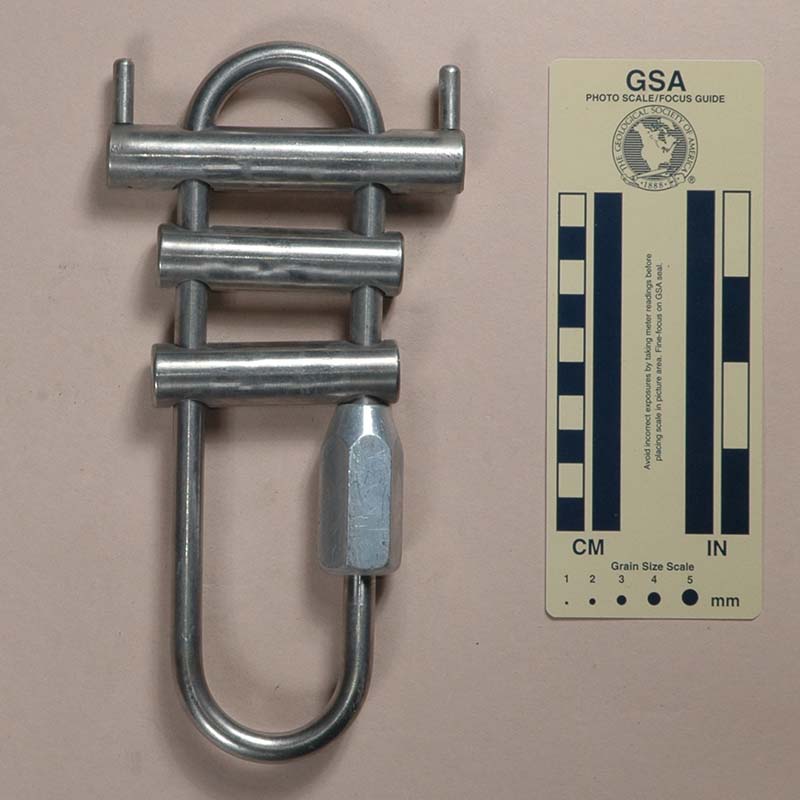
My Titan I rack is 210 mm. tall, 105 mm. wide, 22 mm. thick, and weighs 457 g. The frame is made from 9.5 mm. ASTM grade 6 6Al/4V titanium alloy bent into a C, with an internal width of 43 mm. A threaded 6061-T6 nut closes the frame. There are three brake bars, each made from 6Al/4V titanium tubing with a hollow 6061-T6 aluminum insert (the nut is made in two pieces, but the joint is hard to see). The bars are 19 mm. in diameter. The top bar is a double hyperbar that is 105 mm. long, and the other two are 73 mm. long standard bars. None of the bars are notched to let them swing open, so the frame opens much like a maillon rapide link does.
There are no markings on this rack.
The design and materials make the Titan racks incredibly strong. One disadvantage of this design is that the locking nut takes a lot of room, which means that the rack is long for the amount of available bar movement. Allowing 22 mm. for the rope leaves a completely insignificant 5 mm. range for spreading the bars. On this rack, with only three bars, that isn't a problem - the rack is too fast for my taste, and I wouldn't be spreading bars anyhow - I’d be using the hyperbar to add friction. Another disadvantage is that rigging and derigging takes too much time.
The titanium tubing gives the bars good wear resistance and the hollow aluminum inserts help to absorb and dissipate heat. Unfortunately, although titanium gives good wear resistance, the titanium portion of the bar is thin, so these bars tend to wear out fairly quickly when used on gritty rope.
[ Top | Titan I v. A | Titan II | Titan Prototype | Titan 4-Bar | Return to Racks ]
 |
|
 |
| Front View | Rear View | Open for Rigging |
I acquired this rack from Sam Howell at the 2011 NSS Convention.
My Howell-N-Mann Titan I, Version B rack is 212 mm. tall, 105 mm. wide, 25 mm. thick, and weighs 337 g.
There are no markings on this rack.
The hyperbars on Version B are taller than those on Version A.
Like Version A, this rack does not give enough friction for my taste. It is unnecessarily large for what amounts to being a constant-friction descender.
[ Top | Titan I v. A | Titan I v. B | Return to Racks | Titan Prototype | Titan 4-Bar ]
|
|
 |
 |
| Front View | Rear View | Open |
I acquired this rack from Larry Howell of Howell-N-Man at the 1993 Old Timers Reunion.
My Titan II rack is 282 mm. tall, 105 mm. wide, 22 mm. thick, and weighs 334 g. The design is the same as the Titan I design, but the rack is longer so that it can accommodate five brake bars. The second and fourth bars are slotted, so there is no need to open the rack to rig it on the rope when bringing the tail out on the same side as the standing line.
There are no markings on this rack.
The Titan II is a larger version of the Titan I. As with the Titan I, the workmanship is superb. With five bars, the friction is greater and it is much easier to control. Allowing 35 mm. for the rope leaves 24 mm. range for spreading the bars, which still isn't much, so the Titan II is still essentially a constant friction device.
[ Top | Titan I v. A | Titan I v. B | Titan II | Titan 4-Bar | Return to Racks ]
|
|
 |
| Front View | Rear View |
 |
 |
| Open for Rigging | Side View |
I acquired this rack from Sam Howell at the 2011 NSS Convention.
My Howell-N-Mann Titan Prototype is 305 mm. tall, 106 mm. wide, 29 mm. thick, and weighs 385 g. The frame is made from 9.5 mm. ASTM grade 6 6Al/4V titanium alloy bent into a U, with an internal width of 40 mm. A threaded 6061-T6 nut closes the frame. The nut is made in two pieces. A pin through the nut acts as a stop to keep the nut from sliding too far down the frame when open. A second hole in the nut does not serve any obvious purpose, but it reveals a cross hole drilled in the lower frame and a pin inserted in this hole. The hole and pin serve no purpose; perhaps they had a function earlier in the prototype’s life.
There are five brake bars. The bars are 19 and 25 mm. in diameter and 106 and 67 mm. long. Allowing 35 mm. for the rope leaves 27 mm. for spreading the bars. The top bar is made from 1.3 mm. wall titanium and has a hyperbar post bolted to the outboard end. The post is 9.4 mm. diameter stainless steel and 61 mm. long. It is turned and threaded, leaving 33 mm. extending above the horizontal bar, A shaped aluminum bushing under the horizontal bar provides a flat surface for the lock nut securing the hyperbar post. The second and fourth bars are made from 1.3 mm. wall titanium, and are slotted, allowing them to open for rigging. The third bar is the same material but with an aluminum insert and no slots. The bottom bar is a partially flattened piece of 1.1 mm. wall stainless steel tubing.
There are no markings on this rack.
This rack has significant historical value because it has the original hyperbar. Sam invented the hyperbar in October 1992, and showed it at the 1993 NSS Convention in Pendleton Oregon. Others saw the idea, and soon "everyone" was making hyperbars and/or adding them to their racks.
[ Top | Titan I v. A | Titan I v. B | Titan II | Titan Prototype | Return to Racks ]
|
|
 |
 |
| Front View | Rear View | Open for Rigging |
I acquired this rack from Sam Howell at the 2011 NSS Convention.
This Titan Prototype rack is 305 mm. tall, 106 mm. wide, 29 mm. thick, and weighs 385 g. The frame is made from 9.5 mm. ASTM grade 6 6Al/4V titanium alloy bent into a U, with an internal width of 40 mm. There are 4 brake bars. The bars are 19 and 25 mm. in diameter and 106 and 67 mm. long, respectively. Allowing 35 mm. for the rope leaves 27 mm. for spreading the bars.
There are no markings on this rack, but it has a nice anodized finish.
 Comments
This rack is intermediate between the Titan I and II, both in size and in the friction that it provides. The frame really isn't long enough for four bars, but three wouldn't give me enough friction. The idea at right, demonstrated by Sam at the 1993 NSS Convention, shows one way to get another half bar’s friction.
[ Top | Titan I v. A | Titan I v. B | Titan II | Titan Prototype | Titan 4-Bar ]