This page will not fit into a tiny viewport. Please choose a full-size monitor with a full-width window or select the abridged New Wave pages.


|
|
 |
| Front | Rear |
 |
 |
| Front: Open for Rigging | Rear: Open for Rigging |
I acquired my Singing Rock Sir from Amazon.com in 2015.
The Sir is 126 mm. tall, 73 mm. wide, and 36 mm. thick. It weights 366 g.
The Sir is a shaped like a flattened and deformed avocado.
The Sir consists of four major components: the body, the rotating cam, a cover plate, and an actuating lever assembly.
The body and cover plate are forged from aluminum. Superficially,they are mirror images of each other, although there are some details where this symmetry breaks down. In other, more practical words, the front cover and rear body are roughly the same thickness,and the seam between the two splits the closed device in half. A 6.4 mm. stainless steel rivet joins the front and back near the top. Each piece has a cast stainless steel insert, and the inserts are shaped so that with the covers closed, the inserts form groove for 10 mm. diameter rope.
The cam assembly pivot son a roughly 15 mm. stainless steel axle attached to the body. The attachment method is not clearly visible. A spring-loaded button protruding from the cam axle passes through a hole in the front plate when the cover is closed.
The bottom of the body and cover have aligned 18 mm. holes that form the attachment point. The body has a cast stainless steel anvil next to the hole. The anvil has a U-shaped groove for the rope to run over. The anvil and lever assembly are held by a 5 mm. stainless steel rivet.
The rotating cam is cast steel. It has a webbed design with several reinforcing ribs. The right side of the cam has a rounded V-shaped rope channel with about a 6 mm. minor diameter at the base of the V. The left side has two small grooves to provides finger grip for feeding rope. The bottom of the cam has a flat area that squeezes the rope against the lower anvil when the cam rotates counter-clockwise (i.e., when it closes).
The lever assembly consists of a control lever connected to the cam by a steel link. Pulling the lever downward forces the link upward, opening the cam; however, once the lever passes certain point, the link disengages and the cam rotates closed again under rope tension. At this point, raising the lever opens the cam; but again, the action stops if the lever moves too far.
The cover is printed with an up-pointing arrow, "singing rock," "CE0123," a drawing of the rope path with an anchor icon at the top and a hand icon at the bottom, a double ended arrow with "press" at one end and "&push" at the other (i.e., opening instructions), "SIR," a book-with-an-"i" icon, "0263/0214," "EN 12841 - Type C," "•10-12 mm, 225 kg," "EN341:2011/2A," "•11mm Singing Rock Static R44," "30-180 kg/max 190 m," and "-20°C≤T≤+60°C." The cam has a raised climber icon. The lower anvil has a molded hand-holding-a-rope icon.
The Sir is one of the following closely-related devices:
|
|
|
|
||||||||||||||||
|
|
|
||||||||||||
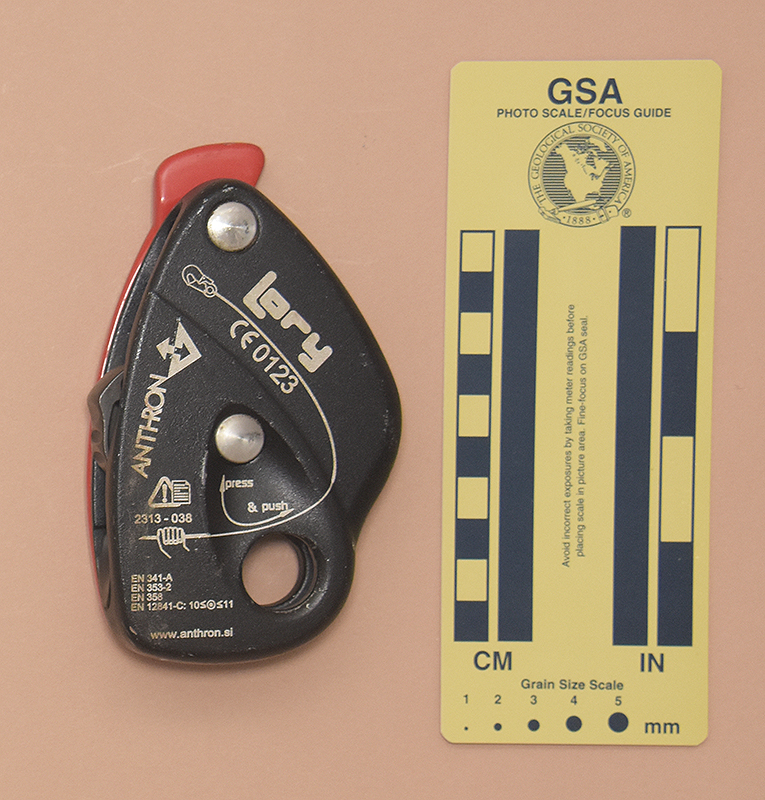
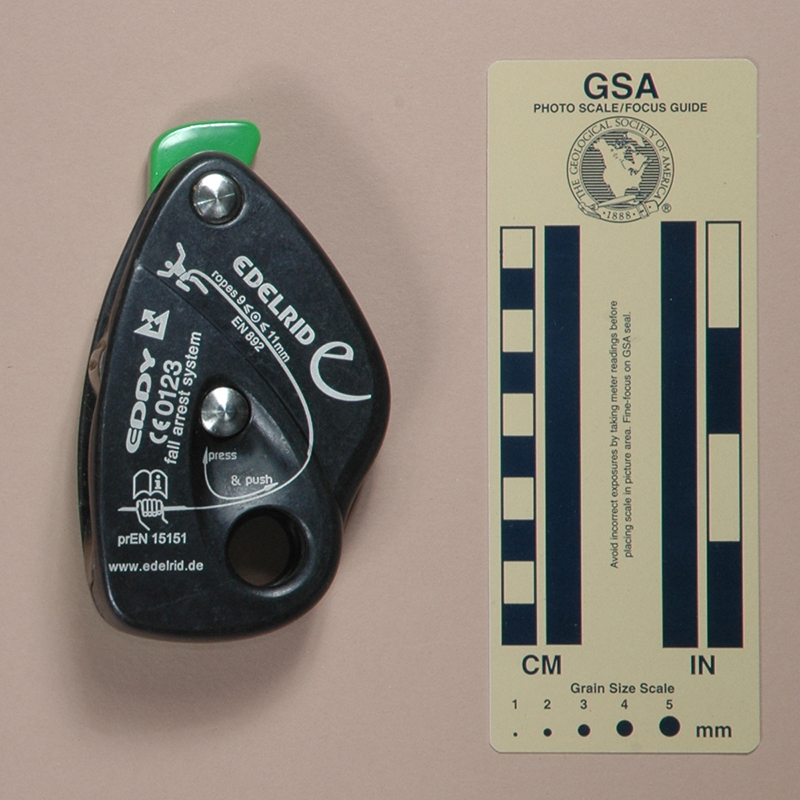
The Slovenian company Anthron made the Anthron Lory, Bornack Lory, Edelrid Eddy, Rollgliss R250, and Singing Rock Sir. The German firm Skylotec bought Anthron in 2016 and continued production with the Skylotec Lory and Lory Pro.
Some of these were sold as belay devices, and the others as descenders. The belay device and descender versions are not the same. The difference is subtle, and easily overlooked. The belay versions have a double-ended plunger pressed into the cam. The cam can be aligned so that spring-loaded balls rest in detents in the body and cover plates, lightly holding the cam in a position that allows relatively free motion of a slack rope.
| Belay Cam | Descender Cam |
|---|---|
 |
 |
One would think that any of these could be used for either purpose, but Skylotec warns against this. They certified their Lory and Lory Pro to different standards. The lawyers have spoken, and I will not openly disagree (in the U.S.A., it is unwise to disagree with lawyers). Having tried both, I can say that the belay cam seems only slightly easier to use when belaying. With either cam, I could feed rope out easily by manually lifting the cam with an index finger. Taking rope in was even easier - I just pulled it through the device. I didn't notice any difference between the two cams when rappelling: rope tension easily overpowers the spring-loaded balls.
The Sir has excellent workmanship and it functions well. It is solid, but it is also quite heavy. This should not be a problem for gym climbers or people who drive to the base of short sport climbs, but I wouldn't consider lugging one of these to a remote climb or up a wall.
The lever function provides partial backup for the user not knowing how to use the lever, but like all such devices, it relies on the user being completely incompetent rather than partially incompetent.
The lever action has a bizarre feature: once the user moves the lever past the release point, the lever function reverses. In other words, I would normally lower by pulling down on the lever, with farther down meaning a faster lower. If I pull too far, then the cam locks. At this point, I could resume lowering by pushing the lever up, with farther up meaning a faster lower. If I go too far again, the action reverses a second time, and the lever operates as it originally did. I do not like this behavior. I found that if I somehow pull the handle into the lower lock position, I could "slam" the handle upward to the upper locking position with a negligible drop, bypassing the reverse-acting behavior. Sort this out at home, not at the cliffs. I give this feature a lemon award:  .
The lever assembly is greased. This grease will pick up sand and dirt. As an enclosed device, the Sir is not well-suited for use on severely mud-covered ropes.
Singing Rock is a climbing equipment manufacturer in the Czech Republic. The headquarters, production, training and testing centre is located in Poniklá. Our textile production plant is situated in Semily. The production of metal products and components is placed in Sudkov. The Kladno training centre for work at height is just 20 min from Prague. Singing Rock supplies products to more than 65 countries worldwide through its network of distributors and agents.
The Singing Rock company was founded in 1992. Before starting Singing Rock, one of its founders, Vladimír Křapka, was earning his living by sewing the backpacks and sandals which became very popular in former Czechoslovakia under the name Tucan. The Tucan brand was at the very beginning of the new company's activities, from the backpacks and sandals to the climbing harnesses. After founding Singing Rock in 1992 and starting the partnership with Jan Goddefroy from Belgium, a new company name and logo were chosen in cooperation with a British advertising agency. Thus the "Tatrman" who was the initial representative of the Singing Rock's identity was brought to life. It showed an Indian during the traditional Sun dance at the place where the rock really does sing thanks to the wind – and that is where the name Singing Rock came from.
The "Tatrman" logo was in use until 2000 when it was replaced by the "arrow." The company logo got this unique shape by accident – their longterm graphic designer Jiří Mělnický from the H.R.G. printing house used the symbol of an American road sign on the cover of the catalogue. Vláďa Křapka liked this idea so much that he had a new company logo created using this sign. Like the "Tatrman," the "Singing Rock arrow" is inspired by Western culture and stands for a clear, straight direction, sense of purpose and, most of all, the vertical – a direction connected with everything that Singing Rock creates.
The private financial fund ARX Equity Partners bought Singing Rock in 2009. At the same time Singing Rock s.r.o. and Lanex a.s. merged. The successor company had the business name Lanex a.s. They acquired Raveltik s.r.o. in 2011 to extend the portfolio with the metal products; expansion to the market with products for ice climbing and mountaineering. Two years later, in 2013, the Singing Rock division split from Lanex a.s. and reorganized back to Singing Rock s.r.o.