

This page will not fit into a tiny viewport. Please choose a full-size monitor with a full-width window or select the abridged New Wave pages.


Version A
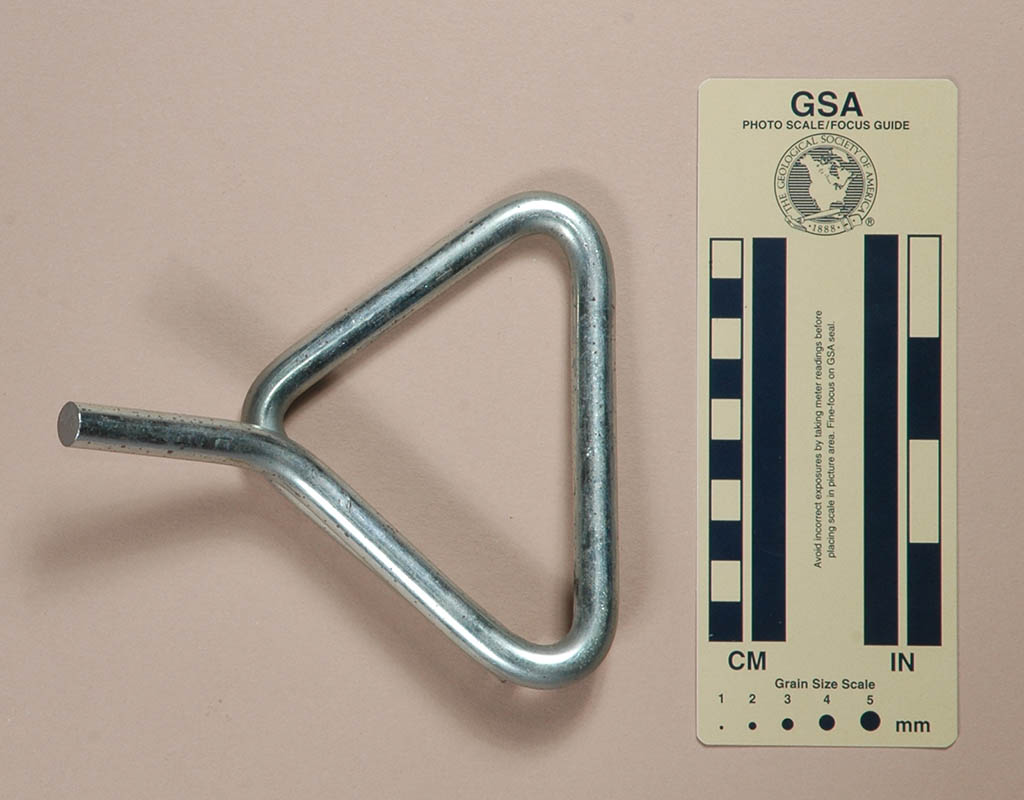
Version B
|
|
|
| Version A | Version B |
Tom King was a caver in the Wisconsin Speleological Society and a ski patrol member. He was from Menomonie, Wisconsin. Around 1972 he was trying to develop and market a device for ski patrol members to rappel from a stalled ski hill chair lift.
Gary Storrick saw one of these NSS Museum collection. He made two of these from steel rod, trying to match dimensions scaled from a photograph. He later was able to examine the original and determined that it was made from aluminum. He took careful measurements but has not yet made another more faithful copy.
Gary Storrick, NSS 12967 FE CM, began caving, climbing, and collecting vertical equipment in 1971. He created this web site in 1999, and earned an NSS Certificate of Merit in 2024 for his work. Back in the day, his father Robert had some small equipment made for him in the shops that he managed. Gary now makes samples in his home machine and wood shops to aid his research. He suggests, "I may have tried more devices than the average caver."
I first saw one of these many years ago in the NSS Museum collection. I talked to the curator, a good friend of mine, and he didn't have any information on who made it or where it came from.
I visited the NSS headquarters in October 2021 and was again able to inspect and photograph the original triangle. It was made of aluminum, and appeared to have been made with a commercial bending jig. One side was stamped "T-K."
 |
 |
In January 2023, George Zachariasen (creator of the Musicbox and Son of Musicbox) sent me a letter with the following information:
Looking at your museum website I believe I recognize one of your unknowns, a horn marked TK that you have. About in 1972 I tested a device that looked just like that for Tom King, a caver and ski patrol member who was trying to market a device for ski patrol members to rappel from a stalled ski hill chair lift. Tom was a member of the Wisconsin Speleological Society, as I was and a college student at UW Madison. He was from Menomonie, Wisconsin. He included some 1" [25 mm.] webbing with it, wanting it to be very compact. There was very little control and I told him it felt unsafe.
[ Top | Version B | Return to Horns ]
|
|
 |
| Front | Rear |
I made this descender in 2005.
This descender is 172 mm. tall, 137 mm. wide, 42 mm. thick, and weighs 399 g.
 I've wondered about the one of these in the NSS museum for many years before I decided to make one for myself. I bent a piece of 11 mm. steel rod that I had laying around. I mistakenly thought that the descender was made from plated steel rod, and I didn't have any at the time, so I used plain steel rod. I wasn't careful about the dimensions.
The dimensions are clearly not critical. Note that the descender is not flat: the extension to the left is bent away from the reader at about 30 degrees. This helps keep the rope in place. Also note that mine is left-handed while the NSS museum original was right-handed. I used a 30°-30°-120° triangle, the NSS museum original is closer to 45°-45°-90°. In both cases, the two congruent sides of the triangle are about 75 mm. long.
The Triangle reminds me of the Lirakis Sidewinders and it functions similarly. It is too large and heavy for so little performance, so I view it with historical curiosity and would not seriously consider making this my primary descender.
[ Top | Version A | Return to Horns ]
|
|
 |
| Front | Rear |
I made this descender in 2005.
This descender is 124 mm. tall, 140 mm. wide, 36 mm. thick, and weighs 335 g.
I made Version B about a month after making Version A, having found some plated 11 mm. steel rod in a local hardware store. This time I tried to match my memory of the dimensions of the NSS museum original. It was a hot and humid morning when I made Version B and nothing seemed to be going well in the shop that day, but I managed to get closer to the original. I also made this version right-handed like the museum original. Version B is lighter and smaller than Version A, but still too heavy or bulky for the performance it delivers.
[ Top | Version A | Version B ]