

This page will not fit into a tiny viewport. Please choose a full-size monitor with a full-width window or select the abridged New Wave pages.

 Storrick – Zachariasen Musicboxes

Musicbox

Son of Musicbox
|
|
|
| Musicbox | Son of Musicbox |
George Zachariasen is a Wisconsin caver. He joined the National Speleological Society in 1971 and was made a Fellow of the Society in 1986.
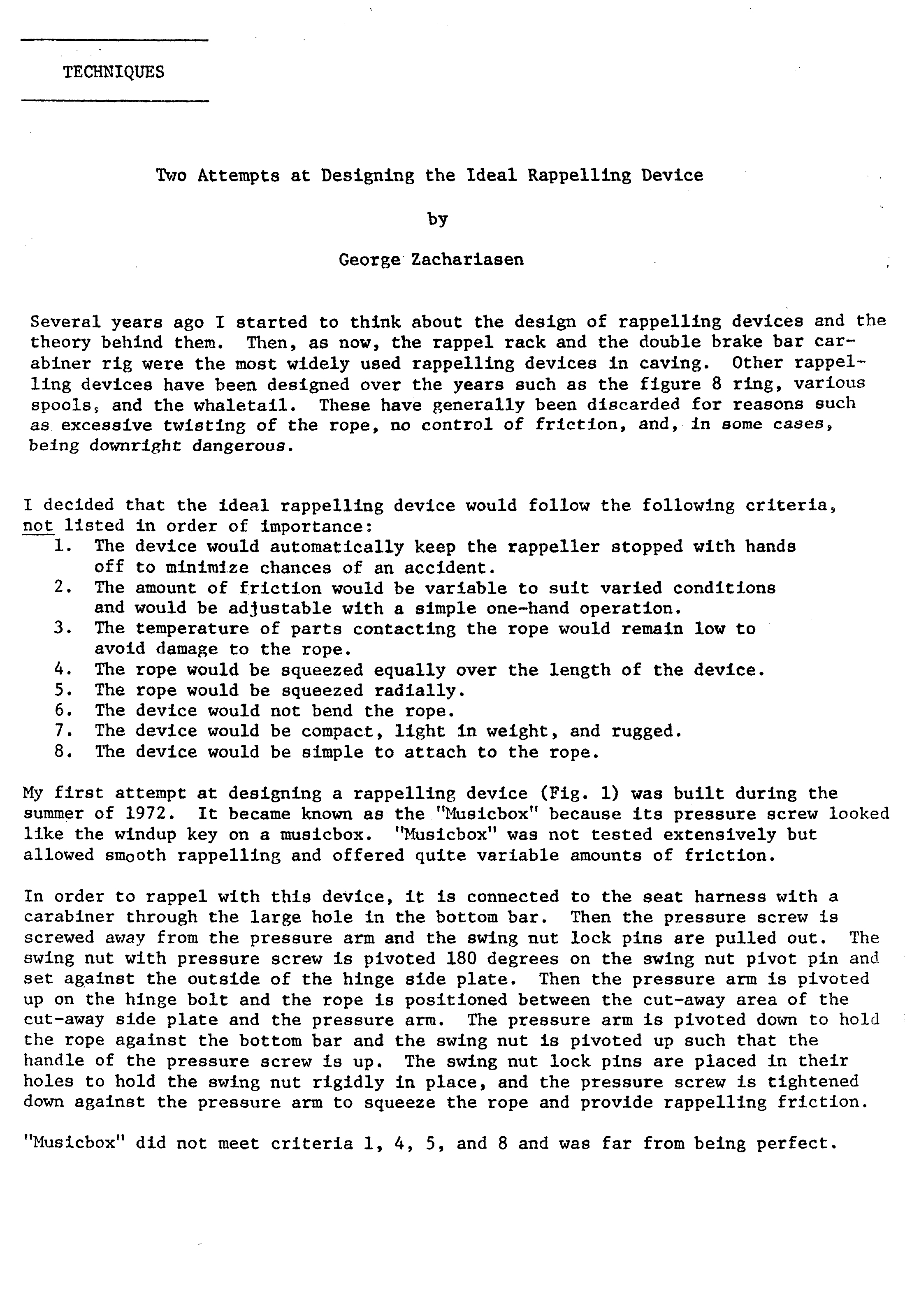
 In the summer of 1972, George built a squeeze brake, called Musicbox, and demonstrated it at the at the 1972 N.S.S. Convention. George published his design in 1972[1], writing,
I decided that the ideal rappelling device would follow the following criteria, not listed in order of importance:
When he tested the Musicbox, George noticed that the swing nut lock and pivot pins were not strong enough. He retired his Musicbox, writing:
"Musicbox" did not meet criteria 1, 4, 5, and 8 and was far from being perfect Also some comments were made on the inadequate strength of the swing nut lock pins and the swing nut pivot pins. These pins were made of 1/8 inch steel rod and receive the full pressure exerted by the pressure screw. On examination after the "Musicbox" had gotten some testing, the lock pins had developed kinks showing that they were not strong enough. I was also dissatisfied with the pressure arm because pressure was not applied evenly to the rope. "Musicbox" was permanently retired from use.
 After retiring the Musicbox, George made the Son of Musicbox (S.O.M.) in the fall of 1972. The S.O.M. had a pressure screw like the one on the Musicbox, but it was mounted on a pressure spring and pressed against a sliding pressure plate. George’s idea was that the pressure spring would minimize the effect of changes in rope diameter, but his spring was too strong and barely deflected.
George found that the S.O.M. gave a smoother rappel than the Musicbox, but that he “would speed up and slow down for no apparent reason.” This was particularly evident when used on kernmantle rope. George concluded,
S.O.M. still did not meet criteria 1 and 5. Criterion 5 could be approached by making the rope contacting surfaces of the pressure arm and the bottom bar concave. Criterion 1 would be difficult to meet and the mechanism required would probably be complicated and rather delicate. "Musicbox" and S.O.M. are not significant improvements over other rappelling devices.
George eventually donated the Musicbox and Son of Musicbox to the NSS Museum in Huntsville, Alabama. Gary Storrick photographed them in late 2022. He finished making copies in 2023, scaling dimensions from the photos.
Gary Storrick, NSS 12967 FE CM, began caving, climbing, and collecting vertical equipment in 1971. He created this web site in 1999, and earned an NSS Certificate of Merit in 2024 for his work. Back in the day, his father Robert had some small equipment made for him in the shops that he managed. Gary now makes samples in his home machine and wood shops to aid his research. He suggests, "I may have tried more devices than the average caver."
[ Top | Son of Musicbox | Return to Squeeze Brakes ]
|
|
 |
 |
| Front View | Side View | Rear View |
 |
 |
 |
| Front View: Open for Rigging | Side View: Open for Rigging | Rear View: Open for Rigging |
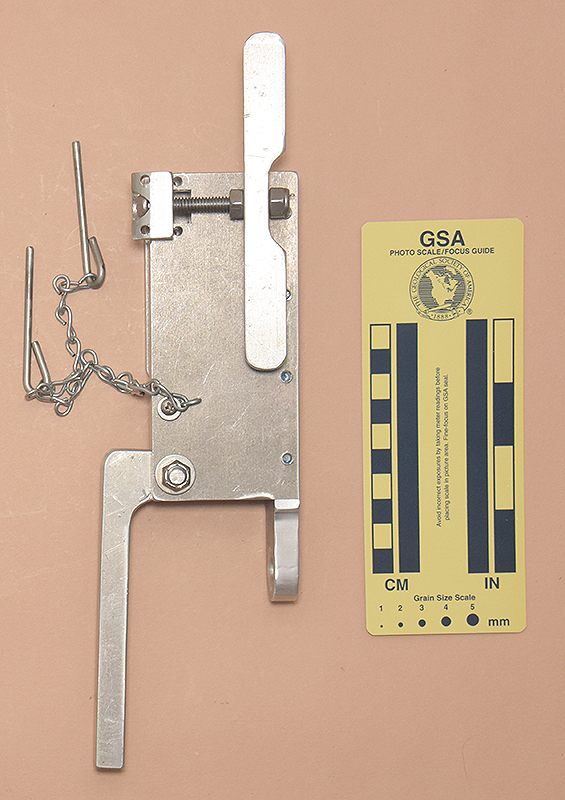
I made this Musicbox in 2023.
My Musicbox is 222 mm. tall, 80 mm. wide, 60 mm. thick, and weighs 622 g.
My Musicbox has 3/8" (9.5 mm.) 6061 aluminum front and back plates connected by a spine plate of the same thickness and material. A swinging pressure arm fits between the plates. A pivoting block holds a pressure screw and wing nut. Two 1/8" (3.2 mm) pins hold the block in the closed position. Turning the nut forces the screw against the pressure plate, forcing it against the rope to increase friction.
I stamped my Musicbox with my logo.
My Musicbox is a copy of one that on George Zachariasen’s built in the summer of 1972. He later donated his Musicbox to the N.S.S. Museum, where I photographed it in 2022. I scaled dimensions for my version from those photographs.
Most rappel devices increase friction when a braking force is provided below – that much is obvious from the Euler–Eytelwein formula. Squeeze brakes do not; if anything, friction reduces slightly. Experience shows that turning a pressure screw is not fast enough to control one’s descent speed. There have been severe accidents because of this. For your own safety, do not rappel on a Musicbox.
|
Warning: The swing nut lock pins and the swing nut pivot pins are not strong enough TO PROVIDE AN ADEQUATE SAFETY MARGIN |
|
|
Warning: The Musicbox' friction can vary quickly, widely and unpredictably,leading to COMPLETE loss of control. |
|
 |
 |
 |
 |
[ Top | Musicbox | Return to Squeeze Brakes ]
|
|
 |
| Front | Rear |
 |
 |
| Side | Open for Rigging |
I made this Son of Musicbox in 2023.
My Son of Musicbox is 159 mm. tall, 124 mm. wide, 70 mm. thick, and weighs 1113 g.
My Musicbox has 3/8" (9.5 mm.) 6061 aluminum front and back plates with a sliding pressure plate between. A removable pressure block is held in place by two QR pins. A pressure spring holds a pressure screw and wing nut. Turning the nut forces the screw against the pressure plate, forcing it against the rope to increase friction.
I stamped my Son of Musicbox with my logo.
My Musicbox is a copy of one that on George Zachariasen’s built in the fall of 1972. He later donated his Musicbox to the N.S.S. Museum, where I photographed it in 2022. I scaled dimensions for my version from those photographs.
Most rappel devices increase friction when a braking force is provided below – that much is obvious from the Euler–Eytelwein formula. Squeeze brakes do not; if anything, friction reduces slightly.
Experience shows that turning a pressure screw is not fast enough to control one’s descent speed. There have been severe accidents with other squeeze brakes because of this. For your own safety, do not rappel on a Son of Musicbox.
|
Warning: The Musicbox' friction can vary quickly, widely and unpredictably,leading to COMPLETE loss of control. |
|
--------
[1] George Zachariasen, 1974. Two Attempts at Designing the Ideal Rappelling Device. The Wisconsin Speleologist, XIII(2), Wisconsin Speleological Society, Madison, Wisconsin.
|
|
|
|
|
[ Top | Musicbox | Son of Musicbox ]