

This page will not fit into a tiny viewport. Please choose a full-size monitor with a full-width window or select the abridged New Wave pages.

This page is not suitable for tiny viewports. Please choose a larger screen and/or expand the window.
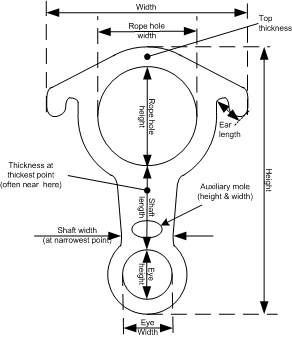 Figure eights with ears have more to describe than their deaf cousins, so after expanding those descriptions, doing the same for the eights with ears was straightforward. I chose to take the same approach that I took for the deaf eights; namely, differentiate by measurement. I measured the following dimensions for each eared eight in my collection:
The total thickness includes the effect of any bends. In other words, if you sandwich the eight between two parallel boards that are also parallel to the plane defined by the length and width dimensions, the thickness is how far apart the boards must be. Since some figure eights with ears have unique features, I used some judgment in deciding what the last four dimensions referred to. In most cases, you should easily be able to decide what measurements I made.
As the following chart shows, there are two branches to the correlation between height and weight that applies well for most of my eared eights. The upper branch is for aluminum eights and the lower for steel eights. The four huge eights are Radeberger Haken, one of which is the absurdly heavy beast at the right.
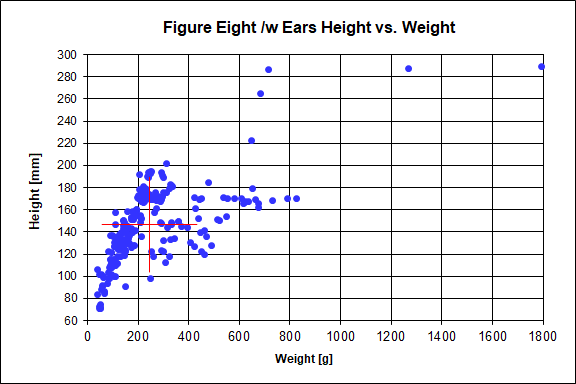
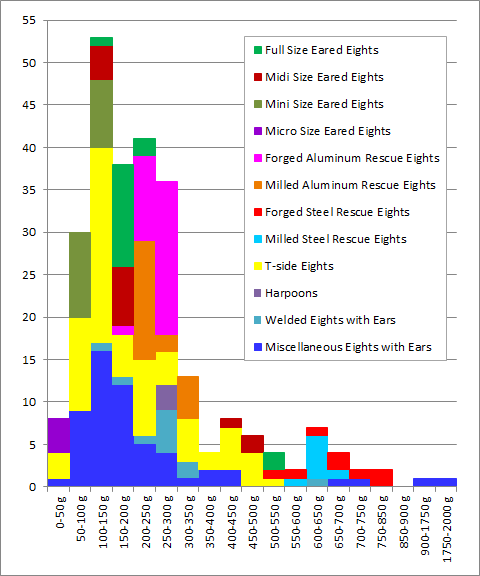
I grouped my figure eights with ears into several categories based on similarities in size, shape, material, and manufacturing method. The previous chart shows that if you view all the eared eights at once, they do not fall into distinct size groups. Despite this, I was able to make reasonable groups when I looked at them in detail. The following pages provide tables showing the following key dimensions for each of the following categories:
 |