This page will not fit into a tiny viewport. Please choose a full-size monitor with a full-width window or select the abridged New Wave pages.

Resonator 3000

Zone 8
|
|
|
| Resonator 3000A | Zone 8 |
CanyonStore formed in 2013. Gertjan van Pelt had a Belgian colleague at first. After six years, they separated their stores, and Gertjan changed his store's name to CanyonZone in 2018. Canyonzone is an international retailer of canyoning and caving clothing and equipment. They operate from Zutphen, The Netherlands.
[ Top | Zone 8 | Return to Figure Eights ]
|
|
 |
| Front | Rear |
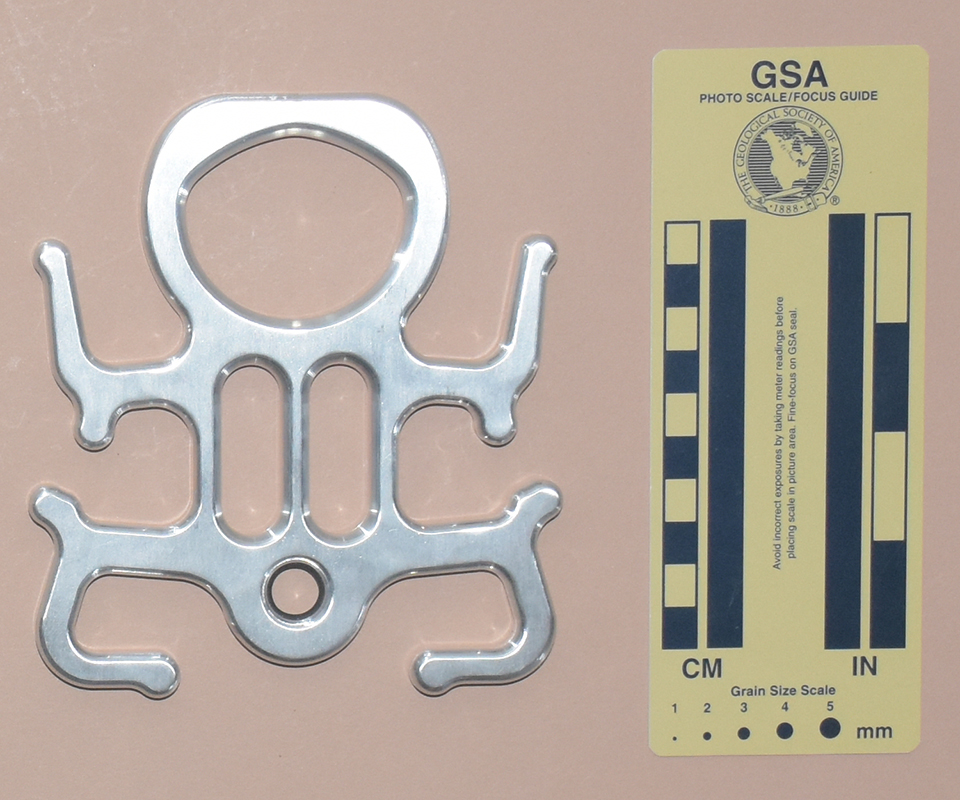
I acquired my Resonator 3000 from Canyon Gear in 2020.
The Resonator 3000 is milled from 7075-T6 aluminum alloy plate and then clear anodized. Mine is 140 mm. tall, 125 mm. wide, and 9 mm. thick. The rope hole is 42 mm. high and 51 mm. wide. The top center thickness is 9 mm. The shaft length and width are 56 mm. and 48 mm., respectively. The auxiliary hole is 39.6 mm. high and 13.8 mm. wide. The eye measures 14 mm. by 14 mm. The ears are 27.2 and 36.3 mm. long. My Resonator 3000 weighs 178 g.
There are no markings on the Resonator 3000.
The Resonator 3000 falls into my miscellaneous figure eights with ears category.
The Resonator 3000 is an experimental advanced descender designed for recreational canyoneering and technical search & rescue. It reminds me of a CRITR that suffered DNA damage so that the arms and legs bifurcated. On-line literature says that it has more than 30 adjustable degrees of friction, and one can find numerous ways to rig the Resonator 3000.
The Resonator is one of a growing population of canyoneering descenders that are essentially figure eights with a multitude of horns and/or ears that provide a variety of friction arrangements by looping the rope around various combinations of horns. I find this idea to be rather humorous - how many different ways to rig a device does one need?
The value and need for horns strongly depends on the rope being used. On stiff mud-covered PMI pit rope, descending with an eight sometimes requires hand-feeding. At the other extreme, rappelling on clean, thin, polyethylene "strings" can be bloody fast, and one can appreciate almost anything that provides more friction.
To be fair, I see nothing fundamentally wrong with the concept of multiple horns, I just don't think their value offsets the increases in device size and complexity. One can debate whether adding horns to a constant-friction device is a better approach than using a variable friction device (or even a constant friction device that provides the right amount of friction for the user), but it really boils down to personal preference. I prefer to K.I.S.S.
The eye is small and there are many normal carabiners and maillons that will not fit through it. This is a fatal flaw, in my opinion. A tiny eye restricts versatility, and eliminates the option of using two carabiners for redundancy.
The eye has an annoying o-ring insert. In my mind, this is just a bad idea that won't go away.
Plan on dedicating a special carabiner if you want to use your Resonator.
Canyoneering descender designers and users may love o-ring eyes, but I hate them. O-ring eyes increase cost without providing a corresponding benefit. I see too many disadvantages to the small o-ring eye design and no advantages.
You may disagree with me about o-ring eyes, I don't mind, but the undersize o-ring eye alone is sufficient for me to eliminate the Resonator from serious consideration.
The Resonator 3000 got its name because you can hit with a carabiner and it will produce a long lasting eerie sound resonating at a frequency of 3000Hz. I like to hang mine from a string and spin it so that I get a beat to the sound.
[ Top | Resonator 3000 | Return to Figure Eights ]
|
|
 |
| Front | Rear |
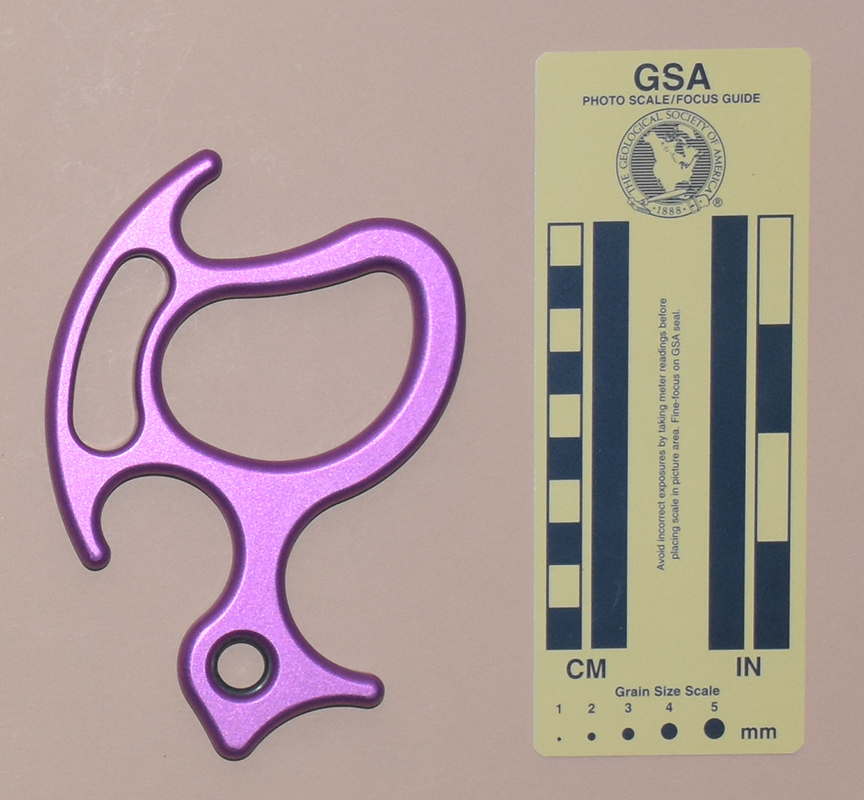
I acquired my CanyonZone Zone 8 from CanyonZone.com - Gertjan van Pelt in 2020.
The CanyonZone Zone 8 is milled from aluminum alloy plate and then soft anodized. Mine is 132 mm. tall, 93 mm. wide, and 10 mm. thick. The rope hole is 42 mm. high and 57 mm. wide. The top center thickness is 10 mm. The shaft length and width are 41 mm. and 12 mm., respectively. The auxiliary hole is 46.1 mm. high and 12.7 mm. wide. The eye measures 14 mm. by 14 mm. The ears are 21.2 and 28 mm. long. My CanyonZone Zone 8 weighs 111 g.
The front of the Zone 8 has the Canyon Zone logo incorporating their URL "CanyonZone.com."
The Zone 8 is an unusual T–side eight. It is one of the following closely-related designs:
|
|||||||||||||||
These vary in size and construction, with the Oka being the lightest and the Canyon the heaviest. The Oka was the progenitor, with the others following.
The unusual shape of the rope hole allows for a taller hole without increasing the height of the eight.
The slot between the T-horns is suitable for belaying.
The lower spur does not appear to serve an essential purpose. Perhaps it is a result of the aversion some canyoneers have to rigging a figure eight in the standard manner. I prefer the location used on the Canyon, as it points away from me and cannot poke me in the stomach.
The eye is small and there are many normal carabiners and maillons that will not fit through it. This restricts versatility, and eliminates the option of using two carabiners for redundancy. The eye has an annoying o-ring insert that keeps the Zone 8 from moving freely on the carabiner. It makes attaching and removing the Zone 8 more difficult. The ring catches in the notch in some of the carabiners that will fit. Removing the o-ring is a straight-forward option, but it still leaves a device with a small eye. Plan on dedicating a carabiner if you want to use your Zone 8 without a lot of hassle. I see too many disadvantages to the small eye design and no advantages (reducing the chance of dropping the device in one unlikely scenario by adding another doesn't count). The eye alone is sufficient for me to eliminate the Zone 8 from serious consideration.
[ Top | Resonator 3000 | Zone 8 ]