This page will not fit into a tiny viewport. Please choose a full-size monitor with a full-width window or select the abridged New Wave pages.

|
|
 |
| Front | Rear |
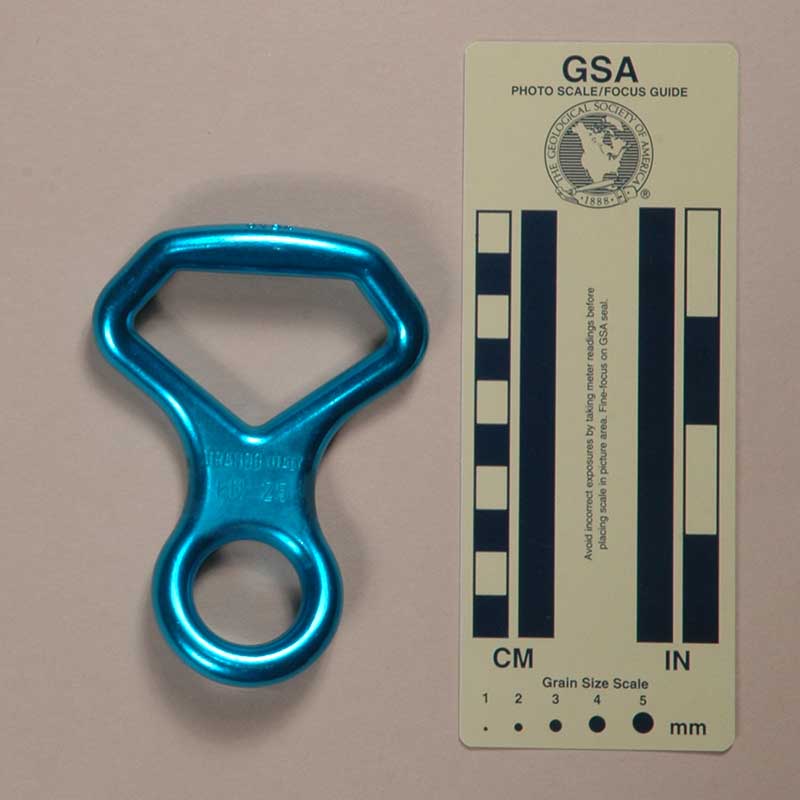
I acquired this eight new on eBay from Joel Schloesser in 2009.
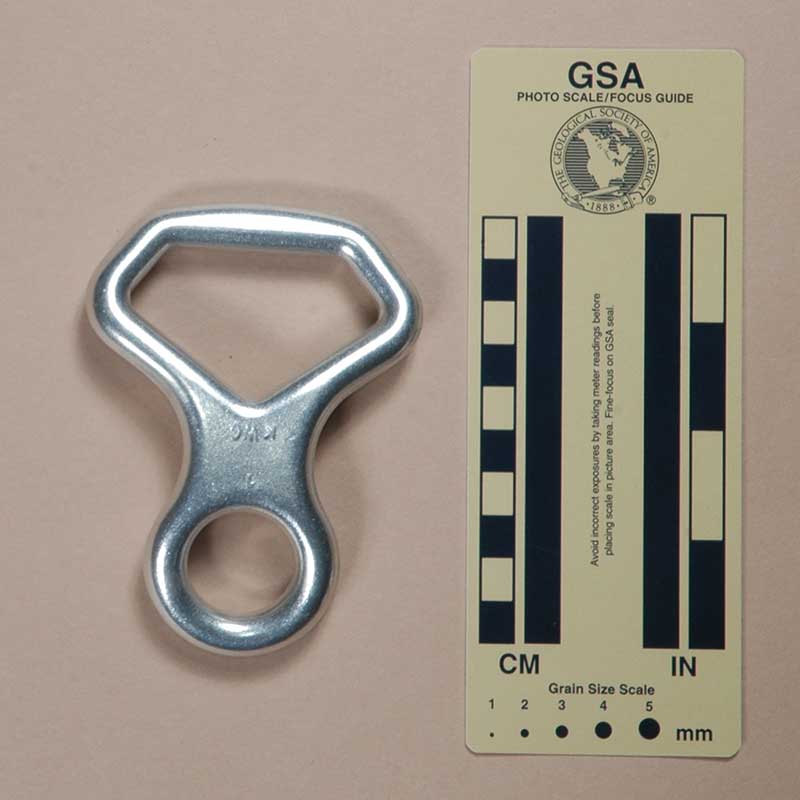
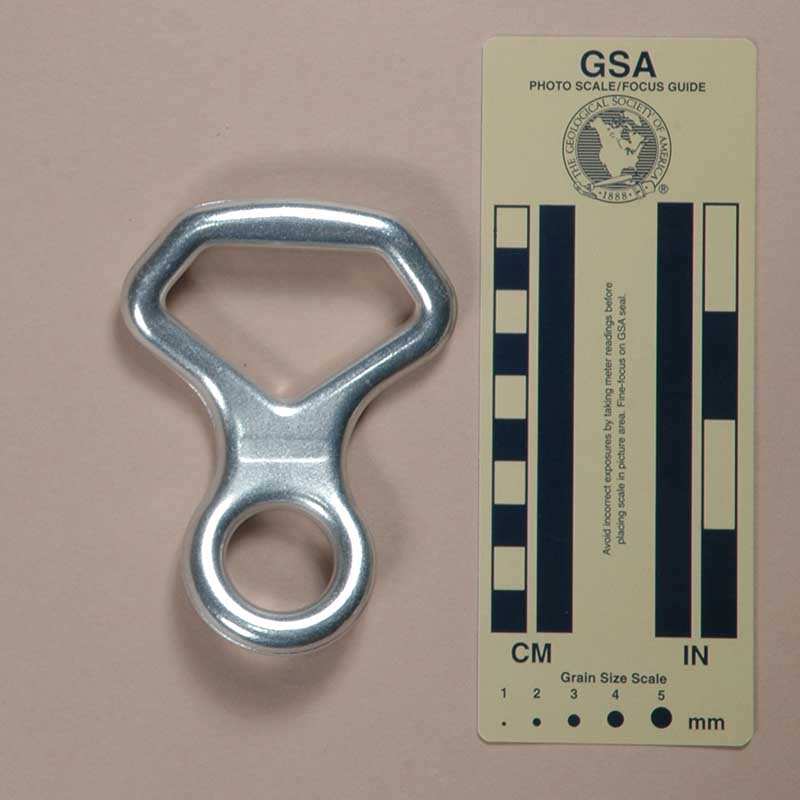
The KWO is forged from aluminum alloy. Mine is 106 mm. tall, 79 mm. wide, and 20 mm. thick. The KWO has a distinct bend that accounts for the increased thickness; if flat, it would be only 11 mm. thick. The rope hole is 35 mm. high and 58 mm. wide. The top center thickness is 11 mm. The shaft length and width are 26 mm. and 30 mm., respectively. The eye measures 25 mm. by 26 mm. My eight weighs 80 g.
The convex side of the KWO has "1" and "KWO" in raised characters.
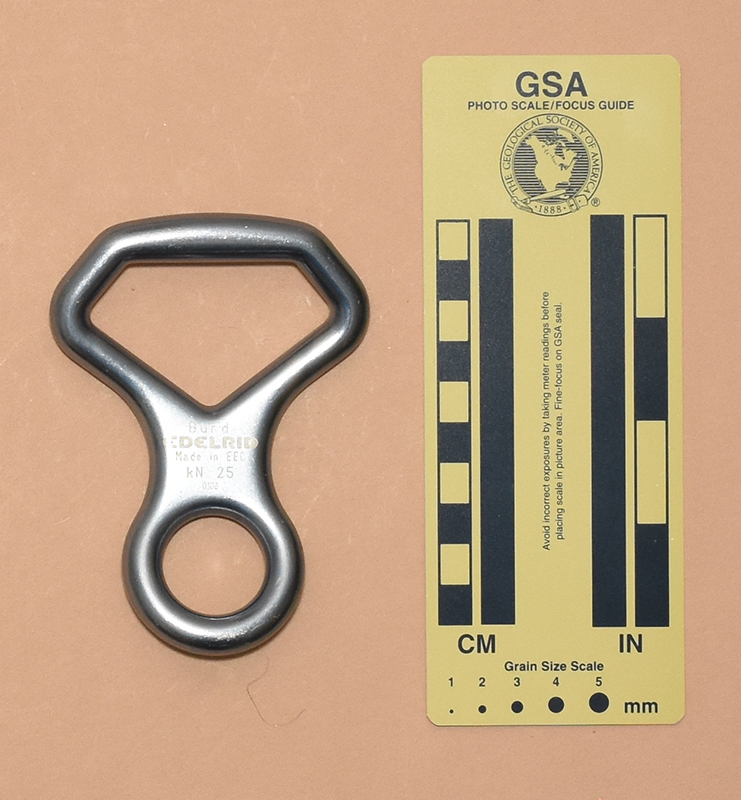
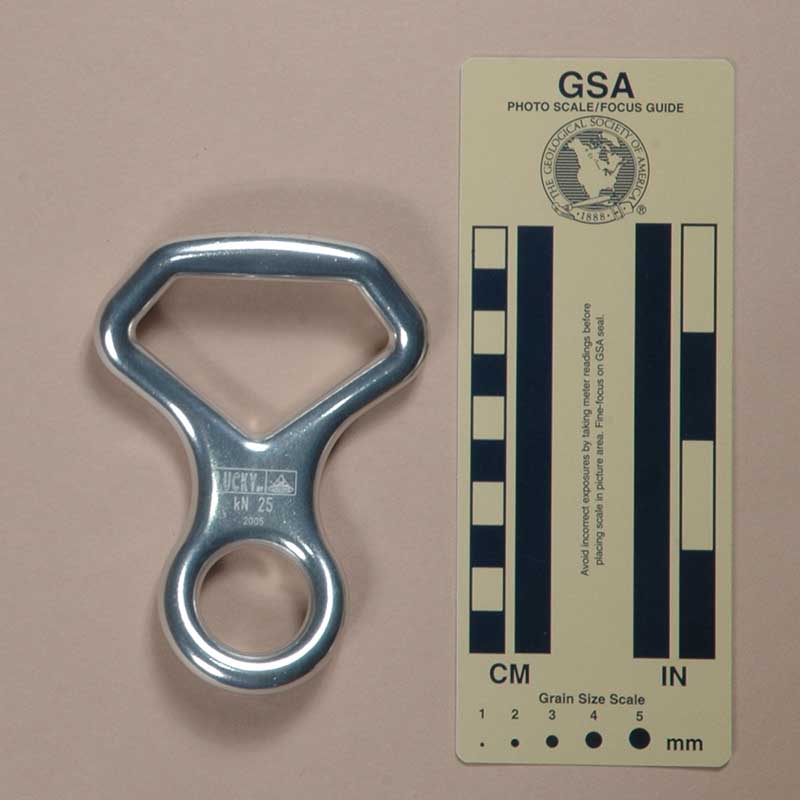
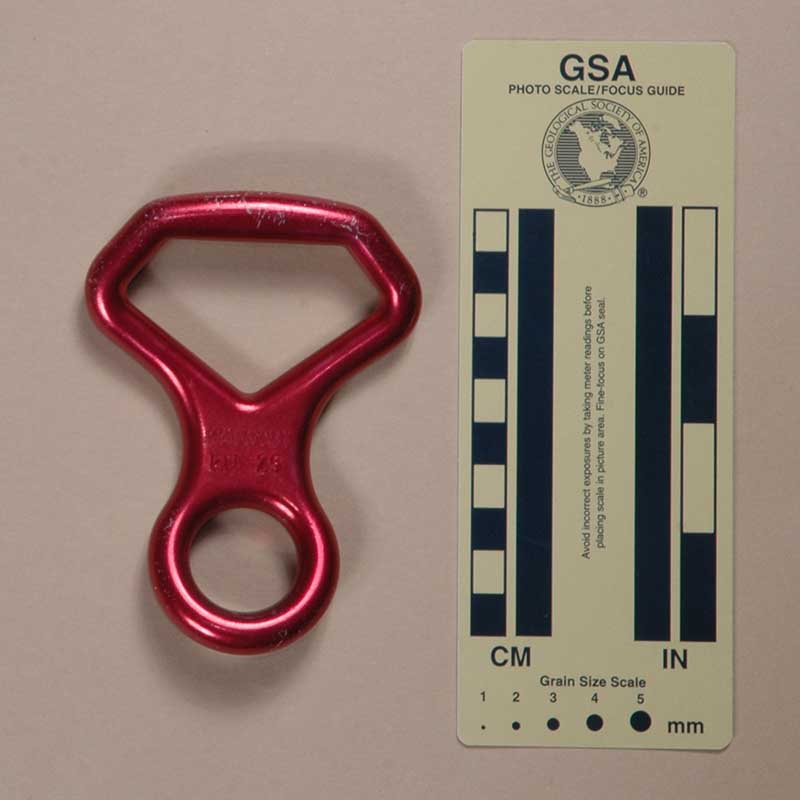
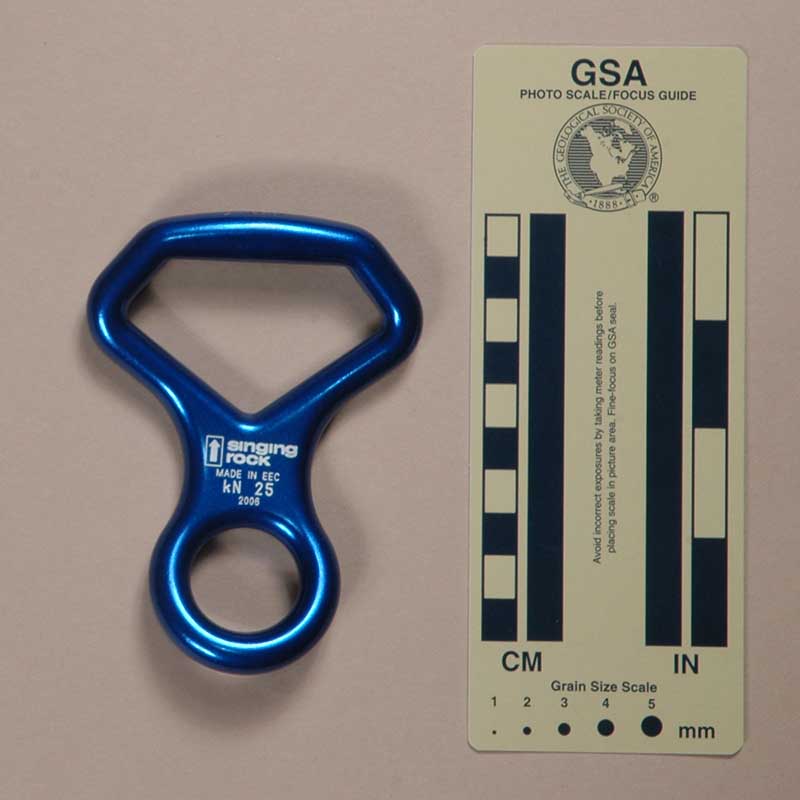
The Kabelwerk Oberspree (KWO) is one several odd-shaped,bent figure eights. Here are the ones that I have collected:
|
|
|
||||||||||||||||||
The first of these was the KWO, and it was not intended to be a figure eight! Carsten Strietzel sent me a note on April 19, 2009 describing its origin. Here is what he wrote:
Hello Gary,
Thank you for your very interesting website.
Probably I can give some additional information according to the KWO eight.
This eight had its origin in East Germany, and was popular for climbers in the Elbsandstein.
KWO stands for "Kabelwerk Oberspree," and to my knowledge the initial intention of this device was a part of a industrial safety harness and not a abseil device. I think to remember the device was mounted at a belt for climbing poles, thru the large hole was the strap sewed on the belt and the small hole was the attachment point for the carabiner.
…the non intentional use of things was very popular for us East German climbers…. :-)
I might be wrong, but to my recognition the western versions of this shape appeared later.
best regards
Carsten
I asked if he remembered when the KWO eight appeared, and he replied as follows:
I would say the KWO "eight" appeared 1984/85, but definitely before 1987.
The idea worked well enough as an eight, and others copied the design.
Each of these is 107±1 mm. tall and 79±1 mm. wide. Their weights fall in the 80±1 g. range. These are normal manufacturing variations that have no practical significance.
These eights are smaller and much lighter than most eights. While the advantages are manifest, there are two practical disadvantages:
The bend allows rigging these eights in two ways with differing amounts of friction. The short overall length and sharp bends makes this eight rather "grabby" when using the high friction arrangement on sandy ropes.
None of these eights have slots for Sticht-type belaying, and their round eyes are not designed for that purpose.
 Emil Rathenau, the CEO of AEG founded the Oberspree Cable Works (Kabelwerk an der Oberspree or KWO) in 1897 in Oberschöneweide to produce electrical cables and wires. In 1913, AEG bought the neighboring property and expanded its campus to the east along the entire bend in the Spree. Production continued in the GDR, but after the wall fell, the business collapsed. The plant was subsequently closed in 1995 and the uniform yellow brick buildings are now listed for historical preservation.
This "eight" was not designed to be a rappel device. It was a part of a industrial safety harness, mounted on a belt for climbing poles. The straps were sewn through the large hole with the small hole serving as an attachment point for a carabiner. Back in the day, using things in unintended ways was an accepted common practice with East German climbers. This harness piece became a popular descender among climbers in the Elbsandstein.