This page will not fit into a tiny viewport. Please choose a full-size monitor with a full-width window or select the abridged New Wave pages.


Version A
Version B
Version C
Version D
Version E
|
|
|
|
| Version A | Version B | Version C |
|
|
|
| Version D | Version E |
Black Diamond Equipment is an American manufacturer specializing in equipment for climbing, skiing, and mountain sports. The company was founded in 1989 and is headquartered in Holladay, Utah.
Yvon Chouinard bought a second-hand coal-fired forge in 1957 and started making hardened steel pitons under the Great Pacific Iron Works name. Their success led him to form Chouinard Equipment Ltd. He partnered with Tom Frost, and they moved their operation to Ventura California in 1967. The Chouinard product line expanded into a wide variety of climbing and related outdoor gear. In 1971-1972, they introduced Hexentrics and Stoppers. Frost left the operation in 1977, and his name was removed from ice axes and other products that had born the CBouinard-Frost name.
In 1968, during a trip to Italy to participate in the Trento Mountain Film Festival, Chouinard visited the CAMP factory in Premana with Hermann Huber (Salewa). Following this visit, an agreement was reached for CAMP to manufacture ice axes, pitons, Hexentrics and Stoppers for Chouinard (and later Black Diamond). This equipment was sold by CAMP with the double marking of the logos CHOUINARD and CAMP and, through 1980, the additional logo of the INTERALP sales agent. All Chouinard equipment marked "Made in Italy" or "Italy" was manufactured by CAMP.
Initially Black Diamond continued using the "C-inside-a-diamond" logo inherited from Chouinard Equipment. Over time, this logo evolved into the current "cut diamond" design. The exact year of this transition is not precisely documented, but discussions among climbers suggest that the new logo was introduced around the year 2000. Archived web pages show that the cut diamond was in use by the beginning of 2000, but the 2000 summer catalog still contains the older logo. Black Diamond also had Chouinard stock with the old logo that was not sold for many years, making dating an item by its logo difficult to impossible.
I do not know a simple way to date used eights with the older logo to know whether they were made before or after the company name change. I chose to put all Super 8s on the Black Diamond page.
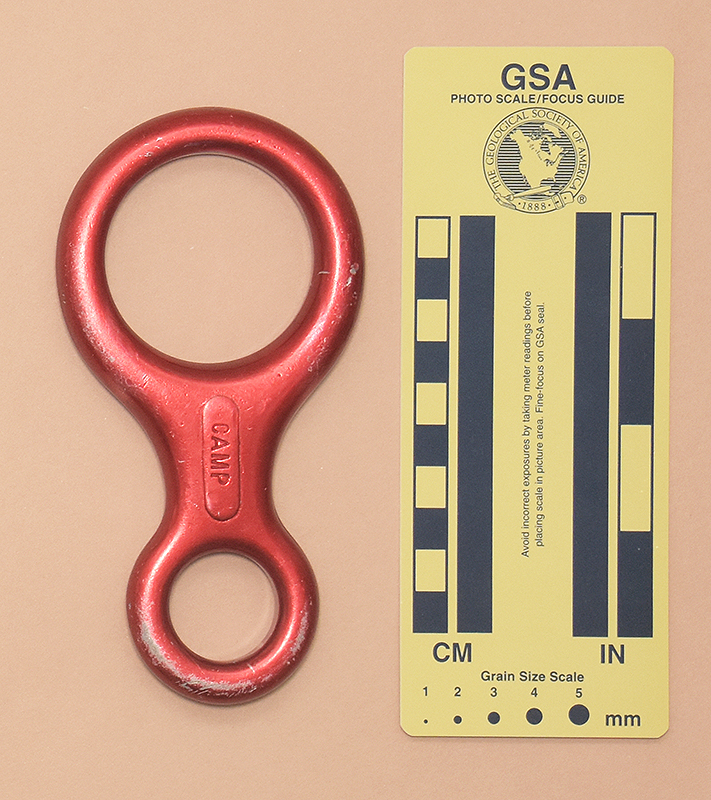
Several Chouinard eights were made in Italy by C.A.M.P.
Blacksmith Nicola Codega founded C.A.M.P. in 1889 to produce wrought-iron goods. The company first entered the climbing equipment business in 1920 when Nicola's son Antonio started making ice axes for the Italian Army Alpine Corps. The firm continued to grow and was handed down through the family.
 From about 1950 through 1976, C.A.M.P. used a diamond-shaped logo bearing "D CN & FD CAMP" for "Ditta Codega Nicola & Figli De Codega Antonio Metilde Premana."
In 1968, C.A.M.P. entrusted Robert Charles Maillot and his firm Interalp to distribute C.A.M.P. products outside Italy. These products bore both C.A.M.P. and INTERALP logos. Their relationship continued until 1980.
 C.A.M.P. changed its name to "Construzione Articoli Montagna Premana" in 1972.
In 1972 C.A.M.P. started using a new logo with "CAMP" inside a rounded rectangle above a mountain. The transition was completed around 1976.
 C.A.M.P. introduced a new wolfs-head logo in 1992.
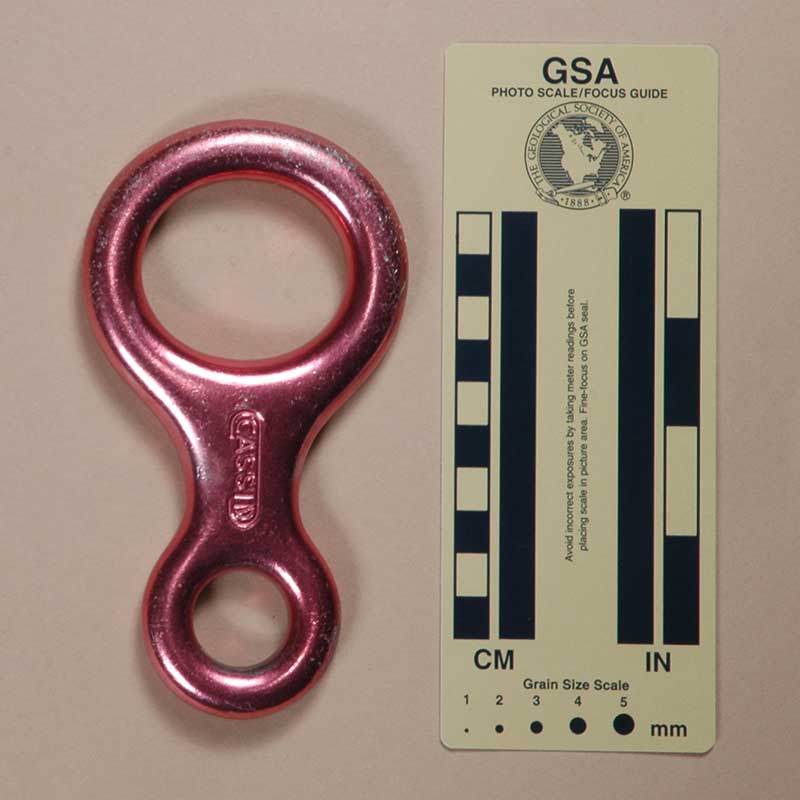
C.A.M.P. acquired Cassin in 1997.
 In 2003 C.A.M.P. again changed the company name, this time to "Concezione Articoli Montagna Premana" and changed their logo to CAMP in italics.
 C.A.M.P. introduced another new logo in 2022 and returned to the name "Construzione Articoli Montagna Premana."
Denis Pivot of C.A.M.P. provided the following information on C.A.M.P.'s relationships with other manufacturers:
CAMP and Other Manufacturers
CAMP has always maintained good relations with its competitors. The biggest brands (Chouinard, Black Diamond, Lowe, Cassin, Salewa, Simond, Charlet Moser, Petzl [and Kong]), thanks to the confidence they had in CAMP's manufacturing quality, subcontracted the manufacturing of mountain equipment to CAMP. This was an opportunity for the latter to make its industrial tooling profitable.
CAMP - Chouinard & Black Diamond
In 1968, during a trip to Italy to participate in the Trento Mountain Film Festival, Yvon Chouinard visited the CAMP factory in Premana with Hermann Huber (Salewa). Following this visit, an agreement was reached for CAMP to manufacture ice axes, pitons, Hexentrics and Stoppers for Chouinard (later Black Diamond). This equipment was sold by CAMP with the double marking of the logos CHOUINARD and CAMP and, through 1980, the additional logo of the INTERALP sales agent. All Chouinard equipment marked "Made in Italy" or "Italy" was manufactured by CAMP.
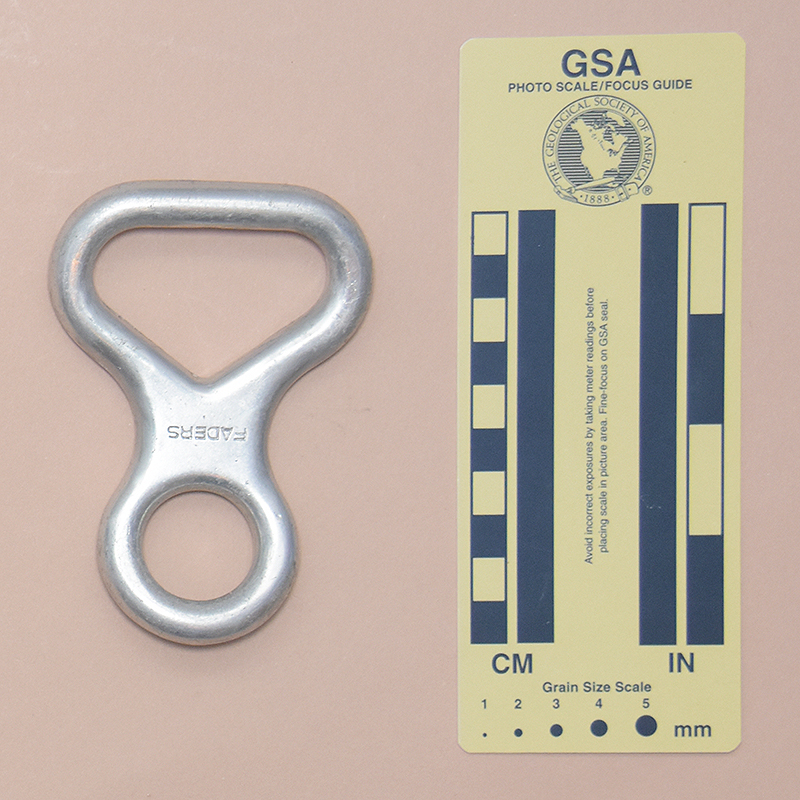
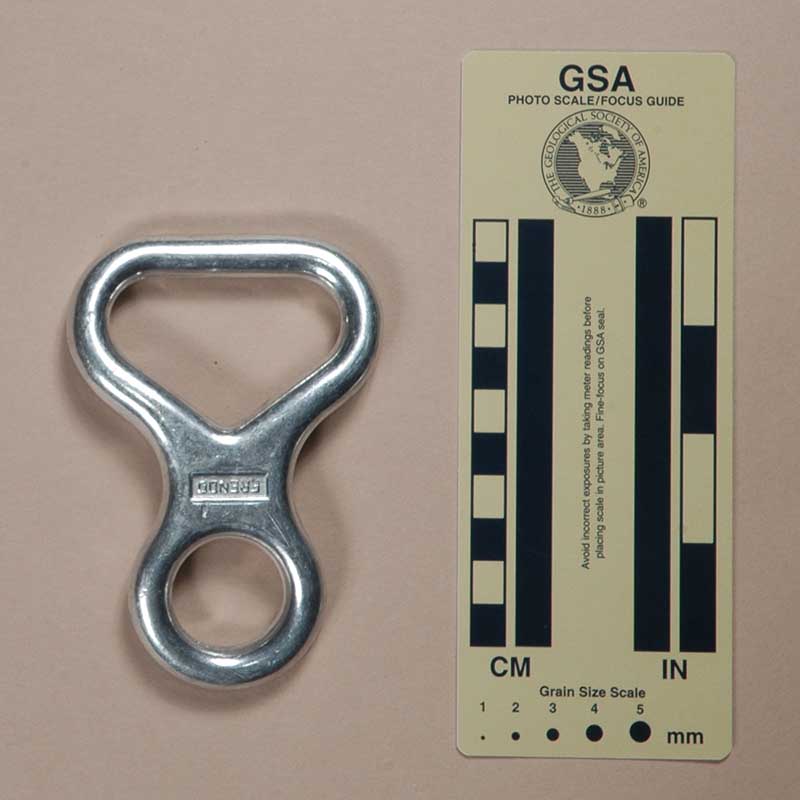
Some Chouinard eights were made in Spain, undoubtedly by Faders who made identical eights for themselves and for others such as Frendo
In the 1940s, Sígfrid Quer, a Swiss engineer living in Barcelona, started to design climbing and mountaineering products under the name Quer. Faders became Quer’s successor in 1973. Faders later merged with Fixe in 2011 to form the Tech Rock Group.
[ Top | Version B | Version C | Version D | Version E | Return to Figure Eights ]
|
|
 |
| Front | Rear |
I acquired this eight from Skinny Skis around 1979. I acquired a second one from Mark Schneider in 2018, a third from eBay seller zombiefamilyjohn in 2021, a fourth from Repair Lair in 2023, and a fifth from Al & Karen Padgett at the 2023 Fall TAG Cavein.
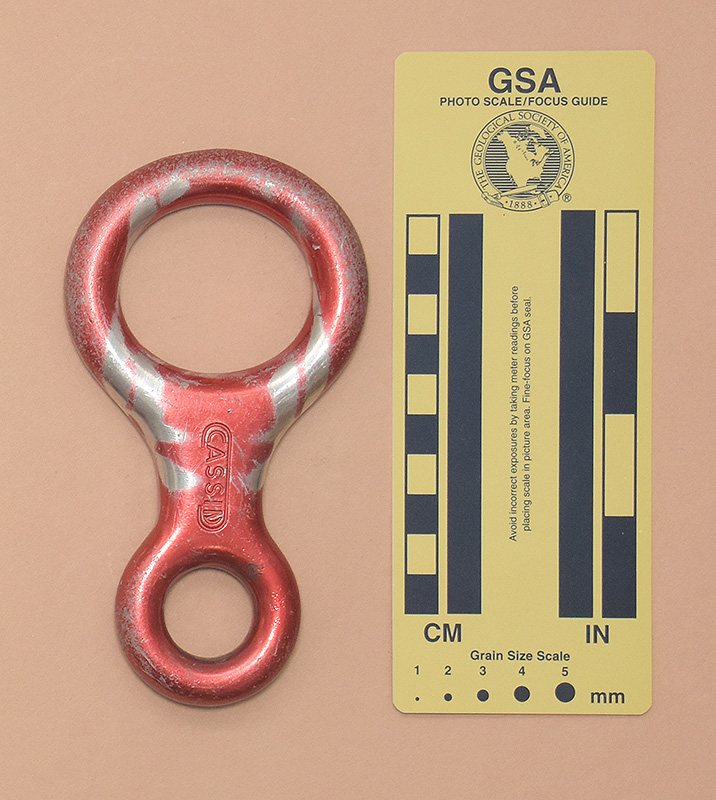
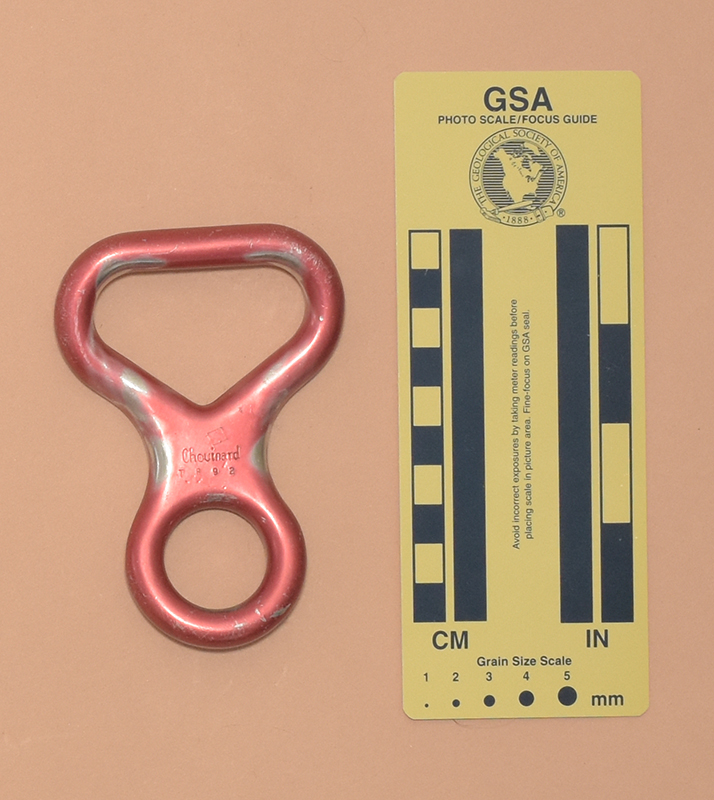
Version A is forged from aluminum alloy and then soft anodized. Mine is 107 mm. tall, 74 mm. wide, and 17 mm. thick. Version A has a distinct bend that accounts for the increased thickness; if flat, it would be 10.7 mm. thick. The rope hole is 35 mm. high and 54 mm. wide. The top center thickness is 11 mm. The shaft length and width are 26 mm. and 30 mm., respectively. The eye measures 26 mm. by 26 mm. My eight weighs 82 g.
The concave side is stamped with "Chouinard."
The Chouinard, Version A is one several nearly identical odd-shaped,bent figure eights. Here are several that I have collected:
|
|
|
|
|
||||||||||||||||||||
The bend allows rigging these eights in two ways with differing amounts of friction. The rope hole is shorter than normal, so the high friction position may provide too much friction on stiff or muddy ropes. The short overall length and sharp bends makes this eight rather "grabby" when using the high friction arrangement on sandy ropes.
None of these eights have slots for Sticht-type belaying, and their round eyes are not designed for that purpose.
[ Top | Version A | Version D | Version B | Version E | Return to Figure Eights ]
|
|
 |
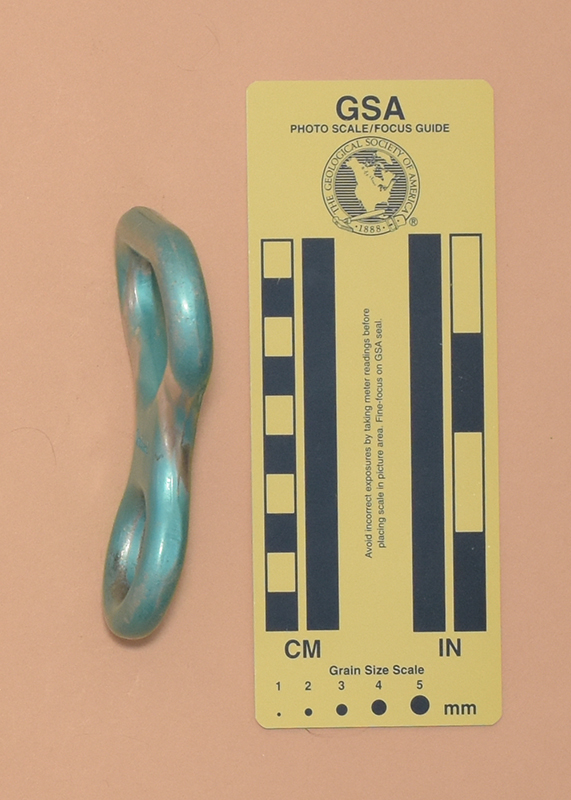 |
| Front | Rear | Side |
I acquired this eight from Tim Ryan in 2025
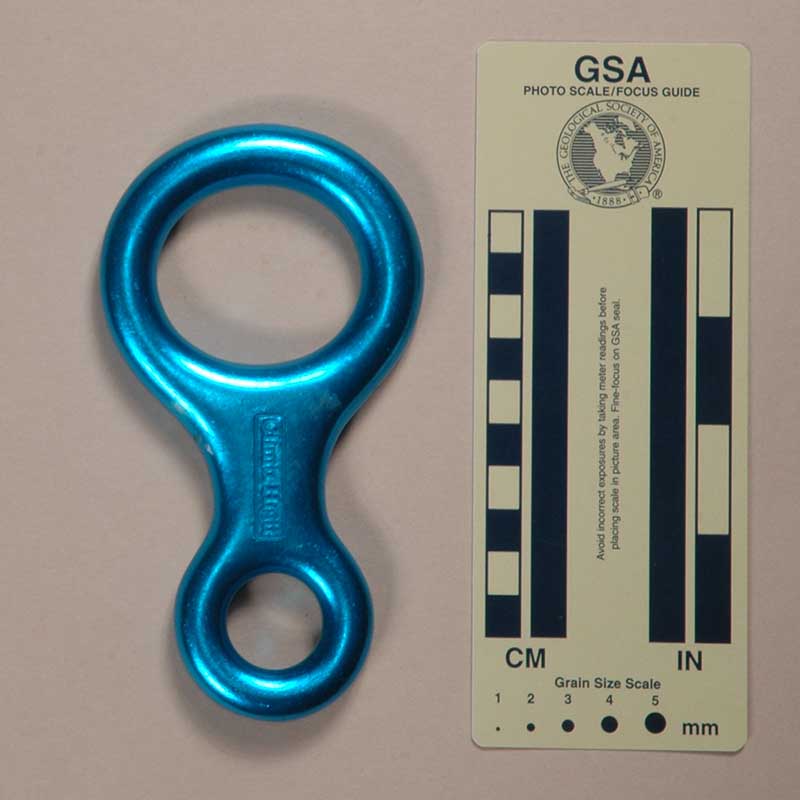
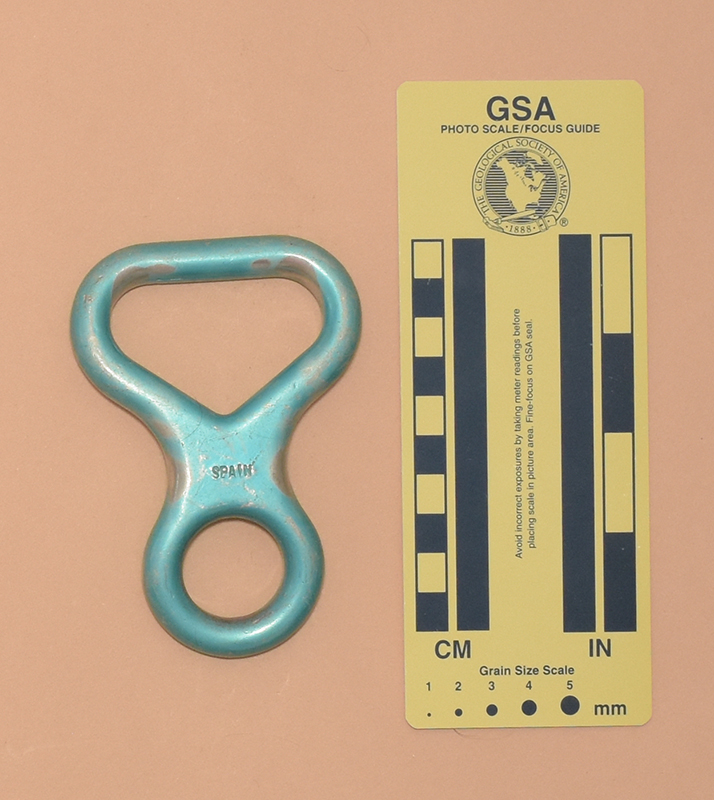
Version B is forged from aluminum alloy and then soft anodized. Mine is 107 mm. tall, 74 mm. wide, and 17 mm. thick. It has a distinct bend that accounts for the increased thickness; if flat, it would be 11.1 mm. thick. The rope hole is 35 mm. high and 54 mm. wide. The top center thickness is 11 mm. The shaft length and width are 26 mm. and 30 mm., respectively. The eye measures 26 mm. by 26 mm. This eight weighs 84 g.
The concave side is stamped with "Chouinard" and the convex side "SPAIN."
The Chouinard, Version B is one several nearly identical odd-shaped,bent figure eights. Here are several that I have collected:
|
|
|
|
|
||||||||||||||||||||
The bend allows rigging these eights in two ways with differing amounts of friction. The rope hole is shorter than normal, so the high friction position may provide too much friction on stiff or muddy ropes. The short overall length and sharp bends makes this eight rather "grabby" when using the high friction arrangement on sandy ropes.
None of these eights have slots for Sticht-type belaying, and their round eyes are not designed for that purpose.
[ Top | Version A | Version B | Version D | Version E | Return to Figure Eights ]
|
|
 |
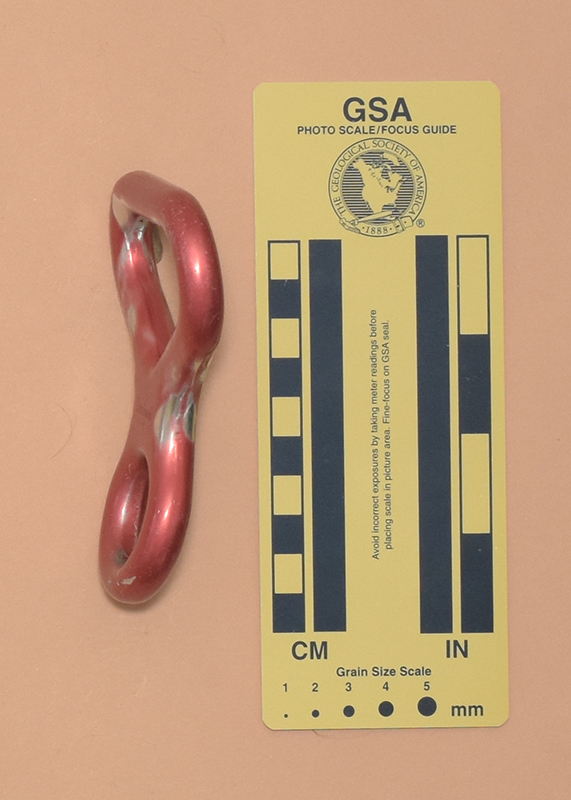 |
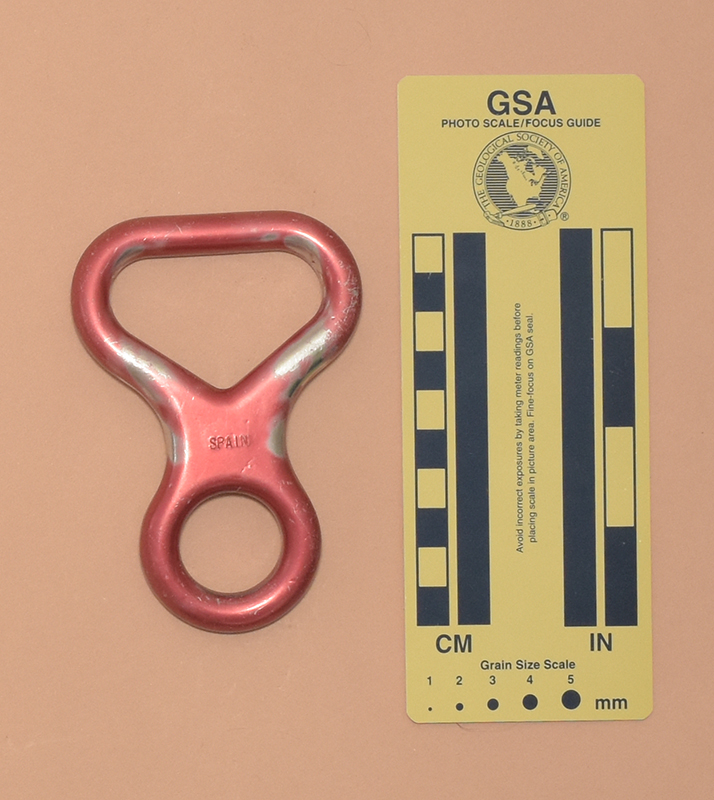
| Front | Rear | Side |
I acquired this eight from Treasures To Go in 3035.
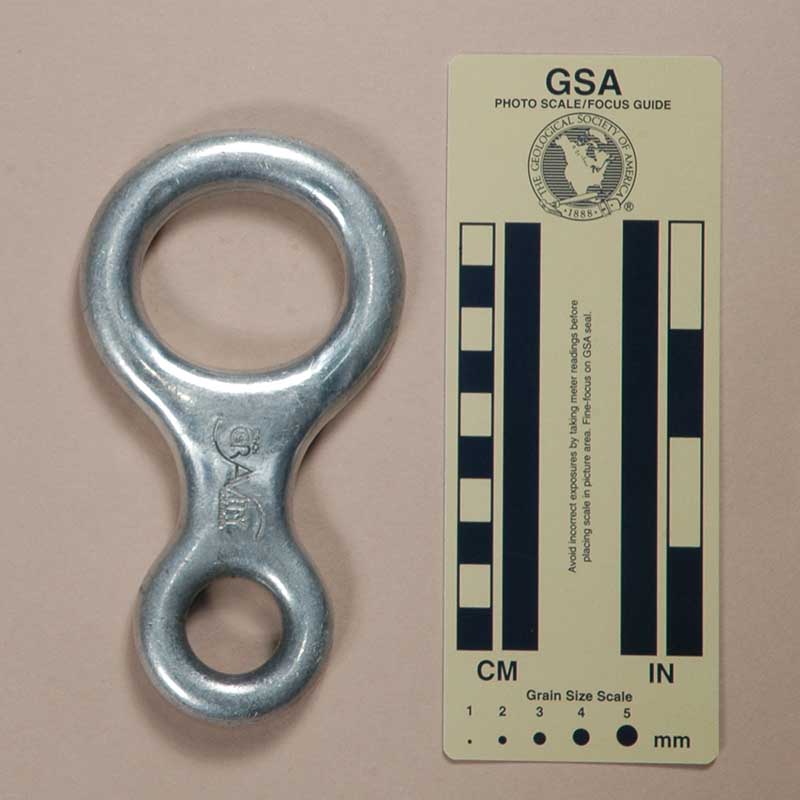
Version C is forged from aluminum alloy and then soft anodized. Mine is 107 mm. tall, 74 mm. wide, and 17 mm. thick. It has a distinct bend that accounts for the increased thickness; if flat, it would be 11.0 mm. thick. The rope hole is 35 mm. high and 54 mm. wide. The top center thickness is 11 mm. The shaft length and width are 26 mm. and 30 mm., respectively. The eye measures 26 mm. by 26 mm. This eight weighs 85 g.
The concave side is stamped with a diamond inside a rectangle logo, "Chouinard" and "T892." The rear is stamped "SPAIN."
The Chouinard, Version C is one several nearly identical odd-shaped,bent figure eights. Here are several that I have collected:
|
|
|
|
|
||||||||||||||||||||
The bend allows rigging these eights in two ways with differing amounts of friction. The rope hole is shorter than normal, so the high friction position may provide too much friction on stiff or muddy ropes. The short overall length and sharp bends makes this eight rather "grabby" when using the high friction arrangement on sandy ropes.
None of these eights have slots for Sticht-type belaying, and their round eyes are not designed for that purpose.
[ Top | Version A | Version B | Version C | Version E | Return to Figure Eights ]
|
|
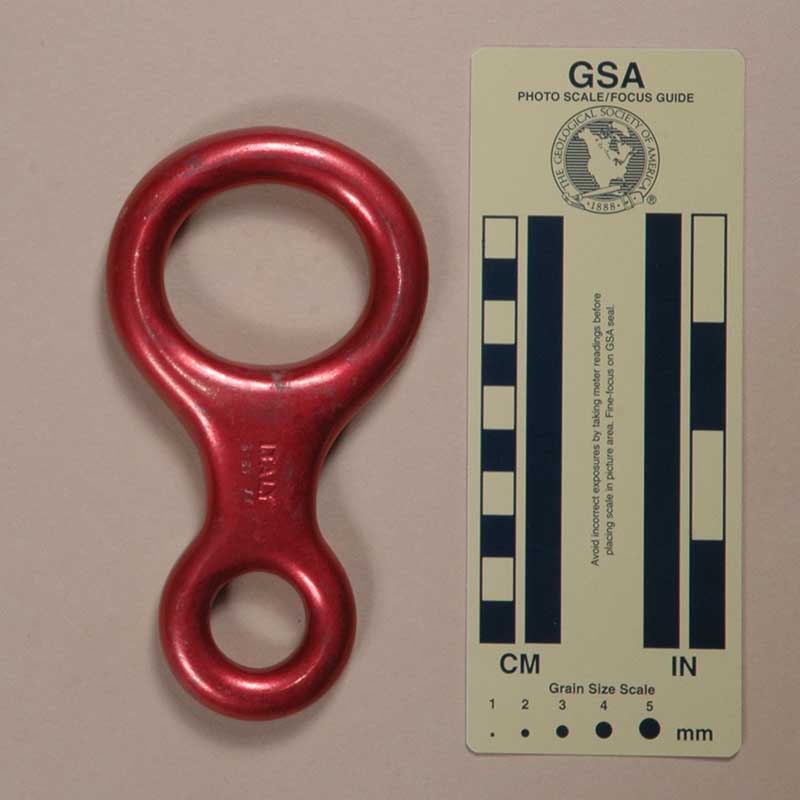 |
| Front | Rear |
I acquired this eight from Skinny Skis around 1979.
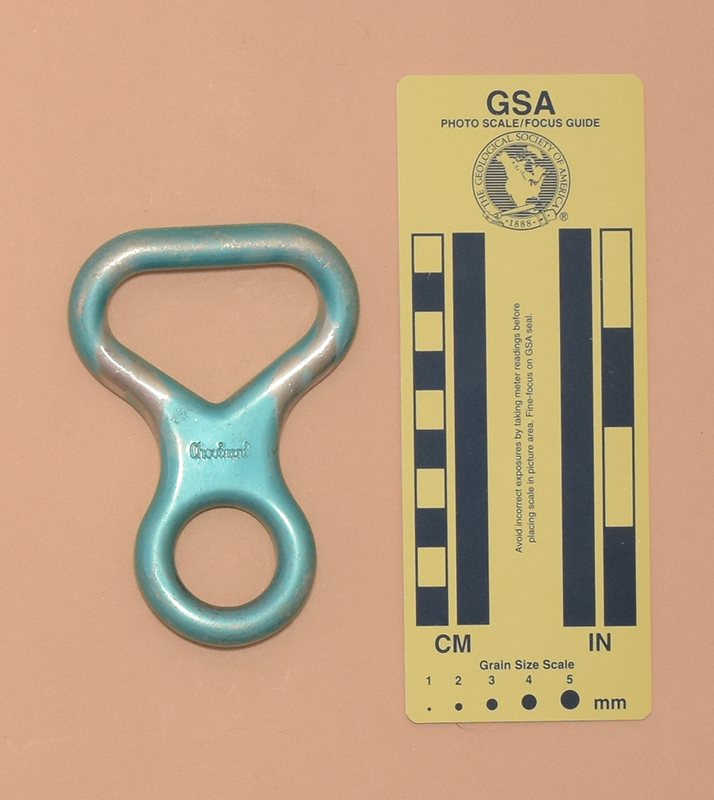
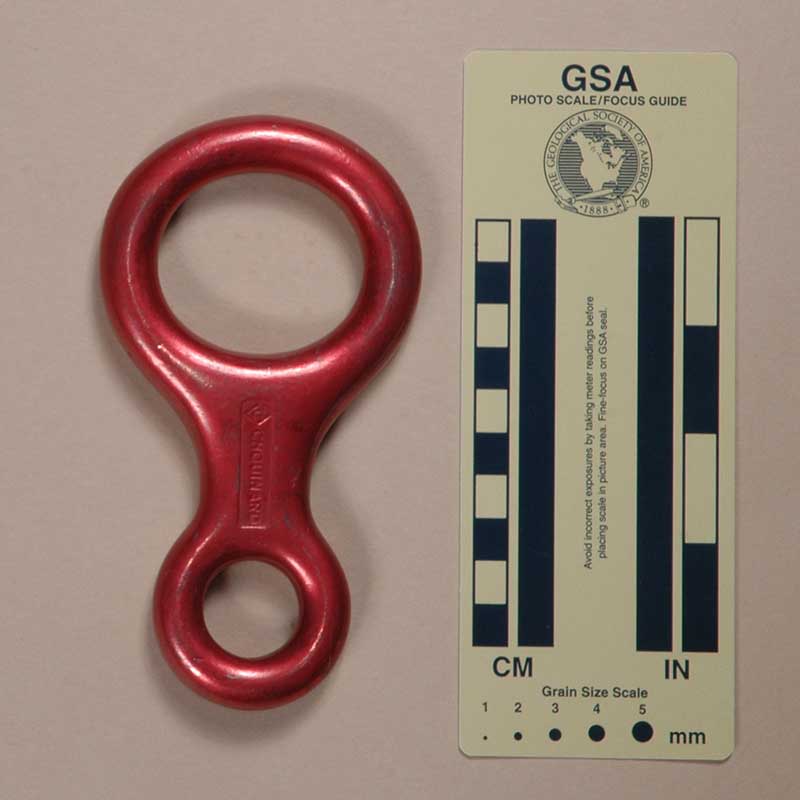
Version D is forged from aluminum alloy and then soft anodized. Mine is 136 mm. tall, 76 mm. wide, and 16 mm. thick. The rope hole is 42 mm. high and 48 mm. wide. The top center thickness is 14 mm. The shaft length and width are 48 mm. and 26 mm., respectively. The eye measures 22 mm. by 22 mm. My eight weighs 146 g.
The front of the eight has a forged logo (a "C" inside a diamond) and "CHOUINARD." The rear is stamped "ITALY."
The Chouinard is a full-sized, forged,aluminum eight with a rounded shaft. The following eights of this type are similar to each other, but vary in color and markings:
|
|
|
||||||||||||||||||||||||
Each of these eights is 139±3 mm. tall and 75±1 mm. wide. Their weights fall in the 137±9 g. range. These are normal manufacturing variations that have no practical significance. They are slightly heavier than Standard,Full Size, Forged Eights, but the difference is only 6 g. on average and their ranges overlap.
The shafts on these eights are rather fat and well-rounded, so the rope tends to run smoothly. They provide excellent contact for dissipating heat. Their soft finishes wear faster than a hard-anodized finish would, but the fat shafts have more than adequate margin for accommodating reasonable wear. These eights may sometimes grab a bit when one first stars to move, but this is not a big problem for competent users.
Although similar, these eights are not identical, and close inspection will reveal some minor differences in their shapes. None of these affect their performance to any noticeable degree.
None of these eights have slots for Sticht-type belaying, and their round eyes are not designed for that purpose.
[ Top | Version A | Version B | Version C | Version D | Return to Figure Eights ]
|
|
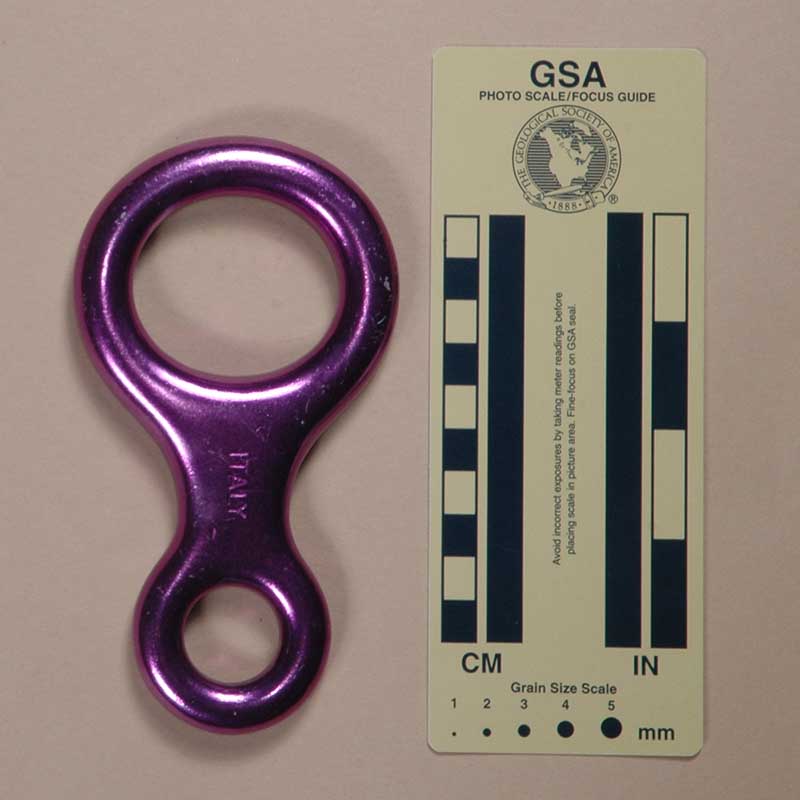 |
| Front | Rear |
I acquired this eight from Michael Silvey in 2009, and a second from Steven Gonzales in 2021.
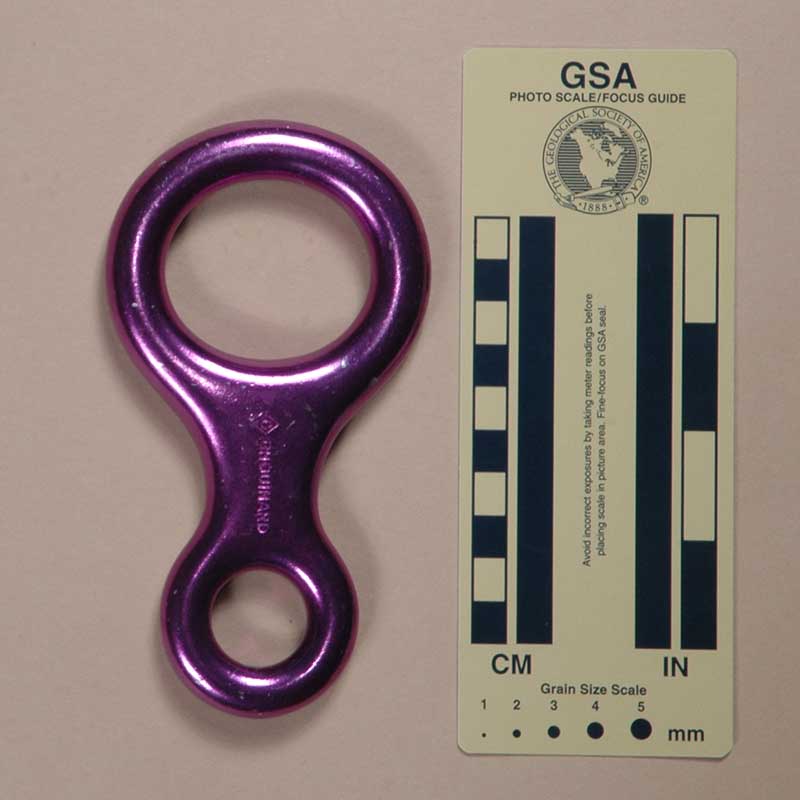
The Chouinard, Version E is forged from aluminum alloy and then soft anodized. Mine is 140 mm. tall, 76 mm. wide, and 16 mm. thick. The rope hole is 42 mm. high and 48 mm. wide. The top center thickness is 14 mm. The shaft length and width are 49 mm. and 26 mm., respectively. The eye measures 22 mm. by 22 mm. My eight weighs 134 g.
The front of the eight has a stamped logo (a "C" inside a diamond) and "CHOUINARD." The rear is stamped "ITALY."
Version E is essentially identical to Version D except that the markings do not sit in a recess in the shaft.
The Chouinard is a full-sized, forged,aluminum eight with a rounded shaft. The following eights of this type are similar to each other, but vary in color and markings:
|
|
|
||||||||||||||||||||||||
Each of these eights is 139±3 mm. tall and 75±1 mm. wide. Their weights fall in the 137±9 g. range. These are normal manufacturing variations that have no practical significance. They are slightly heavier than Standard,Full Size, Forged Eights, but the difference is only 6 g. on average and their ranges overlap.
The shafts on these eights are rather fat and well-rounded, so the rope tends to run smoothly. They provide excellent contact for dissipating heat. Their soft finishes wear faster than a hard-anodized finish would, but the fat shafts have more than adequate margin for accommodating reasonable wear. These eights may sometimes grab a bit when one first stars to move, but this is not a big problem for competent users.
Although similar, these eights are not identical, and close inspection will reveal some minor differences in their shapes. None of these affect their performance to any noticeable degree.
None of these eights have slots for Sticht-type belaying, and their round eyes are not designed for that purpose.
[ Top | Version A | Version B | Version C | Version D | Version E ]