

This page will not fit into a tiny viewport. Please choose a full-size monitor with a full-width window or select the abridged New Wave pages.


|
|
 |
 |
| Front | Rear | Open for Rigging |
I acquired my Singing Rock Locker from Outdoors Etc. in 2012.
The Singing Rock Locker is 118 mm. tall, 68 mm. wide, 29 mm. thick, and weighs 174 g. It consists of a movable lever and a fixed anvil sandwiched between two plates. The rear plate is an irregular pentagonal-shaped stamping made from 4 mm. anodized aluminum. A round 15.0 mm. hole is cut in the right side of the plate, and a larger 24.6 by 24.6 mm. hole is cut in the left side. The front plate is pear-shaped and smaller, lacking the projection for the upper hole. The front plate pivots on the lever mounting pin, and a notch in the left side of the front plate provides clearance for the anvil mounting pin.
The anvil and lever appear to be 13.5 mm. slices cut from an aluminum extrusion. The anvil is attached to the rear plate by a rivet and a pin. The anvil itself is shaped like a low, wide isosceles triangle, with a cutout opposite the lever end. The lever is mounted on another rivet, but is free to rotate. A small spring forces the lever to the engaged position. A cutout on the rear side of the lever provides clearance for the spring.
The front plate has a rigging icon, "ø 11 mm," an up-pointing arrow, "singing rock," "EN353-2:02," "EN358:99," a book-with-an-"i" icon, and "CE0123" printed on the face. The inside of the rear plate has a printed rope-hanging-from-rigging illustration and "0701 - 04/01/08" printed in white.
The following rope grabs are all variations of the same basic design:
| Image | Rope Grab | Manufactured | Side Plates | Lever Locking Tab |
|---|---|---|---|---|
 |
ISC Rocker | 2006 (?) | 3.9 mm. Anodized Aluminum | Yes |
 |
NTR Rocker | 2017 (?) | 3.9 mm. Anodized Aluminum | Yes with forward fold |
 |
Proverti AC080 | 4/2015 | 4.4 mm. Anodized Aluminum | Yes |
 |
Proverti AC081 | 4/2015 | 2.5 mm Stainless Steel | Yes |
 |
SAR Rocker | 2012 | 3.9 mm. Anodized Aluminum | Yes |
|
|
Singing Rock Locker | 1/2008 | 4.0 mm. Anodized Aluminum | Yes |
 |
Troll Rocker, Version A | ~2001 | 4.3 mm. Anodized Aluminum | No |
 |
Troll Rocker, Version B | ~2003 | 3.9 mm. Anodized Aluminum | Yes |
 |
Vento (Венто) Rocker | ~2019 | 3.9 mm. Anodized Aluminum | Yes |
 |
Xinda Rocker | ~2014 | 4.0 mm. Anodized Aluminum | Yes |
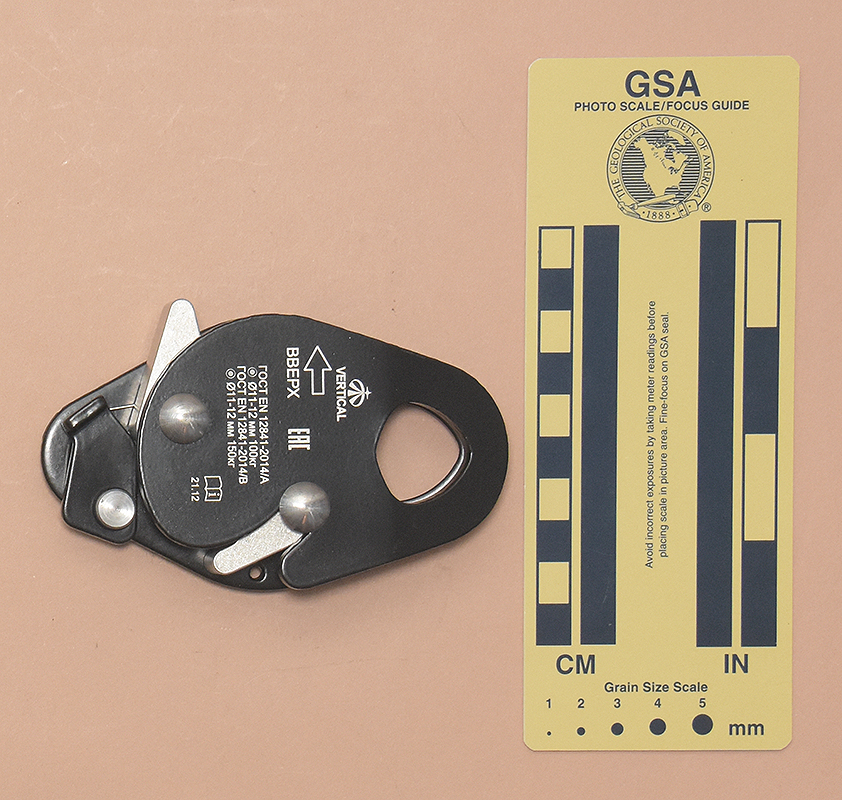 |
Vertical (Вертикаль) Rocker ver 0115 |
12/2021 | 4.0 mm. Anodized Aluminum | Yes with forward fold |
 |
Yates Rocker | ~2003 | 4.3 mm. Anodized Aluminum | Yes |
 |
Z&W Rocker | ~2019 | 4.0 mm. Anodized Aluminum | Yes with forward fold |
Each of these is a compact, lightweight (except for the stainless steel Proverti AC081) fall arrest that can also be used as a ratchet when hauling loads over a pulley. They can all be used as rocker-arm ascenders, but that was not the original design intent for the Troll Rocker, the progenitor of the others in the chart.
These have no sharp teeth to cut the rope sheath. Some informal testing suggests that, lacking teeth, these can slide before engaging, but normally the slippage is less than a foot. The cases where I observed this were somewhat contrived (i.e.,I held the grab in a specific position and carefully dropped the load straight down), and so I'm not too worried about the slippage. I would be far more concerned if they had sharp teeth and didn't slip at all.
The top hole is used for releasing or offloading a locked rocker by placing a carabiner in the hole and pulling toward the slack rope.
Except for the early Troll, each of these incorporates a lever lock. Troll added one to theirs before the others came out. The lever lock works, but one needs to be careful not to bump it so that it accidentally disengages. A carabiner in the upper hole can help prevent this. When the lever lock is disengaged,it blocks access to the upper hole.
The NTR, Vertical, and Z&W have a forward 90° bend at the top of their lever lock, making their locks much easier to operate than the others that rely on shallow rounded serrations.
Troll warns that using a rocker on a soft or loose-sheathed ropes can cause the rope sheath to slip or tear. They also warn that rope conditions (water, ice, mud, dirt, etc) as well as rope diameter, manufacturer, etc. will affect device performance. These warning apply to all of these fall arrests.
Singing Rock is a climbing equipment manufacturer in the Czech Republic. The headquarters, production, training and testing centre is located in Poniklá. Our textile production plant is situated in Semily. The production of metal products and components is placed in Sudkov. The Kladno training centre for work at height is just 20 min from Prague. Singing Rock supplies products to more than 65 countries worldwide through its network of distributors and agents.
The Singing Rock company was founded in 1992. Before starting Singing Rock, one of its founders, Vladimír Křapka, was earning his living by sewing the backpacks and sandals which became very popular in former Czechoslovakia under the name Tucan. The Tucan brand was at the very beginning of the new company's activities, from the backpacks and sandals to the climbing harnesses. After founding Singing Rock in 1992 and starting the partnership with Jan Goddefroy from Belgium, a new company name and logo were chosen in cooperation with a British advertising agency. Thus the "Tatrman" who was the initial representative of the Singing Rock's identity was brought to life. It showed an Indian during the traditional Sun dance at the place where the rock really does sing thanks to the wind – and that is where the name Singing Rock came from.
The "Tatrman" logo was in use until 2000 when it was replaced by the "arrow." The company logo got this unique shape by accident – their longterm graphic designer Jiří Mělnický from the H.R.G. printing house used the symbol of an American road sign on the cover of the catalogue. Vláďa Křapka liked this idea so much that he had a new company logo created using this sign. Like the "Tatrman," the "Singing Rock arrow" is inspired by Western culture and stands for a clear, straight direction, sense of purpose and, most of all, the vertical – a direction connected with everything that Singing Rock creates.
The private financial fund ARX Equity Partners bought Singing Rock in 2009. At the same time Singing Rock s.r.o. and Lanex a.s. merged. The successor company had the business name Lanex a.s. They acquired Raveltik s.r.o. in 2011 to extend the portfolio with the metal products; expansion to the market with products for ice climbing and mountaineering. Two years later, in 2013, the Singing Rock division split from Lanex a.s. and reorganized back to Singing Rock s.r.o.