

This page will not fit into a tiny viewport. Please choose a full-size monitor with a full-width window or select the abridged New Wave pages.


|
|
 |
| Front View: Closed | Rear View: Closed |
 |
 |
| Front View: Open for Rigging | Rear View: Open for Rigging |
I acquired my Kong Procave from Expé-Spelemat in 2008. I acquired another pair in 2017 as part of Bob Thrun’s collection.
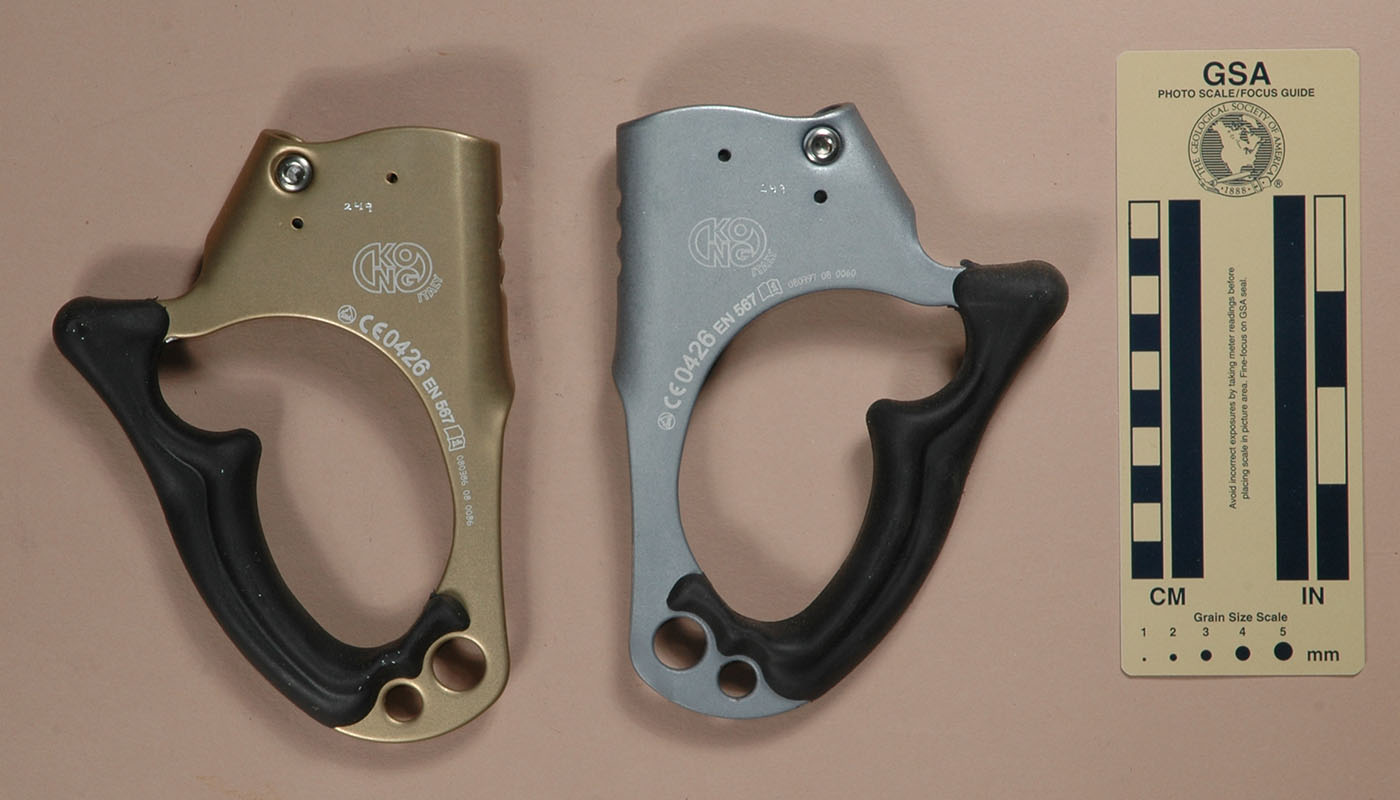
The Kong Procave is 161 mm. tall, 119 mm. wide, 27 mm. thick, and weighs 201 g.
 The shell is a tall irregular shaped stamping made from 3.5 mm. aluminum alloy sheet metal. A 15.0 mm. rope channel is formed in the upper portion of one side and a smaller cam channel lies on the other. The rope channel has three 6.8 by 4.8 mm. relief holes. A hole drilled through both sides of the cam channel accepts a 6 mm. semi-tubular rivet. The cam and cam spring are mounted on this rivet. The head of the rivet is on the front of the shell, and the roll sits in a depression in the rear. The pivot is centered 48 mm. from the inside of the rope channel. The handle below the cam has a soft "rubbery" hand grip molded into place. The hand grip has a huge cusp to support the index finger. A 13.7 mm. sling attachment hole is punched below the handle opening, and a 9.7 mm. hole is punched below and outside the first. There are two 3 mm. holes in the shell behind the cam, perhaps used during manufacture.
The cam is an oxide-finished skeletonized steel casting. The cam radius, measured from the pivot, increases from 37 to 57 mm. over an angle of 42°, giving a 29° cam angle. The cam has number of small conical teeth, all of which have their axes approximately parallel to the lower surface of the cam. The tooth pattern is (3)(4.H)^2(3.H)^2(3.2.2). The H stands for small oval holes. A spring-loaded manual safety is mounted on an axle riveted to the bottom center of the cam. The normal action of the spring holds the safety against the cam. The safety has a small tab bent outward for the fingers. When the cam is opened, the shell interferes with the safety, thus preventing cam opening. At full open the safety can be released and the spring will hold the tab against the back of the shell, locking the cam open.
The frame has a triangle with an overlapping "!" stamped behind the cam. The front of the rope channel is printed with an up-pointing arrow, a rigging illustration, "PROCAVE DX," and "Ø 8-13 mm." The rear is printed with the Kong logo, "Italy,"the UIAA Logo, "CE0426," "EN 567," a book-with-an-"i" icon, and "80386 08 0086."
The Procave is a well-made ascender that performs much like the Petzl Ascension. All sharp edges have been removed. The attachment points are simply holes in the shell, and although rounded, they should have been beveled more. I consider their small radius too sharp for directly attaching sling ropes.
The handle is sloped to create less wrist strain for a straight-down pull. The sloping handle takes some getting used to, but the handle on handled ascenders is not normally used as a handle to lift one's weight (unless you climb Frog). What matters to me is that the Procave is wider than necessary.
Kong says that the Procave’s handgrip was specially designed for using with both hands. Most climbing systems don't use two hands per ascender. The grip is uncomfortable for my large hands, since the huge cusp digs directly into my middle finger. A file might be able to fix this.
The relief holes in the shell and cam may allow certain mud and debris to clear, but really nasty cave mud will overwhelm any relief capability that these holes provide.
The lower attachment hole has the same potential safety problem as the one on Clog Version A.
This ascender could theoretically has the same pit lip disadvantage as the Clog and other stamped frame ascenders. The shell is thin like the ones on the Camp Pilot and Kong-Bonaiti, but the front strap isn't reinforced as it is on those. The handle provides some reinforcement on the other side, and the ascender is shorter, so the potential problem may be academic.
The instruction books that came with my Procaves discuss other Kong ascenders, but do not mention or illustrate the Procave.
Kong's history began in 1830 when Giuseppe Bonaiti opened the Bonaiti workshop on Lake Como in Lecco, Italy using with an engineering apparatus that was unusual for those times. That plant started producing Bonaiti carabiners in the early 1900s, establishing the Bonaiti name in the climbing community. More climbing gear soon followed.
The Bonaiti company reorganized in 1977, adopted the name KONG, moved to the new factory of Monte Marenzo, and installed new machinery. In 1982 the company registered the name and trademark Kong in various countries. Kong continued to include the name Bonaiti on its products for many years.
The company is now managed by a sixth generation Bonaiti. Most Kong products are manufactured inside the Kong factory in Italy. Kong continues to produce carabiners and other tools used for safety in climbing, caving, arborism, rescue, yachting and work at height.