

This page will not fit into a tiny viewport. Please choose a full-size monitor with a full-width window or select the abridged New Wave pages.


Version A

Version B

Version C

Version D

Version D1

Version D2

Version E, Vendor Modified

Version E1

Version E2

Version F

Version G1

Version G2

Version I

Version J

Version K

Version L

Version M
|
|
|
|
| Version A | Version B | Version C |
|
|
|
|
|
| Version D | Version E1 | Version E2 | Version E, Vendor Modified Vendor Modified |
|
|
|
|
|
|
| Version F1 | Version F2 | Version G | Version H1 | Version H2 |
|
|
|
|
| Version I | Version J | Version K |
|
|
|
 |
 |
| Version L | Version M | Version N | Version O |
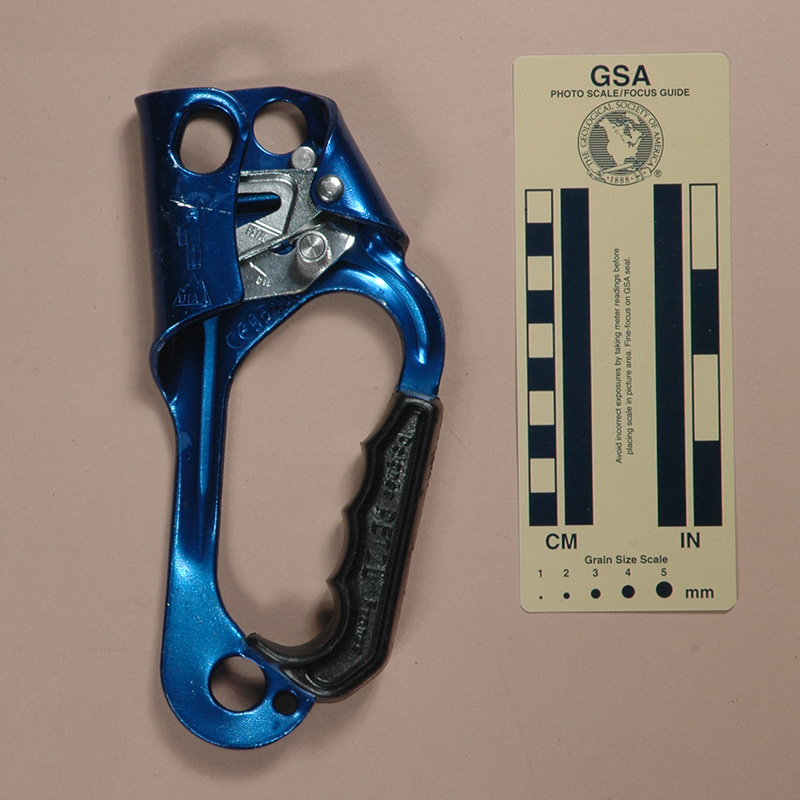 |
 |
 |
 |
| Version P | Version P† | Version Q | Version Q† |
 |
 |
 |
| Version R | Version S | Version T |
In 1930, Fernand Petzl discovered caving at the age of 17. Back at his workshop after each excursion to the depths, Fernand imagined new tools for exploring darkness and heights. With his inventions taking up more and more space, he decided to create his own workshop, sparking the growth of his small business. Working together brought Fernand closer to his son, Paul, who was determined to grow the business. From the beginning, Paul's wife Catherine took care of the accounting.
Paul Petzl, a mechanical engineering student, had already been thinking about creating a real company and began to plan out his first investments. In 1970, the Petzl brand was created. Five years later, the first company headquarters was established at the foot of the Dent de Crolles. In the years that followed, the number of employees increased as the company experienced local and international growth.
Petzl is a family business that, over the years, has become the largest European manufacturer of personal protective equipment for those who work and play in darkness or at height. All Petzl products are invented and developed at their headquarters in the heart of the French Alps.
The Petzl brand is present in over 55 countries with 85% of their sales made internationally. More than 9 million products are sold every year, and 10 million people use Petzl personal protective equipment every day.
The Petzl Ascension is probably the most old-school handled ascender still in widespread use. First developed in 1974, it progressed through numerous variations, and remains in production. Despite the design’s great age, it remains a viable ascender.
The prototypes consisted of separate handles attached to the existing Petzl Basic. These basics had the horrid zedel cams with ridges instead of conical teeth on the cam face. I don't know if these rudimentary disaster-cams entered production in handled ascenders, but they were common otherwise. The much older and now discontinued Jumar had switched to a modern conical tooth design more than a decade before, and the contemporaneous Clogs had conical teeth as well. Petzl followed suit and abandoned the embarrassing zedels. All of the production handled Petzl ascenders in my collection have conical teeth.
Petzl soon introduced cams had a flat area at the top to facilitate down-climbing. This confused many users, and Petzl eliminated the idea before the end of the 1970s. Around the same time, they introduced a cam safety supplied with an interchangeable “knob” and “post” targeting cavers and expedition climbers, respectively. I liked having a choice. Eventually they replaced these with a floppy screw-knob, apparently believing that replacing the fixed Speleo and Expedition knobs was beyond the customer’s mechanical skill. Thankfully, Petzl eventually abandoned the floppy knob that many of us felt needed to be epoxied into position. The current cam safeties are plastic. Early ones were sharp thumb impalers, but the current versions are comfortable.
Petzl devices soon became a European standard, but were not widely available in the USA until about 1979. The Ascension soon gained a following among U.S. cavers who were going on expeditions with European cavers, and its popularity then spread to the general U.S. caving population.
The Petzl Ascension may be the oldest of the surviving old-school handled ascender lineages, but it remains popular. Now there are many copies of the Petzl Ascension on the market. These are often of very high quality (with a few not-so-much). It will be interesting to see how well the Ascension survives in the face of competition from excellent ascenders available at half the price.
Petzl has made many modifications to their ascender designs. Most of the modifications were fairly minor, with each change introducing a new version. I have not tried to collect them all, but I have acquired several versions which are fairly representative of their designs over the past five decades.
 |
I am looking for any variations that I am missing and to complete incomplete pairs. If you have any of these that you would be willing to part with, please email me. |
Here is a quick summary of the versions in my collection:
| Image | Ascender | Frame Shape | Frame Finish | Hand Grip | Upper Holes | Lower Holes | Cam Stop | Cam | Teeth | Safety | Safety Finish | Safety Pin |
|---|---|---|---|---|---|---|---|---|---|---|---|---|
|
|
Petzl Ascension, Version A | I: Not Reinforced | Plain Anodized | I Hard Plastic With Finger Grooves |
Round Channel Hole Pair | 14.5 | None | I Plain Teeth | (3.4)^2(3.2)^2(1.2) | Short | Plain Anodized | Knob |
|
|
Petzl Ascension, Version B | II With Flat | (F)(3.4)^3(3.2)^2(3) | |||||||||
|
|
Petzl Ascension, Version C | 13.5 | ||||||||||
|
|
Petzl Ascension, Version D | Color Anodized | Long | |||||||||
|
|
Petzl Ascension, Versions E1 & E2 | 14.5 | III No Flat | (3.4)^2(3.2)^2(1.2) | Threaded Pin or Knob with nut | |||||||
|
|
Petzl Ascension, Version E, Vendor Modified | II Reinforced Behind Cam |
11.5 | |||||||||
|
|
Petzl Ascension, Versions F1 & F2 | Oval Channel Hole Pair + Second Round Hole |
14.5 | Round Pin | ||||||||
|
|
Petzl Ascension, Version G2 | 16 | ||||||||||
|
|
Petzl Ascension, Versions H1 & H2 | |||||||||||
|
|
Petzl Ascension, Version I | IV With Slots | (2.3)(2S2.1S1)^2(1S1)^3(1.2) | Knurled, Adjustable | ||||||||
|
|
Petzl Ascension, Version J | Color Anodized | ||||||||||
|
|
Petzl Ascension, Version K | III Reinforced Top and Straps | ||||||||||
|
|
Petzl Ascension, Version L | IV Semicircular Base | Plain Anodized | |||||||||
|
|
Petzl Ascension, Version M | Color Anodized | ||||||||||
|
|
Petzl Ascension, Version N | 16, 6 | ||||||||||
|
|
Petzl Ascension, Version O | |||||||||||
|
|
Petzl Ascension, Version P | Plain Anodized | ||||||||||
|
|
Petzl Ascension, Version P† | |||||||||||
|
|
Petzl Ascension, Version Q | Color Anodized | ||||||||||
|
|
Petzl Ascension, Version Q† | |||||||||||
|
|
Petzl Ascension, Version R | V Rounded Form |
II Rubbery Plastic | Round Channel Hole Pair | 15, 10 | Stamped | V |
(3.4)(1S1)^2(2S2)(1S1)^4(3.4.3) | Plastic Type I Thumb Stabber |
|||
|
|
Petzl Ascension, Version S (B17SLN, B17SRG) |
III Two Plastics with Index Finger Support |
||||||||||
|
|
Petzl Ascension, Version T (B17ALA, B17ARA) |
16x27 | Plastic Guard | Plastic, Type II Thumb ridges |
||||||||
[ Top
| Version B
| Version C
| Version D
| Versions E1 & E2
| Version E2 mod.
| Versions F1 & F2
| Versions G1 & G2
| Versions H1 & H2
| Version I
| Version J
]
[ Version K
| Version L
| Version M
| Version N
| Version O
| Version P
| Version P†
| Version Q
| Version Q†
| Version R
| Version S
| Version T
| Return to H.E.C. Ascenders
]
|
|
 |
| Front View: Closed | Rear View: Closed |
 |
 |
| Front View: Open for Rigging | Rear View: Open for Rigging |
I acquired my Petzl Ascension, Version A in 2017 as part of Bob Thrun’s collection.
Version A is 181 mm. tall, 86 mm. wide, 26 mm. thick, and weighs 184 g.
 The shell is a tall irregular shaped stamping made from 4.2 mm. aluminum alloy sheet metal. A 16 mm. wide rope channel is formed in the upper portion of one side and a smaller cam channel lies opposite the first. A hole drilled through both sides of the cam channel accepts a 5.5 mm. semi-tubular rivet. The cam and cam spring are mounted on this rivet. The head of the rivet sits into a stamped depression on the back of the shell, while the roll is exposed on the open side. The handle below the cam has a soft black plastic hand grip molded into place. The hand grip has four finger grooves. A 14.7 mm. sling attachment hole is punched below the handle opening. This hole is slightly beveled. A 14.1 mm. hole through both sides of the rope channel provides an attachment point just above the cam. This hole is very well beveled.
The cam is a plated skeletonized steel casting. The cam axle is centered 48 mm. from the inside of the rope channel. The cam radius increases from 36 to 53 mm. over an angle of 37°, giving a 30° cam angle. The cam has number of small conical teeth, all of which have their axes approximately parallel to the lower surface of the cam. The tooth pattern is (3.4)^2(3.2)^2(1.2). Like the other ascenders, the inner cam face radius reduces from top to bottom to accommodate various sized ropes. A spring-loaded manual safety bar is mounted on the bottom of the cam with a somewhat cracked steel semi-tubular rivet. The normal action of the spring holds the safety against the cam. When the cam is opened, the shell interferes with the safety bar, thus preventing opening the cam. If the safety bar is moved away from the cam (opposing the spring), it will clear the shell and the cam will open. At full open the safety can be released and the spring will hold the safety against the back of the shell. This provides a means of locking the cam open. A knob on the safety bar assists in operating the safety mechanism.
The plastic hand grip has "Poignée F.PETZL-France" molded into one side.
I feel that this is a well made ascender. All sharp edges have been removed. The attachment points are simply holes in the shell, and although well rounded I consider their small radius too sharp for directly attaching sling ropes. They are probably acceptably rounded for webbing, but considering the proximity of the attachment points to the main rope, I would recommend using a small maillon for most attachments in order to reduce the risk of sling abrasion. The lower attachment hole could theoretically have the same safety problems as the one on Clog Version B . The upper rope attachment hole is located very close to the main rope. A carabiner through the upper attachment hole may drag on the main line. Note that such a carabiner will prevent putting the Petzl on or off rope, so one’s climbing system must be designed accordingly.
The cam is well made. The cam teeth are quite sharp and well done. The teeth are oriented more steeply than on the C.M.I. or the Jumar, so they tend to be even more self cleaning
Single-handed operation of this ascender is fairly easy with the proper hand, but is rather difficult with the opposite hand. Closing an locked open ascender is much easier than opening, since the strong cam spring assists the user.
This ascender has the same pit lip disadvantage as the Clog.
The Petzl expedition series is a very popular among handled ascender users, particularly in Europe. Undoubtedly much of this popularity is due to its light weight and good workmanship.
[ Top
| Version A
| Version D
| Versions E1 & E2
| Version E2 mod.
| Versions F1 & F2
| Versions G1 & G2
| Versions H1 & H2
| Version I
| Version J
]
[ Version K
| Version L
| Version M
| Version N
| Version O
| Version P
| Version P†
| Version Q
| Version Q†
| Version R
| Version S
| Version T
| Return to H.E.C. Ascenders
]
|
|
 |
| Front View: Closed | Rear View: Closed |
 |
 |
| Front View: Open for Rigging | Rear View: Open for Rigging |
I acquired this pair of ascenders from Julie E Rasmussen in 2015.
Version B is 181 mm. tall, 84 mm. wide, 24 mm. thick, and weighs 192 g.
 The shell is a tall irregular shaped stamping made from 4.2 mm. aluminum alloy sheet metal. A 15 mm. wide rope channel is formed in the upper portion of one side and a smaller cam channel lies opposite the first. A hole drilled through both sides of the cam channel accepts a 5.5 mm. semi-tubular rivet. The cam and cam spring are mounted on this rivet. The head of the rivet sits into a stamped depression on the back of the shell, while the roll is exposed on the open side. The handle below the cam has a soft black plastic hand grip molded into place. The hand grip has four finger grooves. A 13.1 mm. sling attachment hole is punched below the handle opening. This hole is slightly beveled. A 14.1 mm. hole through both sides of the rope channel provides an attachment point just above the cam. This hole is very well beveled.
The cam is a plated skeletonized steel casting. The cam axle is centered 48 mm. from the inside of the rope channel. The cam radius increases from 38 to 51 mm. over an angle of 36°, giving a 25° cam angle. The cam has number of small conical teeth, all of which have their axes approximately parallel to the lower surface of the cam. The tooth pattern is (F)(3.4)^3(3.2)^2(3). The F stands for a short flat area designed to allow the user to cant the ascender and slide it down the rope without opening the cam. The outside two bottom teeth are almost ground away. Like the other ascenders, the inner cam face radius reduces from top to bottom to accommodate various sized ropes. A spring-loaded manual safety bar is mounted on the bottom of the cam with a somewhat cracked steel semi-tubular rivet. The normal action of the spring holds the safety against the cam. When the cam is opened, the shell interferes with the safety bar, thus preventing opening the cam. If the safety bar is moved away from the cam (opposing the spring), it will clear the shell and the cam will open. At full open the safety can be released and the spring will hold the safety against the back of the shell. This provides a means of locking the cam open. A knob on the safety bar assists in operating the safety mechanism.
The plastic hand grip has "Poignée PETZL France" molded into one side and "breveté," "France_Etranger," and "MAXI: 400 kgs" molded into the other.
I feel that this is a well made ascender. All sharp edges have been removed. The attachment points are simply holes in the shell, and although well rounded I consider their small radius too sharp for directly attaching sling ropes.
The cam is well made. The cam teeth are well done. The teeth are oriented more steeply than on the C.M.I. or the Jumar, so they tend to be even more self cleaning. The flat area on the cam has caused some confusion. Some cavers think this was a design defect, but actually it was provided as a feature. The flat area allows one to cant the ascender then slide it down the rope without opening the cam, provided there is no carabiner in the rope channel holes. This feature did not work very well and was later abandoned.
[ Top
| Version A
| Version B
| Version D
| Versions E1 & E2
| Version E2 mod.
| Versions F1 & F2
| Versions G1 & G2
| Versions H1 & H2
| Version I
| Version J
]
[ Version K
| Version L
| Version M
| Version N
| Version O
| Version P
| Version P†
| Version Q
| Version Q†
| Version R
| Version S
| Version T
| Return to H.E.C. Ascenders
]
|
|
 |
| Front View: Closed | Rear View: Closed |
 |
 |
| Front View: Open for Rigging | Rear View: Open for Rigging |
 I acquired a left-handed ascender in 2017 as part of Bob Thrun’s collection.
Version C is the same as Version B except the lower hole diameter was reduced by 1 mm.
The plastic hand grip has "Poignée PETZL France" molded into one side and "breveté," "France_Etranger," and "MAXI: 400 kgs" molded into the other.
I cannot explain the reduction in the size of the lower tie-in hole. It remains adequate, and eventually Petzl started making these holes larger.
[ Top
| Version A
| Version B
| Version C
| Versions E1 & E2
| Version E2 mod.
| Versions F1 & F2
| Versions G1 & G2
| Versions H1 & H2
| Version I
| Version J
]
[ Version K
| Version L
| Version M
| Version N
| Version O
| Version P
| Version P†
| Version Q
| Version Q†
| Version R
| Version S
| Version T
| Return to H.E.C. Ascenders
]
|
|
 |
| Front View: Closed | Rear View: Closed |
 |
 |
| Front View: Open for Rigging | Rear View: Open for Rigging |
 Technical Details
 I acquired this pair of ascenders from Speleoshoppe in October 1979.
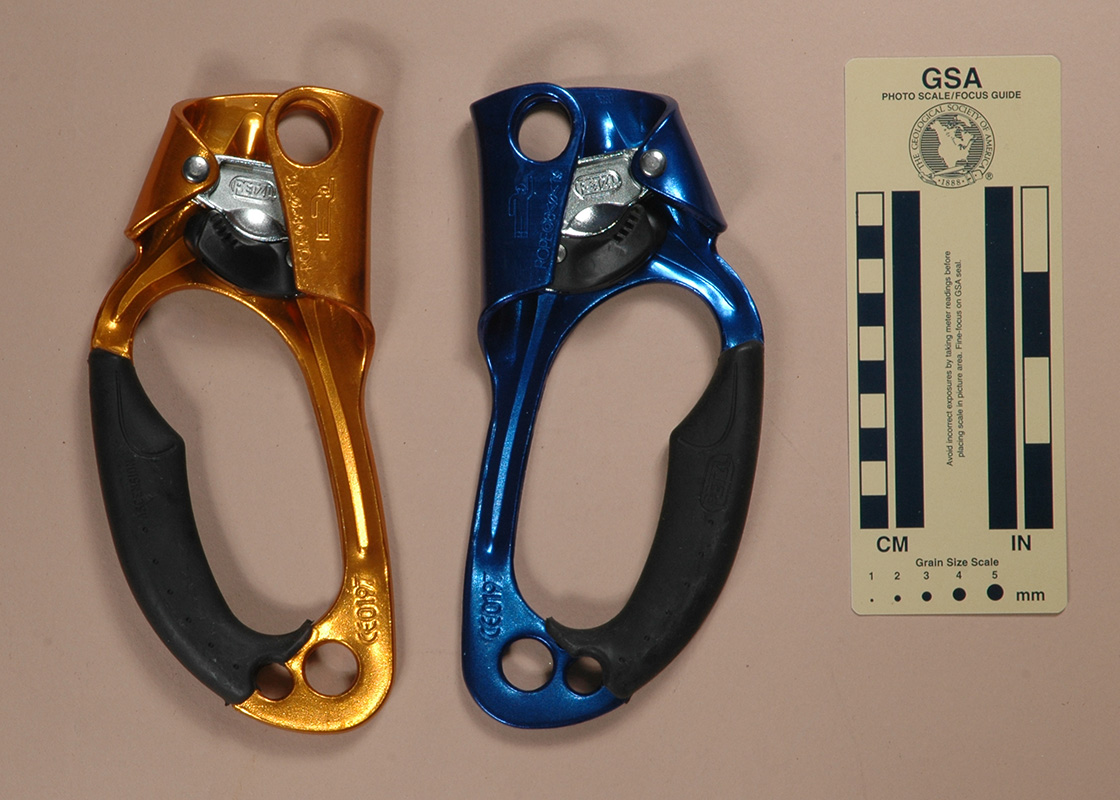
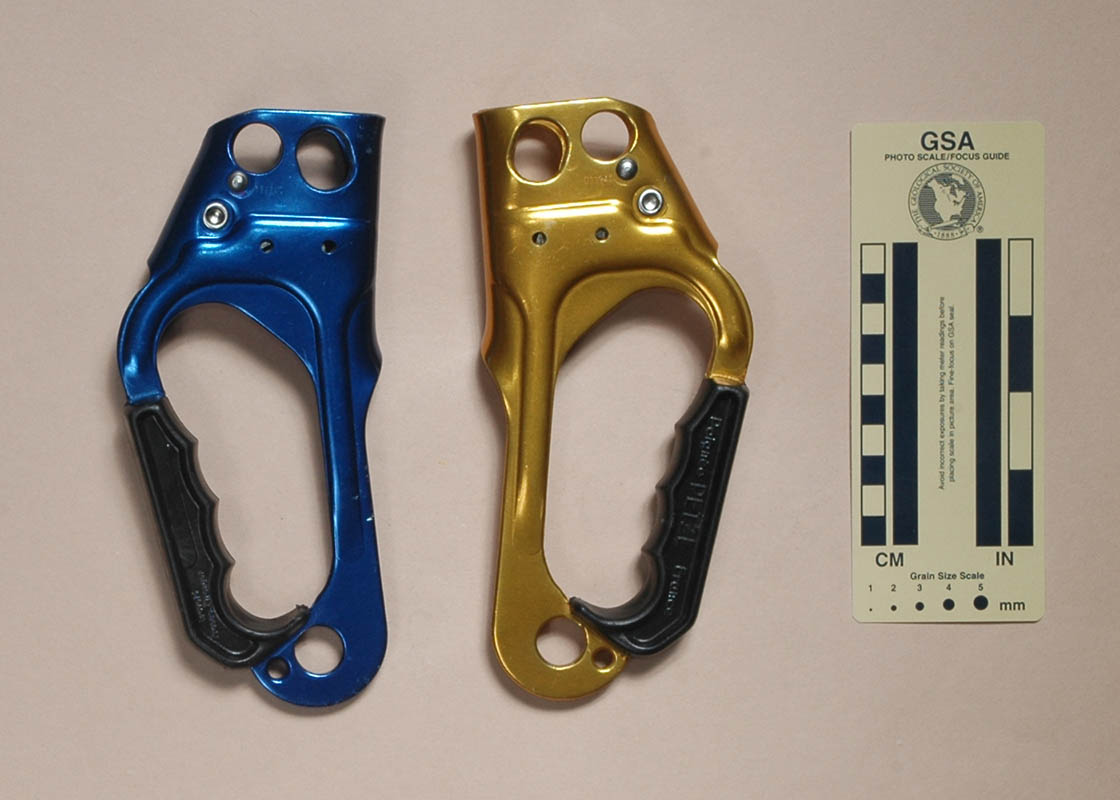
Version D is the same as Version C except the left-handed ascender is gold anodized and the right-handed ascender is blue.
The markings are also the same as those on Version D .
Petzl followed this color convention was followed for many years.
The shell is crushed at the top edge of the hand grip due to some clamping during the manufacturing process. This crushed point is located at precisely the point that one would expect the shell to bend in the pit lip scenario referred to previously and described for the Clog.
[ Top
| Version A
| Version B
| Version C
| Version D
| Version E2 mod.
| Versions F1 & F2
| Versions G1 & G2
| Versions H1 & H2
| Version I
| Version J
]
[ Version K
| Version L
| Version M
| Version N
| Version O
| Version P
| Version P†
| Version Q
| Version Q†
| Version R
| Version S
| Version T
| Return to H.E.C. Ascenders
]
I acquired my Petzl Ascension, Version E used from Bruce Ellison on in 2009. I acquired two more in 2012, one from Stuart Holmes and another from Daniel MacKinnon. All three were eBay purchases. Finally, Carol Jo Rushin-Elron donated a fourth one while I was at the 2016 NSS Convention.
 Version E is 190 mm. tall, 87 mm. wide, 30 mm. thick, and weighs 187 g.
The shell has been substantially enlarged. The original pair of upper carabiner holes have been enlarged to 13.6 by 19.5 mm. oval holes, and an additional 15.8 mm. hole is punched beside the first pair. The handle opening is larger than Version D’s.
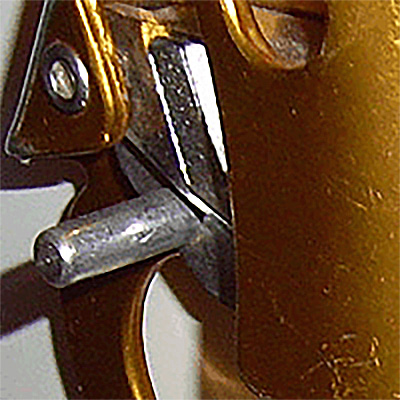
The cam assembly has been changed in several ways. The flat area on the cam was eliminated and the tooth pattern changed to (3.4)^2(3.2)^2(1.2). The cam radius increases from 38 to 52 mm. over an angle of 39°, giving a 24° cam angle. The cam axle is centered 47 mm. from the inside of the rope channel. The cam safety has a slightly different shape, but functions in the same manner as Version D’s. The safety knob is threaded and attached to the safety by a hex nut rather than riveted. This version was supplied with two types of safety knobs, so the buyer could choose which type (s)he prefers. Version D1 is converted to Version D2 by unbolting the mushroom shaped ("Speleo") thumb knob on the cam safety and replacing it with the cylindrical ("Expedition") knob supplied with the ascender. The Speleo knob had the same shape as the Version B safety. This knob is less bulky and would normally be used for caving. The expedition knob is longer, and easier to operate with gloved hands typical in winter mountaineering conditions. I recommend selecting the one you want to use and epoxying it in place.
 |
 |
 |
| Speleo Knob | Expedition Knob | Speleo Conversion Kit |
The hand grip is very similar to Version D’s, with a slight change in finish. I attribute this to normal manufacturing variation.
The plastic hand grip has "Poignée PETZL France" molded into one side and "breveté," "France_Etranger," and "MAXI: 400 kgs" molded into the other. The cam has "PETZL" cast in each side. The cam safety has "OIL" stamped into it with an arrow pointing to the safety pivot.
The doubled upper rope attachment hole is located very close to the main rope. A carabiner through the upper oval attachment hole will probably drag on the main line. The main purpose for this hole is when using the ascender as a safety on a fixed line. The axis of the oval hole is canted so that when trailing the ascender upward, the ascender pulls free of the rope, but it drags a bit if the used falls.
This version introduces a second rope attachment hole. When used in conjunction with the frame side of the double hole, it facilitates using the ascender as a chest ascender. I haven't seen this mentioned in Petzl’s literature, but the idea is shown in the Fixe Capitan instructions.
Carol Jo also donated two Expedition Safety kits, so I was able to shuffle safeties between various ascenders to have a pair with each type.
[ Top
| Version A
| Version B
| Version C
| Version D
| Versions E1 & E2
| Versions F1 & F2
| Versions G1 & G2
| Versions H1 & H2
| Version I
| Version J
]
[ Version K
| Version L
| Version M
| Version N
| Version O
| Version P
| Version P†
| Version Q
| Version Q†
| Version R
| Version S
| Version T
| Return to H.E.C. Ascenders
]
|
|
 |
| Front View: Closed | Rear View: Closed |
 |
 |
| Front View: Open for Rigging | Rear View: Open for Rigging |
 Technical Details
I acquired this Petzl Ascension from On Rope 1 in 2021.
This ascender is 190 mm. tall, 87 mm. wide, 30 mm. thick, and weighs 190 g. The rope channel is 15 mm. wide. The cam rivet is centered 47 mm. from the inside of the rope channel. The cam radius increases from 38 to 52 mm. over an angle of 39°, giving a 24° cam angle. The tooth pattern is (3.4)^2(3.2)^2(1.2).
This ascender is identical to Version E except that the vendor modified the ascender by placing a brass grommet in the lower attachment hole. Each side of the grommet is trimmed along a chord to clear the plastic handgrip.
The markings on this ascender match those on Version E.
Carolina Shrewsbury originally purchased this ascender from a Petzl stall in France in the early 1980s.
The grommet is an interesting idea. It decreases the sharp bend that a sling takes over the hole from 3.8 to 7.5 mm. A disadvantage is that it reduces the diameter of the lower attachment hole 10 11.7 mm, which is too small for many standard carabiners.
[ Top
| Version A
| Version B
| Version C
| Version D
| Versions E1 & E2
| Version E2 mod.
| Versions G1 & G2
| Versions H1 & H2
| Version I
| Version J
]
[ Version K
| Version L
| Version M
| Version N
| Version O
| Version P
| Version P†
| Version Q
| Version Q†
| Version R
| Version S
| Version T
| Return to H.E.C. Ascenders
]
 I acquired a left Petzl Ascension, Version F from Richard Bradley in 2009, a pair from Avri Keren in 2011, another right from Stuart Holmes in 2012, and another left from Travis Luther in 2013, all on eBay.
Version F is 193 mm. tall, 88 mm. wide, 28 mm. thick, and weighs 197 g. The rope channel is 16 mm. wide. The cam axle is centered 48 mm. from the inside of the rope channel. The cam radius increases from 38 to 52 mm. over an angle of 39°, giving a 24° cam angle. The tooth pattern is (3.4)^2(3.2)^2(1.2).
Version F introduces some stamped shell reinforcing behind the cam; otherwise, it is essentially the same as Version E
This version was supplied with two types of safety knobs, so the buyer could choose which type (s)he prefers. Version F1 is converted to Version F2 by unbolting the mushroom shaped ("Speleo") thumb knob on the cam safety and replacing it with the cylindrical ("Expedition") knob supplied with the ascender. The Speleo knob is less bulky and would normally be used for caving. The expedition knob is longer, and easier to operate with gloved hands typical in winter mountaineering conditions. I recommend selecting the one you want to use and epoxying it in place.
Speleo Knob |
Expedition Knob |
The plastic hand grip has "Poignée PETZL France" molded into one side and "breveté," "France_Etranger," and "MAXI: 400 kgs" molded into the other. The cam has "PETZL" cast in each side. The cam safety has "OIL" stamped into it with an arrow pointing to the safety pivot.
Although the reinforcing is nice, the area behind the shell is not where it was needed. Later versions extend the reinforcing to the handle area where it can do some good.
[ Top
| Version A
| Version B
| Version C
| Version D
| Versions E1 & E2
| Version E2 mod.
| Versions G1 & G2
| Version H
| Version I
| Version J
]
[ Version K
| Version L
| Version M
| Version N
| Version O
| Version P
| Version P†
| Version Q
| Version Q†
| Version R
| Version S
| Version T
| Return to H.E.C. Ascenders
]
 Technical Details
I acquired this left-hand ascender from Inner Mountain Outfitters at O.T.R. in 1989, but it represents the design of about two years earlier. It was paired with a right-hand Version H ascender.
This version was supplied with two types of safety knobs, so the buyer could choose which type (s)he prefers. Version G1 is converted to Version G2 by unbolting the mushroom shaped ("Speleo") thumb knob on the cam safety and replacing it with the cylindrical ("Expedition") knob supplied with the ascender. I made the conversion before I realized that the two ascenders had different frames. The Speleo knob is less bulky and would normally be used for caving. The expedition knob is longer, and easier to operate with gloved hands typical in winter mountaineering conditions. I recommend selecting the one you want to use and epoxying it in place.
Speleo Knob |
Expedition Knob |
The shell is essentially the same as the Version F shell, as is the handle. The carabiner holes were increased from 12.7 mm. top/13.8 mm. bottom to 15.5 mm. top/15.7 mm. bottom. There is a cylindrical cam stop riveted above the cam. The major difference is the addition of a cam stop.
The plastic hand grip has "Poignée PETZL France" molded into one side and "breveté," "France_Etranger," and "MAXI: 400 kgs" molded into the other. The cam has "PETZL" cast in each side. The cam safety has "OIL" stamped into it with an arrow pointing to the safety pivot.
The workmanship of the cam does not appear to be as good as on Version B , but is certainly adequate. The cam mounting is sloppy, with about 2 mm. of lateral play. The cam safety mounting is also loose. I doubt there is any strength problem, but one expects better workmanship in assembling a modern ascender.
The cylindrical cam closing stop is located with about 0.7 mm. clearance between the stop and the cam, so is accomplishes nothing in normal use. The stop prevents the cam from pulling through during strength tests. I'm no fan of gimmicks designed exclusively to pass some regulatory standard, but which serve no function in the real world. Unless I'm missing some other useful function, I’d suggest eliminating the stop as a cost savings.
[ Top
| Version A
| Version B
| Version C
| Version D
| Versions E1 & E2
| Version E2 mod.
| Versions F1 & F2
| Versions G1 & G2
| Version I
| Version J
]
[ Version K
| Version L
| Version M
| Version N
| Version O
| Version P
| Version P†
| Version Q
| Version Q†
| Version R
| Version S
| Version T
| Return to H.E.C. Ascenders
]
 Technical Details
I acquired a right-hand Version G ascender from Inner Mountain Outfitters at O.T.R. in 1989, but it represents the design of about two years earlier. I acquired another right-handed one from Richard Bradley in 2009 and another left-handed one from Daniel MacKinnon in 2012, both on eBay.
This version was supplied with two types of safety knobs, so the buyer could choose which type (s)he prefers. Version H1 is converted to Version H2 by unbolting the mushroom shaped ("Speleo") thumb knob on the cam safety and replacing it with the cylindrical ("Expedition") knob supplied with the ascender. The Speleo knob is less bulky and would normally be used for caving. The expedition knob is longer, and easier to operate with gloved hands typical in winter mountaineering conditions. I recommend selecting the one you want to use and epoxying it in place.
Speleo Knob |
Expedition Knob |
The shell is essentially the same as the Version G shell, as is the handle.
The plastic hand grip has "Poignée PETZL France" molded into one side and "breveté," "France_Etranger," and "MAXI: 400 kgs" molded into the other. The cam has "PETZL" cast in each side. The cam safety has "OIL" stamped into it with an arrow pointing to the safety pivot.
This ascender is bulkier than earlier versions. I don't see any compelling justification for the increased bulk. The larger frame provides more hand room, but increases the bulk of the ascender. I have rather large hands, and with the cam locked open, the cam teeth in Version B dig into my finger. In this version there is adequate clearance, but the minutely improved comfort hardly justifies the size increase. The extra sling hole above the cam is a welcome addition, and the enlargement of the previous version’s upper hole reduces the drag imposed by a carabiner in that hole. The crushed area noted on Version B is also present here.
The workmanship of the cam does not appear to be as good as on Version B , but is certainly adequate. The cam mounting is sloppy, with about 2 mm. of lateral play. The cam safety mounting is also loose. I doubt there is any strength problem, but one expects better workmanship in assembling a modern ascender.
The cylindrical cam closing stop is located with about 0.7 mm. clearance between the stop and the cam, so is accomplishes nothing in normal use. The stop prevents the cam from pulling through during strength tests. I'm no fan of gimmicks designed exclusively to pass some regulatory standard, but which serve no function in the real world. Unless I'm missing some other useful function, I’d suggest eliminating the stop as a cost savings.
[ Top
| Version A
| Version B
| Version C
| Version D
| Versions E1 & E2
| Version E2 mod.
| Versions F1 & F2
| Versions G1 & G2
| Versions H1 & H2
| Version J
]
[ Version K
| Version L
| Version M
| Version N
| Version O
| Version P
| Version P†
| Version Q
| Version Q†
| Version R
| Version S
| Version T
| Return to H.E.C. Ascenders
]
|
|
 |
| Front View: Closed | Rear View: Closed |
 |
 |
| Front View: Open for Rigging | Rear View: Open for Rigging |
I acquired the left-hand ascender from Sheryle Bauer in 2009, and two right-hand ascenders in 2012, one from James R. Armstrong and one from Dane Hardinge. All three were eBay acquisitions. I acquired another left-handed one from Rob Byrom on eBay in 2021.
The shell is essentially the same as in Versions F1/F2. The rope channel is 15 mm. wide. The cam axle is centered 47 mm. from the inside of the rope channel.
 The cam is a revised skeletonized casting, plated as before. The cam radius, measured from the axle axis, increases from 37 to 53 mm. over an angle of 37°, giving a 29° cam angle. The cam face is divided by a vertical slot designed to provide clearance for mud. The face is supported by more elaborate bracing than Version F. The conical cam teeth have their axes approximately parallel to the lower surface of the cam. The tooth pattern is (2.3)(2S2.1S1)^2(1S1)^3(1.2), where the "S"s stand for the single longitudinal mud removal slot.
The thumb knob has been replaced by a two piece mechanism consisting of a threaded rivet fixed to the safety, and a knurled cylinder which screws onto the rivet. This allows the cylinder to be screwed down against the safety where it does not project very far, or unscrewed about 7.8 mm. to make it easier to operate with gloved hands.
The front of the left ascenders (see photo) and one of the right ascenders are stamped with a Sieg Heil icon, "CORDE," "ROPE," "Ø MINI," and 10 mm." The plastic hand grip has "Poignée PETZL France" molded into one side and "breveté," "France_Etranger," and "MAXI: 400 kgs" molded into the other.
The front of the second right ascender (see photo) is stamped with a Sieg Heil icon and the U. I. A. A. approval logo. The hand grip markings are the same as the left's except that "MAXI: 400 Kgs" is not present.
Each ascender has "PETZL" cast into both sides of the cam, and "OIL" and an arrow are stamped into the cam safety. The arrow points to the cam safety pivot.
The cam and cam safety mounting are just as sloppy as in Version G1/G2. The cam stop is just as useless as it is there.
The slot in the cam is intended to reduce the risk of ascender slippage due to mud-caked cam teeth. This may be of some benefit under certain caving conditions, particularly with wet non-cohesive silty mud. My experience is that caves that have enough mud to clog ascender teeth usually have enough mud to stop a bulldozer. I suspect that most ropes muddy enough to stop other ascenders will stop this one too, despite the mud holes. Although I have not tried this ascender in the appropriate conditions, I suspect that the holes will not eliminate the icing problems common to other toothed cam ascenders.
Like the other versions, the ascender is easy to operate with the proper hand, but still difficult to operate with the opposite hand. A Sieg Heil icon shows which way is up for certain uses. Anyone who needs this assistance, particularly on a handled ascender, shouldn't be using the ascender anyhow. Petzl’s literature shows their ascenders being used in hauling systems, in which case the figure is upside down.
The U. I. A. A. approval logo on the right-hand ascender is interesting, since by my tests, the hand opening is smaller than the one that the U. I. A. A. specified at the time this ascender was made. Version K corrected this deficiency. In the real world, the opening is certainly adequately sized on any of these versions.
I am amused by the fact that the hand grip no longer gives a strength figure, particularly since it was clearly molded with one. In the place where "MAXI 400 Kgs" was molded in Version G1/G2, one finds a depressed groove with obvious milling machine marks. Only the descender on the letter "g" in "Kgs" is still visible.
[ Top
| Version A
| Version B
| Version C
| Version D
| Versions E1 & E2
| Version E2 mod.
| Versions F1 & F2
| Versions G1 & G2
| Versions H1 & H2
| Version I
]
[ Version K
| Version L
| Version M
| Version N
| Version O
| Version P
| Version P†
| Version Q
| Version Q†
| Version R
| Version S
| Version T
| Return to H.E.C. Ascenders
]
|
|
 |
| Front View: Closed | Rear View: Closed |
 |
 |
| Front View: Open for Rigging | Rear View: Open for Rigging |
 I acquired the right-hand ascender on eBay from Sheryle Bauer in 2009. I acquired another right-hand ascender in 2017 as part of Bob Thrun’s collection.
This ascender is identical to the second right-hand Version I ascender except the cam safety is anodized.
A Sieg Heil icon and the U. I. A. A. approval logo are stamped onto the front of the rope channel portion of the shell. The plastic hand grip has "Poignée PETZL France" molded into one side and "breveté," and "France_Etranger" molded into the other. "PETZL" is cast into both sides of the cam, and "OIL" and an arrow are stamped into the cam safety. The arrow points to the cam safety pivot.
As you can see, Petzl mare a lot of small changes to their ascenders, creating a number of minor variations.
[ Top
| Version A
| Version B
| Version C
| Version D
| Versions E1 & E2
| Version E2 mod.
| Versions F1 & F2
| Versions G1 & G2
| Versions H1 & H2
| Version I
| Version J
]
[ Version L
| Version M
| Version N
| Version O
| Version P
| Version P†
| Version Q
| Version Q†
| Version R
| Version S
| Version T
| Return to H.E.C. Ascenders
]
|
|
 |
| Front View: Closed | Rear View: Closed |
 |
 |
| Front View: Open for Rigging | Rear View: Open for Rigging |
 I acquired this pair of ascenders from Bob & Bob at the 1989 N.S.S. Convention. I acquired another left-handed ascender in 2017 as part of Bob Thrun’s collection.
The shell is essentially the same size as in Version I. An indentation stamped into the frame extends across the upper portion of the shell and down both sides of the hand hole, ending just above the plastic hand grip on one side and about 22 mm. above the lower sling attachment hole on the other. A cylindrical cam closing stop is riveted to the shell just above the cam. The hand grip is very similar to Version D’s, with a slight change in finish.
The cam and cam safety are the same as those on Version J. Both safeties are anodized red.
A Sieg Heil icon and the U. I. A. A. approval logo are stamped onto the front of the rope channel portion of the shell. The plastic hand grip has "Poignée PETZL France" molded into one side and "breveté," and "France_Etranger" molded into the other. "PETZL" is cast into both sides of the cam, and "OIL" and an arrow are stamped into the cam safety. The arrow points to the cam safety pivot.
The stamped indentations should add some resistance to bending in the pit lip scenario described in the Clog discussion, but the indentation on the hand grip side ends right where the maximum bending moment would be expected. The crushed area noted on Version D is also present here.
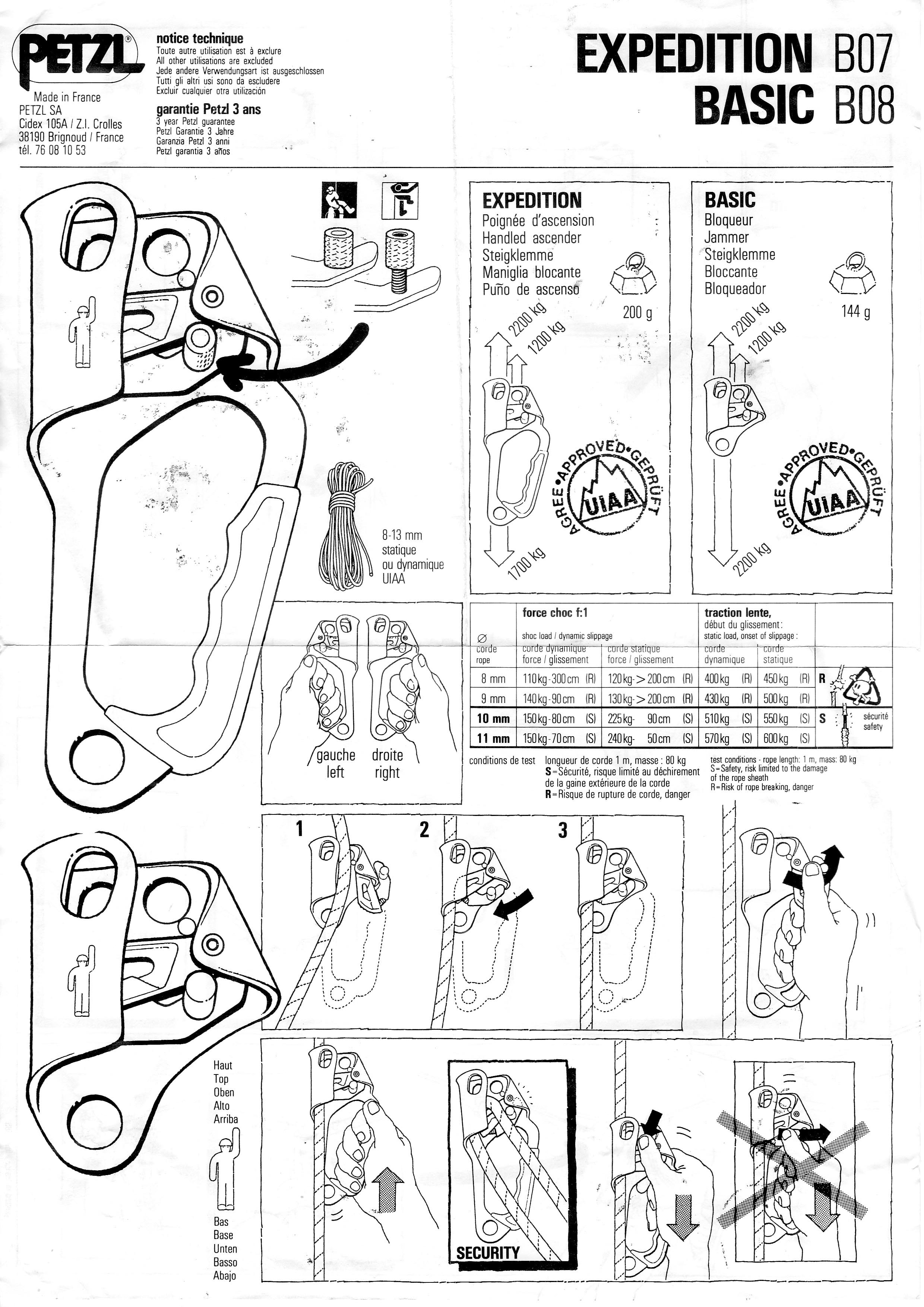
This is the first U. I. A. A. approved ascender that I acquired. Looking at the U. I. A. A. criteria for ascenders explains why the handle opening was enlarged: there is a minimum size for acceptance. The earlier Petzl Expedition openings were too small. I made a template conforming to the dimensions of U. I. A. A. requirement M4.1.4 to check various ascenders. This ascender passes, but barely. There is a lot of extra room in the handle, but it is located in the wrong place. The protrusions between the finger grooves just miss interfering with my template. Of course, in the real world, the opening is certainly adequately sized on any of these versions.
 |
 |
[ Top
| Version A
| Version B
| Version C
| Version D
| Versions E1 & E2
| Version E2 mod.
| Versions F1 & F2
| Versions G1 & G2
| Versions H1 & H2
| Version I
| Version J
]
| Version K
| Version M
| Version N
| Version O
| Version P
| Version P†
| Version Q
| Version Q†
| Version R
| Version S
| Version T
| Return to H.E.C. Ascenders
]
|
|
 |
| Front View: Closed | Rear View: Closed |
 |
 |
| Front View: Open for Rigging | Rear View: Open for Rigging |
 I acquired my Petzl Ascension, Version L from Sam Smith in 2012.
Version L is 196 mm. tall, 88 mm. wide, 27 mm. thick, and weighs 207 g. The rope channel is 15 mm. wide. The cam axle is centered 47 mm. from the inside of the rope channel. The cam radius increases from 36 to 53 mm. over an angle of 34°, giving a 33° cam angle. The tooth pattern is (2.3)(2S2.1S1)^2(1S1)^3(1.2).
This version changes the shape of the bottom of the shell, making it more rounded. The cam stop has a rounded, semi-tapered shape imposed by the riveting process.
A Sieg Heil icon and the U. I. A. A. approval logo are stamped onto the front of the rope channel portion of the shell. The plastic hand grip has "Poignée PETZL France" molded into one side and "breveté," and "France_Etranger" molded into the other. "PETZL" is cast into both sides of the cam, and "OIL" and an arrow are stamped into the cam safety. The arrow points to the cam safety pivot. The rear of the ascender shell is stamped with the following date:
| ID | Date Code |
|---|---|
| 1901 | 07693A |
For practical purposes, I see no great advantage or disadvantage to the change introduced in this version. Although visually obvious, the changes in the shell shape don't seem to have much functional impact.
[ Top
| Version A
| Version B
| Version C
| Version D
| Versions E1 & E2
| Version E2 mod.
| Versions F1 & F2
| Versions G1 & G2
| Versions H1 & H2
| Version I
| Version J
]
[ Version K
| Version L
| Version P
| Version P†
| Version Q
| Version Q†
| Version R
| Version S
| Version T
| Return to H.E.C. Ascenders
]
|
|
 |
| Front View: Closed | Rear View: Closed |
 |
 |
| Front View: Open for Rigging | Rear View: Open for Rigging |
 I acquired my Petzl Ascensions, Version M on eBay from B. Bieger in 2012.
Version M is 195 mm. tall, 89 mm. wide, 28 mm. thick, and weighs 210 g. The rope channel is 15 mm. wide. The cam axle is centered 47 mm. from the inside of the rope channel. The cam radius increases from 36 to 53 mm. over an angle of 34°, giving a 33° cam angle. The tooth pattern is (2.3)(2S2.1S1)^2(1S1)^3(1.2).
This version includes an anodized cam safety.
A Sieg Heil icon and the U. I. A. A. approval logo are stamped onto the front of the rope channel portion of the shell. The plastic hand grip has "Poignée PETZL France" molded into one side and "breveté," and "France_Etranger" molded into the other. "PETZL" is cast into both sides of the cam, and "OIL" and an arrow are stamped into the cam safety. The arrow points to the cam safety pivot. The rear of the ascenders are stamped with codes as follows:
| ID | Date Code |
|---|---|
| 1571 | (none) |
| 1571 | 3311A |
Anodizing the cam safety is primarily a decorative change.
[ Top
| Version A
| Version B
| Version C
| Version D
| Versions E1 & E2
| Version E2 mod.
| Versions F1 & F2
| Versions G1 & G2
| Versions H1 & H2
| Version I
| Version J
]
[ Version K
| Version L
| Version M
| Version O
| Version P
| Version P†
| Version Q†
| Version Q
| Version R
| Version S
| Version T
| Return to H.E.C. Ascenders
]
|
|
 |
| Front View: Closed | Rear View: Closed |
 |
 |
| Front View: Open for Rigging | Rear View: Open for Rigging |
 I acquired a pair of these from Jeffrey Kuchak in 2012. Tony Brengosz donated a left-handed one in 2026.
This version is 195 mm. tall, 88 mm. wide, 32 mm. thick, and weighs 205 g. The rope channel is 15 mm. wide. The cam axle is centered 47 mm. from the inside of the rope channel. The cam radius increases from 36 to 53 mm. over an angle of 34°, giving a 33° cam angle. The tooth pattern is (2.3)(2S2.1S1)^2(1S1)^3(1.2).
The following changes were made from Version M:
A Sieg Heil icon and the U. I. A. A. approval logo are stamped onto the front of the rope channel portion of the shell. The plastic hand grip has "Poignée PETZL France" molded into one side and "breveté," and "France_Etranger" molded into the other. "PETZL" is cast into both sides of the cam, and "OIL" and an arrow are stamped into the cam safety. The arrow points to the cam safety pivot.
The rear of the ascenders are stamped with date codes as follows:
| ID | Date Code |
|---|---|
| 1900L | 03394A |
| 1900R | 18694C |
| 3684 | 33394A |
The modifications allow using the same frame for Ascension and the Petzl Pompe. The Pompe mounts a pulley to the rear of the ascender and uses the lower hole as part of it's mechanical advantage mechanism.
[ Top
| Version A
| Version B
| Version C
| Version D
| Versions E1 & E2
| Version E2 mod.
| Versions F1 & F2
| Versions G1 & G2
| Versions H1 & H2
| Version I
| Version J
]
[ Version K
| Version L
| Version M
| Version N
| Version P
| Version P†
| Version Q
| Version Q†
| Version R
| Version S
| Version T
| Return to H.E.C. Ascenders
]
|
|
 |
| Front View: Closed | Rear View: Closed |
 |
 |
| Front View: Open for Rigging | Rear View: Open for Rigging |

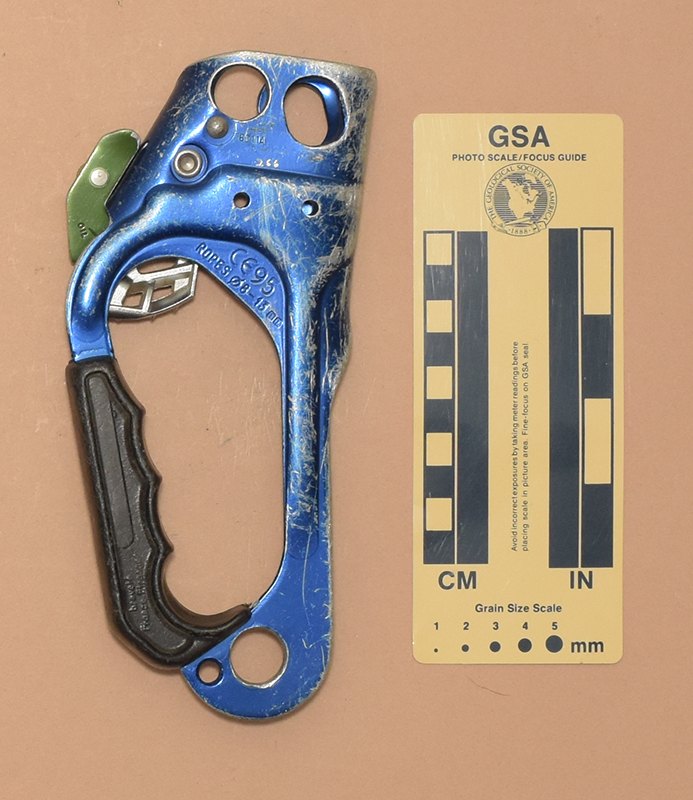
I acquired this Petzl Ascension, Version O from J. Matzke in 2009.
This Ascension is 194 mm. tall, 88 mm. wide, 43 mm. thick, and weighs 204 g. The rope channel is 15 mm. wide. The cam axle is centered 47 mm. from the inside of the rope channel. The cam radius, measured from the axle axis, increases from 37 to 53 mm. over an angle of 37°, giving a 29° cam angle. The tooth pattern is (2.3)(2S2.1S1)^2(1S1)^3(1.2).
A Sieg Heil icon and the U. I. A. A. approval logo are stamped onto the front of the rope channel portion of the shell. "CE95" and "ROPES Ø8–13 mm" are stamped above the hand opening on the front and back. The plastic hand grip has "Poignée PETZL France" molded into one side and "breveté," and "France_Etranger" molded into the other. "PETZL" is cast into both sides of the cam, and "OIL" and an arrow are stamped into the cam safety. The arrow points to the cam safety pivot. This ascender has the following date code:
| ID | Date Code |
|---|---|
| 266 | 96011A |
Stamping "CE95" and the rope range on both sides of the shell is repetitive and redundant and repeats itself over and over, but does not affect the ascender's function in any meaningful way.
[ Top
| Version A
| Version B
| Version C
| Version D
| Versions E1 & E2
| Version E2 mod.
| Versions F1 & F2
| Versions G1 & G2
| Versions H1 & H2
| Version I
| Version J
]
[ Version K
| Version L
| Version M
| Version N
| Version O
| Version P†
| Version Q
| Version Q†
| Version R
| Version S
| Version T
| Return to H.E.C. Ascenders
]
|
|
 |
| Front View: Closed | Rear View: Closed |
 |
 |
| Front View: Open for Rigging | Rear View: Open for Rigging |
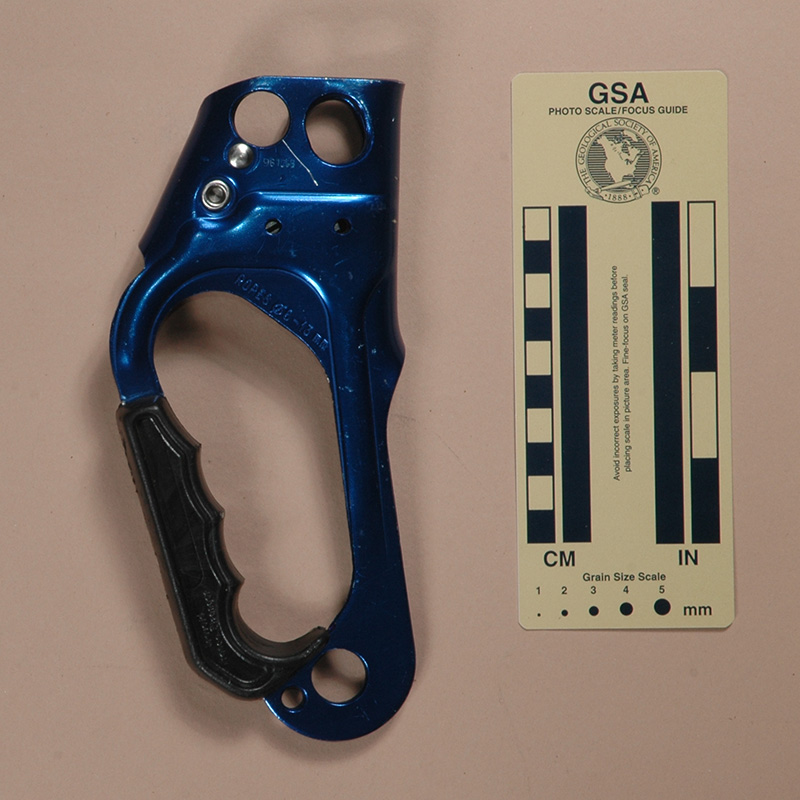
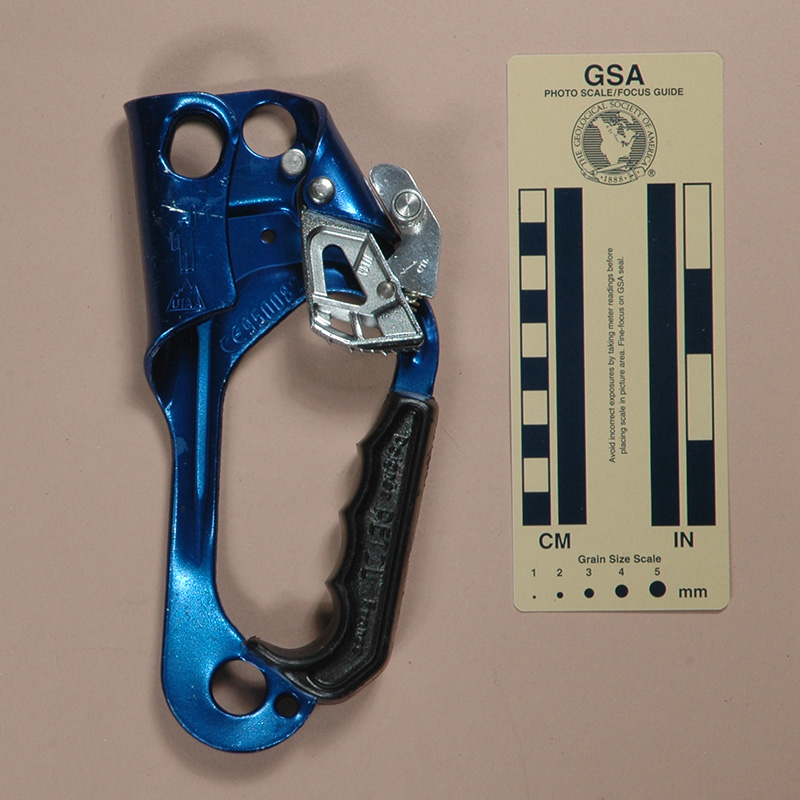
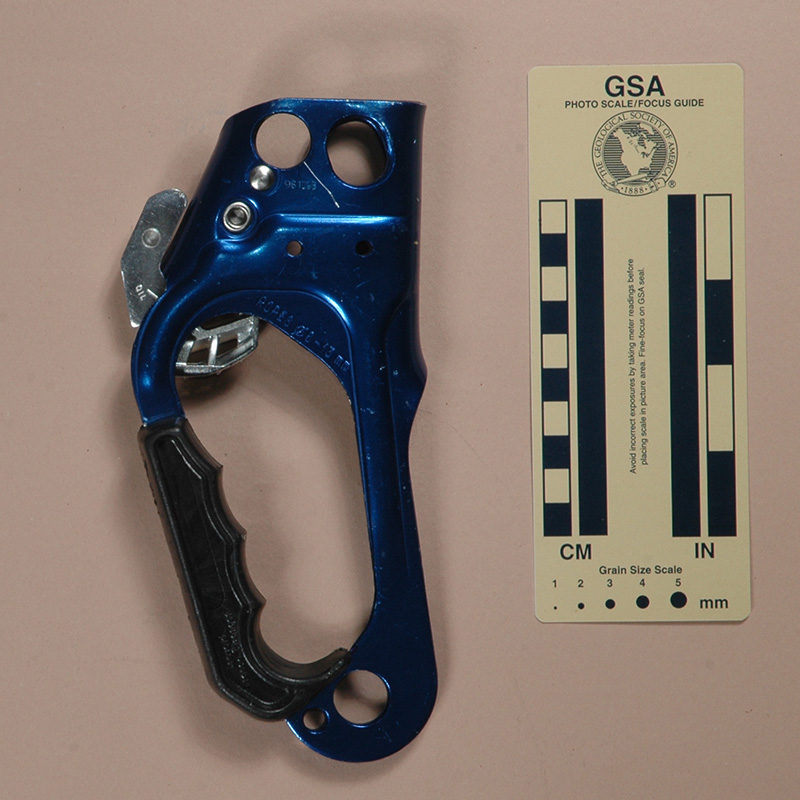
 I acquired this right-hand ascender from Alan Shelby on eBay in 2004 and another from Melody Madison in 2015.
Version P is 194 mm. tall, 88 mm. wide, 43 mm. thick, and weighs 204 g. The rope channel is 15 mm. wide. The cam axle is centered 47 mm. from the inside of the rope channel. The cam radius increases from 36 to 53 mm. over an angle of 34°, giving a 33° cam angle. The tooth pattern is (2.3)(2S2.1S1)^2(1S1)^3(1.2).
A Sieg Heil icon and the U. I. A. A. approval logo are stamped onto the front of the rope channel portion of the shell. "CE950082" is stamped on the inside of the shell below the cam. The plastic hand grip has "breveté" and "France_Etranger" molded into the front in raised letters, and "Poignée PETZL France" molded into the rear. "PETZL" is cast into both sides of the cam, and "OIL" and an arrow are stamped into the cam safety. The arrow points to the cam safety pivot. The rear of the ascender shell is stamped with "ROPES Ø8-13 mm" and the following date code:
| ID | Date Code |
|---|---|
| 169 | 96106B |
| 2054 | 96204A |
Petzl stopped repeating themselves over and over by eliminating the repetitive and redundant stampings of Version O. and replacing them with distinct stampings on each side of the frame. Ascender functionality was not changed.
[ Top
| Version A
| Version B
| Version C
| Version D
| Versions E1 & E2
| Version E2 mod.
| Versions F1 & F2
| Versions G1 & G2
| Versions H1 & H2
| Version I
| Version J
]
[ Version K
| Version L
| Version M
| Version N
| Version O
| Version P
| Version Q
| Version Q†
| Version R
| Version S
| Version T
| Return to H.E.C. Ascenders
]
|
|
 |
| Front View: Closed | Rear View: Closed |
 |
 |
| Front View: Open for Rigging | Rear View: Open for Rigging |
 Technical Details
I acquired this left-hand ascender from Jon Oshiro in 2019.
This version is 195 mm. tall, 90 mm. wide, 27 mm. thick, and weighs 207 g. The rope channel is 16 mm. wide. The cam axle is centered 46 mm. from the inside of the rope channel. The cam radius increases from 36 to 53 mm. over an angle of 34°, giving a 33° cam angle. The tooth pattern is (2.3)(2S2.1S1)^2(1S1)^3(1.2).
A Sieg Heil icon and the U. I. A. A. approval logo are stamped onto the front of the rope channel portion of the shell. "ROPES Ø8-13 mm" is stamped on the inside of the shell below the cam. The plastic hand grip has "breveté" and "France_Etranger" molded into the front in raised letters, and "Poignée PETZL France" molded into the rear. "PETZL" is cast into both sides of the cam, and "OIL" and an arrow are stamped into the cam safety. The arrow points to the cam safety pivot. The rear of the ascender shell is stamped with "CE950082" and the following date code:
| ID | Date Code |
|---|---|
| 2924 | 96383A |
 Comments
This ascender has the very distinct barrel-shaped cam stop that I first observed on Version Q†, indicating that the latter was not a one-time fluke. I think that these stops are an artifact of the production process rather than an intentional change. In any case, they have no effect on ascender performance in the field.
[ Top
| Version A
| Version B
| Version C
| Version D
| Versions E1 & E2
| Version E2 mod.
| Versions F1 & F2
| Versions G1 & G2
| Versions H1 & H2
| Version I
| Version J
]
[ Version K
| Version L
| Version M
| Version N
| Version O
| Version P
| Version P†
| Version Q†
| Version R
| Version S
| Version T
| Return to H.E.C. Ascenders
]
|
|
 |
| Front View: Closed | Rear View: Closed |
 |
 |
| Front View: Open for Rigging | Rear View: Open for Rigging |
 I acquired one Petzl Ascension, Version Q from Jon Oshiro in 2019 and another from Finding Home Vintage in 2026.
The Petzl Ascension, Version Q is 194 mm. tall, 88 mm. wide, 43 mm. thick, and weighs 205 g. The rope channel is 16 mm. wide. The cam axle is centered 47 mm. from the inside of the rope channel. The cam radius, measured from the axle axis, increases from 37 to 53 mm. over an angle of 37°, giving a 29° cam angle. The tooth pattern is (2.3)(2S2.1S1)^2(1S1)^3(1.2).
A Sieg Heil icon and the U. I. A. A. approval logo are stamped onto the front of the rope channel portion of the shell. "CE950082" is stamped on the inside of the shell below the cam. The plastic hand grip has "breveté" and "France_Etranger" molded into the front in raised letters, and "Poignée PETZL France" molded into the rear. "PETZL" is cast into both sides of the cam, and "OIL" and an arrow are stamped into the cam safety. The arrow points to the cam safety pivot. The rear of the ascender shell is stamped "ROPES Ø8-13 mm" and the date code.
| ID | Date Code |
|---|---|
| 2925 | 96096A |
| 3699 | 96100A |
This version has a colored anodized safety.
[ Top
| Version A
| Version B
| Version C
| Version D
| Versions E1 & E2
| Version E2 mod.
| Versions F1 & F2
| Versions G1 & G2
| Versions H1 & H2
| Version I
| Version J
]
[ Version K
| Version L
| Version M
| Version N
| Version O
| Version P
| Version P†
| Version Q
| Version R
| Version S
| Version T
| Return to H.E.C. Ascenders
]
|
|
 |
| Front View: Closed | Rear View: Closed |
 |
 |
| Front View: Open for Rigging | Rear View: Open for Rigging |
 Technical Details
I acquired this left-hand ascender from Jay Kennedy in 2005.
Version Q† is 195 mm. tall, 90 mm. wide, 27 mm. thick, and weighs 206 g. The rope channel is 15 mm. wide. The cam axle is centered 47 mm. from the inside of the rope channel. The cam radius increases from 36 to 53 mm. over an angle of 34°, giving a 33° cam angle. The tooth pattern is (2.3)(2S2.1S1)^2(1S1)^3(1.2).
A Sieg Heil icon and the U. I. A. A. approval logo are stamped onto the front of the rope channel portion of the shell. "ROPES Ø8-13 mm" is stamped on the inside of the shell below the cam. The plastic hand grip has "breveté" and "France_Etranger" molded into the front in raised letters, and "Poignée PETZL France" molded into the rear. "PETZL" is cast into both sides of the cam, and "OIL" and an arrow are stamped into the cam safety. The arrow points to the cam safety pivot. The rear of the ascender shell is stamped with "CE950082" and the date code.
| ID | Date Code |
|---|---|
| 264 | 97013B |
 Comments
At first I speculated that Version Q may not have existed in left-hand form, but as soon as I said so here, Jay Kennedy sent me this one to match. Stampings indicate that this ascender was made in 1997. Version Q† has a very distinct barrel-shaped cam stop. I think this is just an artifact of the production process, but the machine adjustment is far enough out that I decided to list this one separately.
[ Top
| Version A
| Version B
| Version C
| Version D
| Versions E1 & E2
| Version E2 mod.
| Versions F1 & F2
| Versions G1 & G2
| Versions H1 & H2
| Version I
| Version J
]
[ Version K
| Version L
| Version M
| Version N
| Version O
| Version P
| Version P†
| Version Q
| Version Q†
| Version S
| Version T
| Return to H.E.C. Ascenders
]
|
|
 |
| Front View: Closed | Rear View: Closed |
 |
 |
| Front View: Open for Rigging | Rear View: Open for Rigging |
 Technical Details
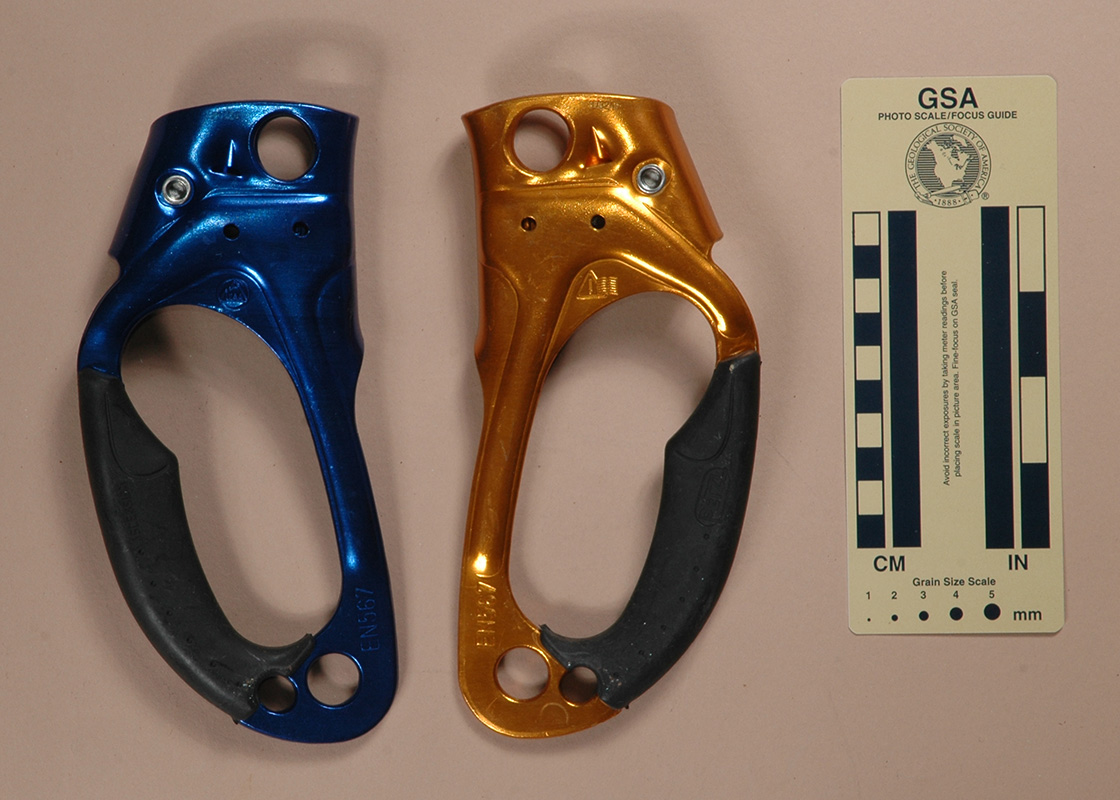
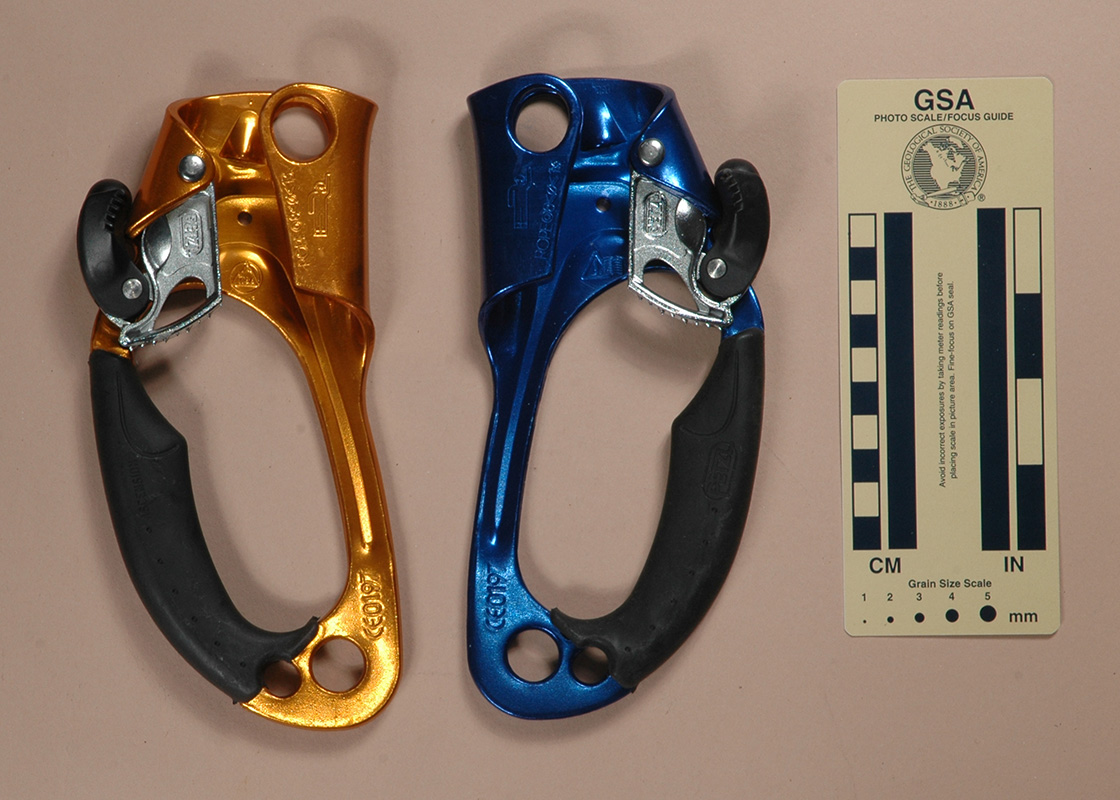
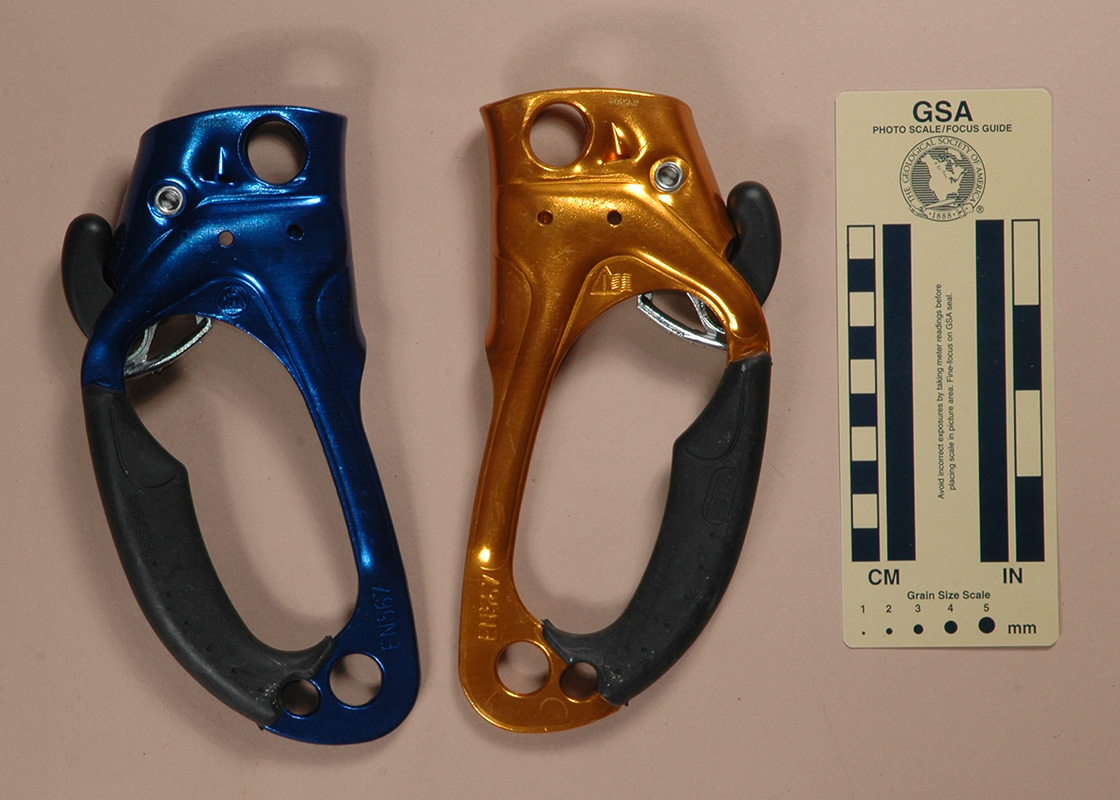
I acquired this version from On Rope 1 at the 1998 Speleofest. I acquired another pair in 2017 as part of Bob Thrun’s collection.
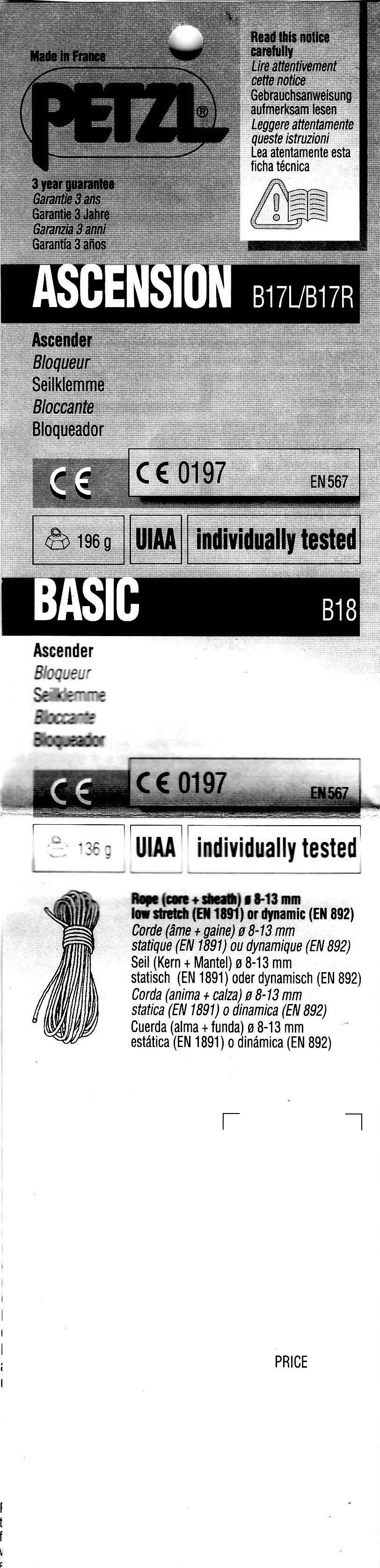
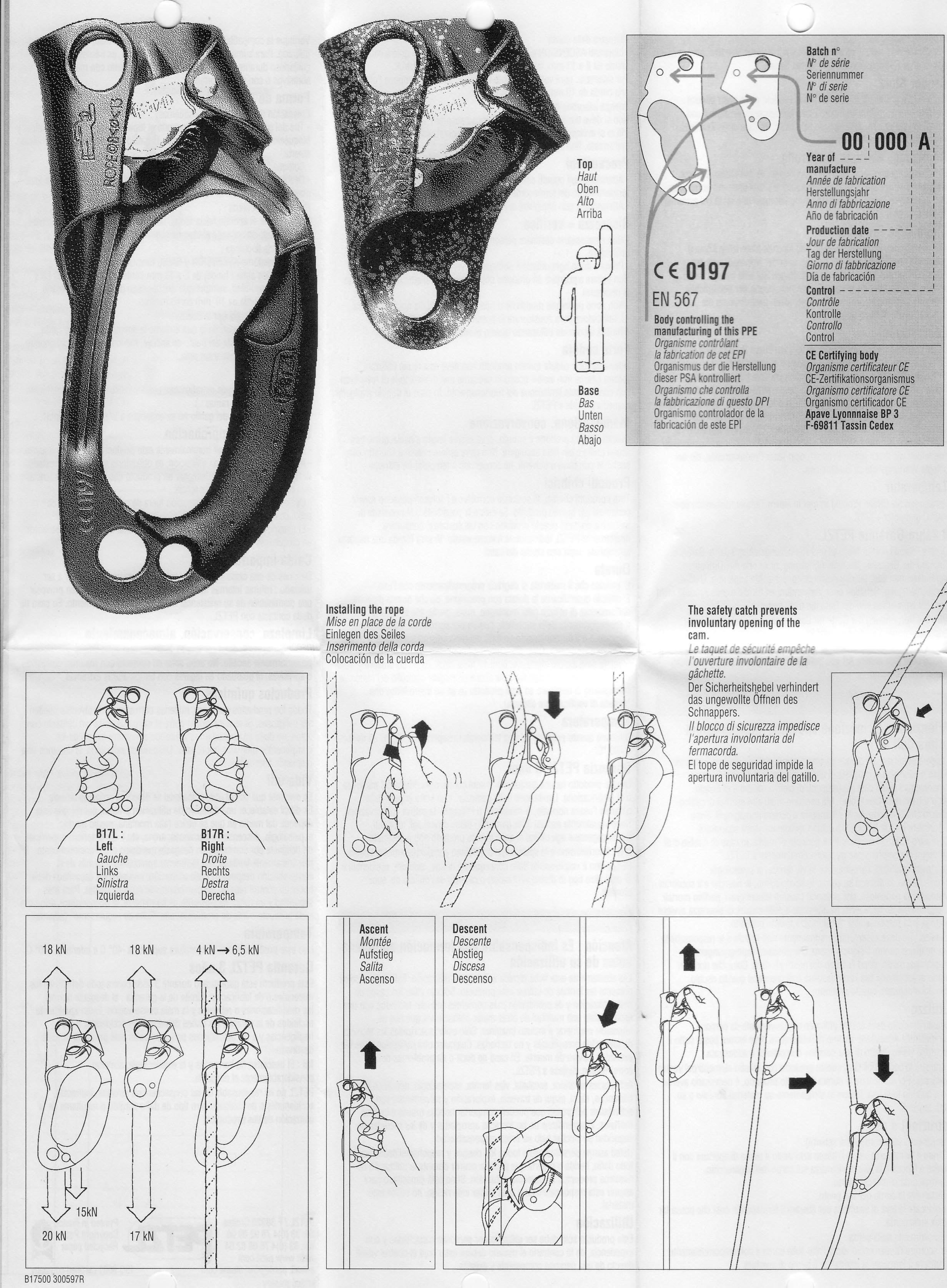
Version R is 190 mm. tall, 89 mm. wide, 32 mm. thick, and weighs 188 g. The rope channel is 15 mm. wide. The cam axle is centered 47 mm. from the inside of the rope channel. The cam radius increases from 36 to 53 mm. over an angle of 34°, giving a 33° cam angle. The tooth pattern is (3.4)(1S1.2S2)^2(1S1.2.3), where the "S"s stand for the single longitudinal mud removal slot.
The front of each ascender is stamped "ROPE•8<Ø<13," the Sieg Heil icon, and "CE0197." is stamped with a date code, the Reading is Dangerous icon on the left-hand ascender and the UIAA logo on the right-hand ascender, and "EN567." One side of each grip has the Petzl logo molded into it, the other side has "ASCENSION." The cam has the Petzl logo cast into it.
My ascenders have the following date codes:
| ID | Date Code |
|---|---|
| 127L | 97324F |
| 127R | 97324F |
| 2186L | 98160C |
| 2186R | 98133G |
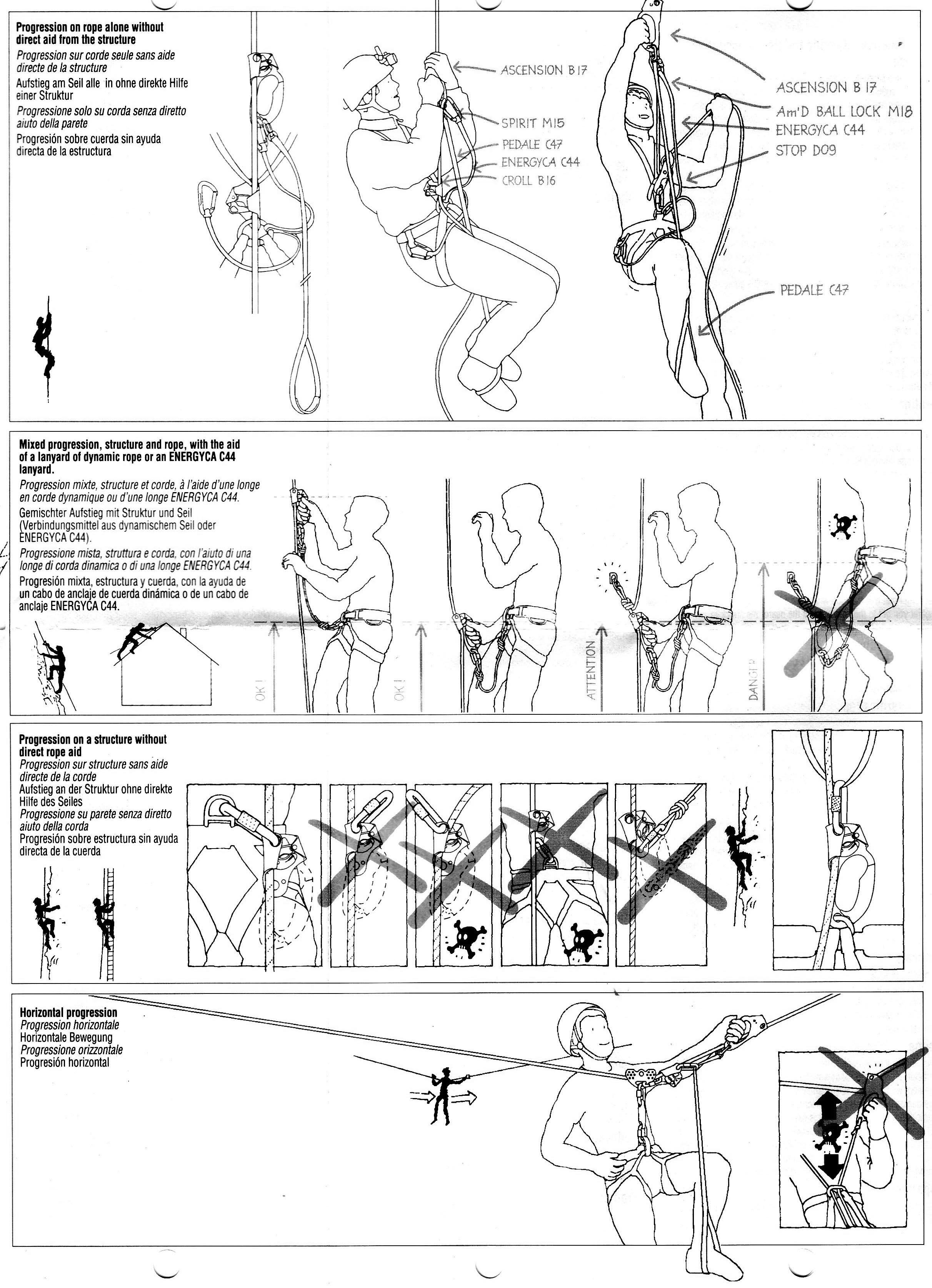
 Version R replaced the finger-groove handle with a rounded rubber handle that I find to be much more comfortable than the old ones, and would be even better if the remaining cusp were eliminated. There are two tie-in holes at the base: the main one is 15.5 mm., the smaller one 11.4 mm. The second top carabiner hole has disappeared, to be replaced by a dimpled cam stop located where the cam cannot touch it. Although the upper attachment hole on earlier versions was not essential, replacing it with an ineffective cam stop does nothing. Remember, these cam stops only increase the ascender strength in unrealistic laboratory tests, they serve no function in proper field use.
The cam safety is now a large plastic thumb piece. It works smoothly, but not comfortably, and then only with the proper hand. Opening the cam with the opposite hand is possible, but not as easy as it is on the early Jumar. Like all Petzl eccentric cam ascenders with down-sloping teeth, thumbing the cam for down-climbing is awkward. I find that it is easier to work the cam on stiff ropes, since loose-sheathed ropes seem to snag more readily.

 |
 |
 |
 |
 |
[ Top
| Version A
| Version B
| Version C
| Version D
| Versions E1 & E2
| Version E2 mod.
| Versions F1 & F2
| Versions G1 & G2
| Versions H1 & H2
| Version I
| Version J
]
[ Version K
| Version L
| Version M
| Version N
| Version O
| Version P
| Version P†
| Version Q
| Version Q†
| Version R
| Version T
| Return to H.E.C. Ascenders
]
|
|
 |
| Front View: Closed | Rear View: Closed |
 |
 |
| Front View: Open for Rigging | Rear View: Open for Rigging |
I acquired this pair of ascenders from On Rope 1 in 2009. I acquired another pair in 2017 as part of Bob Thrun’s collection.
The Petzl Ascension, Version S is 192 mm. tall, 89 mm. wide, 31 mm. thick, and weighs 197 g. The left ascender is model B17SLN; the right is B17SRG.
 The shell is a tall irregular shaped stamping made from 4.0 mm. aluminum alloy sheet metal. A rope channel is formed in the upper portion of one side and a smaller cam channel lies opposite the first. The rope channel is 15 mm. wide. A hole drilled through both sides of the cam channel accepts a 5.5 mm. semi-tubular rivet. The cam and cam spring are mounted on this rivet. The head of the rivet is exposed on the open side, while the roll sits into a stamped depression on the back of the shell. The handle below the cam has a two-piece plastic hand grip molded into place. The orange portion is hard plastic, while the black portion is a softer artificial rubber. The hand grip has a sharp projection to fit between the index and middle fingers. A 15.3 mm. sling attachment hole is punched below the handle opening, and a smaller 11.6 by 10.5 mm. hole is punched beside it. An 18.2 by 16.8 mm. hole through both sides of the rope channel provides an attachment point just above the cam. All of these holes are somewhat rounded. An indentation stamped into the frame extends across the upper portion of the shell and down both sides of the hand hole, ending just above the plastic hand grip on one side and about 28 mm. above the lower sling attachment hole on the other. A stamped cam closing stop is punched into the shell just above the cam.
The cam is a skeletonized casting, as before. The cam axle is centered 49 mm. from the inside of the rope channel. The cam radius increases from 39 to 55 mm. over an angle of 34°, giving a 30° cam angle. The conical cam teeth have their axes approximately parallel to the lower surface of the cam. The tooth pattern is (3.4)(1S1.2S2)^2(1S1.2.3), where the "S"s stand for the single longitudinal mud removal slot. The cam safety is much like Version R’s.
The front of the rope channel portion of the shell is stamped with an up-pointing arrow surrounding the word "UP," "ASCENSION, and a book-with-an-"i" icon. The rear is printed with "CE0197," "EN567:1997 • ø8-13mm," "Made in France," the UIAA logo, a date code, and a scanner code. The hand grip has the Petzl logo cast into both sides, as does the cam.
My ascenders have the following date codes:
| ID | Date Code |
|---|---|
| 298L | 09065FR7923 |
| 298R | 08331FR5985 |
| 2112L | 09065FR7914 |
| 2112R | 08331FU5980 |
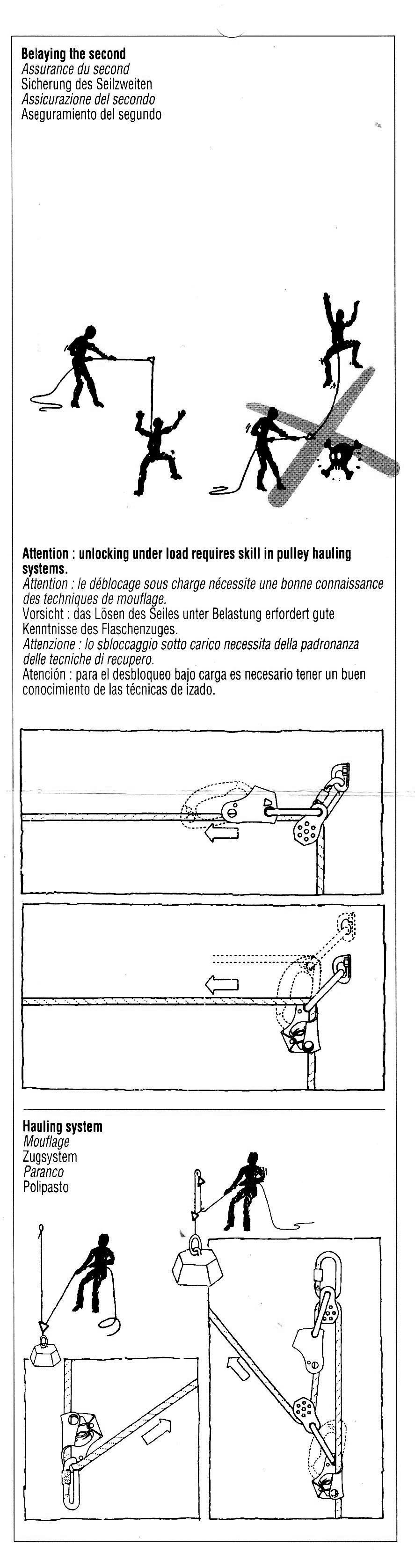
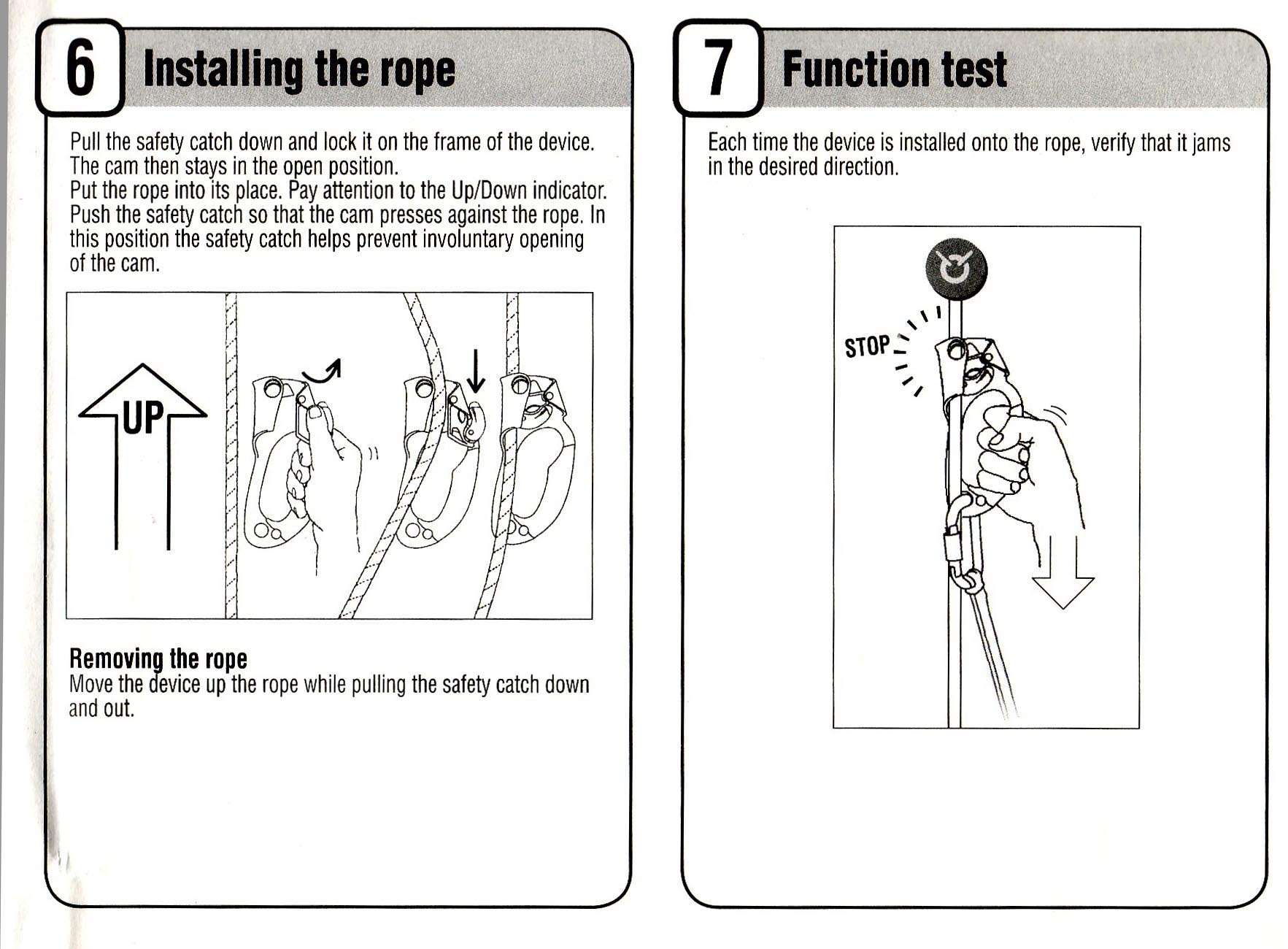
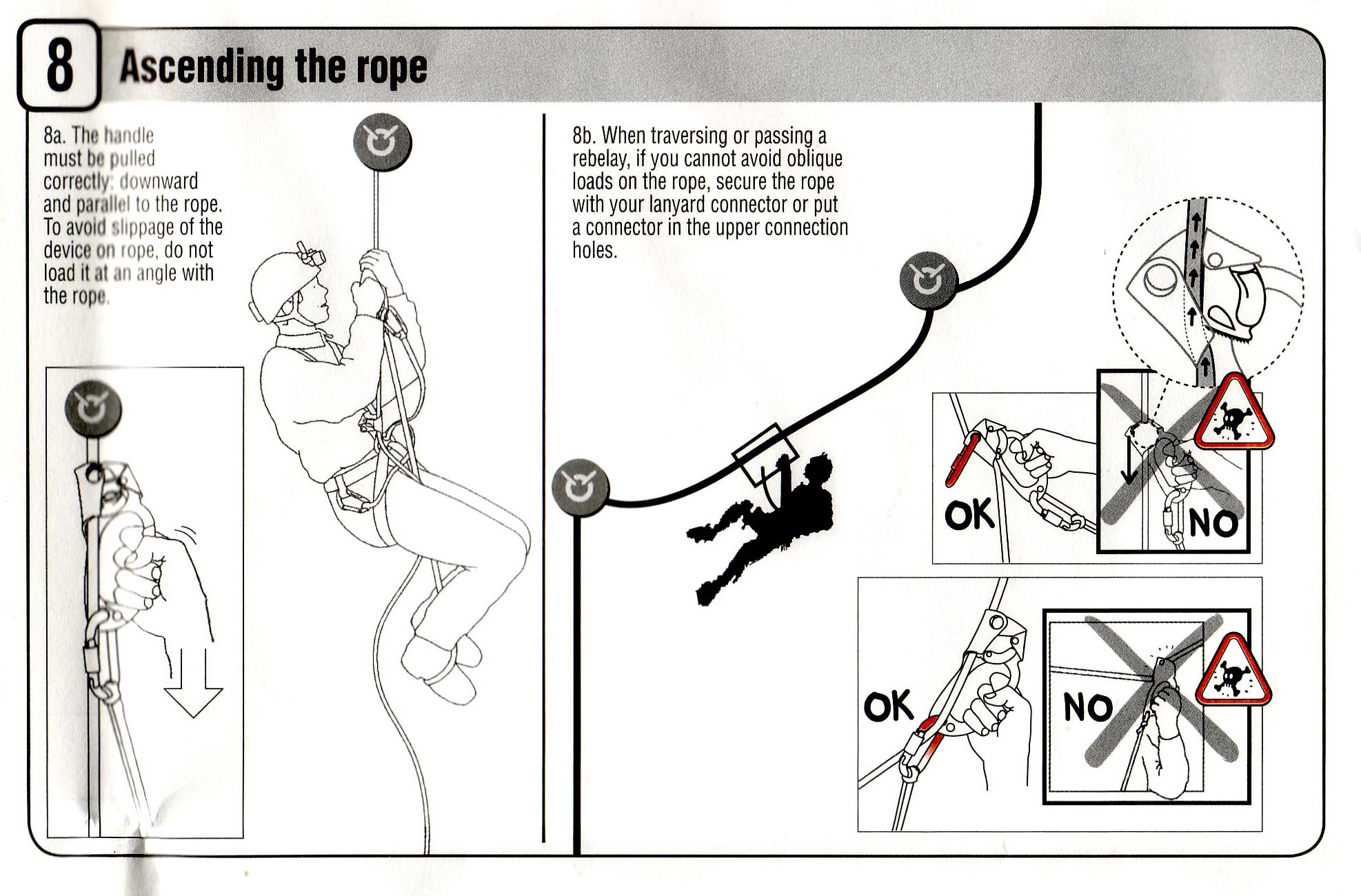
After a long interval, Petzl made some significant changes to the Ascension. Despite the bulge, the new handle is rather comfortable, and has room for my large hands. The cam safety is still awkward to use with the wrong hand, and it still has the sharp point that digs into my thumb. Down-climbing is still quite awkward, since the down-pointing teeth easily snag on the rope. The cam has a couple supernumerary teeth that, frankly, I don't see the reason for. Overall, though, this is a nice improvement over earlier ascensions.
 |
 |
 |
 |
 |
 |
 |
[ Top
| Version A
| Version B
| Version C
| Version D
| Versions E1 & E2
| Version E2 mod.
| Versions F1 & F2
| Versions G1 & G2
| Versions H1 & H2
| Version I
| Version J
]
[ Version K
| Version L
| Version M
| Version N
| Version O
| Version P
| Version P†
| Version Q
| Version Q†
| Version R
| Version S
| Return to H.E.C. Ascenders
]
|
|
 |
| Front View: Closed | Rear View: Closed |
 |
 |
| Front View: Open for Rigging | Rear View: Open for Rigging |
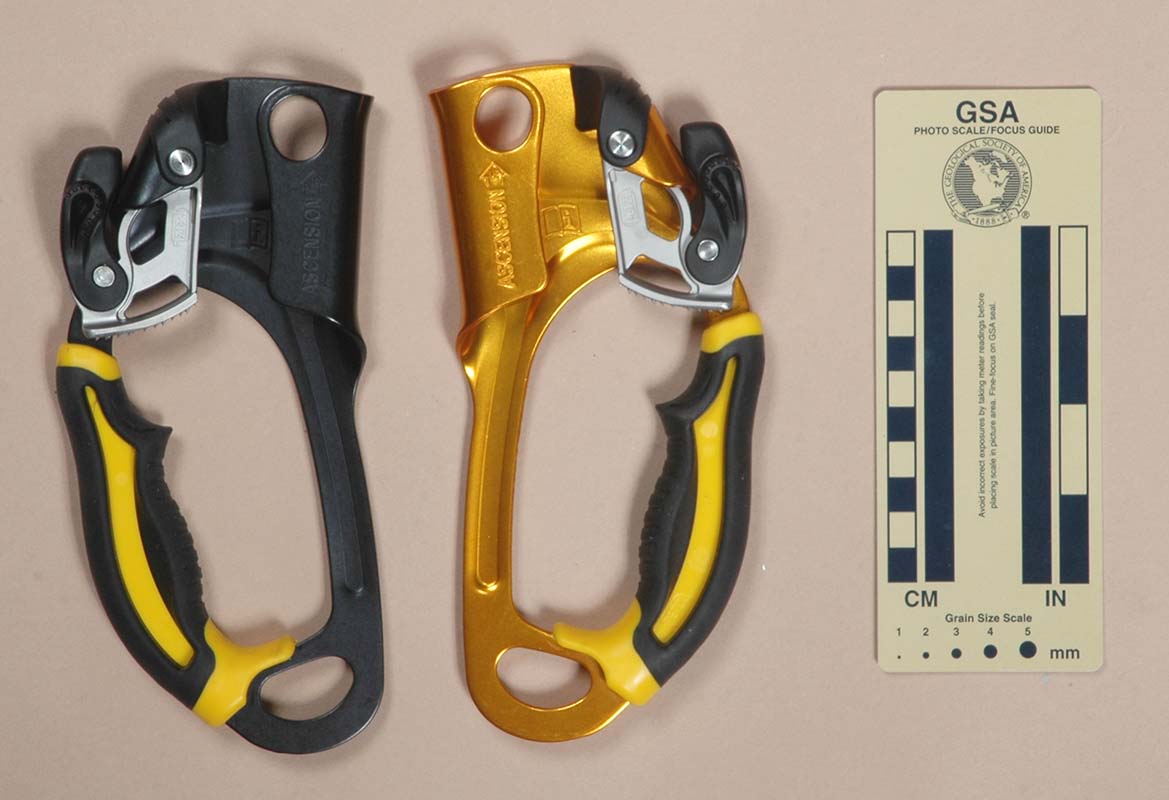
I acquired this pair of ascenders from Expé-Spelemat in 2015. I acquired another left-handed ascender in 2017 as part of Bob Thrun’s collection. In 2021 I bought two right-hand ascenders for destructive testing, one from Jamie Vise and one from eBay seller ppp_irving.
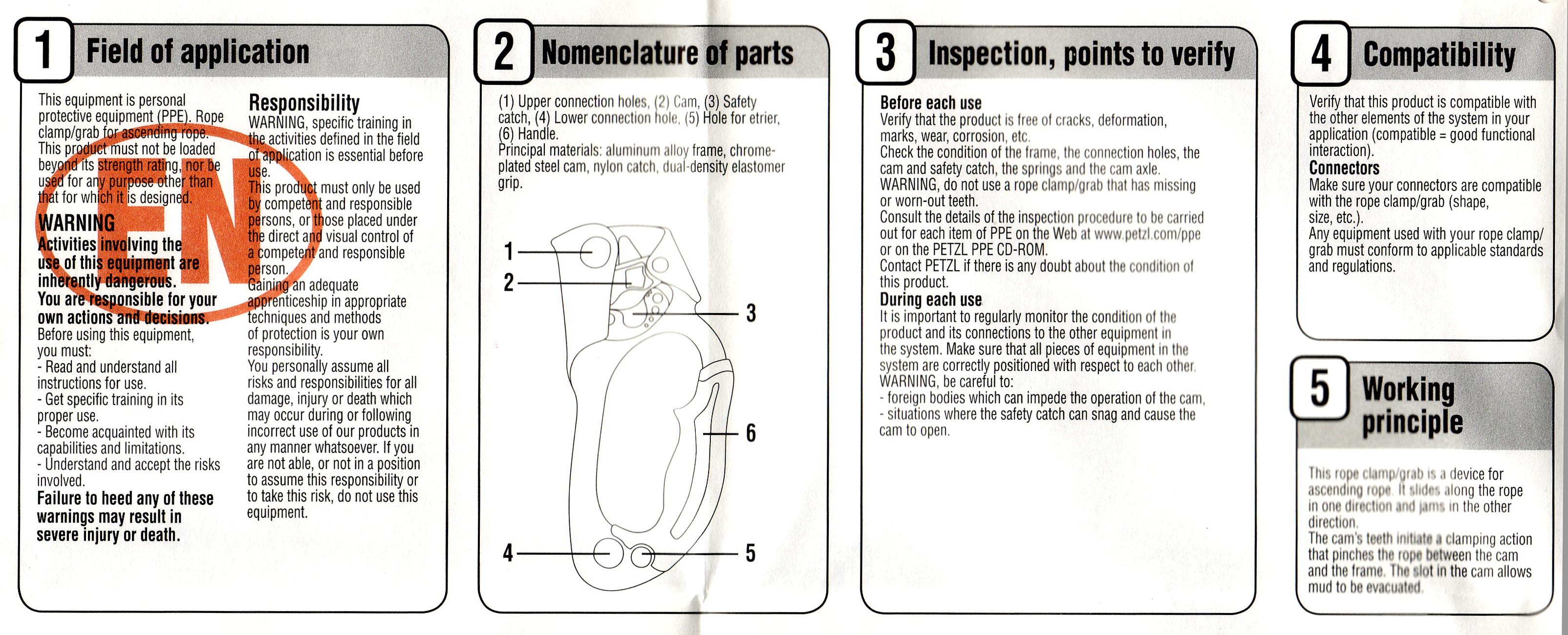
Version T is 192 mm. tall, 90 mm. wide, 24 mm. thick, and weighs 164 g. The left ascender is model B17ALA; the right is B17ARA.
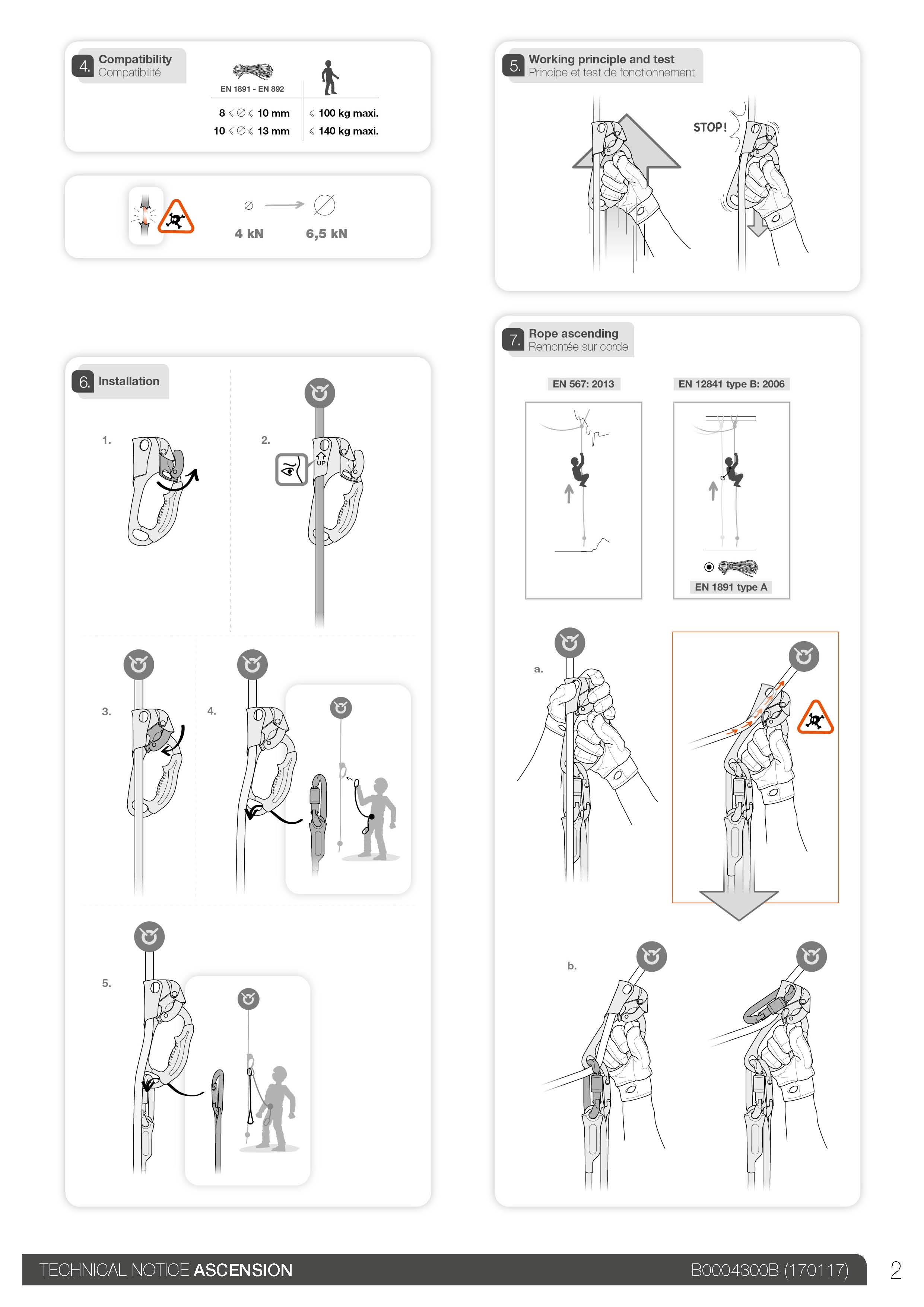
The shell is a tall irregular shaped stamping made from 3.4 mm. aluminum alloy sheet metal. A rope channel is formed in the upper portion of one side and a smaller cam channel lies opposite the first. The rope channel is 14 mm. wide. A hole drilled through both sides of the cam channel accepts a 4.5 mm. rivet. The cam and cam spring are mounted on this rivet. There is a plastic guard above the cam channel. A countersunk Philips head screw passing from the rear holds the guard in place.
 The handle below the cam has a two-piece plastic hand grip molded into place. The yellow portion is hard plastic, while the black portion is a softer artificial rubber. The hand grip has a sharp projection to fit between the index and middle fingers. A 27 mm. wide, 15.7 mm. tall sling attachment hole is punched below the handle opening. A 17.8 by 15.5 mm. hole through both sides of the rope channel provides an attachment point just above the cam. All of these holes are somewhat rounded. An indentation stamped into the frame extends across the upper portion of the shell and down both sides of the hand hole, ending 8 mm. above the plastic hand grip on one side and about 19 mm. above the lower sling attachment hole on the other.
The new cam is a skeletonized casting. The cam axle is centered 54 mm. from the inside of the rope channel. The cam radius increases from 39 to 55 mm. over an angle of 34°, giving a 30° cam angle. The conical cam teeth have their axes approximately parallel to the lower surface of the cam. The tooth pattern is changed to (3.4)(1S1)^2(2S2)(1S1)^4(3.4.3), where the "S"s stand for the single longitudinal mud removal slot. The new cam safety is plastic.
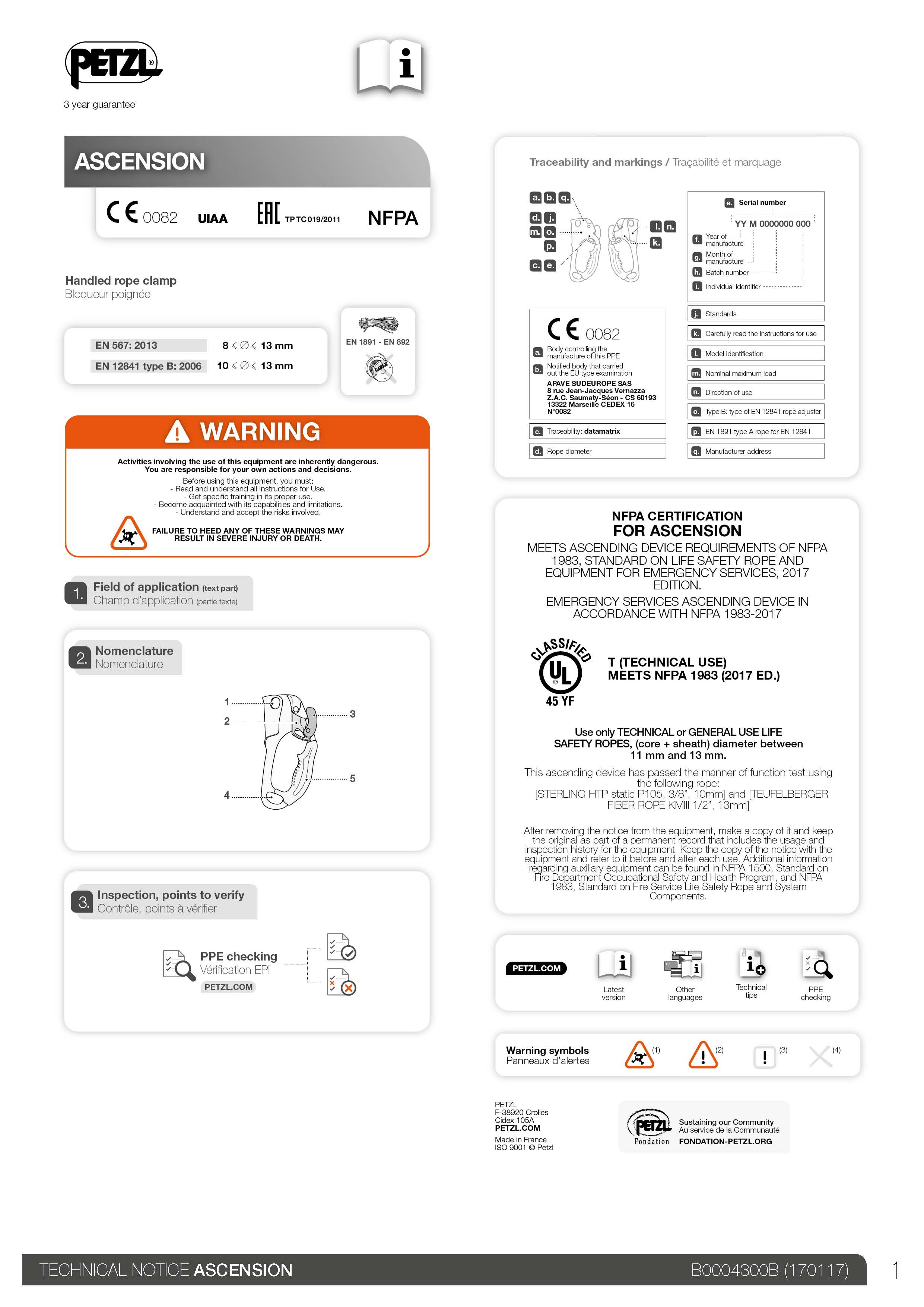
The front of the rope channel portion of the shell is stamped with an up-pointing arrow surrounding the word "UP," and "ASCENSION." The inside is stamped with book-with-an-"i" icon, behind the cam. The rear is printed with "CE0082," "Made in France," "EN567:2012 Ø8-13mm," "EN12841:2006B•Ø8-13mm 140kg," "MEETS NFPA 1983(2012Ed.)," "FOR ROPE 11≤Ø≤13mm," "T" the UL Classified logo, "45YF," "EAC," a date code, and a scanner code. The hand grip has the Petzl logo cast into both sides, as does the cam.
My ascenders have the following date codes:
| ID | Date Code |
|---|---|
2010L |
15069FP6771 |
| 2010R | 15047FR3177 |
| 2065 | 15079FP2083 |
| 3479R | 15216FN3652 |
| 3487R | 19F0198215646 |
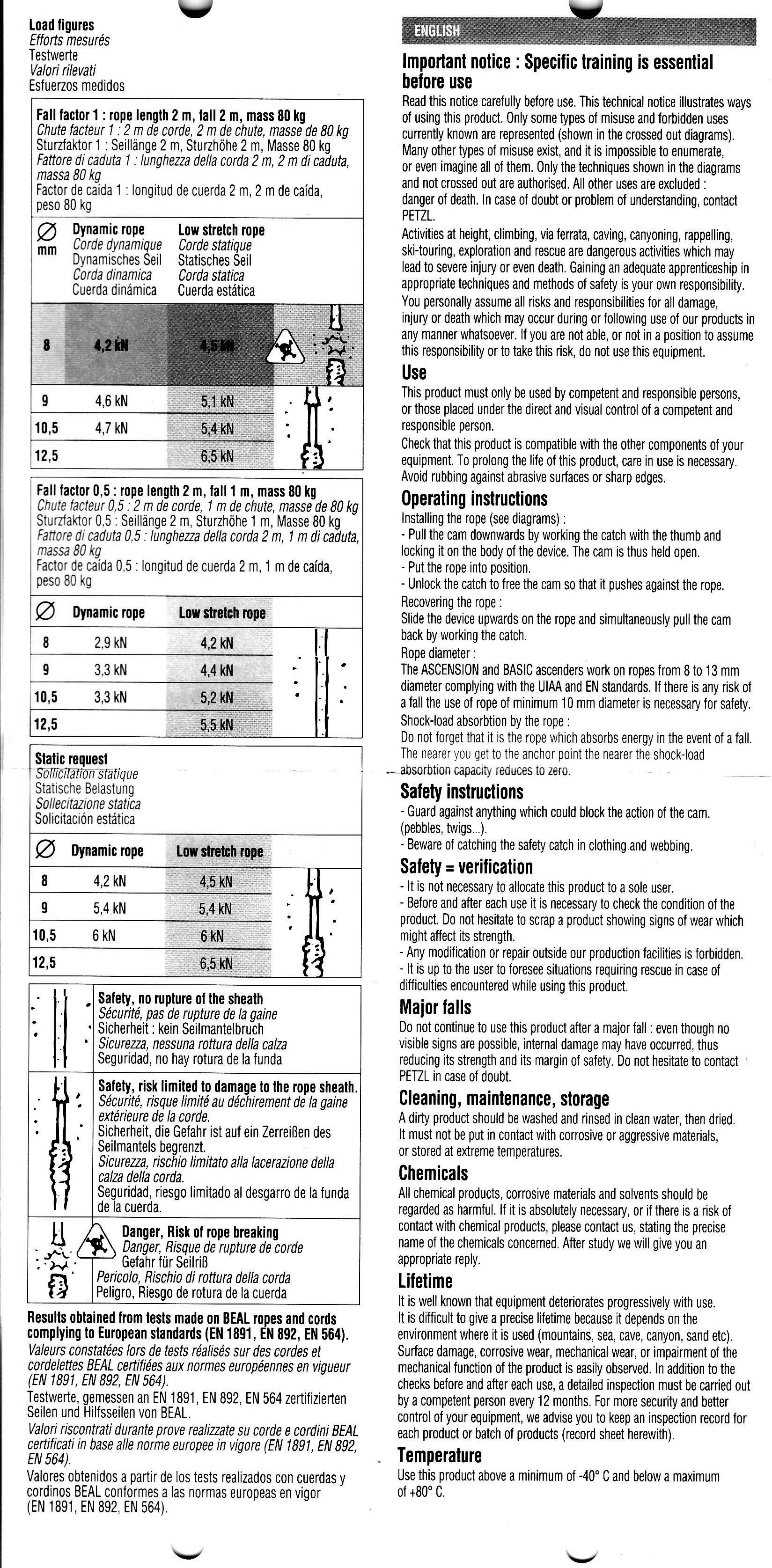
Petzl made a lighter ascender by going to a thinner shell, among other changes. This might reduce the resistance to bending in the pit lip scenario described in the Clog discussion.
Petzl eliminated one of the bottom holes, but made the remaining one large enough for multiple attachments. I like it.
The new cam is well made and the teeth are quite sharp.
The cam safety eliminated the thumb-stabbing projection. It is far more comfortable to use with the proper hand, but is still awkward to use with the wrong hand. Down-climbing is still quite awkward, since the down-pointing teeth easily snag on the rope.
The plastic guard acts as a cam stop.
In general, I like the improvements introduced in this version.
 |
 |
 |
 |
[ Top
| Version A
| Version B
| Version C
| Version D
| Versions E1 & E2
| Version E2 mod.
| Versions F1 & F2
| Versions G1 & G2
| Versions H1 & H2
| Version I
| Version J
]
[ Version K
| Version L
| Version M
| Version N
| Version O
| Version P
| Version P†
| Version Q
| Version Q†
| Version R
| Version S
| Version T
]


