

This page will not fit into a tiny viewport. Please choose a full-size monitor with a full-width window or select the abridged New Wave pages.


Version A

Version B
|
|
|
| Version A | Version B |
In 1930, Fernand Petzl discovered caving at the age of 17. Back at his workshop after each excursion to the depths, Fernand imagined new tools for exploring darkness and heights. With his inventions taking up more and more space, he decided to create his own workshop, sparking the growth of his small business. Working together brought Fernand closer to his son, Paul, who was determined to grow the business. From the beginning, Paul's wife Catherine took care of the accounting.
Paul Petzl, a mechanical engineering student, had already been thinking about creating a real company and began to plan out his first investments. In 1970, the Petzl brand was created. Five years later, the first company headquarters was established at the foot of the Dent de Crolles. In the years that followed, the number of employees increased as the company experienced local and international growth.
Petzl is a family business that, over the years, has become the largest European manufacturer of personal protective equipment for those who work and play in darkness or at height. All Petzl products are invented and developed at their headquarters in the heart of the French Alps.
The Petzl brand is present in over 55 countries with 85% of their sales made internationally. More than 9 million products are sold every year, and 10 million people use Petzl personal protective equipment every day.
[ Top | Version B | Return to H.E.C. Ascenders ]
|
|
 |
| Front View: Closed | Rear View: Closed |
 |
 |
| Front View: Open for Rigging | Rear View: Open for Rigging |
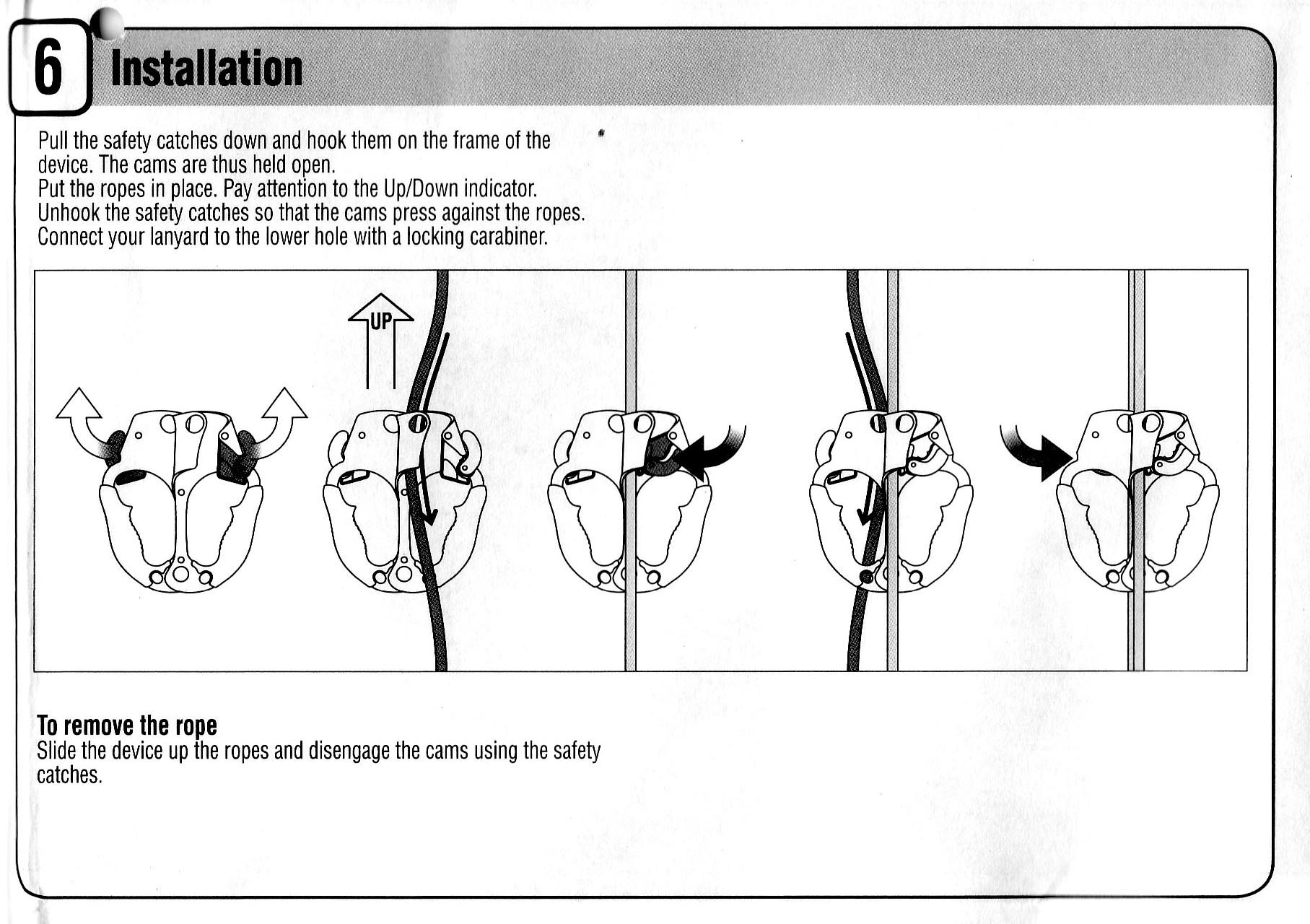
 I acquired my Petzl Ascentree from On Rope 1 in 2009. I acquired another in 2017 as part of Bob Thrun’s collection.
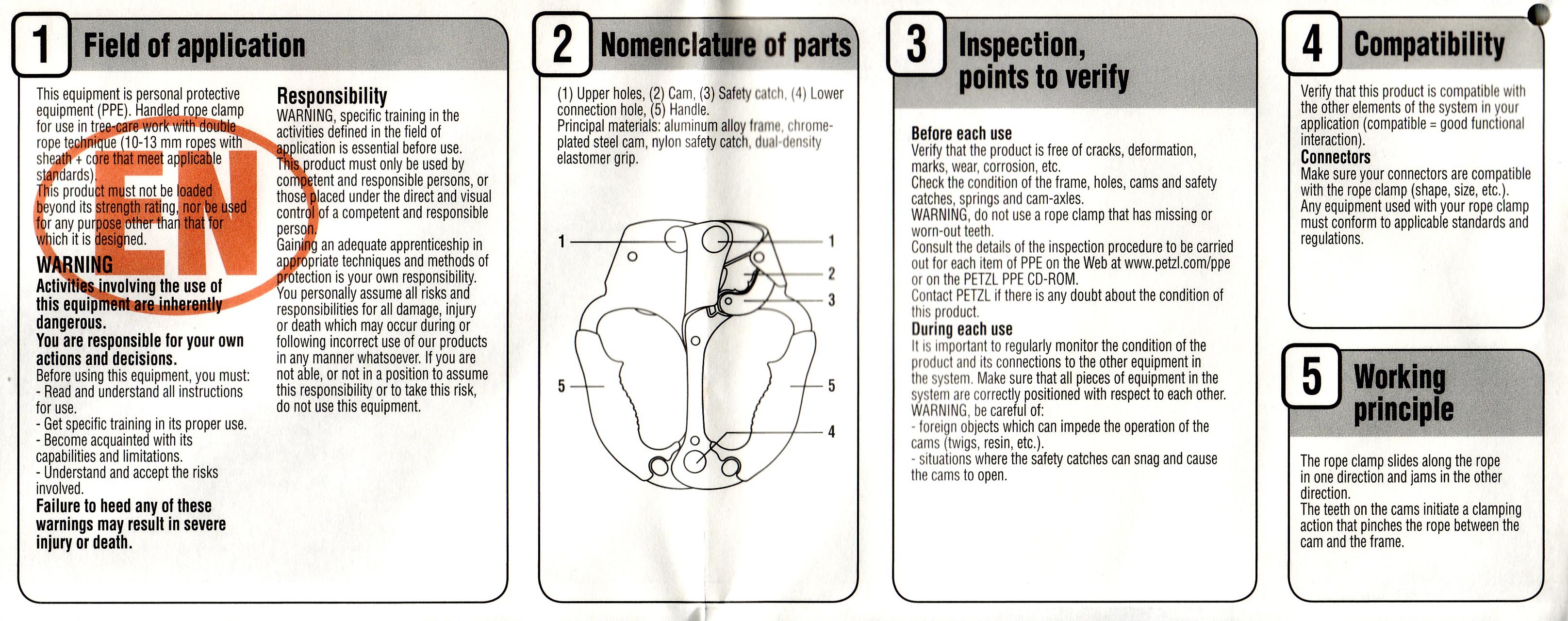
This Petzl Ascentree is 190 mm. tall, 169 mm. wide, 45 mm. thick, and weighs 397 g. It looks like two 2009 Petzl Ascension, Version J ascenders riveted together, but close inspection shows that the frames are not the same, nor are the cam safeties. The hand opening on the Ascentree is larger than the one on the Ascension, and the hand grip is sloped instead of nearly vertical as on the ascension. The Ascentree shell is not stamped with reinforcing ribs, either. The two have the same cam, but different cam safeties: the Ascentree cam safety does not have the pain-producing point that the Ascension safety has.
The front of the rope channel portion of the shell is stamped with an up-pointing arrow surrounding the word "UP," "ASCENTREE," and a book-with-an-"i" icon. One side is printed with "CE0197," "Made in France," "Patented," "08329FR0677," a scanner code, "• ø10-13mm," and the Petzl logo. The hand grips have the Petzl logo cast into both sides, as do the cams.
The Ascentree is a dual-handled ascender intended for arborists, so I'll let Tarzan evaluate it for that purpose. Dual ascenders do not have a major role in the type of caving that I prefer. I don't know why the Ascentree is limited to 10-13 mm. ropes when the Ascension can handle 8-13 mm. ropes. Although I would rather see reinforcing ribs in the shell; perhaps the Tarzans don't run into the ascender-folding situation at pit lips that we sometimes encounter.
I find the hand grips to be slightly too small for my hands, but I have extra(or extra-extra) large hands.
 |
 |
 |
 |
[ Top | Version B | Return to H.E.C. Ascenders ]
|
|
 |
| Front View: Closed | Rear View: Closed |
 |
 |
| Front View: Open for Rigging | Rear View: Open for Rigging |
 I acquired my Petzl Ascentree from On Rope 1 at the 2016 NSS Convention.
Version B is 295 mm. tall, 169 mm. wide, 42 mm. thick, and weighs 339 g.
Version B replaces the three bottom holes on Version A with a larger hole capable of accepting two standard carabiners. The cam has changed, as has the cam safety. There is a new plastic piece above the cam, held in place by a Phillips screw. The rope channel is 15 mm. wide. The cam radius increases from 38 to 55 mm. over an angle of 34°, giving a 32° cam angle. The tooth pattern is (3.4)(1S1)^2(2S2)(1S1)^3(2.3.4.3).
The front of the rope channel portion of the shell is stamped with an up-pointing arrow surrounding the word "UP," and "ASCENTREE." There is a book-with-an-"i" icon stamped behind the cam. One side is printed with "CE 82," "Made in France," "Patented," "• Ø10-13mm 140Kg," the Petzl logo, "15345FN9398,": and a scanner code. The hand grips have the Petzl logo cast into both sides, as do the cams.
The significant change is the reduction in the number of attachment holes from three to one. I question whether that was a step in the right direction.
The plastic piece above the cam seems to be more cosmetic than functional.
|
|
|
|
|
|
[ Top | Version A | Version B ]