

This page will not fit into a tiny viewport. Please choose a full-size monitor with a full-width window or select the abridged New Wave pages.

|
|
 |
| Front | Rear |
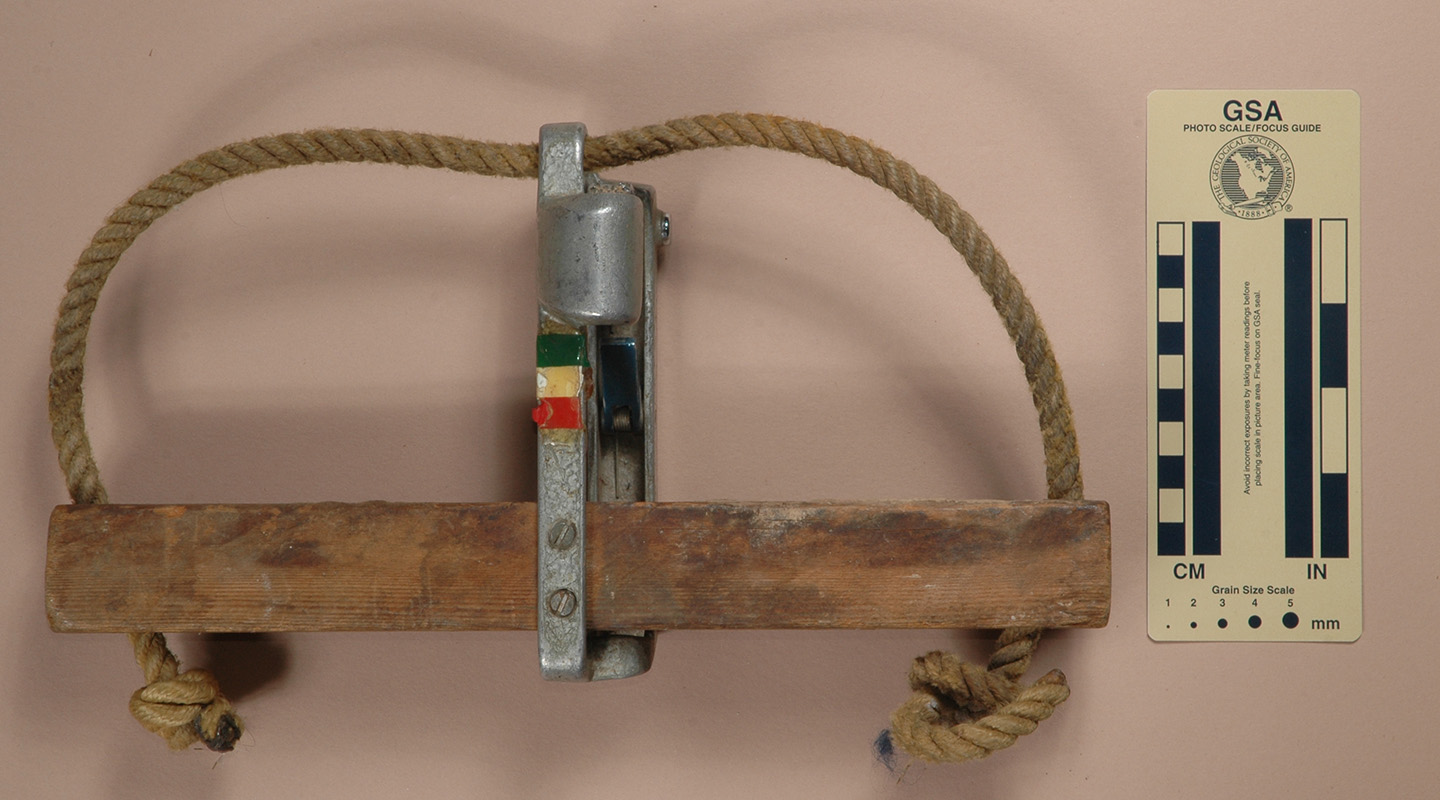
 Mike Walsh gave me his old Mar-bar rig at the 2001 NSS Convention.
Mike’s Mar-bar rig is 162 mm. tall, 306 mm. wide, 74 mm. thick, and weighs 451 g. It consists of a pine board attached to an old Jumar ascender. The rope is 3/8" (9.5 mm) Goldline.
Mar-bars are used in the inchworm climbing system, a sit-stand system that is particularly easy to teach, and one that worked rather well on long, free drops. Old Mar-bar rigs were homemade, and often crude. Cavers rarely use the inchworm any more, but recently some arborists have adopted it, and commercial Mar-bars such as the Buckingham are now available.
Thanks to the wood, Mike’s Mar-bar rig is lighter than many others that use metal for the foot bar. One thing that I do not like about Mike’s Mar-bar is that the weight is transferred to the ascenders by the screws - the wood bar does not rest against the bottom of the Jumar handle opening.
To improve efficiency, one should ensure that the rope loops fit tightly.
Mike Walsh was an American caver from Texas.
This Mar-Bar uses a Jumar ascender.
Jümar Pangit was a Swiss manufacturer located in Reichenbach, founded by Adolph Juesi (Jüsi) and Walter Marti. Mr. Juesi was studying eagles for the Swiss government and needed to ascend on ropes in order to perform his work, so Mr. Marti developed the ascender for him. In 1958, they introduced the first Jümar to the climbing market.
Originally spelled "Jümar," the umlaut was dropped in many countries that do not use umlauts in their native language.
The Jumar began to appear in American caving circles in the early 1960s, and remained the most popular mechanical ascender from that time until Europeans zealots demanded that all Americans must climb frog and only frog.
Around 1977 Mr. Marti developed the Jumar Combi. This ascender was far ahead of its time, with features like stamped frame (but looking nothing like the Petzl), a plastic cam with replaceable metal teeth, a safety catch that kept the rope from coming out the side, and a pulley that clipped onto the ascender for hauling. Some prototypes were shared, but Walter Marti decided that it was just too much of a change from tradition and the Combi never made it into full production. Mr. Marti didn't even keep a pair for himself.
1979 saw major redesign of the Jumar with new frames, cams, and safeties. The new "Jumar 79" series is easily recognized by its bright yellow paint.
In 1982 Ivisited Walter Marti. Hei shared a great deal of information with me about his ascenders while his secretary, Mrs. Baumann, translated. Both Mr. Marti and Mrs. Baumann were very friendly. I learned that there are many variations of Jumar that were never put into commercial production. I saw early Jumars whose cams had "Z" shaped teeth similar to those found on the early Clog ascenders. These are the ones described as "verzahntes bogenförmiges Ende" (serrated arcuate end) in Swiss Patent 362351.
In the 1990s, Jumar production was taken over by Wohn und Arbeitsgemeinschaft für Körperbehinderte Gwatt of Gwatt, Thun and subsequently by Fritschi. Production ceased in the 1990s or 2000s.