

This page will not fit into a tiny viewport. Please choose a full-size monitor with a full-width window or select the abridged New Wave pages.


Rig, Version A

Rig, Version B
|
|
|
| Rig, Version A | Rig, Version B |
In 1930, Fernand Petzl discovered caving at the age of 17. Back at his workshop after each excursion to the depths, Fernand imagined new tools for exploring darkness and heights. With his inventions taking up more and more space, he decided to create his own workshop, sparking the growth of his small business. Working together brought Fernand closer to his son, Paul, who was determined to grow the business. From the beginning, Paul's wife Catherine took care of the accounting.
Paul Petzl, a mechanical engineering student, had already been thinking about creating a real company and began to plan out his first investments. In 1970, the Petzl brand was created. Five years later, the first company headquarters was established at the foot of the Dent de Crolles. In the years that followed, the number of employees increased as the company experienced local and international growth.
Petzl is a family business that, over the years, has become the largest European manufacturer of personal protective equipment for those who work and play in darkness or at height. All Petzl products are invented and developed at their headquarters in the heart of the French Alps.
The Petzl brand is present in over 55 countries with 85% of their sales made internationally. More than 9 million products are sold every year, and 10 million people use Petzl personal protective equipment every day.
[ Top | Rig v. B | Return to Double-Stop Bobbins ]
|
|
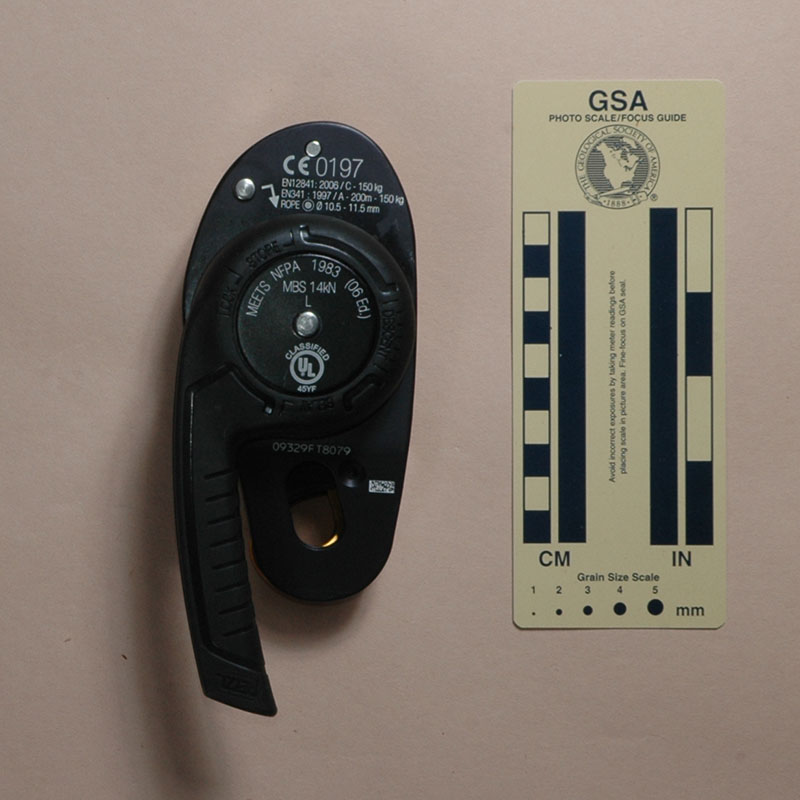 |
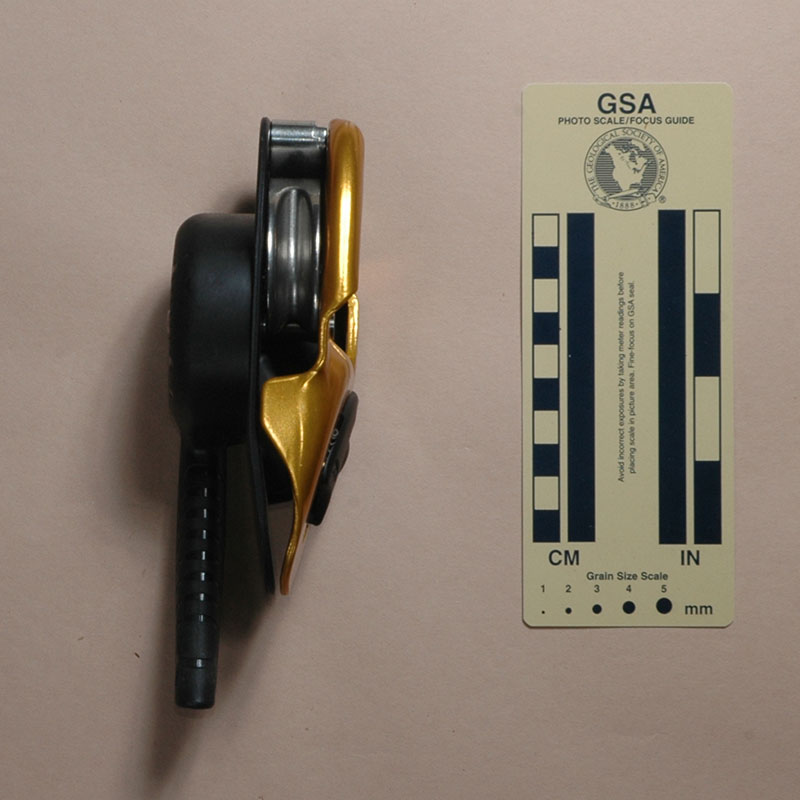 |
| Front View Handle in Storage Position |
Rear View Handle in Storage Position |
Side View |
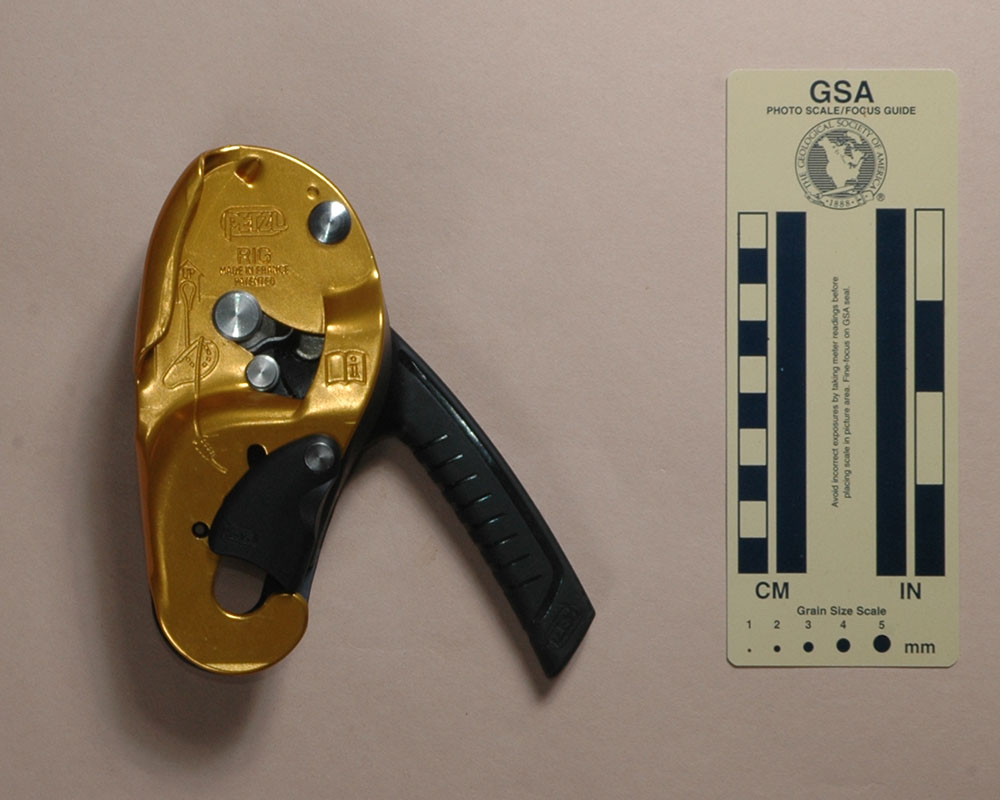 |
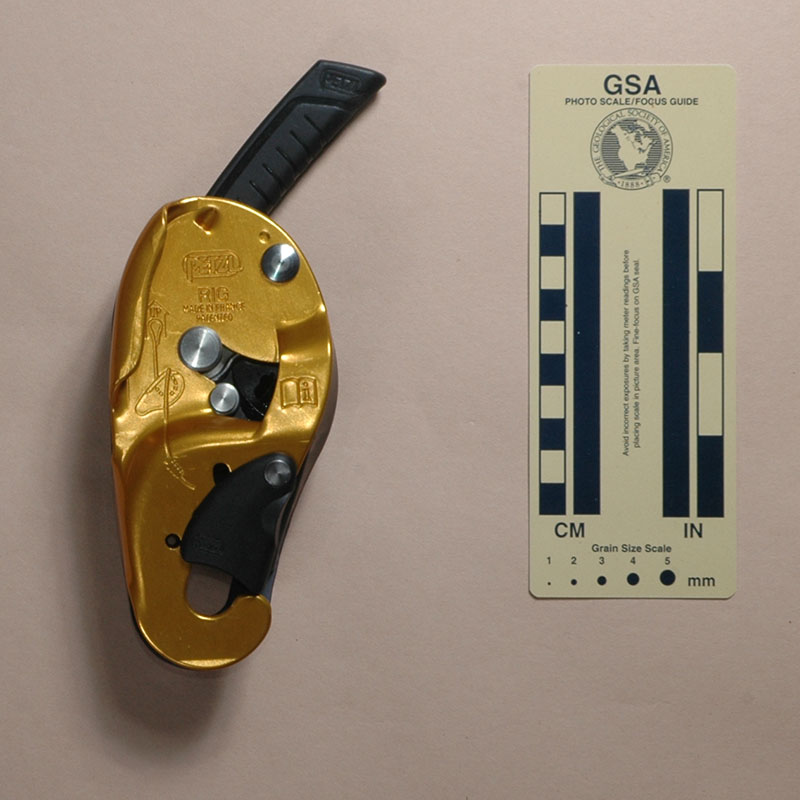 |
 |
| Front View Handle in Lock Position |
Front View Handle in Belay Position |
Front View Handle in Rappel Position |
 |
 |
| Front View: Open for Rigging Handle in Intermediate Position |
Rear View: Open for Rigging Handle in Intermediate Position |
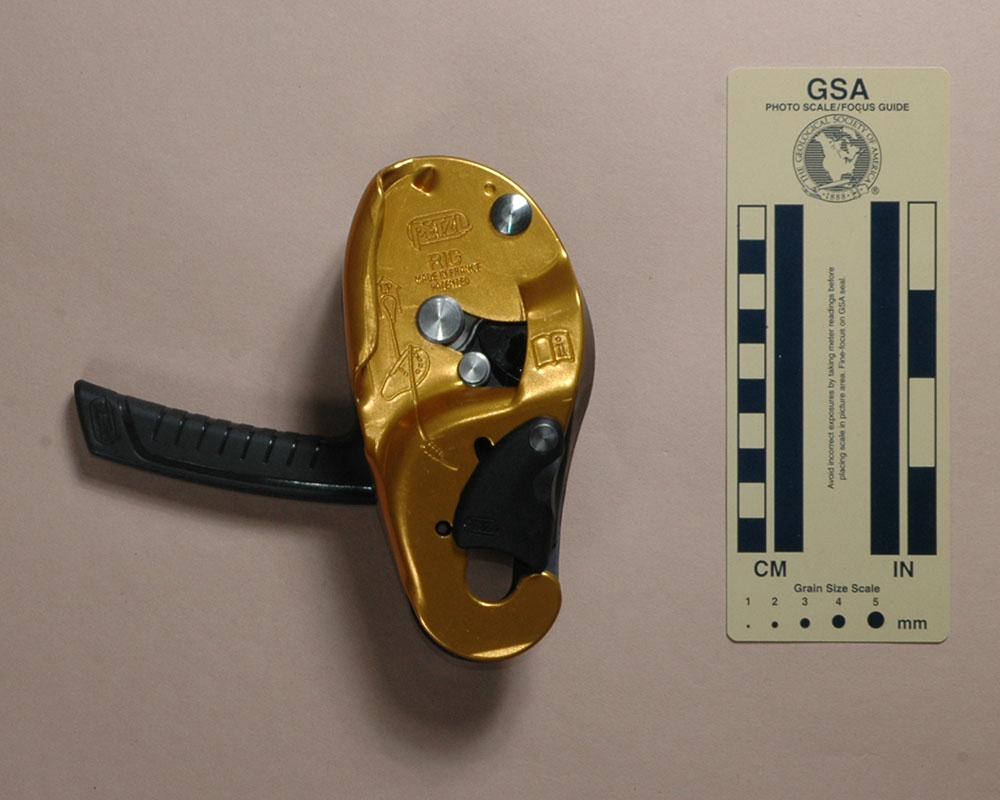
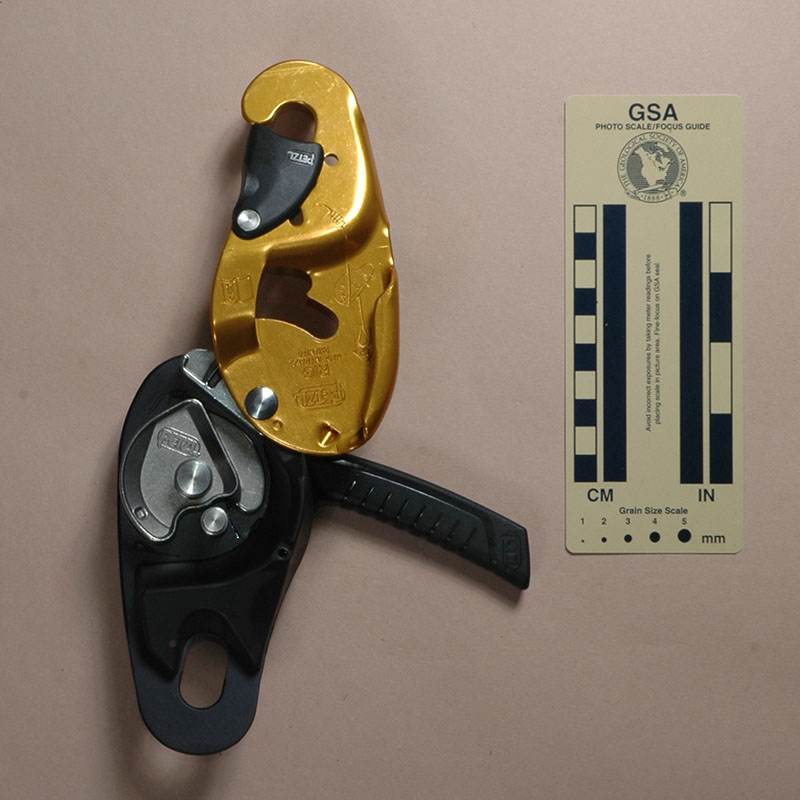
 I acquired my Petzl Rig, Version A from On Rope 1 in 2010. I bought a used one from Ed-Man Corporation in 2017 and cut it open in 2021 to show the internal mechanism.
This Petzl Rig is 177 mm. tall, 67 mm. wide, 58 mm. thick, and weighs 379 g.
The Rig is basically a smaller, simplified variation on the Small I’D, Version A. The following description is based on the one for the Small I’D, Version A, with the unchanged text shown in gray.
The Rig is shaped like an inverted pear (or perhaps an avocado) with a handle on the back. There are two stamped aluminum plates with a variety of other parts attached. The rear plate is black anodized 3 mm. aluminum, and serves as the main frame. The lower portion of this plate is bent forward, and a 14.9 by 26.0 mm slot serves as the clip-in eye.
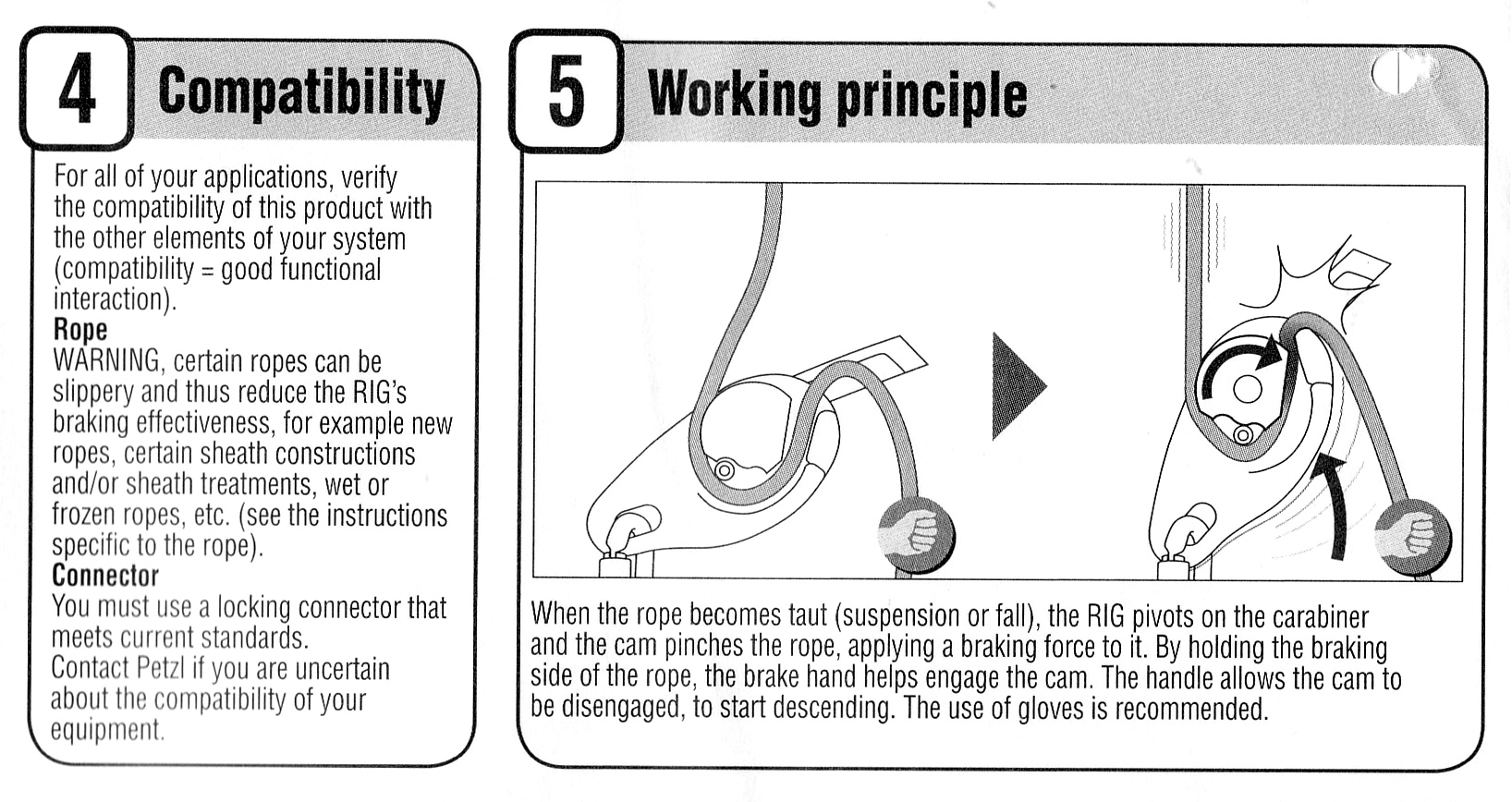
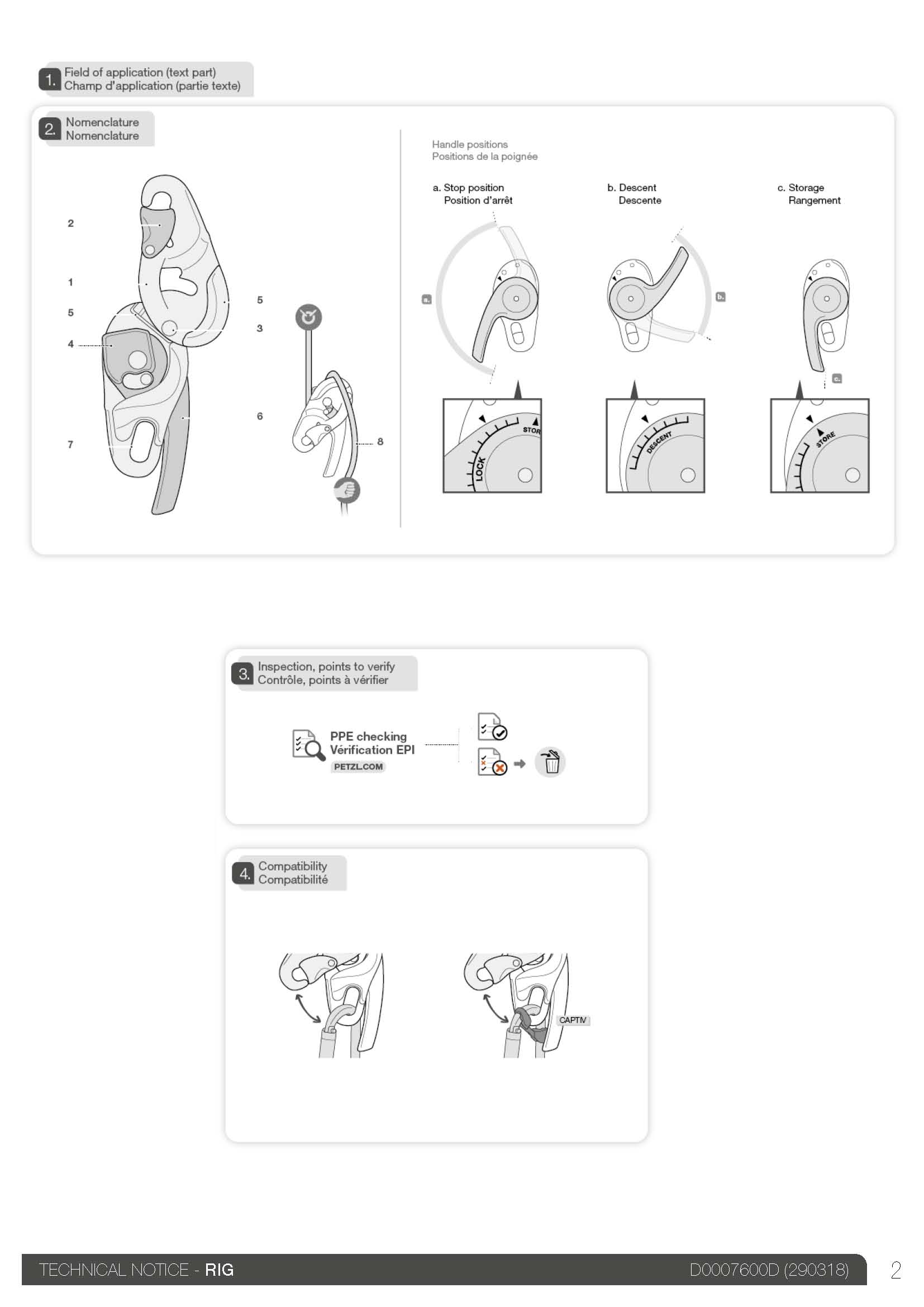
The rear plate has several components mounted on it. Starting from the top, there is a 16.5 mm. thick rounded triangular anvil mounted at the upper right. Below this to the left is a 50 mm. diameter bollard. Most of the bollard’s circumference is grooved to guide the rope. The upper left side of the main bollard is flattened so that the rope can run between it and the anvil. The lower portion is cut away to clear a small post. The main bollard can be rotated about 30 degrees using the handle. Rotating the bollard clockwise squeezes the rope against the anvil, stopping the descent.
The post is slightly grooved, being 10 mm. in diameter at the ends and only 8.3 mm. in the center. Although the rope runs over the post, its primary function is to limit the rotation of the main bollard.
The Rig does not have the "anti-error catch" present on the I’D.
Finally, a plastic guide runs down the right side of the Rig. Its function is cosmetic. There is a countersunk hole in the rear plate, beside the clip-in eye, that aligns with a smaller diameter hole in the plastic guide. This is obviously intended for a self-tapping screw to secure the guide, but my Rig came without such a screw.
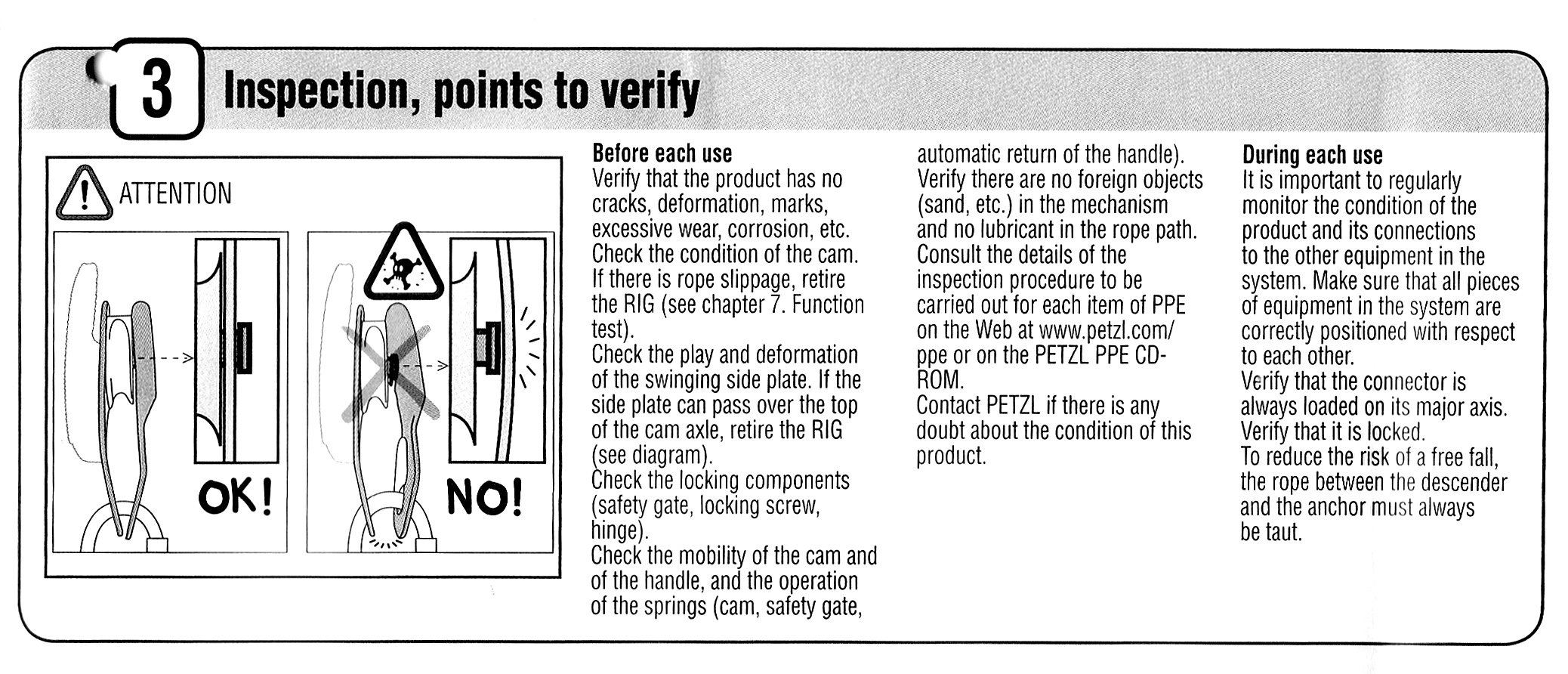
The front plate is mounted and pivots on a small rivet attached to the lower right corner of the anvil. The fit is quite loose. This plate is stamped into a more complex form than the rear plate. The left side is bent back on itself to create a rounded edge for the rope to run against. The left side is raised so that it clears a slot that engages a rim on the main bollard pivot. A notch in the slot rests against the small bollard. A dimple in the top hits the anvil; unlike similar dimples on Petzl ascenders, this one actually makes contact. A J-notch on the lower portion of the front plate lines up with the oval hole on the rear plate. The notch admits the seat maillon. Unlike the Small I’D, Version A, the notch carries weight. A plastic safety catch keeps the front plate from accidentally opening. The notch is not deep enough to fully secure the seat maillon without the catch engaged.
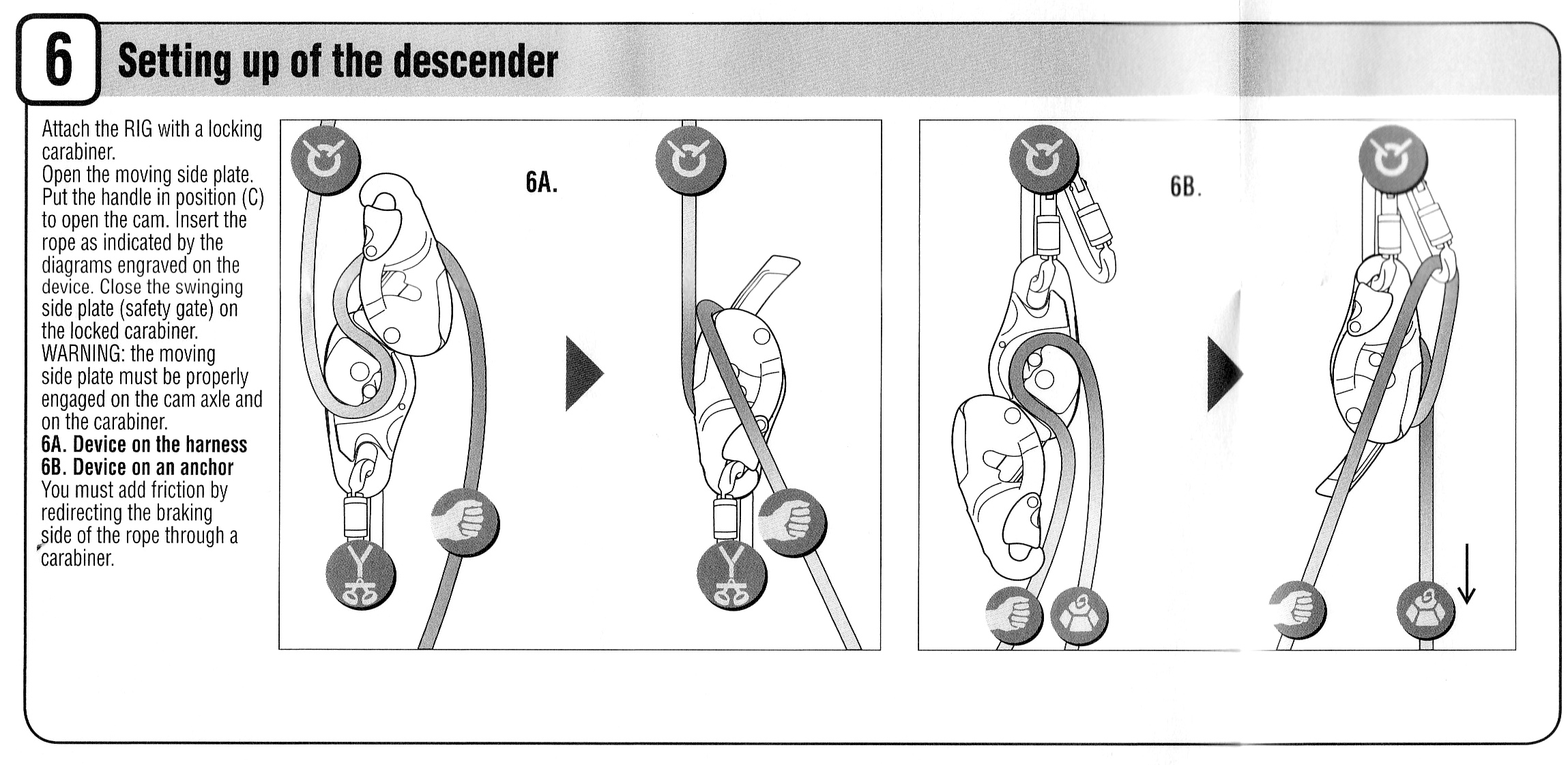
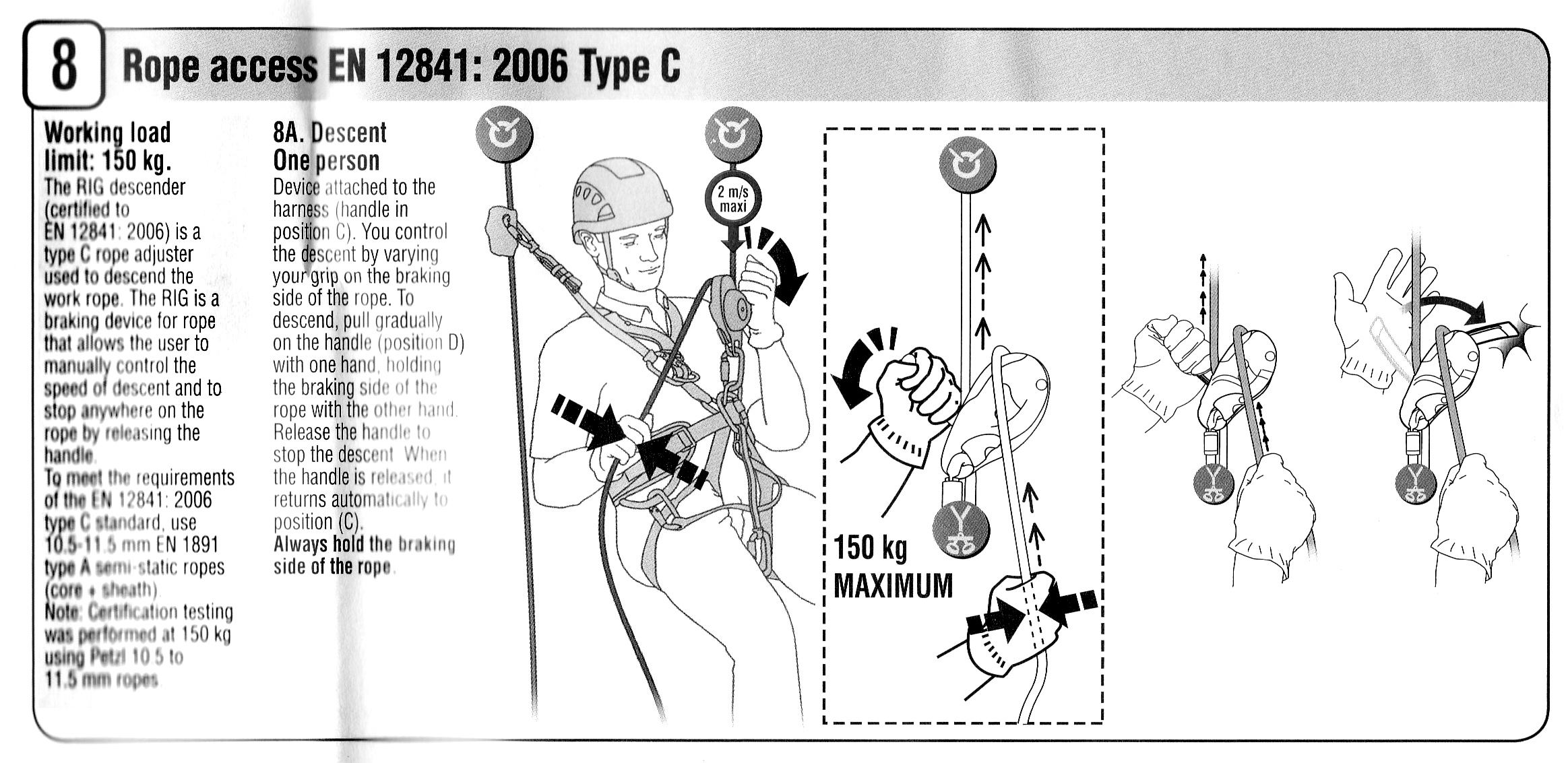
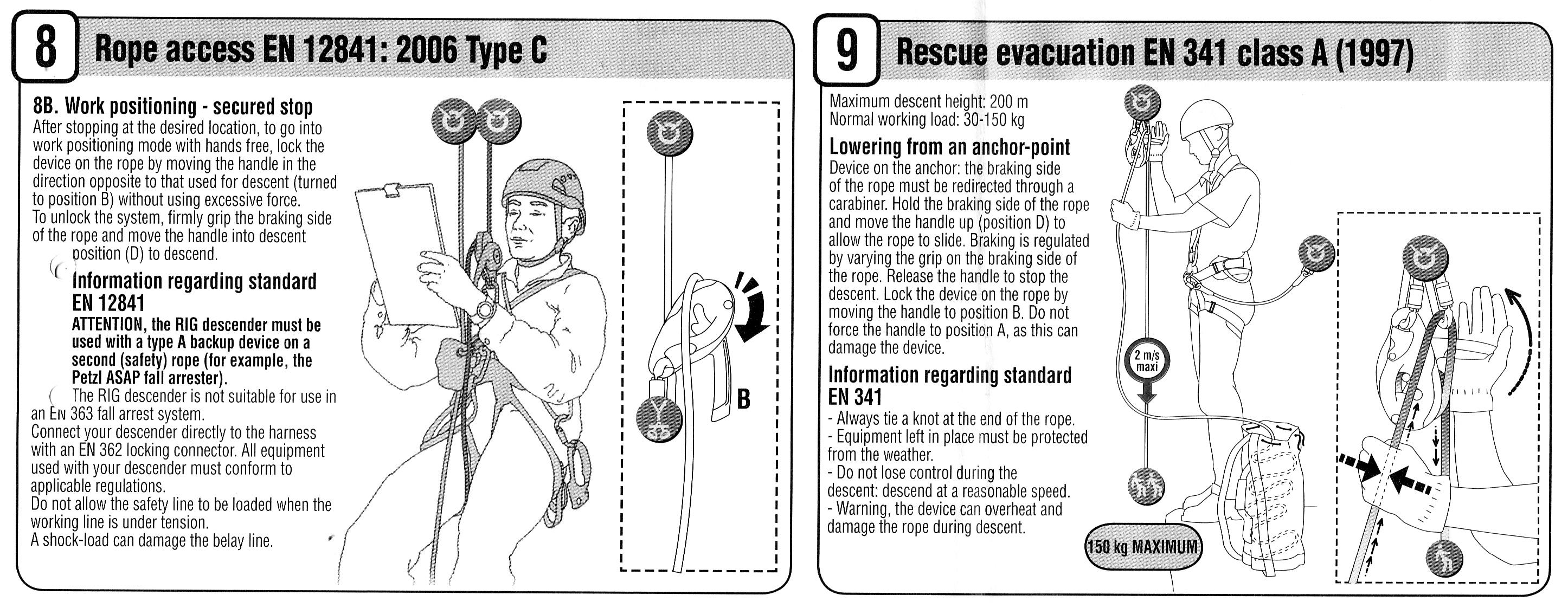
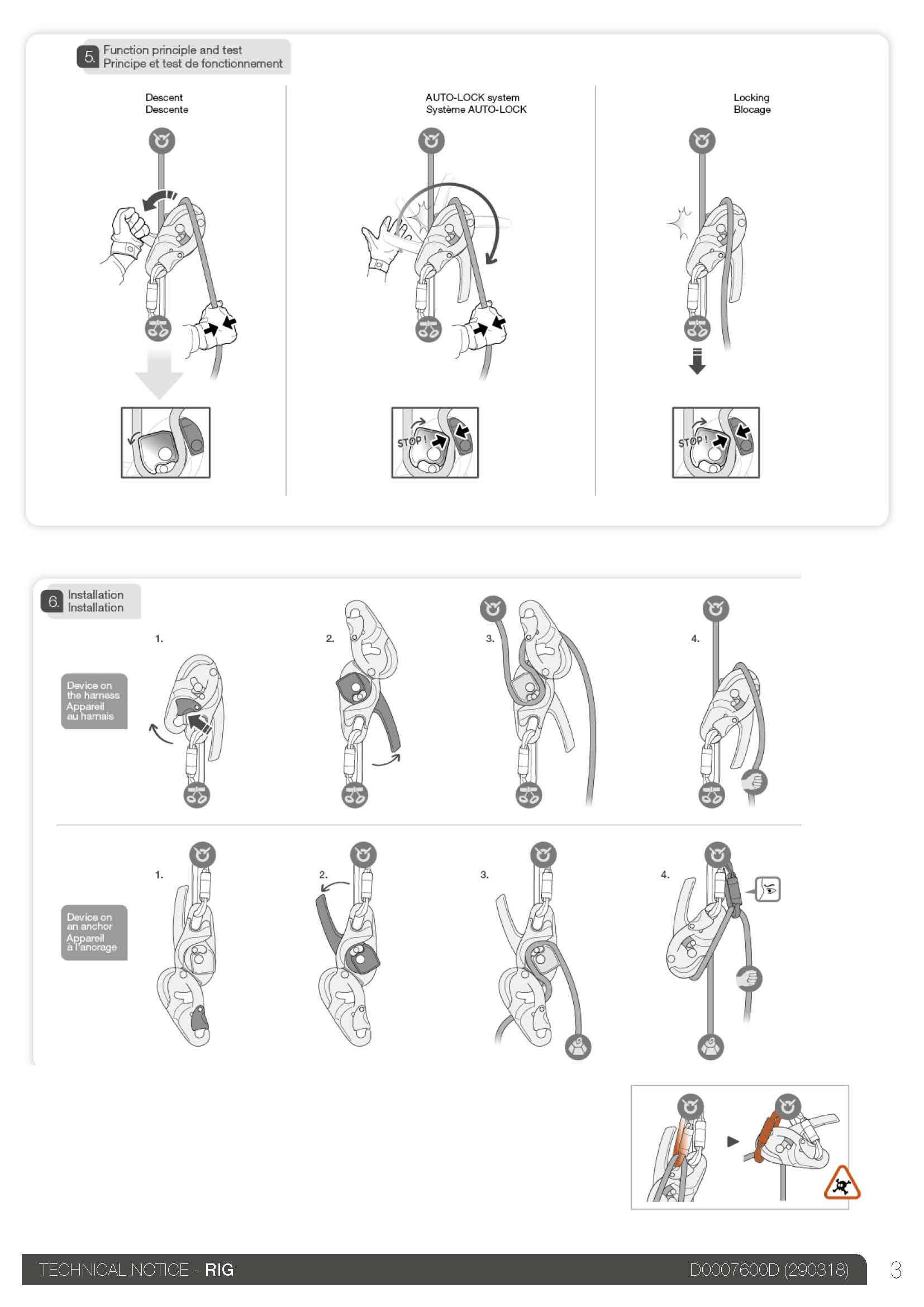
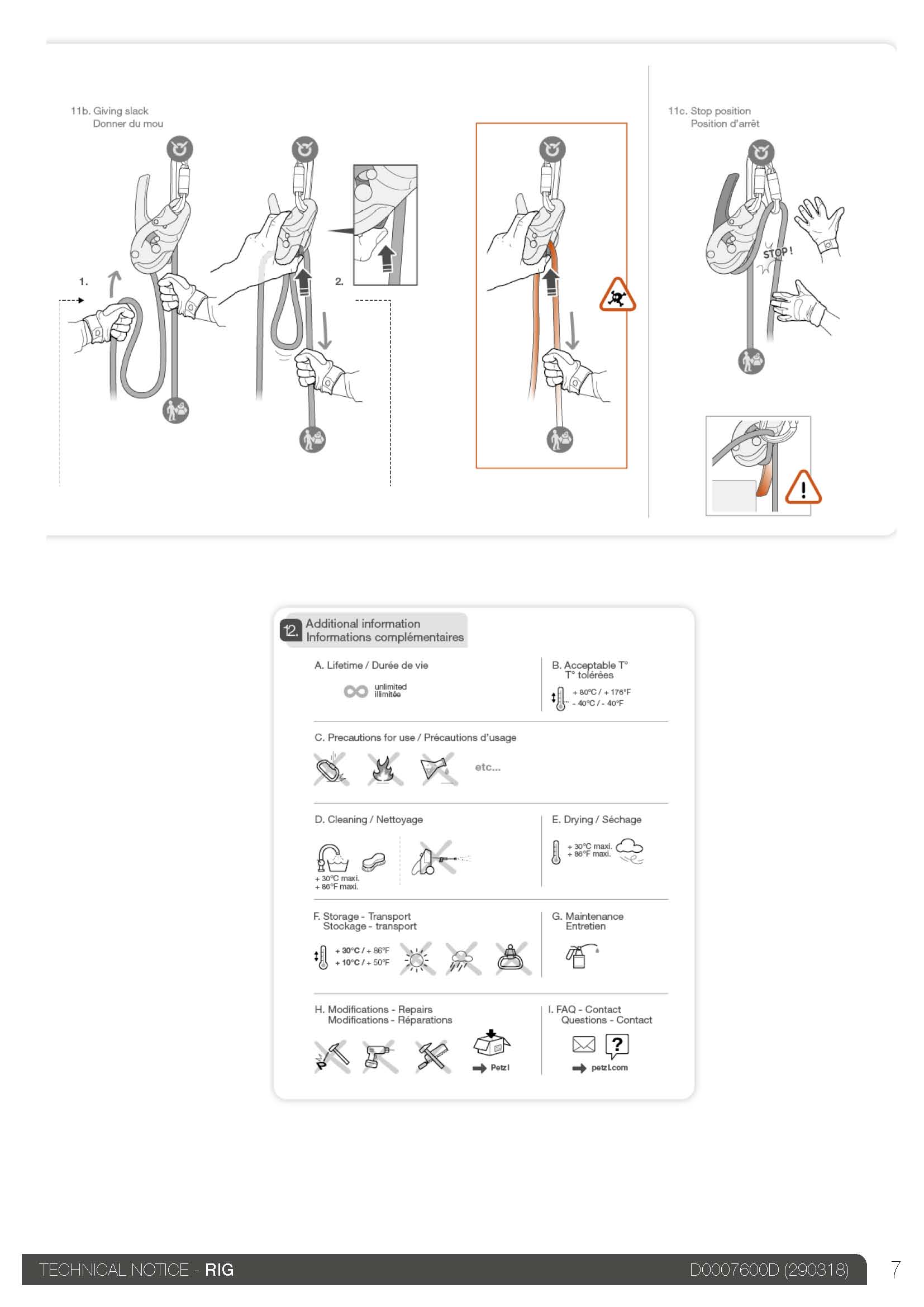
The normal rigging path is to bring the rope down the left side, under the main bollard and smaller bollard, and up between the main bollard and the anvil, then out the top and over the anvil. The rope path is much like the classic bobbin rope path.
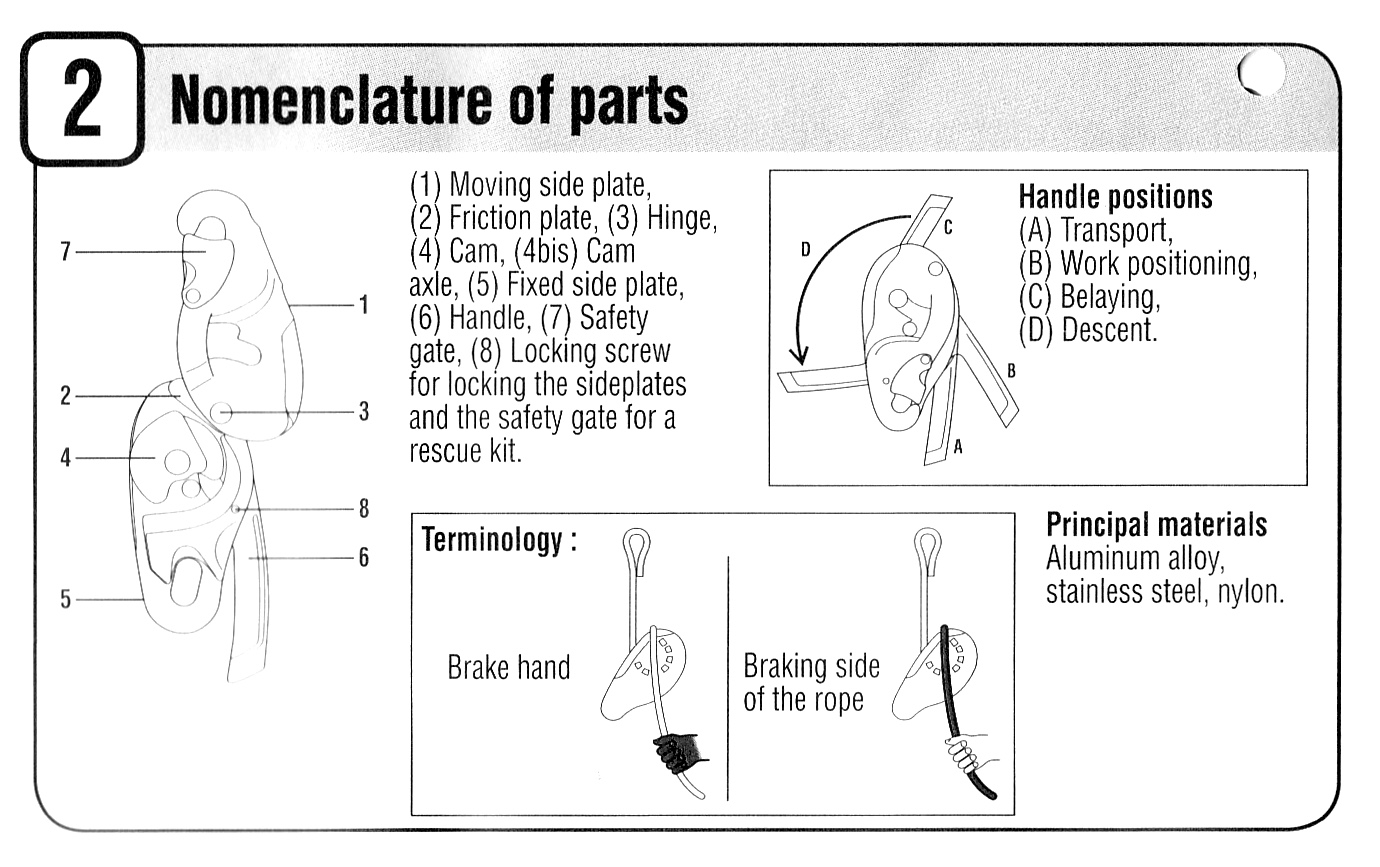
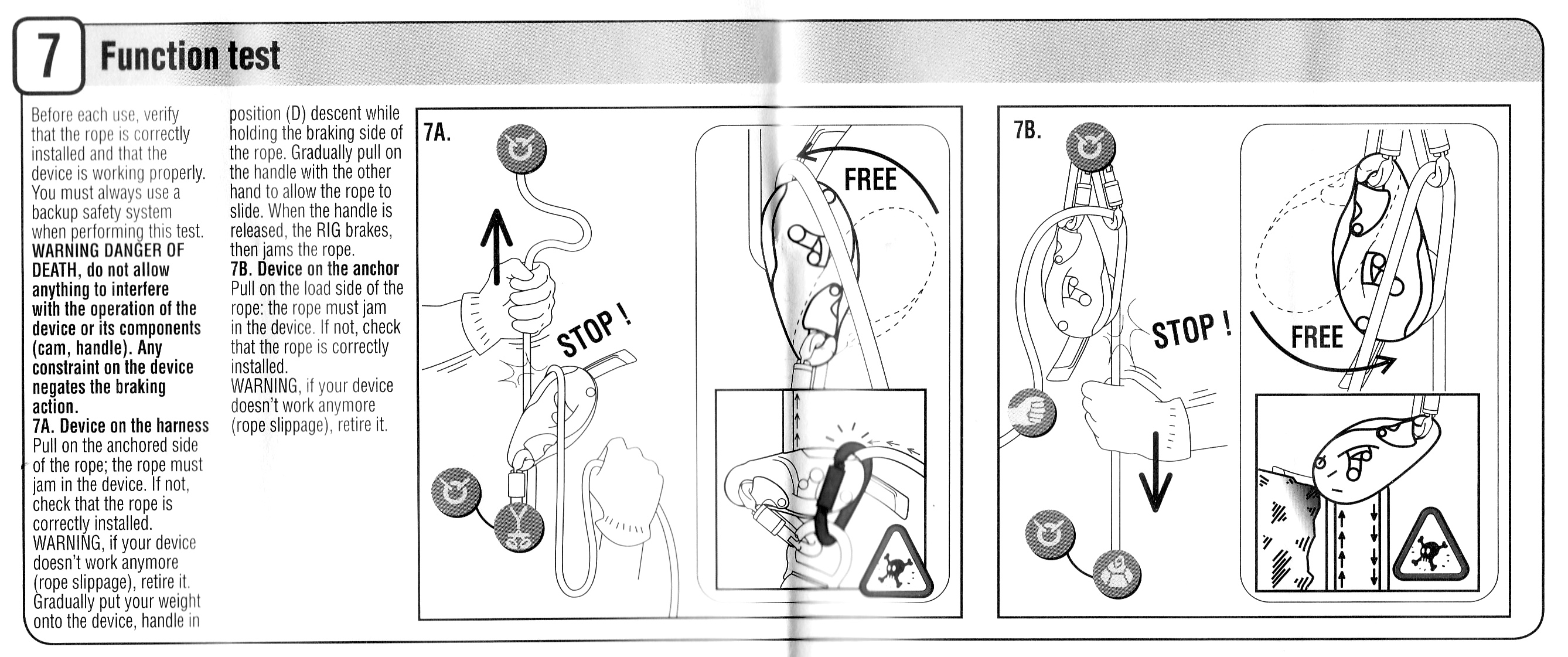
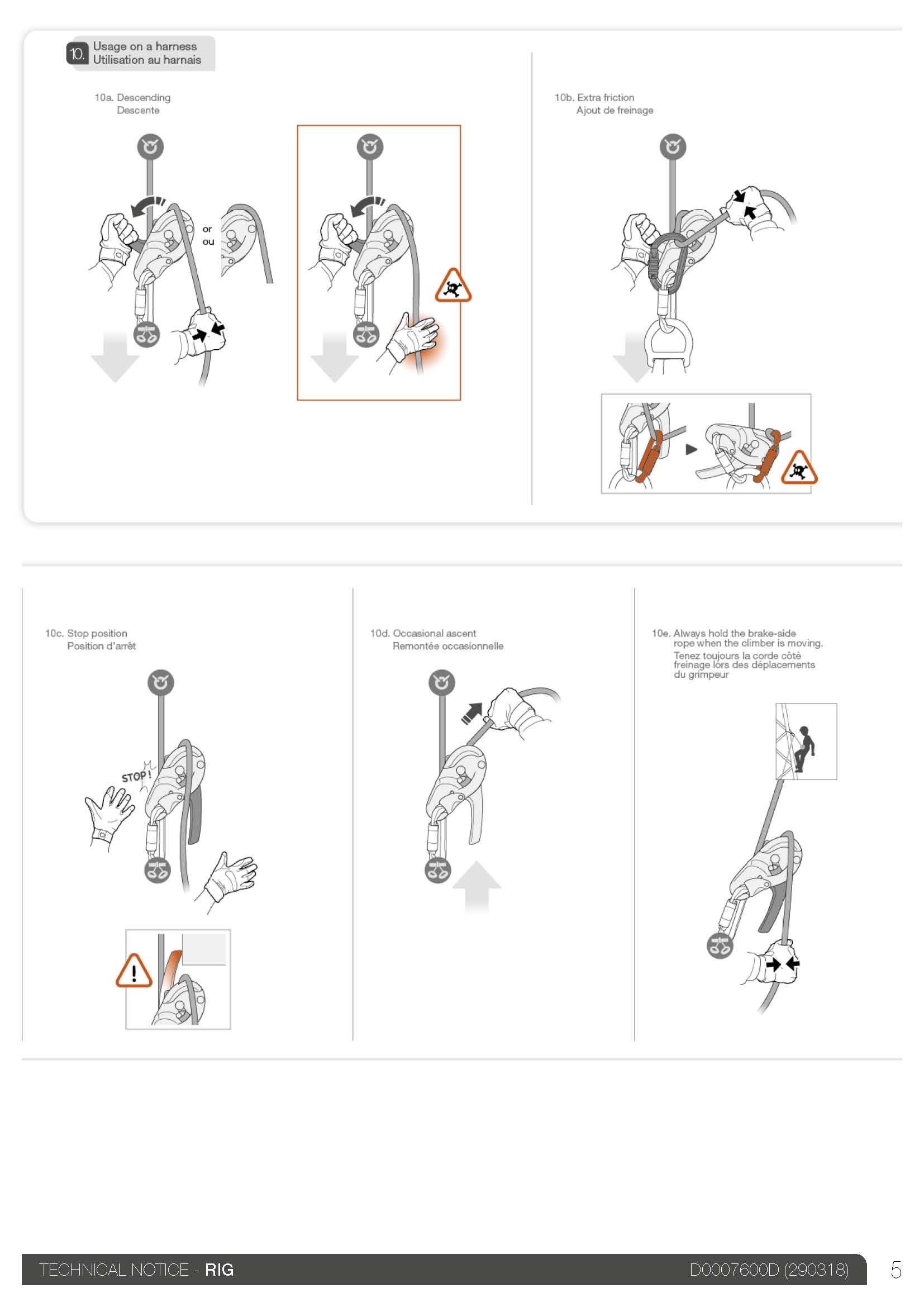
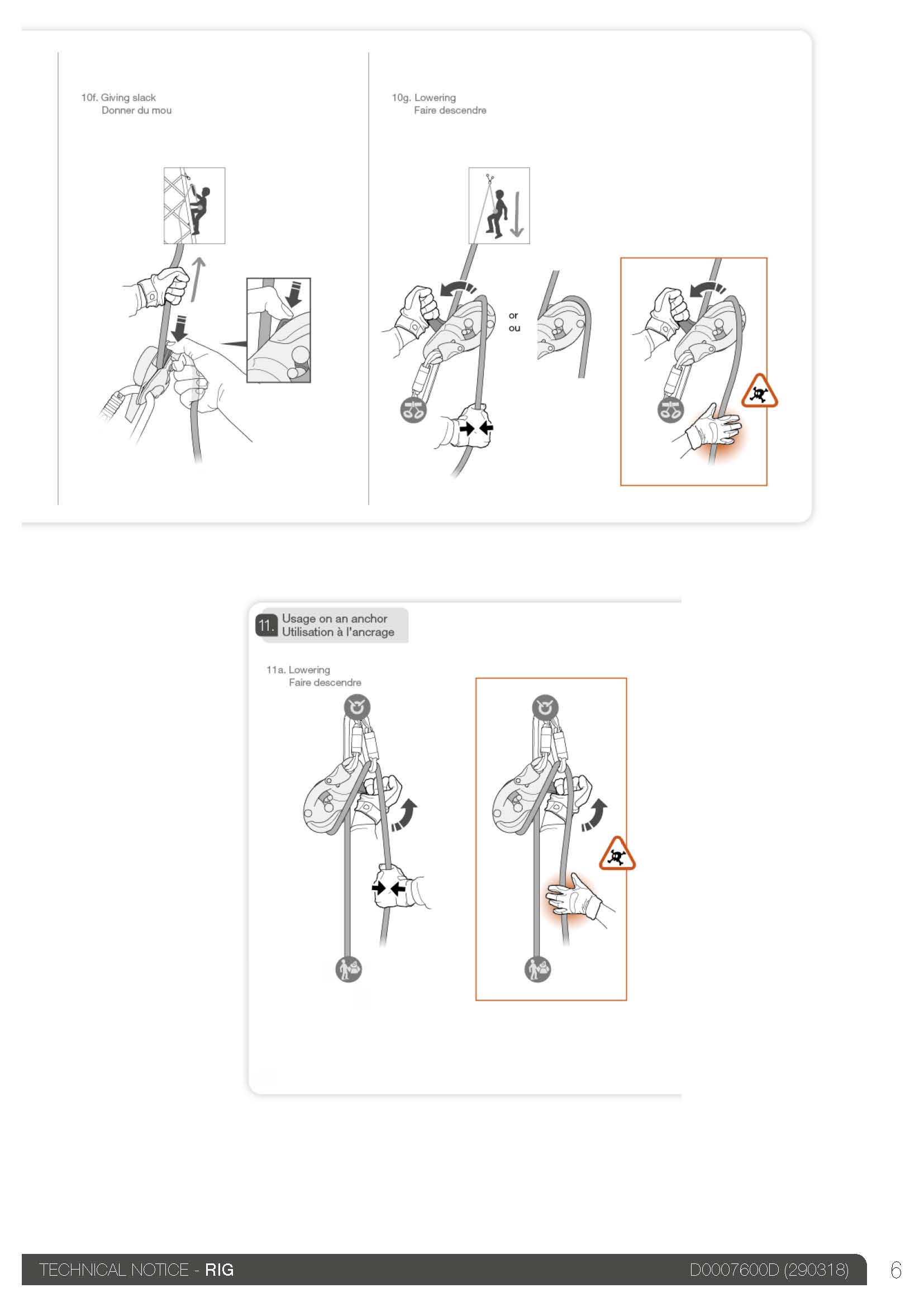
The main bollard is turned by the handle on the rear of the device. The handle pivots on an extension of the front post, and held on by a 40 mm. diameter aluminum fender washer. A clutch assembly controls the motion. The clutch is not visible without destroying the device. A light spring tends to turn the bollard counter-clockwise, but when used on rope the rope friction completely overpowers the spring. As a result, the behavior of the device on rope is quite different than one would expect after examining the device in the hand. The device works as follows: When viewed from the front, the normal descending position is with the handle at 10 o’clock. The rope friction is turning the bollard so that the rope is squeezed against the anvil Pulling down (counter clockwise) on the handle turns the main bollard counterclockwise, which releases the rope. The Rig does not have the over-travel braking function that the I’D has. The handle on the Rig is spring-loaded, so it returns to the 1 o’clock ("belay") position when released.
Turning the handle from 1 o’clock to 4 o’clock puts the rig into the "lock" position. The next step is the "storage" position at 6 o’clock.
The front plate is stamped with the Petzl logo, "Rig," "MADE IN FRANCE," "PATENTED," a book-with-an-"i" icon, and an illustration of the device in use. The outside of the rear plate is marked with an indexing arrow pointing to the handle markings, "CE0197," "EN12841:2006/c - 150 kg," "EN341:1997/A - 200m - 150 kg," "Rope * Ø 10.5 - 11.5 mm, "09329FT8079" and a digital scanner ID pattern. and "MAX 150 Kg /200m." The inside has symbols that I believe are intended to show how the device is rigged. One symbol looks like a shepherd’s crook, the other shows a hand holding a rope. The main bollard has Petzl logo cast into it. The handle has various index markings labeled "DESCENT, "BELAY," "LOCK," and "STORE." The retaining washer is marked with "MEETS NFPA 1983 (06 Ed.)", "MBS 14kN", "L," the UL "Classified" logo, and "45YF."
The Rig is smaller than the ID and lacks some of the annoying features provided on the ID, such as the over-travel brake and the anti-error catch. It still has hidden parts that make me hesitant to take it into muddy environments, but the Rig wasn't really designed as a caving descender, so enough said.
 |
 |
 |
 |
 |
 |
 |
 |
[ Top | Rig v. A | Return to Double-Stop Bobbins ]
|
|
 |
 |
| Front | Rear | Right Side |
 |
 |
 |
| Left Side | Front: Open for Rigging | Rear: Open for Rigging |
I acquired my Petzl Rig, Version B from On Rope 1 at the 2019 NSS Convention.
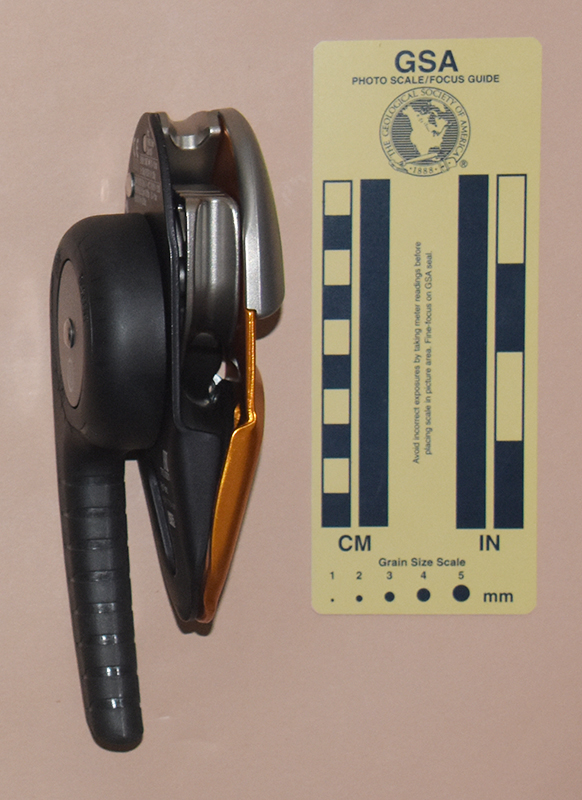
This version is 179 mm. tall, 70 mm. wide, 54 mm. thick, and weighs 402 g. The main differences between version B and A is that version B replaced the turned rope-running surface at the top left with a stainless steel casting.
The front plate is stamped with a hand holding a line representing the rope, a Reading-Is-Dangerous icon, "RIG," and another line representing the rope to the anchor.
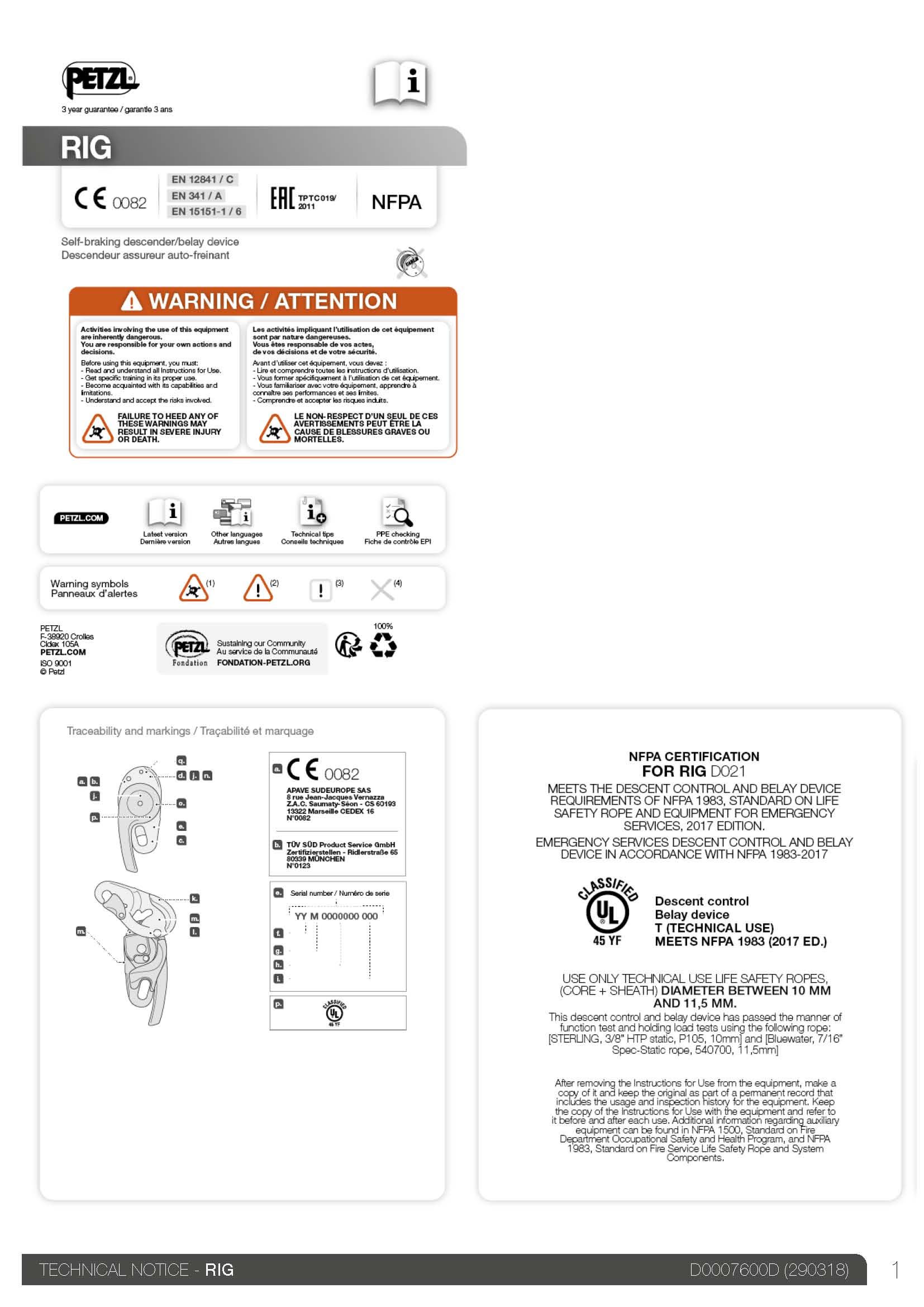
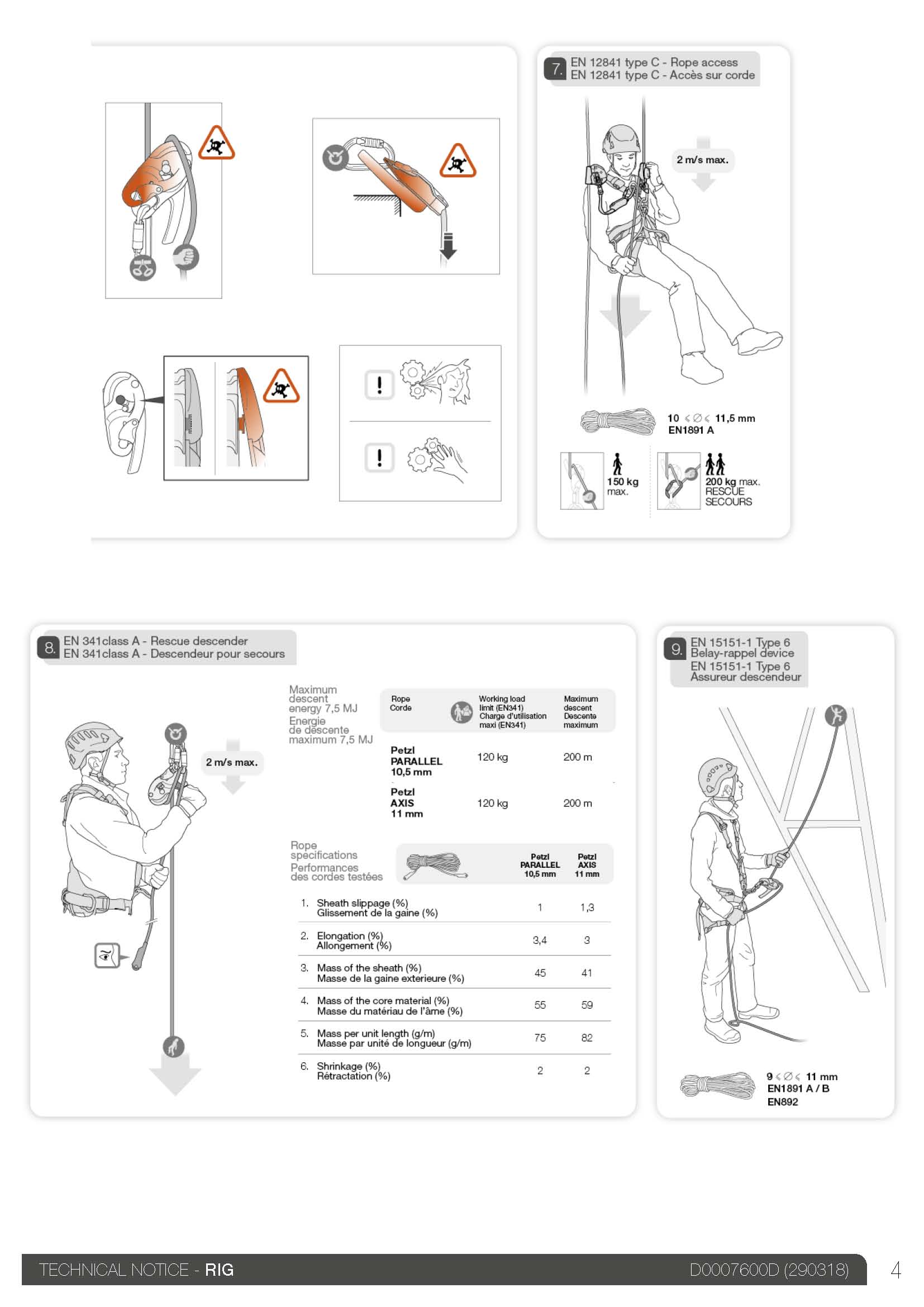
The outside of the rear plate is printed with "CE," "0082," "Petzl," "F-38920 Crolles," "Cidex 104A," "EN12841: 2006/C • 10-11,5 mm," a man icon followed by ":150kg•10-11.5 mm" and then two man icons followed by ":200kg," "EN341 : 2006/C-200T>-40°C," "Petzl PARALLEL 10,5-30/120kg," "Petzl AXIS 11mm-30/120kg," "EN15151-1-2012/6," "Ø9-11mm," a triangle pointing toward the handle, "EAC," "TP/TC 019/2011," "Pat.Pend.,", "19B0177784101," and a scanner code.
The rear of the handle has molded range indicators opposite the triangle showing the following handle ranges: "LOCK," "STORE", and "DESCENT."
The plate at the rear center of the handle is marked with "MEETS NFPA 1003 (2017 Ed.)," "Descent Control, Belay Device(T), "Ø 10-11.5mm," the Underwriters Laboratory "classified" logo, and "45YF." The inside has symbols that I believe are intended to show how the device is rigged. One symbol looks like a shepherd’s crook, the other shows a hand holding a rope. The main bollard has the Petzl Logo cast into it. The plastic safety catch has the Petzl Logo molded into it.
The stainless steel running surface should wear much better than the older design, which was merely a bend in the aluminum shell.
 |
 |
 |
 |
 |
 |
 |
 |