

This page will not fit into a tiny viewport. Please choose a full-size monitor with a full-width window or select the abridged New Wave pages.


|
|
 |
 |
| Front View | Rear View | Side View |
 |
 |
| Front View: Open for Rigging | Rear View: Open for Rigging |
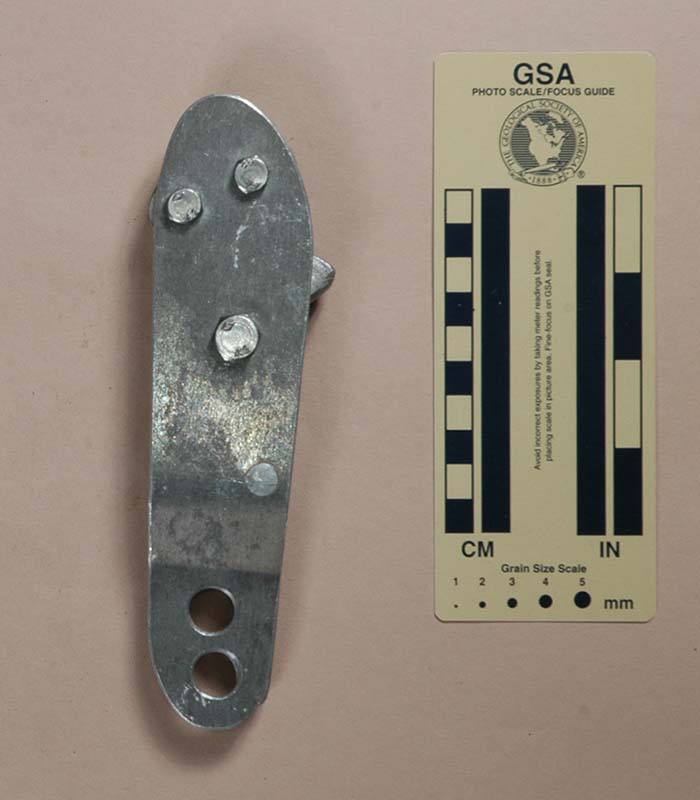
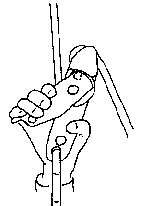 I acquired this descender from Repetto Sport in Genoa, Italy in 1982.
My Dressler DAD is 179 mm. tall, 51 mm. wide, 32 mm. thick, and weighs 247 g.
The fixed side plate is an elongated piece of 4 mm. aluminum bent inwards in a dogleg at the lower end. Two beveled 13 mm. holes below the dogleg serve as attachment points. The upper bollard is an aluminum casting bolted to the fixed side plate with two 6 mm. bolts. This bollard is not circular, but more airfoil shaped with the concavity in the lower surface provided to work in conjunction with the autostop role of the lower bollard. The lower bollard is a spiral shaped aluminum casting bolted to the pivoting side plate This side plate extends upwards only to the bottom of the upper bollard, with a sub-millimeter clearance provided. The lower end of the pivoting side plate doglegs inwards and has one 13 mm. beveled attachment hole aligned with the upper hole on the fixed side plate A projection extending below this hole limits rotation of the pivoting side plate if a carabiner or maillon is in the fixed side plate’s lower hole. The lower bollard and pivoting side plate rotate on an 8 mm. bolt through the fixed side plate A 6 mm. bolt keeps the lower bollard from rotating with respect to the pivoting side plate Finally, a 10 mm. diameter by 14 mm. cylinder is riveted to the inside of the fixed side plate below the lower bollard. This pin is necessary to keep small ropes in the device when the lower bollard and pivoting side plate are rotated to the fully engaged position.
The pivoting side plate is stamped "DAD" and "BREVETE." The bolt heads are marked with "A2" and an "L" inside a diamond.
 Comments
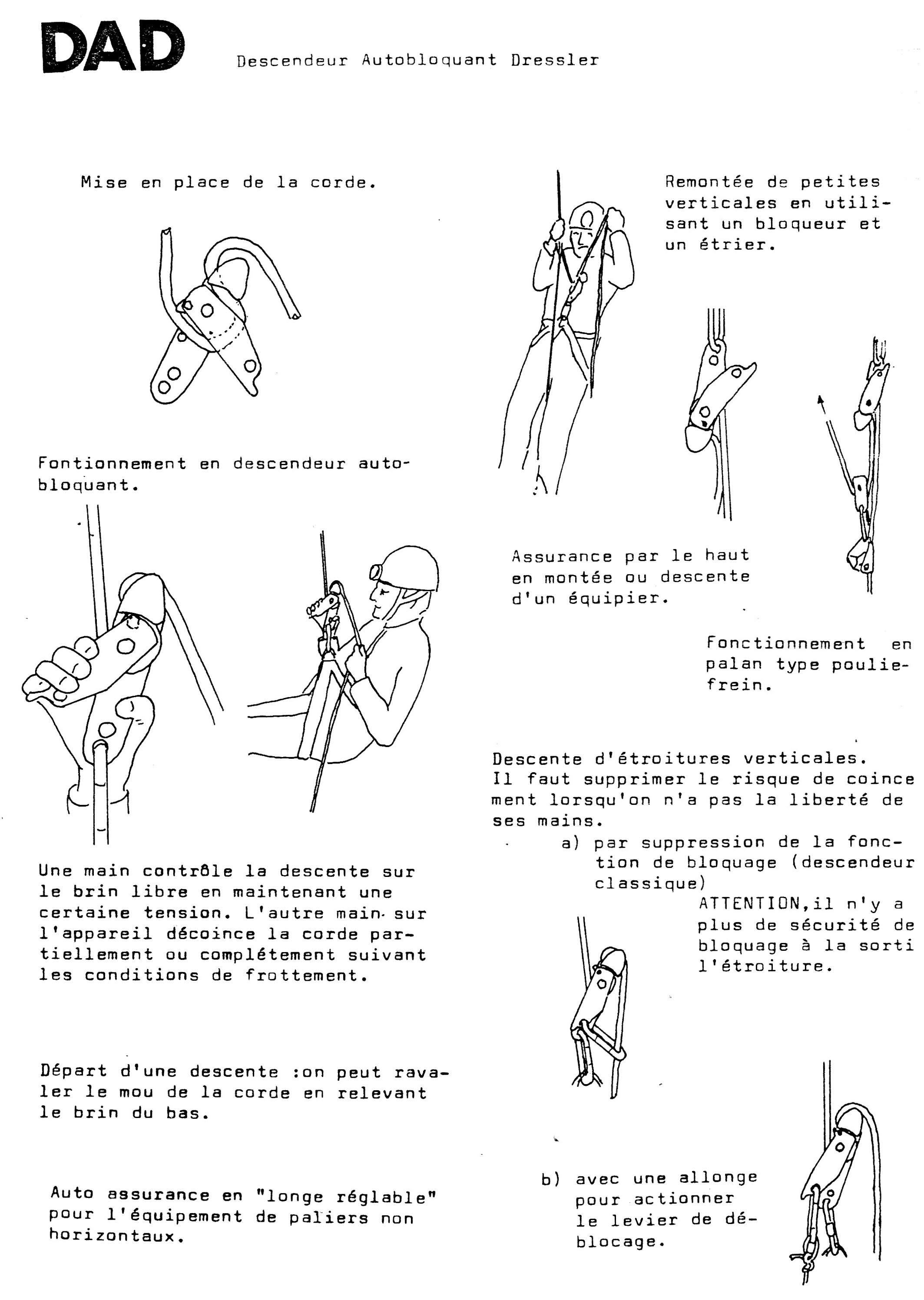
The DAD departs from Dressler's traditional bobbin design in several ways. By using castings, the manufacturer is able to use more complex shapes for the bollards at the probable sacrifice of some superfluous strength. This gives the designer more control over the characteristics of the device. The airfoil shape to the upper bollard reduced the height of the descender by several centimeters. The autostop feature on the DAD holds than on the Diablo, but is easily disengaged by accidentally bumping the pivoting side plate The autostop feature is easily overridden by rigging into the upper, rather than lower attachment hole. My biggest objection to the DAD is the lack of any means to keep the rope running over the top of the upper bollard. I find that stiff ropes, such as PMI standard, are particularly willing to leave their appointed path.
Bruno Dressler patented the DAD in 1979, receiving French Patent #2,448,910.
Bruno Dressler started making caving equipment in the 1960s. His inventions were destined to become an essential part of caving gear. In 1966, with his compulsory military service approaching, Bruno had no real desire to spend his entire engineering career working on caving equipment afterwards. Since no one in his caving club seemed motivated to take his place, Bruno contacted Fernand Petzl. He agreed to take over production and pay royalties, and as early as 1970, the new clamps and descenders made their first appearance under the name of their inventor. The Dressler descender was the first modern bobbin, becoming the Petzl Simple, and his ascender evolved into the Petzl Basic.[1]