

This page will not fit into a tiny viewport. Please choose a full-size monitor with a full-width window or select the abridged New Wave pages.


|
|
 |
 |
| Left Side View | Right Oblique View | Top View |
 |
 |
| Rear View: Open for Rigging | Internal View: Disassembled for Rigging |
I acquired my Mar–Mex Escapeline from J. E. Weinel Inc. in 1985.
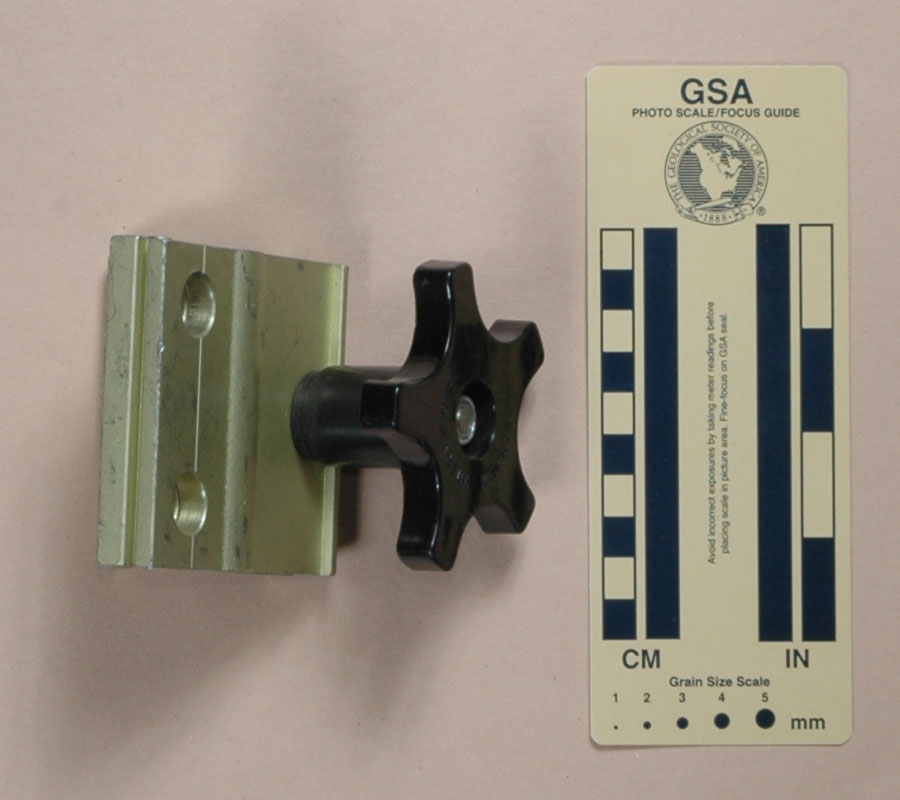
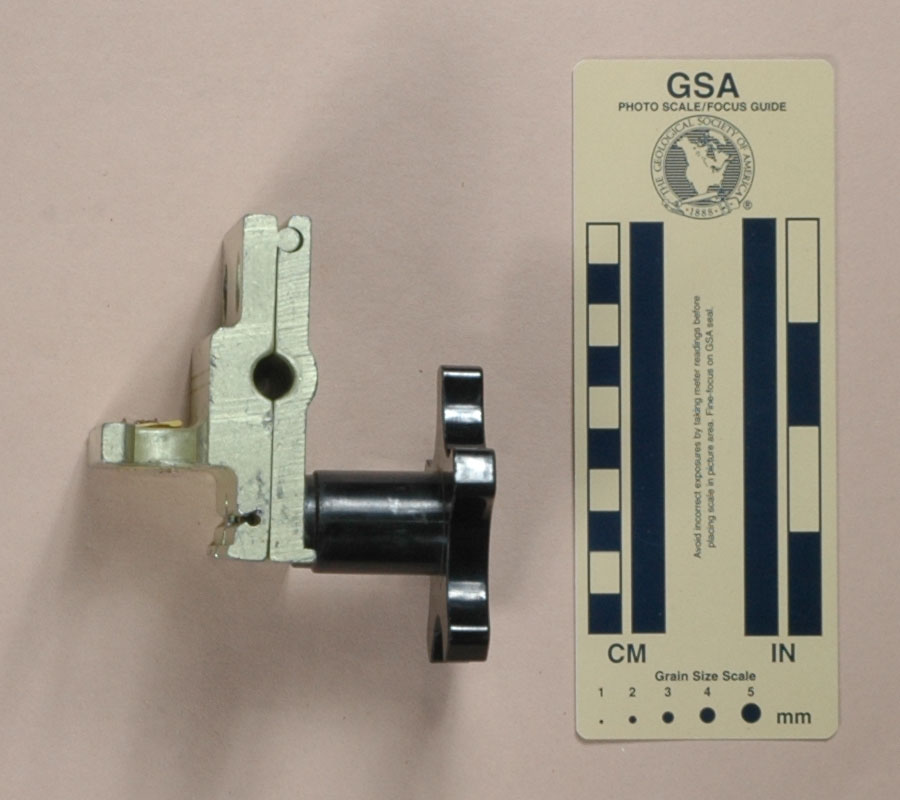
The Mar–Mex Escapeline is the only commercial squeeze brake that I am familiar with. It consists of two extruded aluminum pieces that hinge together. Each piece has a straight groove where the rope runs. A swinging knob locks the plates together, and allows the user to adjust the force the plates exert on the standing line. One of the plates has a hook on the side, and the rope must be looped over this hook. There are two carabiner holes, a lower one for attaching to one’s harness and an upper one for attaching other devices (e.g., a second Escapeline).
My Escapeline has "MAR-MEX INTERNATIONAL" molded into the handle. A yellow sticker on one side reads:
ATTENTION
MAKE SURE ROPE IS
IN NOTCH BEFORE DESCENT
ROPE
(The last word is not my typo). The yellow sticker on the other side reads:
MAR-MEX INTL.-ATLANTA
PATENT PENDING
USA CANADA JAPAN KOREA
AUSTRALIA EUROPEAN COUNTRIES
PCT APPLICATION
I have a Mar–Mex International Ltd. product description sheet that lists the following models:
| Model | Rope | Weight | Description |
|---|---|---|---|
| 1D2R | 9.5-11 mm. | 200 g. | 50 mm. knob on right side |
| 1D2L | 9.5-11 mm. | 200 g. | 50 mm. knob on left side |
| 1D3R | 9.5-11 mm. | 200 g. | 75 mm. knob on right side |
| 1D3L | 9.5-11 mm. | 200 g. | 75 mm. knob on left side |
| 2D2R | 11-13.7 mm | 240 g. | 50 mm. knob on right side |
| 2D2L | 11-13.7 mm | 240 g. | 50 mm. knob on left side |
| 2D3R | 11-13.7 mm | 240 g. | 75 mm. knob on right side |
| 2D3L | 11-13.7 mm | 240 g. | 75 mm. knob on left side |
Squeeze brakes have generated a lot of interest in the caving community because they have a large contact area and do not bend the rope, and therefore appear to be appealing for long drops. Unfortunately, a simple squeeze brake does not provide adequate control because the friction is quite sensitive to the separation between the plates, and unlike snubbing, increasing the tension below the device does not effectively increase friction; instead, it decreases it somewhat. Mar–Mex addressed this by adding the hook on the side. The rope is looped over the hook, which provides a snubbing action in addition to the friction from the brake itself. The knob can be adjusted so that most of the friction comes from squeezing the rope, while the snubbing provides an increase in friction as the tension below the device is increased.
I believe that the Mar–Mex Escapeline is protected by U.S. Patent 4,603,755.
 |
Warning: The hook must be upright, and the rope must be draped over the hook. The Escapeline will not function properly if rigged upside-down. |
|
 |
 |
 |
 |
 |
Mar-Mex International, Ltd. is a Domestic Profit Corporation organized under the laws of the State of Georgia. Juergen Meschke was listed as CEO and Secretary. Klaus Meschke was listed as as CFO. The business was filed on February 5, 1982 and and disolved on July 9, 2005.
Juergen Meschke applied for a U. S. Patent on February 4, 1985 and received U.S. Patent 4,603,755 on August 5, 1986. This patent covered the Escapeline descender and associated harness. Similar ideas appear in older US Patents 4,448,281 and 4,056,166; each of which is referred to by the later patent. See the Storrick-Adams Fire Escape Device and Storrick – Rabelos Detachable Fire Escape Device respectively.
The concept is much older than any of these implementations. At the 1878 World's Fair, Monsieur Eichel showed a descender that closely resembles the Mar-mex Escapeline. A report on the Fair said,[1][2]
This system (Plate 65, Fig. 4) requires a descent rope or wire cable. It consists of two metal plates connected by a hinge, allowing them to open and close like the covers of a book; on the side opposite the hinge, a thumbscrew allows the two plates to be tightened against each other and adjusts the friction on the rope, which passes between the plates in a groove designed for this purpose. The lower end of the hinge features a ring to which a safety harness is attached.
We were unable to obtain the prices for these devices; moreover, their use does not appear to be without risk.
 |
 |