

This page will not fit into a tiny viewport. Please choose a full-size monitor with a full-width window or select the abridged New Wave pages.


Version A

Version B

Version C

Version D

Version E
|
|
|
|
|
|
| Version A | Version B | Version C | Version D | Version E |
John Cole, Dan Patten, and other Huntsville Alabama cavers developed and tested a variety of new rappelling devices in the mid-1960s. Of these, the open-frame rappel rack was the most successful. While there were earlier devices that we would call rappel racks, these generally had closed frames. The open-frame rack was independently developed by at least one other, but John Cole is normally credited with its invention, to a large degree because he published the design nationally in 1966.[1]
John described making the first rack as follows:
We went down to Hopper Hardware in Huntsville and bought some lengths of cold-rolled steel. Then a makeshift forge was improvised from a backyard barbecue grill and a vacuum cleaner hooked up so that it would blow air. Next, we heated up a piece of the steel and used a pair of pliers and a vise to make the U-shaped bend. Finally, the bottom of one of the uprights was rolled around a couple of times to make a loop for the carabiner.[2]
The first rack had five bars "because that looked like the number of rope bends in a double carabiner brake bar rig."[2]
Initial testing revealed a surprise. John described this saying,
Finally, it was time to head out to Hermitage Quarry and try things out. Unfortunately, I missed this particular outing when I had to work late that afternoon. …Patten tried out the rack on this particular drop. Interestingly enough, he discovered that one could control the rate of descent by adjusting the spacing of the brake bars during the rappel. We certainly hadn't planned on that ahead of time, although this particular technique is now probably the single most important method of control.[2]
John started making Rappel Racks, with help from John Patten, Chuck Kincade, Ben Kavanaugh, Dick Mitchell and Bill Cuddington. He estimates that they made about 500 racks. Most used inexpensive, commercially available Holubar brake bars.[2]
[ Top | Version B | Version C | Version D | Version E | Return to Racks ]
|
|
 |
 |
| Front View | Rear View | Side View |
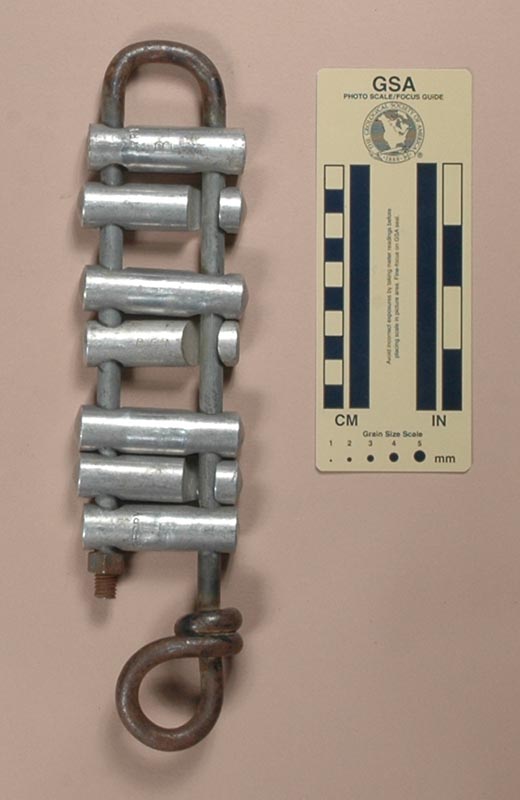
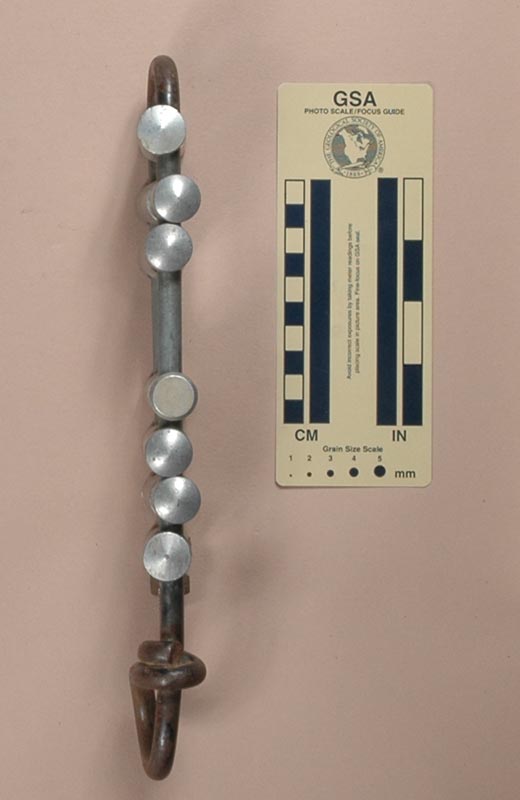
I acquired this rack from Geary Schindel at the 1995 Old Timers Reunion.
Version A is 290 mm. tall, 70 mm. wide, 29 mm. thick, and weighs 647 g. The frame is made from 9.5 mm. steel bent into shape, with an internal width of 33 mm. and a 25 mm. diameter wrapped eye. There are seven brake bars, composed of a mixture of Gerry and REI bars. The bars are 19 mm. in diameter and 66 mm. long. Allowing 45 mm. for the rope leaves 56 mm. for spreading the bars.
The Gerry brake bars are stamped "GERRY" and the REI bars "REI."
Although seven bars are on the rack in the photo, that is too many for this rack. It should be used with only five or possibly six bars.
The "square" bend at the top of the rack may save some overall length, but it prevents moving the bars to the spine of the rack where they belong for safety reasons.
[ Top | Version A | Version C | Version D | Version E | Return to Racks ]
|
|
 |
 |
| Front View | Rear View | Side View |
I acquired this rack in 2017 as part of Bob Thrun’s collection.
Version B is 318 mm. tall, 64 mm. wide, 20 mm. thick, and weighs 655 g. The frame is made from 9.5 mm. steel bent into shape, with an internal width of 30 mm. and a 27 mm. diameter coiled eye. There are 6 brake bars. The bars are 19 mm. tall and 64 mm. long. Allowing 45 mm. for the rope leaves 88 mm. for spreading the bars.
There are no markings on this rack or its bars.
The "square" bend at the top of the rack may save some overall length, but it prevents moving the bars to the spine of the rack where they belong for safety reasons.
[ Top | Version A | Version B | Version D | Version E | Return to Racks ]
|
|
 |
 |
| Front View | Rear View | Side View |
I acquired this rack in 2017 as part of Bob Thrun’s collection.
Version C is 318 mm. tall, 64 mm. wide, 20 mm. thick, and weighs 671 g. The frame is made from 9.5 mm. steel heated and bent into shape, with an internal width of 30 mm. and a 26 mm. diameter coiled eye. There are seven brake bars. top four bars have flat tops, flat unloaded sides, and rounded ends. They are 15.8 mm. tall, 25 mm wide, and 63 mm. long. The top two are stamped "HOLUBAR." The third and fourth are are not marked, but are probably Holubar bars as well. The fifth bar is round, 19 mm. in diameter and 64 mm. long. It is also unmarked, but might be a BlueWater bar. The lower two bars are pin-style bars, 7.8 mm. in diameter and 51mm. long. With this bar combination and allowing 45 mm. for the rope leaves 50 mm. for spreading the bars. The bars are held in place by a hex nut, lock washer, and wing nut.
The top two bars are stamped "HOLUBAR."
The frame on this rack is nearly identical to the Version B frame, with the only significant difference being that the open end is slightly shorter.
Commercial brake bars used to be quite inexpensive, and it was not unusual to see a mix of them on early racks. Although seven bars are on the rack in the photo, that is too many for this rack: it should be used with only six bars.
The "square" bend at the top of the rack may save some overall length, but it prevents moving the bars to the spine of the rack where they belong for safety reasons.
The wing nut gets in the way, and I would replace it and the hex lock nut.
[ Top | Version A | Version B | Version C | Version E | Return to Racks ]
|
|
 |
 |
| Front View | Rear View | Side View |
I acquired this rack from David Jones in 2014.
Version D is 363 mm. tall, 72 mm. wide, 19 mm. thick, and weighs 721 g. The frame is made from 9.5 mm. steel bent into shape, with an internal width of 34 mm. and a 27 mm. diameter coiled eye. There are six brake bars. The bars are 19 mm. in diameter and 72 mm. long. Allowing 45 mm. for the rope leaves 68 mm. for spreading the bars.
There are no markings on the rack or the bars.
This version is a standard length rack, meaning roughly 14 inches (355 mm.) long, and is appropriate for six bars. Many early racks were made of steel rather than stainless steel. Although they rust, with proper care and the right alloy, this was not a major problem. I prefer racks that don't rust.
For safety reasons, the bars should be filed on the unloaded side and moved to the spine of the rack.
[ Top | Version A | Version B | Version C | Version D | Return to Racks ]
|
|
 |
 |
| Front View | Rear View | Side View |
I acquired this rack from Rick Banning at the 2019 NSS Convention.
This rack is 323 mm. tall, 66 mm. wide, 22 mm. thick, and weighs 696 g. The frame is made from 9.5 mm. steel bent into shape, with an internal width of 33 mm. and a 26 mm. diameter coiled eye. There are six CMI brake bars on this rack. The bars are 16 mm. in diameter and 66 mm. long. Each bar has a hole drilled and tapped in the notch end. A small ball bearing, spring, and Allen screw in this hole form a catch to help hold the bars in the closed position. Allowing 45 mm. for the rope leaves 73 mm. for spreading the bars. Two hex nuts retain the bars.
There are no markings on the rack. The bars are stamped with "Cmi." Rick stamped "R C B" on the first through fourth and sixth bars. He stamped "NSS 8083," "R. C. BANNING," "7111 CARROL," and "TAKOMA PK. MD." on the fifth bar.
Rick attached a tag to the rack which reads as follows:
"Brake bar rack by Cole 1 May 19
"On a mid to late 60’s trip to visit pits near Huntsville AL, stopped by John Cole’s house + bought this rack from him. Saw his 2 55 gal. drums with bending jigs on top for shaping the racks. I put Holubar [sic] bars on top, maybe because of the pretty blue color and maybe because the ball bearings kept the bas on the rack better than ordinary bars. I didn't live at 7111 Carroll Ave. > 1971.
Rick Banning"
Although Rick wrote, "Holubar," the blue brake bars are CMI bars. The hole and notch on these bars were sized for the standard oval carabiners of the day (for brake bar rappels), and so are large enough to allow moving the brake bars to the spine of the rack where they are less likely to get bumped open. This is an important safety step that is too often overlooked.
[ Top | Version A | Version B | Version C | Version D | Version E ]