

This page will not fit into a tiny viewport. Please choose a full-size monitor with a full-width window or select the abridged New Wave pages.

Version A
Version B
|
|
|
| Version A | Version B |
In 1930, Fernand Petzl discovered caving at the age of 17. Back at his workshop after each excursion to the depths, Fernand imagined new tools for exploring darkness and heights. With his inventions taking up more and more space, he decided to create his own workshop, sparking the growth of his small business. Working together brought Fernand closer to his son, Paul, who was determined to grow the business. From the beginning, Paul's wife Catherine took care of the accounting.
Paul Petzl, a mechanical engineering student, had already been thinking about creating a real company and began to plan out his first investments. In 1970, the Petzl brand was created. Five years later, the first company headquarters was established at the foot of the Dent de Crolles. In the years that followed, the number of employees increased as the company experienced local and international growth.
Petzl is a family business that, over the years, has become the largest European manufacturer of personal protective equipment for those who work and play in darkness or at height. All Petzl products are invented and developed at their headquarters in the heart of the French Alps.
The Petzl brand is present in over 55 countries with 85% of their sales made internationally. More than 9 million products are sold every year, and 10 million people use Petzl personal protective equipment every day.
[ Top | Version B | Return to Racks ]
|
|
 |
 |
| Front View | Rear View | Side View |
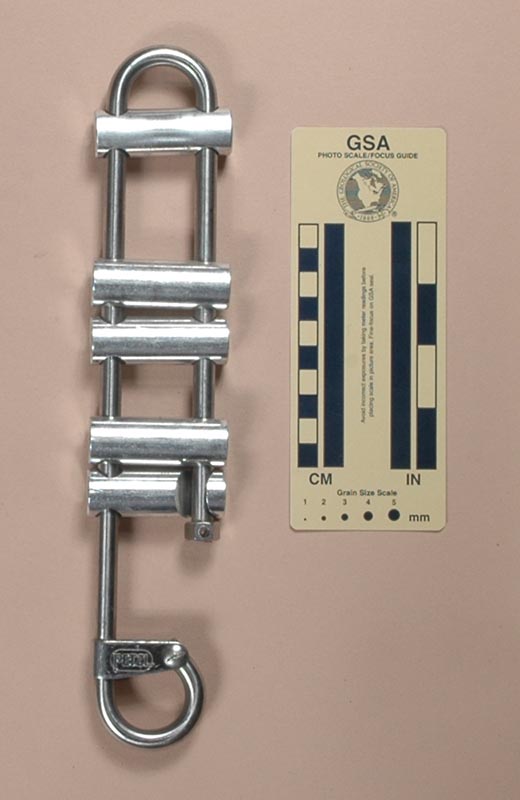
I do not have a record of when or from whom I acquired this rack.
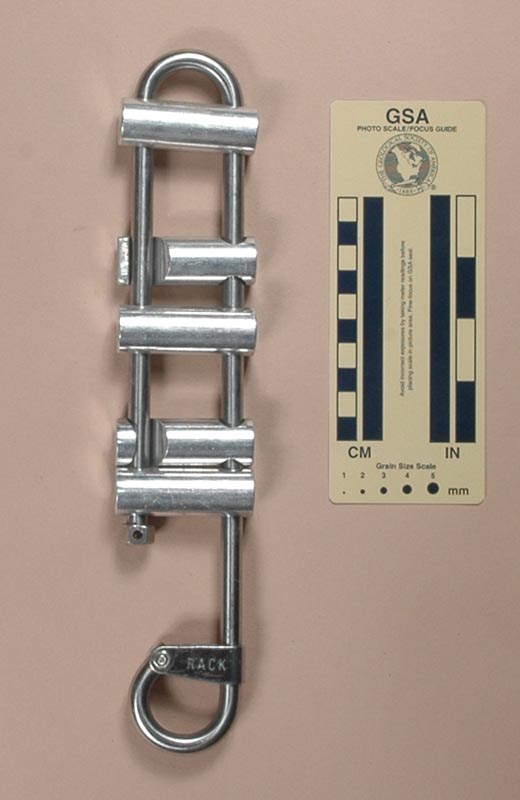
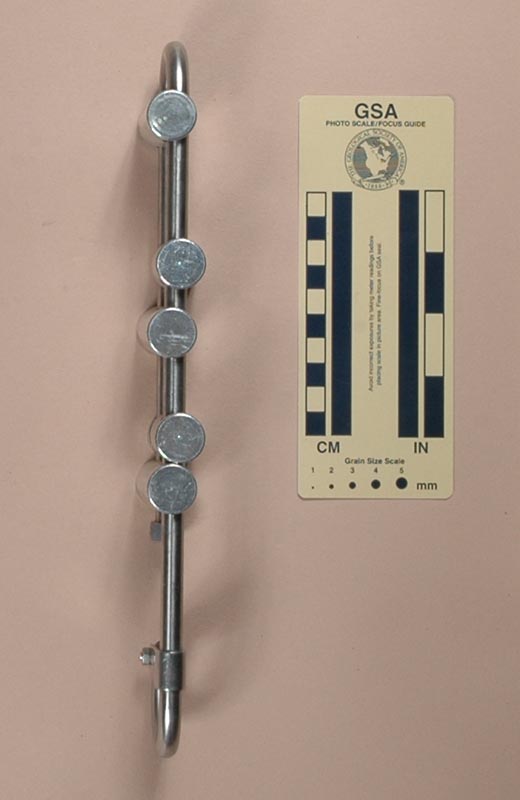
My Petzl, Version A rack is 285 mm. tall, 57 mm. wide, 23 mm. thick, and weighs 484 g. The frame is made from 9.3 mm. stainless steel bent into shape, with an internal width of 28 mm. and a 28 mm. diameter eye. The eye in the frame is open, so a stamped piece of stainless steel is added and held in place with a machine screw and nut. The open end of the frame has a pinned nut to keep the bars in place. There are five brake bars. The bars are 20 mm. in diameter and 56 mm. long. Allowing 45 mm. for the rope leaves 33 mm. range for spreading the bars.
The sheet metal stamping is stamped with the Petzl logo.
Version A was an interesting deviation from conventional rack design. The nut was pinned in place, so it wasn't easy to replace bars. To solve this problem, Petzl did not bend the eye into a complete circle. Now the bars could be put on at the eye, but they had to fit loosely enough to make the bend. Finally, the eye had to be closed, so a stamped piece of stainless steel was added and held in place with a machine screw and nut. The piece of sheet metal has a second purpose: it provides a place to display the Petzl logo!
The second bar on my rack is a floppy bar, designed to immediately open if the rack is rigged backward. Why anyone would do that is beyond me, and how anyone who believes that they could do it accidentally can find the self-confidence to rappel is also a mystery. Still, the floppy bar does no real harm, although I find it annoying when I try to pack the rack.
[ Top | version A | Return to Racks ]
|
|
 |
 |
| Front View | Rear View | Side View |
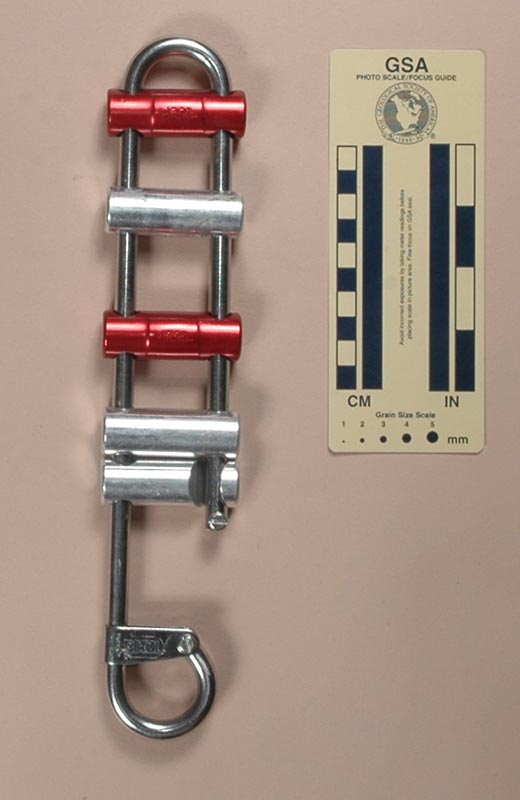
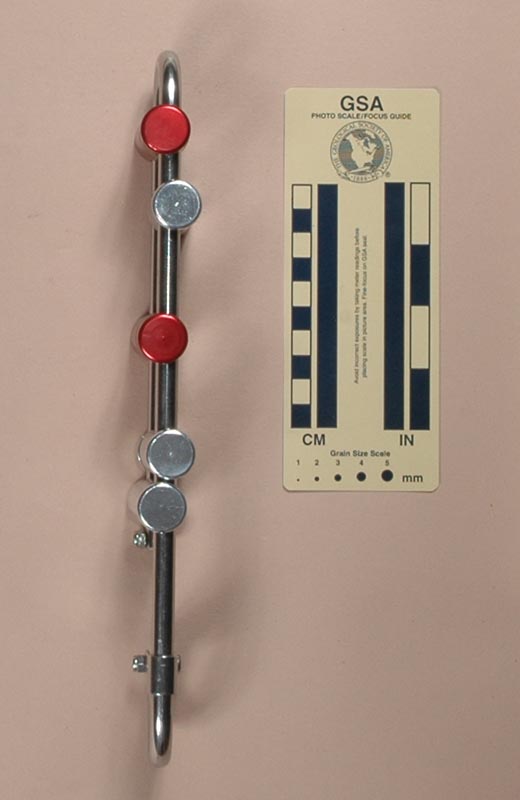
 I acquired this rack from Inner Mountain Outfitters at the 1995 NSS Convention.
My Petzl, Version B rack is 285 mm. tall, 57 mm. wide, 23 mm. thick, and weighs 473 g. The frame is made from 9.3 mm. stainless steel bent into shape, with an internal width of 29 mm. and a 28 mm. diameter eye. The eye in the frame is open, so a stamped piece of stainless steel is added and held in place with a machine screw and nut. The open end of the frame has a machine screw to keep the bars in place. There are five brake bars. The bars are 20 mm. in diameter and 57 mm. long. The red bars have rope grooves that appear to have been stamped, as the entire bar is bent and the displaced metal is raised on the unloaded side of the bar. Allowing 45 mm. for the rope leaves 32 mm. for spreading the bars.
The sheet metal stamping is stamped with the "24894B" and the Petzl logo. The red bars are stamped with the Petzl logo as well.
This rack is much like Version A, except Petzl abandoned the silly pinned nut in favor of using a machine screw. This is a sensible design. I also like the design of the red bars., since they provide some rope guidance.
[ Top | Version A | Version B ]