

This page will not fit into a tiny viewport. Please choose a full-size monitor with a full-width window or select the abridged New Wave pages.

Version A

Version B

Version C

Version D

Version E

Version F

Version G

Version H
|
|
|
|
|
| Version A | Version B | Version C | Version D |
|
|
|
|
|
| Version E | Version F | Version G | Version H |
In 1965, Norway and Britain contended to make the first ascent of Europe's tallest rock face - Norway's Trollveggen. Previously considered unclimbable, members of Britain's Rimmon mountaineering club made the first ascent of their route up the mountain face in 1965. Following this challenging expedition, Tony Howard, Paul Seddon and Alan Waterhouse founded Troll. In the late 1960s Troll developed the world’s first machined climbing nuts and world’s first sit harness; the infamous Whillans Harness. The company now focuses climbing-related on soft goods.
Dr. Andrew Taylor MD from the U. K. wrote:[1]
The "Troll Alp" was designed in 1983 by Dave Allport and myself. Dave now works for Troll but we are still Alphin Rescue Equipment Ltd - the descender in the UK is the Alphin "Allp."
…For your interest - the left-hand thread was instituted after first public field trials where 100% said the control screw ("rod") seemed to turn the wrong way and couldn't we make it LHT? I still have my RHT prototype - you think YOU get confused!
Denzil Broadhurst, also from in the U. K., wrote:[2]
Since the guys who designed the Allp are members of our Rescue Team thought I’d let you know that there should be a new Allp out in the next month or so.
I've only seen the prototype so far, but it’s a little smaller and the "wing nut" doesn't stick out as far (and it doesn't physically move in and out as you wind it). I note your comment about the rod and packing - so the new one should sort that problem! There are no locking pins on the bobbins, but the rope friction tightens all the bobbins as it runs through!
[The "new Allp" is the Pro Allp Tech. - GDS]
Bit of history, if you’re interested.
It was initially developed as an emergency descender for use off North Sea oil rigs. Just set the screw and jump off - speed is more or less constant when the rope is in a bag. Didn't win the contract however, but was used by our team for crag rescues, and the annual crag rescue training weekend we run for MR teams demonstrates the ways in which it can be used. Rescues are done with the rope in a bag on your harness, and you control your descent yourself (traditionally it was always controlled from the top). Descent speed can be set, then fine control done by running the rope through your hand which holds the stretcher, leaving the other hand for dealing with casualty or pushing off crag face.
Was then taken over by Troll for rope access work (and one of the designers, Dave Allport, still works for them).
Dave Allport worked at Troll for over 22 years before the Troll factory in Saddleworth, UK. closed. He sent me the following information about the Allp versions:[3]
I am the designer of the Allp so I will quickly introduce you to its colours.
The Blue was the first and after the first couple of hundred the wrong sheet was sent to us for the side plates. It was standard Alloy instead of NSB4 as it was then.
Luckily there were only seven sent out into the field when it was discovered by two Troll trainers doing a single man snatch rescue (two people). The two person load was too high for the side plates and as they screwed the screw the plates just started to bend. It was not dangerous but it meant they were not going anywhere. We changed our inspection procedure and asked for certificates of conformity with every batch of material and because of this I changed the colour to Gold so there was a visual ID to the change. Also at this point in time a new alloy had come onto the market that was slightly harder so we upgraded to this.
The Red Allp was made under license by my friend George Rex who ran Troll in Wyoming. There was another guy in Australia that was also given the license to manufacture … I did produce a Black Allp for the Police. The lock was introduced at the request of the UK Health and Safety and there were two versions of this. The first being a small screw pin and the second being a spring pin and this is still on the latest (pro ALLP tech) but at the top of the back plate
You my also have realized that the spelling of ALLP is the first part of my second name and the logo has the first L in the leg of the A.
David Allport and Andrew William Taylor of Alphin Rescue Equipment Ltd. filed for an Allp patent in 1992 and received British Patent #2,256,673 in 1994.
[ Top | Version B | Version C | Version D | Version E | Version F | Version G | Version H | Return to Poly-Bollards]
|
|
 |
 |
| Front View | Rear View | Side View |
 |
 |
| Front View: Open for Rigging | Rear View: Open for Rigging |
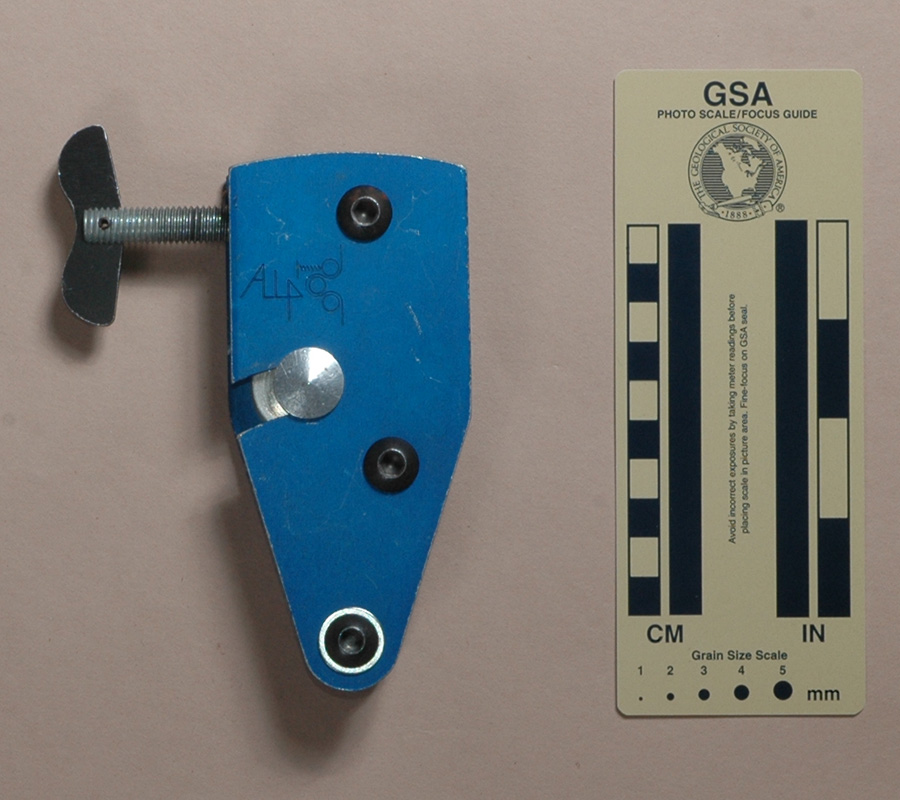
At the 2007 NSS Convention, Jansen Cardy traded this blue Allp to me for a gold one. Considering that only a few blue Allps made it into circulation, this Allp is a rare one and Jansen was quite generous.
Version A is 135 mm. tall, 103 mm. wide, 30 mm. thick, and weighs 293 g.
The Allp consists of three bollards, mounted between two side plates that pivot on a fourth attachment post. An adjustment screw assembly helps vary the friction in the device.
Each side plate is a roughly pentagonal piece of blue anodized 1/8-in (3.3 mm.) aluminum. The plates are 135 mm. high with a curved top. Each plate is 58 mm. wide at the top, and then starting about 63 mm. down, tapers to join a 22 mm. diameter circular arc at the bottom. The side plates are attached to a 16 mm. diameter steel attachment post at the center of the bottom circular arc. The front plate is tightly bolted to the post, while the rear plate is loosely bolted. A spring acts to close the rear plate. The top and bottom rope bollards are bolted to the front plate, while the center bollard is bolted to the rear plate. The bollards do not rotate, but there are no visible pins preventing the rotation. All bolts are hex socket round-head bolts.
The bollards are made of unfinished aluminum. Each rope bollard has a groove that fits into a corresponding notch in the opposite plate. The bollards are 16 mm. wide, measured from between the insides of the side plates. The top bollard diameter is 25.4 mm in the center, and widens to 26.3 mm. about 1 mm. from the side plate, then remains constant. The center and bottom bollards have similar dimensions, with some normal machining variations. The three bollards are mounted 107 mm., 65 mm. and 45 mm. from the center of the pivot point. When the rope is inserted, this asymmetrical arrangement ensures that the rope is pinched between the center and bottom bollards only.
The rear plate has a small aluminum block bolted to the upper left inside of the plate. A 10 mm. threaded rod (with about 7 left-hand threads per centimeter) passes through this plate and presses against the upper bollard. A black painted cross piece is pinned to the other end of the rod, making it much like a wing nut.
The front plate has a rigging illustration and a stylized word "ALLP" stamped into it.
In the Allp History I included these comments that Dave Allport made on the blue Allps:
The Blue was the first and after the first couple of hundred the wrong sheet was sent to us for the side plates. It was standard Alloy instead of NSB4 as it was then.
Luckily there were only seven sent out into the field when it was discovered by two Troll trainers doing a single man snatch rescue (Two People). The two person load was too high for the side plates and as they screwed the screw the plates just started to bend. It was not dangerous but it meant they were not going anywhere. We changed our inspection procedure and asked for certificates of conformity with every batch of material and because of this I changed the colour to Gold so there was a visual ID to the change.
A careful reading shows that only seven blue Allps with the wrong alloy sheet were sent to the field, not that only seven blue Allps made it out. There were a "couple hundred" blue Allps made with the proper alloy.
The Allp received British Patent #2,256,673 in 1994.
[ Top | Version A | Version C | Version D | Version E | Version F | Version G | Version H | Return to Poly-Bollards]
|
|
 |
 |
| Front View | Rear View | Side View |
 |
 |
| Front View: Open for Rigging | Rear View: Open for Rigging |
I acquired one Version B Allp used from David Chapman in 2006, and a second from Speedy-Marquee in 2011.
Version B is 132 mm. tall, 99 mm. wide, 34 mm. thick, and weighs 315 g. Version B is similar to Version A, so I'll use the same description in gray and note any changes in normal text.
Each side plate is a roughly pentagonal piece of gold anodized 1/8-in (3.3 mm.) aluminum. The plates are 134 mm. high with a curved top. The top half of each plate is 60 mm. wide at the top, and then starting about 58 mm. down, tapers to join a 22 mm. diameter circular arc at the bottom. The side plates are attached to a 16 mm. diameter steel attachment post at the center of the bottom circular arc. The front plate is tightly bolted to the post, while the rear plate is loosely bolted. A spring acts to close the rear plate. The top and bottom rope bollards are bolted to the front plate, while the center bollard is bolted to the rear plate. The bollards do not rotate, but there are no visible pins preventing the rotation. All bolts are hex socket round-head bolts.
The bollards are made of unfinished aluminum. Each rope bollard has a groove that fits into a corresponding notch in the opposite plate. The bollards are 16 mm. wide, measured from between the insides of the side plates. The top bollard diameter is 26.5 mm in the center, and widens to 27.8 mm. about 1 mm. from the side plate, then remains constant. The center and bottom bollards have similar dimensions. The three bollards are mounted 107 mm., 65 mm. and 45 mm. from the center of the pivot point. When the rope is inserted, this asymmetrical arrangement ensures that the rope is pinched between the center and bottom bollards only.
The rear plate has a small aluminum block bolted to the upper left inside of the plate. A 10 mm. threaded rod (with about 7 left-hand threads per centimeter) passes through this plate and presses against the upper bollard. A cross piece is pinned to the other end of the rod, making it much like a wing nut.
The front plate has a rigging illustration and a stylized word "ALLP" stamped into it. The rear plate is stamped "ICS."
I have tested the Allp on short drops using clean, dry 11 mm. PMI pit rope, a rather stiff caving rope. In these limited tests (no mud, snow, ice, waterfalls, or long drops), it has performed very well. When the rod is unscrewed, there is enough friction to hold me in place. As the rod is tightened, the friction is gradually reduced. The transition is slow enough that it is easy to maintain control with the braking hand. The rod turns easily, without any sensation of having to force it. This surprised me, I didn't expect it to work so well.
Getting used to the left-hand thread took less effort than I expected. The Allp is designed for the traditional right-handed user who brakes with their right hand at the right hip. Although I'm right-handed, I prefer to brake left-handed, so I’d rather have a mirror-image version, although this hardly is significant enough to be worth worrying about.
The Allp creates part of its friction by squeezing the rope between the center and bottom bollard. As one turns the rod counter-clockwise, it moves the rear plate to separate the center and lower bollard, reducing the rope squeezing action. The friction decreases accordingly. This process only continues until there is no more squeezing. After that, there is very little change in friction. This is rather obvious, because there is no large change in the snubbing angle once the bollards are separated. The practical effect is that if one starts a rappel with the rod screwed in and finds out that the friction is insufficient, it will take many turns before the friction is significantly increased. One should always start with the rod unscrewed as far as practicable for the conditions.
Except for the rod, the Allp has an almost ideal shape for packing. Its a shame that the rod can't fold away for packing. I'm nit-picking here, but its an idea someone might consider implementing. My other nit-pick is that the spring protruding through the back plate sometimes catches on soft webbing and on cloth items.
Overall, I like the Allp, but I like its later incarnation, the Pro Allp Tech even more.
[ Top | Version A | Version B | Version D | Version E | Version F | Version G | Version H | Return to Poly-Bollards]
|
|
 |
 |
| Front View | Rear View | Side View |
 |
 |
| Front View: Open for Rigging | Rear View: Open for Rigging |
I acquired my Troll Allp, Version C from Chris Pund in 2006.
Version C is 133 mm. tall, 100 mm. wide, 32 mm. thick, and weighs 295 g.
Version C is almost identical to Version B. There are two differences. First, the sides of the cross piece are painted red and green. Second, there are no markings stamped into the rear plate of Version C.
This version adds color-coding for those who cannot remember which way to turn the rod. That will not help them in a cave when the lights go out.
[ Top | Version A | Version B | Version C | Version E | Version F | Version G | Version H | Return to Poly-Bollards]
|
|
 |
 |
| Front View | Rear View | Side View |
 |
 |
| Front View: Open for Rigging | Rear View: Open for Rigging |
I acquired my Troll Allp, Version E from John Sales, 2007.
Version D is 134 mm. tall, 98 mm. wide, 34 mm. thick, and weighs 316 g. Version D is similar to Version B, so I'll use the same description in gray and note any changes in normal text.
Each side plate is a roughly pentagonal piece of gold anodized 1/8-in (3.3 mm.) aluminum. The plates are 134 mm. high with a curved top. The top half of each plate is 60 mm. wide at the top, and then starting about 58 mm. down, tapers to join a 22 mm. diameter circular arc at the bottom. The side plates are attached to a 16 mm. diameter steel attachment post at the center of the bottom circular arc. The front plate is tightly bolted to the post, while the rear plate is loosely bolted. A spring acts to close the rear plate. The top and bottom rope bollards are bolted to the front plate, while the center bollard is bolted to the rear plate. The bollards do not rotate, but there are no visible pins preventing the rotation. All bolts are hex socket round-head bolts.
The bollards are made of unfinished aluminum. Each rope bollard has a groove that fits into a corresponding notch in the opposite plate. The bollards are 16 mm. wide, measured from between the insides of the side plates. The top bollard diameter is 26.5 mm in the center, and widens to 27.8 mm. about 1 mm. from the side plate, then remains constant. The center and bottom bollards have similar dimensions. The three bollards are mounted 107 mm., 66 mm and 45 mm. from the center of the pivot point. When the rope is inserted, this asymmetrical arrangement ensures that the rope is pinched between the center and bottom bollards only.
A black oxide finished 7.6 mm. o.d. steel tube is pressed into the inside of the lower left portion of the front plate, and extends 15.6 mm. toward the rear plate. A 12.2 mm. steel knob threads into this tube, and a 3.2 mm. extension extends as much as 3.5 mm., fitting (when extended) into a curved slot in the rear plate. This acts as a latch to keep the side plate from opening.
The rear plate has a small aluminum block bolted to the upper left inside of the plate. A 10 mm. threaded rod (with about 7 left-hand threads per centimeter) passes through this plate and presses against the upper bollard. A cross piece is pinned to the other end of the rod, making it much like a wing nut.
The front plate has a rigging illustration and a stylized word "ALLP" stamped into it, as well as "024" and "J."
This is the first of the two lock pin designs. Personally, The latch is unnecessary, since the Allp cannot open under load. I'm sure that someone at UK Health and Safety knows something that I don't, but in this particular case, perhaps not. The later version (see Version E) is easier to grip, but the one on the Troll (USA) Alp is even better.
[ Top | Version A | Version B | Version C | Version D | Version F | Version G | Version H | Return to Poly-Bollards]
|
|
 |
 |
| Front View | Rear View | Side View |
 |
 |
| Front View: Open for Rigging | Rear View: Open for Rigging |
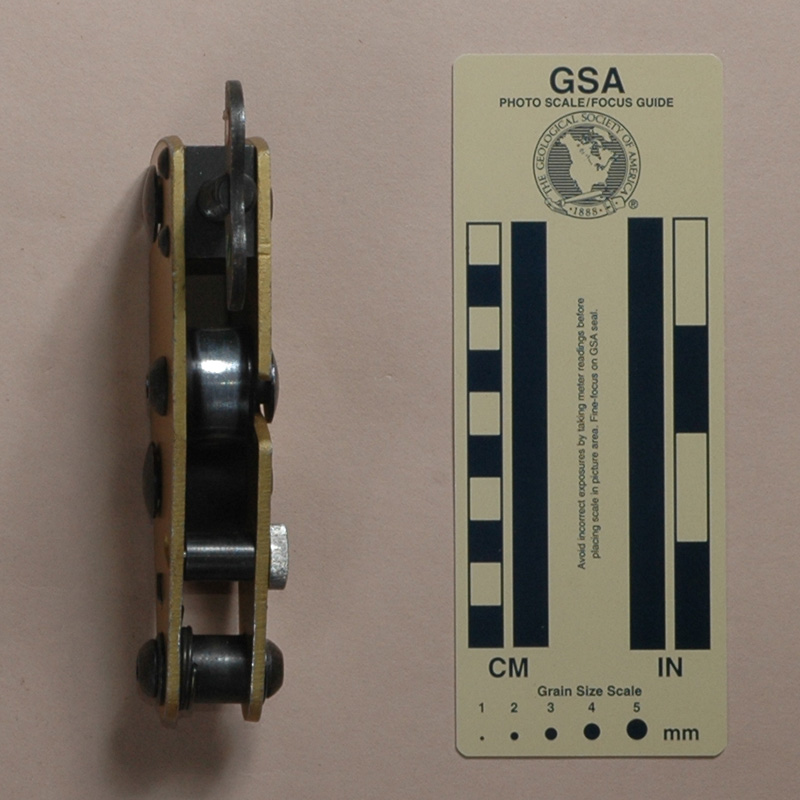
I acquired this Allp used from John Charles in 2007.
Version E is 133 mm. tall, 103 mm. wide, 34 mm. thick, and weighs 322 g. Version E is similar to Version B. The primary differences are as follows:
The note from Dave Allport in the Allp History section shows that this is the second of the two lock pin designs. Although this design is an improvement over the Version D design, the larger, undercut lock knob on the Troll (USA) Alp is easier to grip.
[ Top | Version A | Version B | Version C | Version D | Version E | Version G | Version H | Return to Poly-Bollards]
|
|
 |
 |
| Front View | Rear View | Side View |
 |
 |
| Front View: Open for Rigging | Rear View: Open for Rigging |
I acquired this Allp used from Steve Chamberlain in 2008.
Version F is 134 mm. tall, 102 mm. wide, 34 mm. thick, and weighs 326 g. Version F is similar to Version E. The primary differences are as follows:
The larger washers might be a minor improvement. I prefer the larger knurling on this version’s safety catch; it feels better in my fingers.
The wear pattern on the bollards indicate that a previous owner turned the bollards to distribute the wear - unless they turned themselves!
[ Top | Version A | Version B | Version C | Version D | Version E | Version F | Version H | Return to Poly-Bollards]
|
|
 |
 |
| Front View | Rear View | Side View |
 |
 |
| Front View: Open for Rigging | Rear View: Open for Rigging |
I acquired my Troll Allp, Version G from proacsafety in 2011.
Version G is 134 mm. tall, 98 mm. wide, 34 mm. thick, and weighs 320 g. Version G is similar to Version F. The primary differences are as follows:
This Allp was intended for police use.
[ Top | Version A | Version B | Version C | Version D | Version E | Version F | Version G | Return to Poly-Bollards]
|
|
 |
 |
| Front View | Rear View | Right Side View |
 |
 |
 |
| Left Side View | Front View: Open for Rigging | Rear View: Open for Rigging |
I acquired this Troll Allp from Miles Bradshaw in 2023.
Version H is 134 mm. tall, 99 mm. wide, 34 mm. thick, and weighs 319 g.
Version H is similar to Version G. The primary differences are as follows:
This Allp was intended for police use.
[ Top | Version A | Version B | Version C | Version D | Version E | Version F | Version G | Version H ]