

This page will not fit into a tiny viewport. Please choose a full-size monitor with a full-width window or select the abridged New Wave pages.

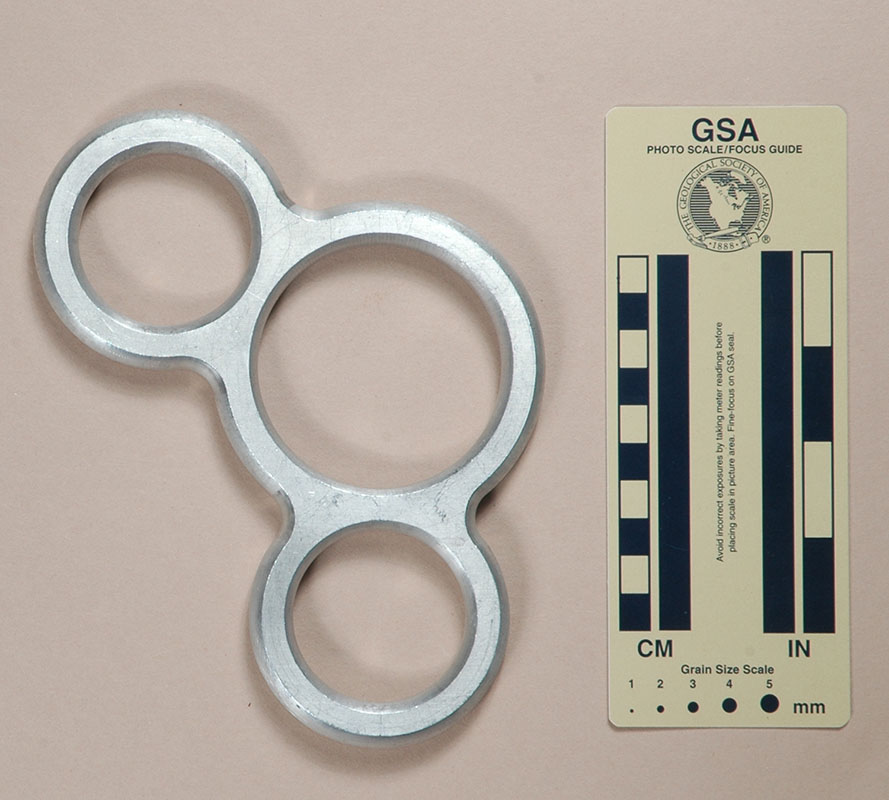
Version A
|
|
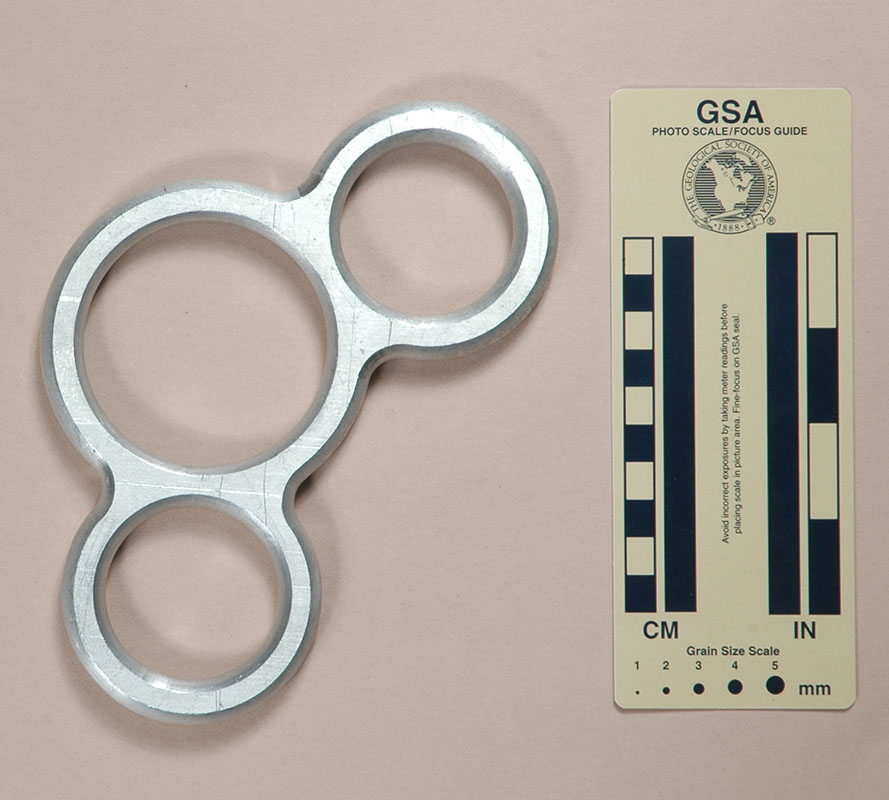 |
| Front | Rear |
I built this device in 2005.
I milled my Hopf device from 1/2" (12.7 mm.) 6061-T6 aluminum plate. The central hole and outer holes have 65 and 46 mm. internal diameters respectively, and the ring thickness is 11.2 mm. between rings and 12.3 mm. on the periphery. My Hopf weight 197 g.
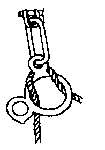 The Hopf is used like a figure eight descender, but it has a third ring that provides some additional flexibility. The third ring’s main function is to provide a convenient tie-off point for stopping on rappel or for supporting a climber after belaying a fall. Personally, I think that the various side-horn type eights (e.g., various Russian eights, S.B.C.I. Sidewinder) provide more convenient tie-offs, and I dislike belaying with a figure eight because I like to have more friction in my belay device.
The extra ring can also perform the same functions that ears do on a a figure eight with ears; i.e., greatly increasing the size of the device in return for reducing the chance of a girth hitch forming on rappel.
I first learned of the Hopf from Norman Kingsley’s 1975 book Icecraft. He credits the design to Dr. Hopf of Bern, Switzerland. Dr. Hopf applied for a patent in 1968 and received Swiss Patent #494,041 for the descender. When I visited Walter Marti (the original Jumar manufacturer) in 1982, he showed me a Hopf, but I was unable to find one in any of the Bernese (or any other Swiss) climbing shops, nor was I able to find one during my visit to Switzerland for the 1997 International Congress of Speleology. I finally settled for making my own. The dimensions I chose are reasonable but somewhat arbitrary; like the figure eight, one can make useful Hopfs with a wide variety of ring sizes. The reason that I separated the two eyes by 135° instead of 90° simply because that is what I remembered, incorrectly. For machining simplicity, I omitted the small nubbin on the tie-off eye.
Gary Storrick, NSS 12967 FE CM, began caving, climbing, and collecting vertical equipment in 1971. He created this web site in 1999, and earned an NSS Certificate of Merit in 2024 for his work. Back in the day, his father Robert had some small equipment made for him in the shops that he managed. Gary now makes samples in his home machine and wood shops to aid his research. He suggests, "I may have tried more devices than the average caver."