

This page will not fit into a tiny viewport. Please choose a full-size monitor with a full-width window or select the abridged New Wave pages.

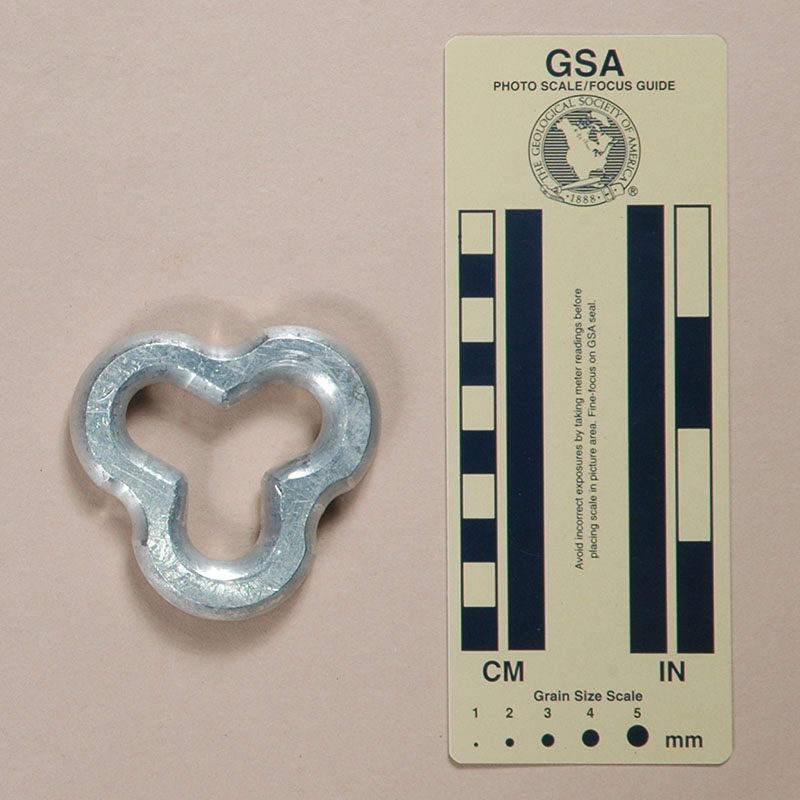
Version A

Version B

Version C

Version D
|
|
|
|
|
| Version A | Version B | Version C | Version D |
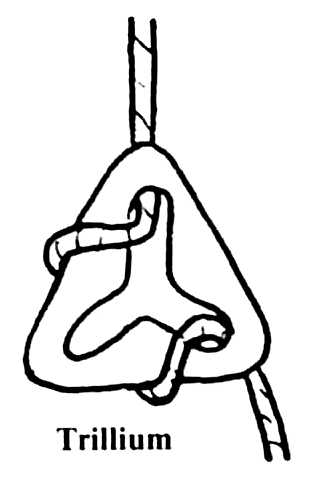 John Cole explained the Trillium as follows:
"The Trillium worked a lot like the figure-of-eight, except that it was triangular, and we hoped to be able to make a mold and cast these devices. Descent control was, however, somewhat poorer than that characteristic of the rack[1]."
No one followed through with those plans to make cast Trilliums. Gary Storrick wanted to test Trilliums, so he made one in 2004 and three more in 2021.
Gary Storrick, NSS 12967 FE CM, began caving, climbing, and collecting vertical equipment in 1971. He created this web site in 1999, and earned an NSS Certificate of Merit in 2024 for his work. Back in the day, his father Robert had some small equipment made for him in the shops that he managed. Gary now makes samples in his home machine and wood shops to aid his research. He suggests, "I may have tried more devices than the average caver."
[ Top | Version B | Version C | Version D | Return to Plate Descenders ]
|
|
I made this Trillium in 2004.
This Trillium is 67 mm. tall, 71 mm. wide, 12.7 mm. thick, and weighs 73 g.
I milled this Trillium from 6061-T6 aluminum plate.
I read about it in 1981, but it wasn't until 2004 that I had the equipment to make one of my own. By then I could not remember where I had read about it and could find the original article, so I went from memory. The result is not particularly faithful to the original: the arms of the Y-shaped slot are too short and so this Trillium lacks the distinct subtriangular shape.
This Trillium is rigged in the same manner as the Free-Run mode on the more recent Yates Belay Slave and similar devices. It works, of course, but like all small devices, tends to overheat. This Trillium tends to rotate so that the standing line slot is vertical, which pushes the carabiner to the side where it tends to trap the rope. If one brakes too hard, the carabiner may shift into a rather low-friction position. I don't have much temptation to make this my primary rappel device, but it is an interesting historical curiosity.
This was my first milling project to use a rotary table, and I found that I needed to do a lot of clamping and unclamping to deal with the four centers of rotation. When I was done, I realized that two stacked rotary tables would have made the job much easier.
[ Top | Version A | Version C | Version D | Return to Plate Descenders ]
|
|
 |
| Front | Rear |
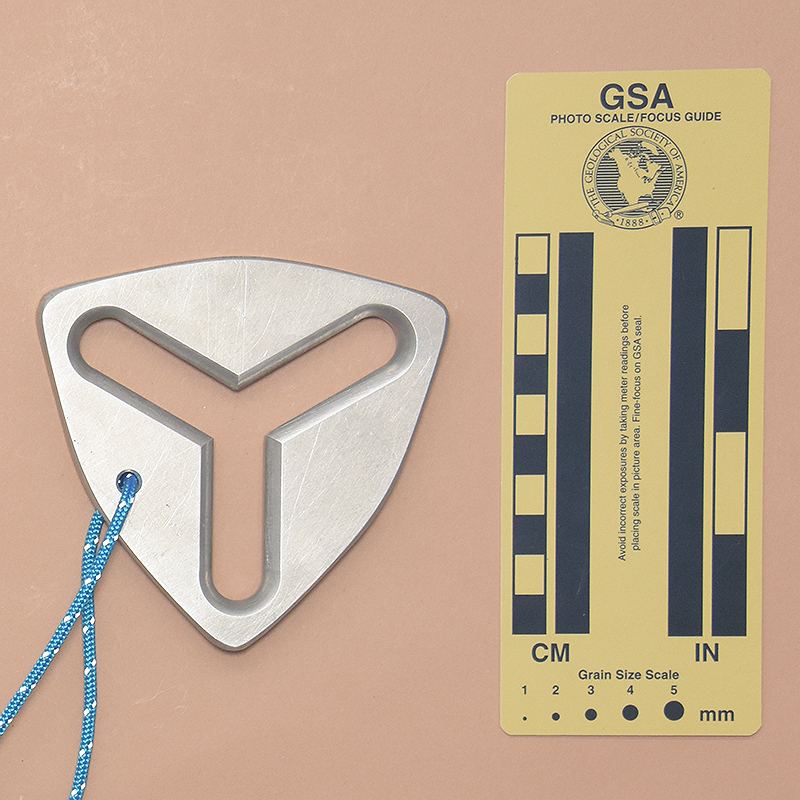
I made this Trillium in 2021.
This Trillium is 98 mm. tall, 102 mm. wide, 10 mm. thick, and weighs 131 g.
I milled this Trillium from 6061-T6 aluminum plate.
While filing papers in 2021, I came across the article describing the Trillium, and decided to make another. This one has aesthetically pleasing convex sides while the sketch in the article had straighter sides. Testing shows that rigging this one like an eight does not work as well as it might if I gave the Trillium concave sides. Rigging it in the free-running mode works better than it does on the earlier version. Carabiner relocation is still a problem, but less so on this version with the longer slots.
[ Top | Version A | Version B | Version D | Return to Plate Descenders ]
|
|
 |
| Front | Rear |
I made this Trillium in 2021.
Version C is 104 mm. tall, 95 mm. wide, 13 mm. thick, and weighs 159 g.
I milled this Trillium from 6061-T6 aluminum plate.
This Trillium has straight sides to closely match the one illustrated in the previously mentioned article. I expected this one to work better than Version B when in the figure-eight mode, and so I made it out of thicker aluminum plate. This accounts for the extra weight. I deleted the hole for the keeper cord, finding that a keeper just gets in the way and tends to get sucked into the device by the main rope.
Testing the figure-eight mode shows that the narrowing sides tend to force the rope toward the attachment carabiner, although this effect is less prominent than it is for Version B. Friction is excessive on stiff ropes, but reasonable on limper lines.
[ Top | Version A | Version B | Version C | Return to Plate Descenders ]
|
|
 |
| Front | Rear |
I made this Trillium in 2021.
Version D is 103 mm. tall, 95 mm. wide, 13 mm. thick, and weighs 111 g.
I milled this Trillium from 6061-T6 aluminum plate.
This version is the same size as Versions B and C, but follows the concept of Version A by eliminating the excess metal. As a result, it works well in figure-eight mode, but once again, carabiner relocation is an issue in the free-running mode.
[ Top | Version A | Version B | Version C | Version D ]