

This page will not fit into a tiny viewport. Please choose a full-size monitor with a full-width window or select the abridged New Wave pages.



|
|
 |
|
| Front View | Rear View | Side View |
I made my Storrick – Kosorukov Triangle (Косоруков Треугольник) in 2021.
My Triangle is 150 mm. tall, 91 mm. wide, 40 mm. thick, and weighs 201 g.
Naturally, when given a book with plans for making home-made SRT equipment, I could not resist the temptation to go to the shop and get to work.
Machining and assembling the Triangle was straightforward. I tried to follow the published plans closely, but I made several lazy-man concessions to my living in a primitive country that has been insanely failing to adopt the metric system despite attempts dating back to Jefferson in 1793.
I did not round the ends of the bars because the plans did not call for doing so, but it would look better if I had.
The tight bends around the two lower bollards means that this is not an ideal device for very stiff ropes. For limp ropes, it gives less friction than I would like.
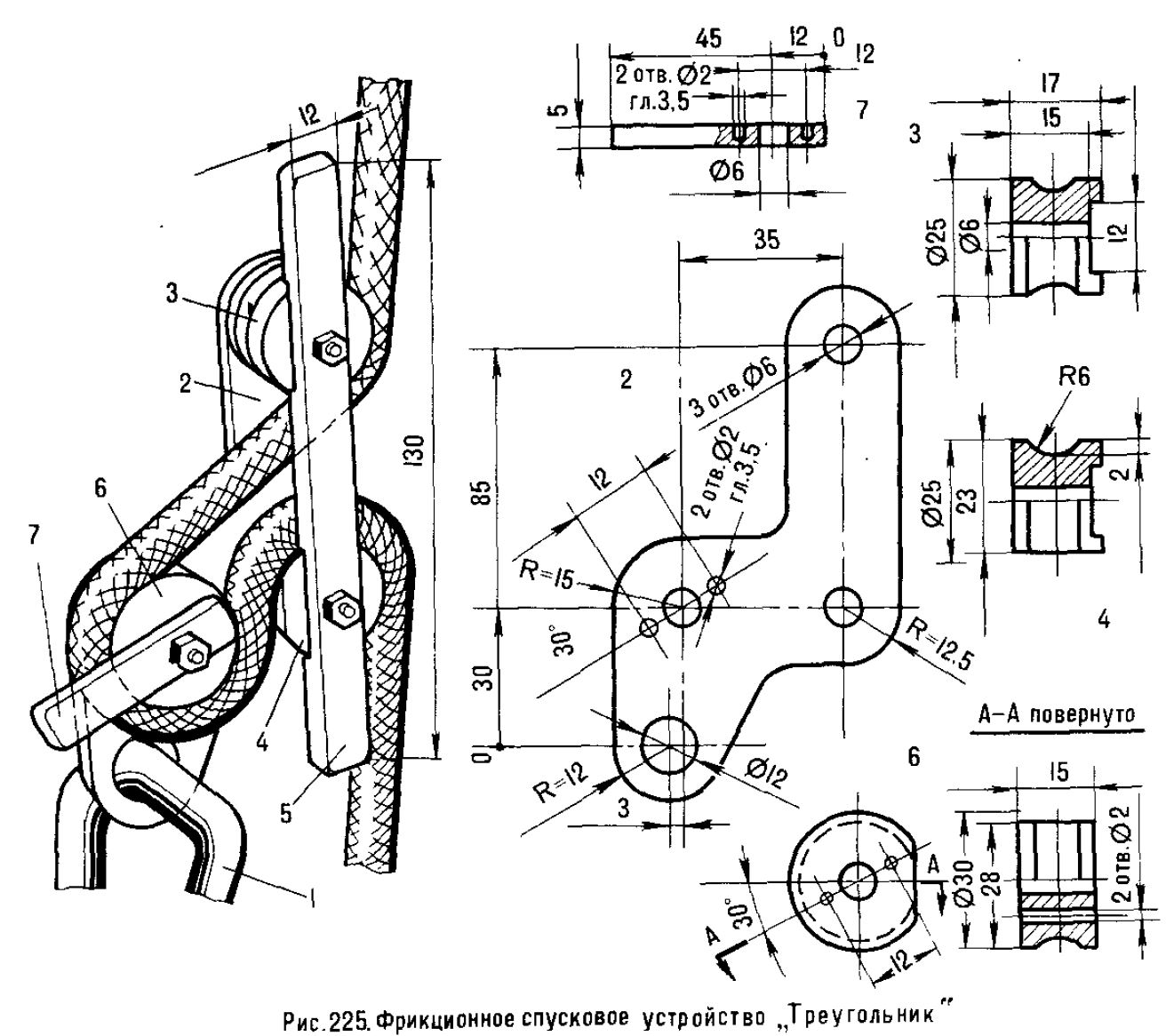 The plans for this descender were published in a fascinating Russian book containing plans for a wide variety of outdoor gear. The book credits Yuri Kosorukov (Юрий Косоруков) with the design. Rather than describe the device, I'll provide my translation of the description from that book:[1]
Frictional descent device "Triangle" (fig. 225)
Does not twist the rope and weighs about 180 g. When fastened with a carabiner (1) to the harness, it is always ready for use.
The device consists of a body (2), the contour of which can be simplified to a triangle with preservation of center-to-center dimensions and loaded sections, two rollers (3) and (4) with grooves for the bar (5). The rollers (4) and (6) have holes for threading the rope. The steel pins, driven into the holes with a diameter of 2 mm. of the roller (6), prevent it and the small bar (7) from rotating. The device is assembled on three steel M6 screws and nuts. The rest of the parts are made of alloy D16. (Author Y. Kosorukov, Moscow.)
Gary Storrick made this Kosorukov Triangle in 2021.
Gary Storrick, NSS 12967 FE CM, began caving, climbing, and collecting vertical equipment in 1971. He created this web site in 1999, and earned an NSS Certificate of Merit in 2024 for his work. Back in the day, his father Robert had some small equipment made for him in the shops that he managed. Gary now makes samples in his home machine and wood shops to aid his research. He suggests, "I may have tried more devices than the average caver."