

This page will not fit into a tiny viewport. Please choose a full-size monitor with a full-width window or select the abridged New Wave pages.


Exo

Escape, Version A

Escape, Version B

Tactical
|
|
|
|
|
| Exo | Escape System, Version A | Escape System, Version B | Tactical |
In 1930, Fernand Petzl discovered caving at the age of 17. Back at his workshop after each excursion to the depths, Fernand imagined new tools for exploring darkness and heights. With his inventions taking up more and more space, he decided to create his own workshop, sparking the growth of his small business. Working together brought Fernand closer to his son, Paul, who was determined to grow the business. From the beginning, Paul's wife Catherine took care of the accounting.
Paul Petzl, a mechanical engineering student, had already been thinking about creating a real company and began to plan out his first investments. In 1970, the Petzl brand was created. Five years later, the first company headquarters was established at the foot of the Dent de Crolles. In the years that followed, the number of employees increased as the company experienced local and international growth.
Petzl is a family business that, over the years, has become the largest European manufacturer of personal protective equipment for those who work and play in darkness or at height. All Petzl products are invented and developed at their headquarters in the heart of the French Alps.
The Petzl brand is present in over 55 countries with 85% of their sales made internationally. More than 9 million products are sold every year, and 10 million people use Petzl personal protective equipment every day.
[ Top | Escape v. A | Escape v. B | Tactical | Return to Lever Boxes ]
|
|
 |
| Front | Rear |
 |
 |
| Left | Right |
I acquired two Petzl Exos on eBay from Phillip Trzcinski in 2019.
My Petzl Exos are 118 mm. tall, 68 mm. wide, 54 mm. thick, and weigh 255 g.
The Exo consists of a spring-loaded cam assembly mounted between a back plate and a swinging front plate. The two plates are stamped from 3.1 mm. aluminum alloy and then anodized. The plates are shaped roughly like a mirror-image "D." The two plates are loosely riveted together near the top, with a 16.5 mm. stamped stainless steel anvil that serves as spacer between the two. The front plate could rotate about 135° clockwise with respect to the rear plate and spacer, allowing one to open the Exo for rigging, but the carabiner supplied with the Exo permanently prevents this. The two plates have inward dog-leg bends near the bottom, where 14.4 mm. attachment holes are punched through the sloping portion of the dog-leg. The front plate has a slot for capturing the head of the cam axle, and an arch to the right of the slot to provide support. The upper left half of the front plate is bent forward to provide a 10.4 mm. diameter curved surface for the rope to run over. A 5.8 mm. U-shaped rod attached to the front plate provides a fixed rope guide. A plastic spine fills the right side of the device between the plates.
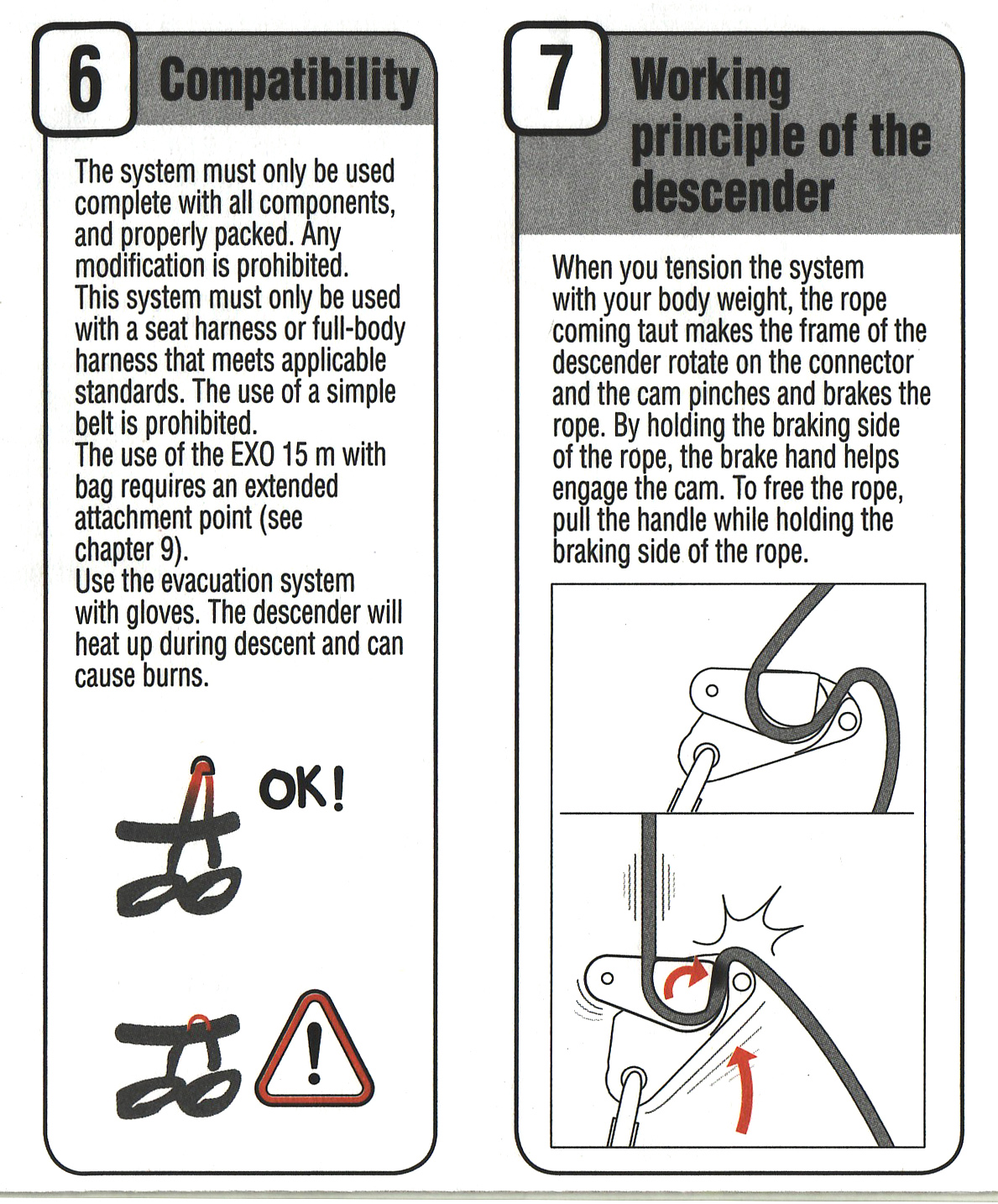
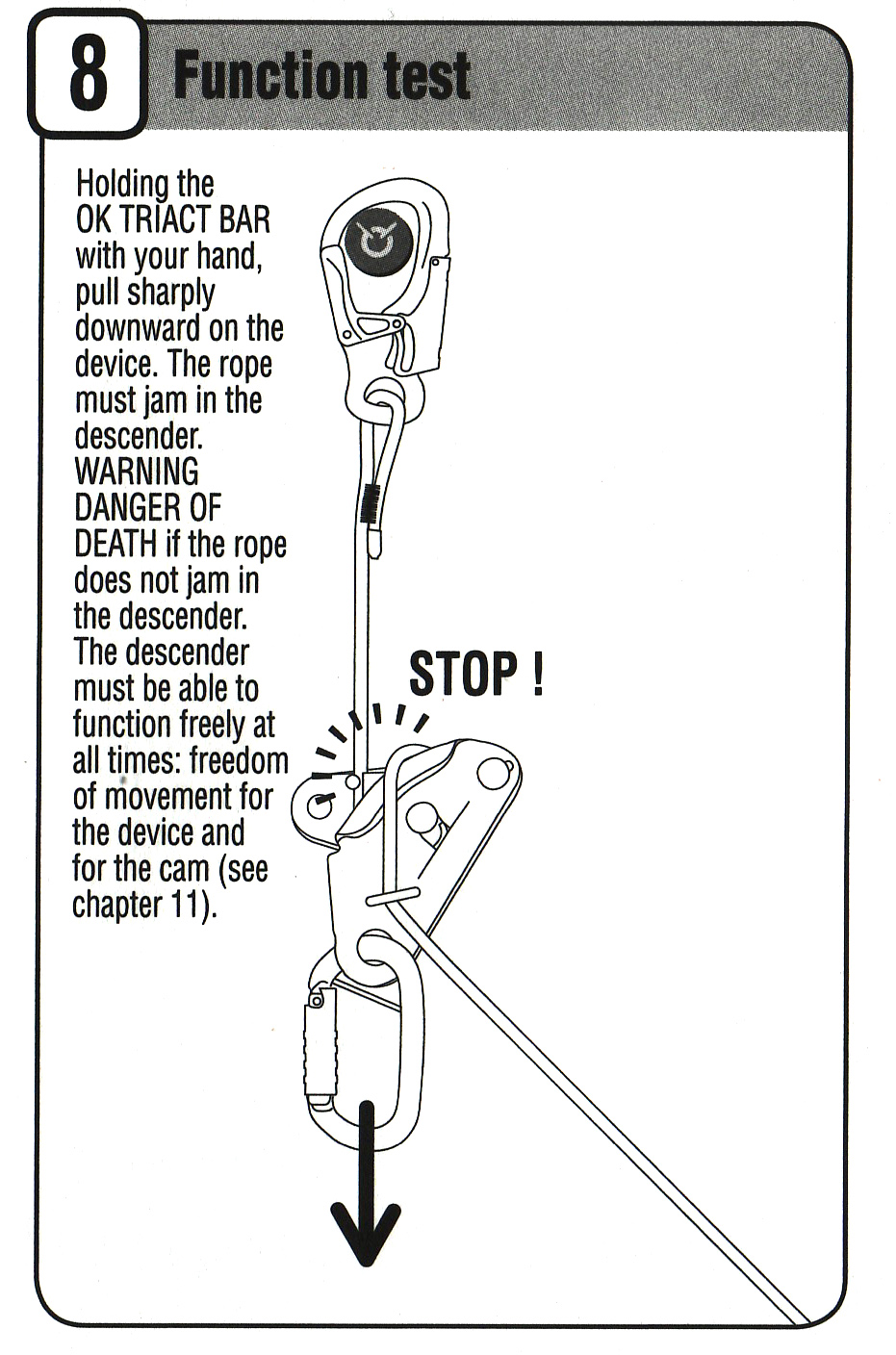
The cam is cast from stainless steel. The cam can rotate about 135° clockwise with respect to the rear plate, but a strong spring opposes this rotation. When loaded, the cam rotates clockwise, and the top surface of the cam squeezes the rope against the anvil. A spring-loaded aluminum handle on the rear of cam gives the user more leverage to release the cam.
The front plate is printed with "Exo." The spine is printed with the Petzl logo. The rear plate is stamped with "WARNING PROPER TRAINING IS ESSENTIAL BEFORE USE," a reading-is-dangerous icon, the Petzl logo, and "MADE IN FRANCE." It is also printed with "USE ONLY APPROVED ROPE," "SEE INSTRUCIONS," and "07088FI0457." The cam is cast with a climber and rope inside an arrow icon.
The Exo is basically a modified Grigri.
The carabiner is permanently attached to the Exo, making it unreasonable difficult to use the device more than once. Trying to back-thread the rope through the device is maddening. For my purposes, this "feature" earns it a Lemon Award  .
I spent a lot of frustrating time trying to get this Exo. Petzl America and its US distributors refused to let me have one without me attending an expensive training course on the other side of the country. On Rope 1 tried to get one for me, but Laurel Smith, Regional Sales & Support Representative of Petzl America wrote the following" (email dated September 3, 2008, quoting Michel Goulet, Manager - Work and Rescue Division):
"We can send an Exo descender (only) free of charge, but we need a letter addressed to Petzl America stating that the device will not be used, that it is intended for exhibit purpose only and when it will be returned to us."
I declined for the obvious reasons, leading to over a decade of frustration before I found these two on eBay.
[ Top | Exo | Escape v. B | Tactical | Return to Lever Boxes ]
|
|
 |
| Front | Rear |
 |
 |
 |
| Left | Right | Kit |
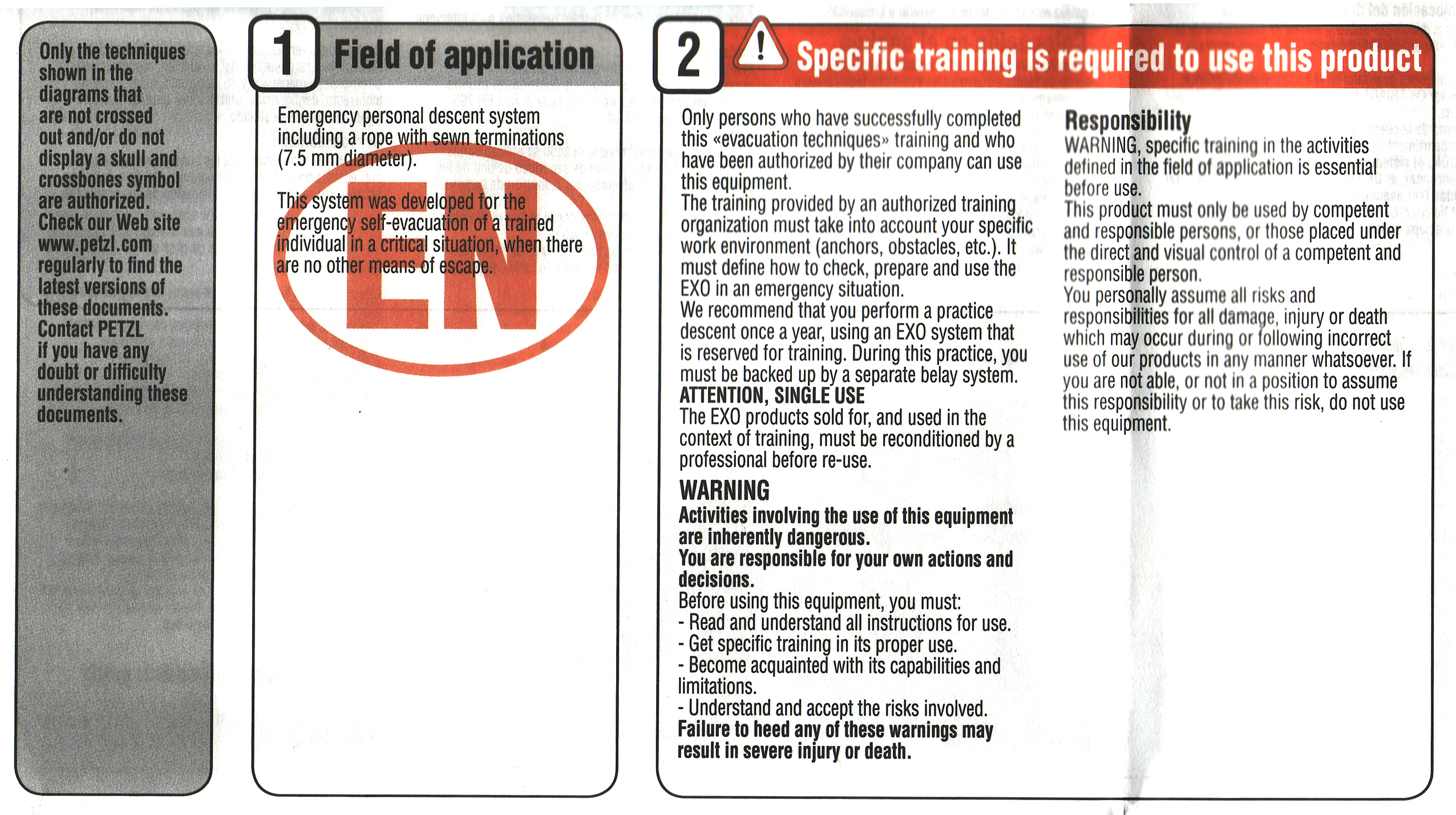
I acquired my Petzl Exo Escape System, Version A from Rock'N'Rescue in 2017.
My Petzl Exo Escape System, Version A descender is 117 mm. tall, 68 mm. wide, 55 mm. thick, and weighs 255 g.
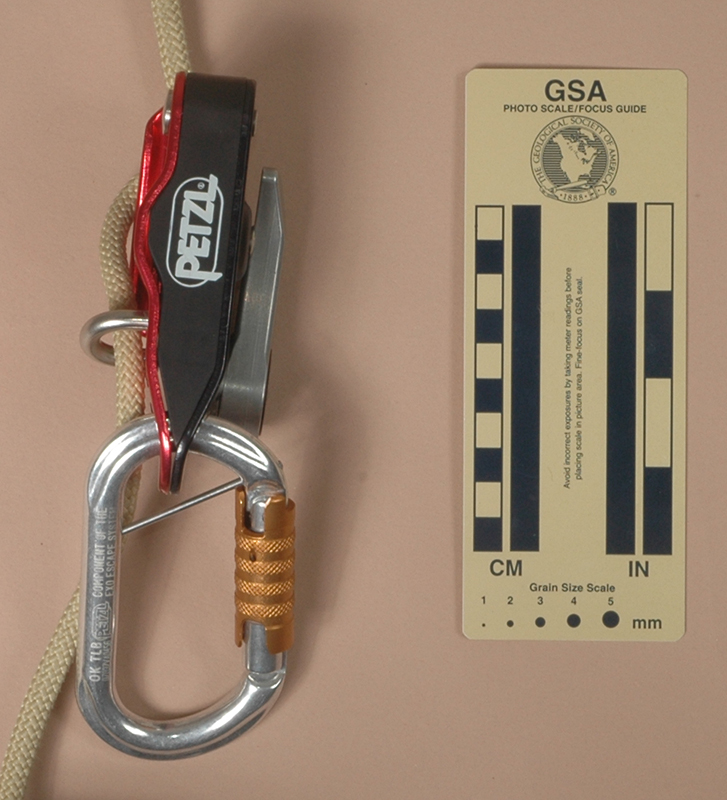
The Exo consists of a spring-loaded cam assembly mounted between a back plate and a swinging front plate. The two plates are stamped from 3.1 mm. aluminum alloy and then anodized. The plates are shaped roughly like a mirror-image "D." The two plates are loosely riveted together near the top, with a 16.5 mm. stamped stainless steel anvil that serves as spacer between the two. The front plate could rotate about 135° clockwise with respect to the rear plate and spacer, allowing one to open the Exo for rigging, but the carabiner supplied with the Exo permanently prevents this. The two plates have inward dog-leg bends near the bottom, where 14.4 mm. attachment holes are punched through the sloping portion of the dog-leg. The front plate has a slot for capturing the head of the cam axle, and an arch to the right of the slot to provide support. The upper left half of the front plate is bent forward to provide a 10.4 mm. diameter curved surface for the rope to run over. A 5.8 mm. U-shaped rod attached to the front plate provides a fixed rope guide. A plastic spine fills the right side of the device between the plates.
The cam is cast from stainless steel. The cam can rotate about 135° clockwise with respect to the rear plate, but a strong spring opposes this rotation. When loaded, the cam rotates clockwise, and the top surface of the cam squeezes the rope against the anvil. A spring-loaded aluminum handle on the rear of cam gives the user more leverage to release the cam.
The front plate is printed with the UL "Classified" logo, "45YF," "MEETS NFPA 1983 (06 ED.)E," "MBS 13.5kN," and "Exo." The spine is printed with the Petzl logo. The rear plate is stamped with "WARNING PROPER TRAINING IS ESSENTIAL BEFORE USE," a reading-is-dangerous icon, the Petzl logo, and "MADE IN FRANCE." It is also printed with "USE ONLY APPROVED ROPE," "SEE INSTRUCIONS," and "07165FR3317." The cam is cast with a climber and rope inside an arrow icon.
The attachment carabiner is etched with "OK TLB," "0709/VA0456," the Petzl logo, and"COMPONENT OF THE EXO ESCAPE SYSTEM." The spine is stamped with "01 07."
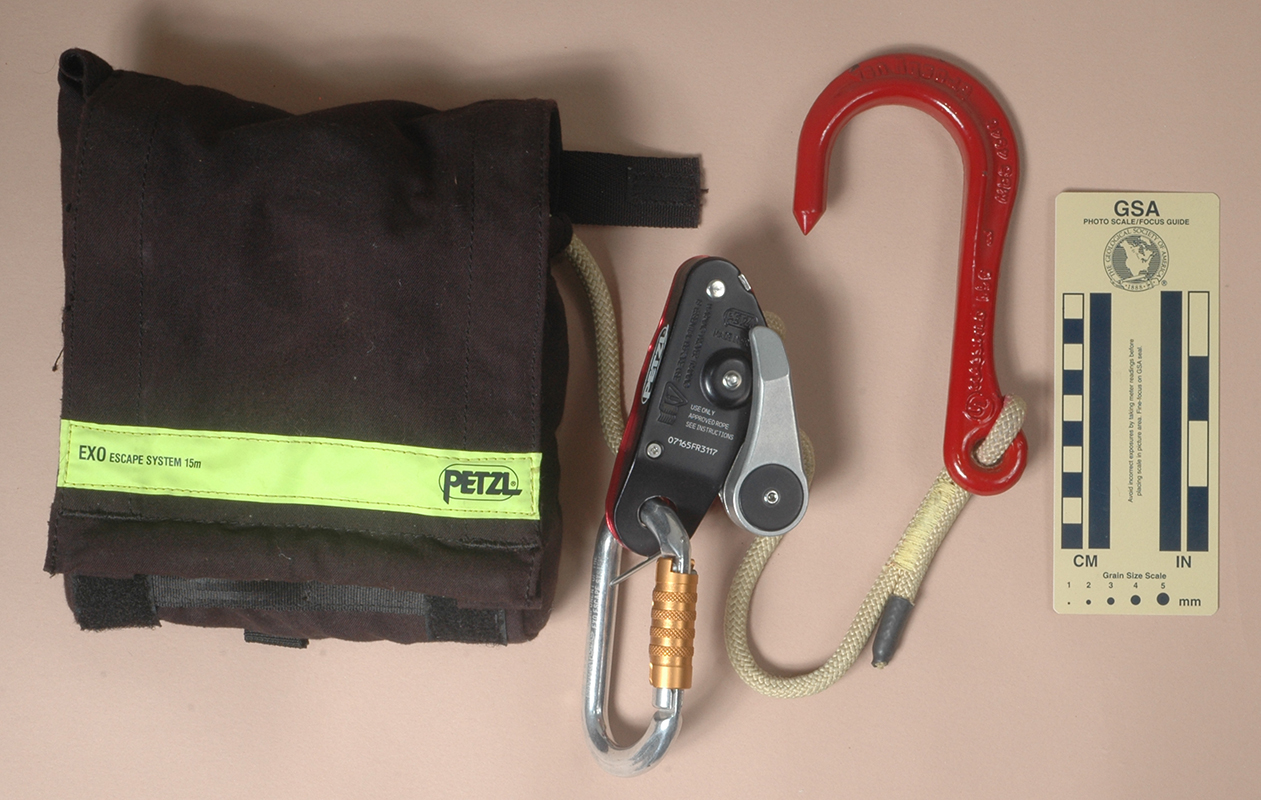
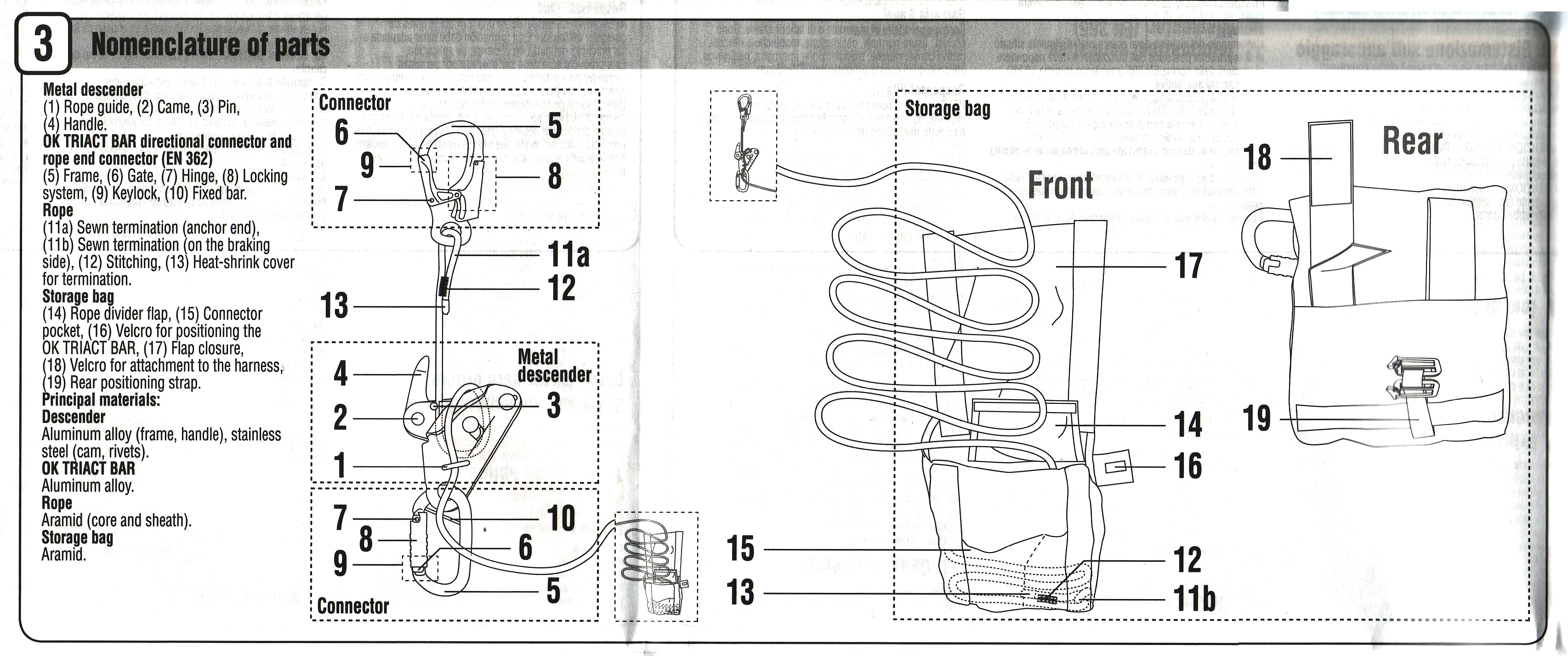
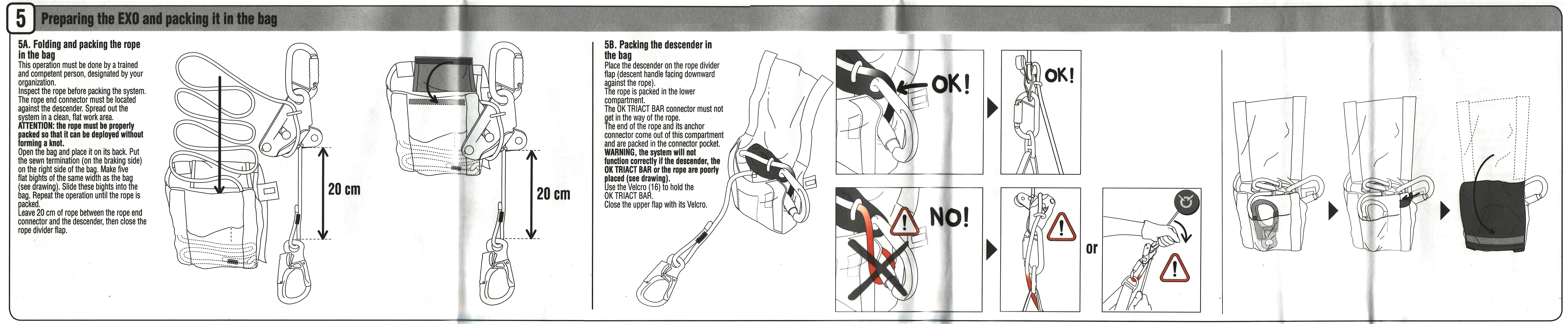
The Exo is basically a modified Grigri. Mine came in a kit that had 15 m. of 8 mm. rope pre-rigged. The upper end was sewn to a painted hook. The hook had the UL logo, "CLASSIFIED," "856," "L," "MBS 4946," and "Crosby USA" forged in raised letters. The Exo, carabiner, line, and hook came in a nice black pouch with nice Petzl markings.
The carabiner is permanently attached to the Exo, making it unreasonable difficult to use the device more than once. Trying to back-thread the rope through the device is maddening. For my purposes, this "feature" earns it a Lemon Award .
Using a hook like the one provided as a sole anchor does not inspire much confidence, but I suppose that when trying to get out of a burning building, anything might look like it is worth the risk.
I spent a lot of frustrating time trying to get this Exo. Petzl America and its US distributors refused to let me have one without me attending an expensive training course on the other side of the country. On Rope 1 tried to get one for me, but Laurel Smith, Regional Sales & Support Representative of Petzl America wrote the following (email dated September 3, 2008, quoting Michel Goulet, Manager - Work and Rescue Division):
"We can send an Exo descender (only) free of charge, but we need a letter addressed to Petzl America stating that the device will not be used, that it is intended for exhibit purpose only and when it will be returned to us."
I declined for the obvious reasons. Eventually, after nearly a decade of frustration with me trying to obtain one elsewhere, Rock’N’Rescue gave me this one. Thank you!
[ Top | Exo | Escape v. A | Tactical | Return to Lever Boxes ]
|
|
 |
 |
| Front | Rear | Hook, Front |
 |
 |
 |
| Left | Right | Hook, Rear |
 |
 |
 |
| Kit, Front | Kit, Right | Kit, rear |
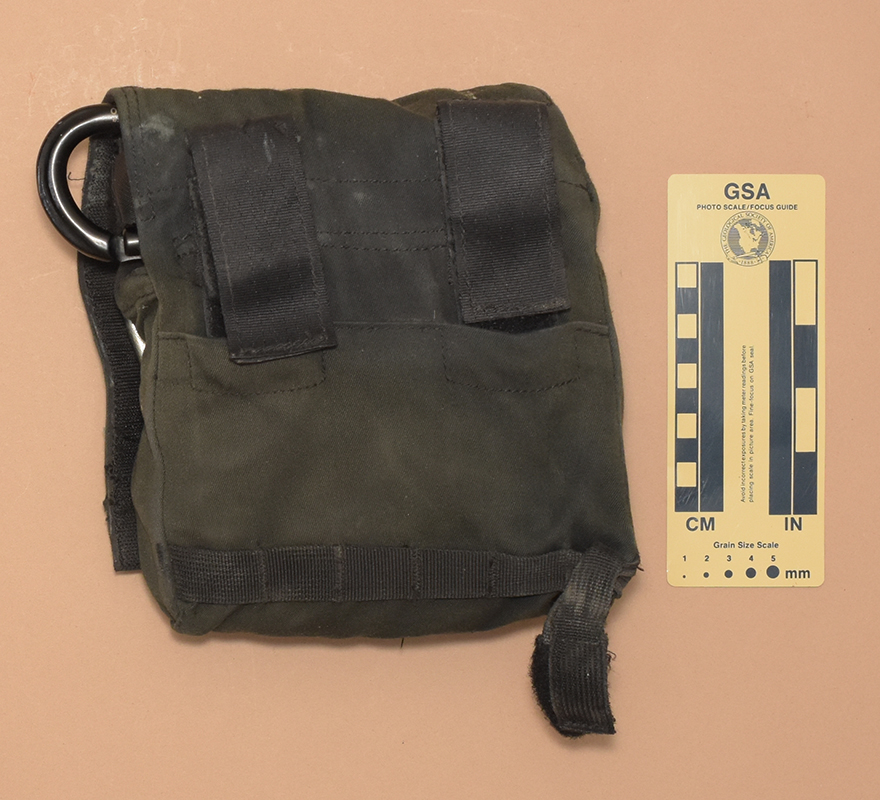
I acquired this used Petzl Exo Escape System, Version B from Westco Surplus Sales in 2026.
My Petzl Exo Escape System, Version B is 118 mm. tall, 68 mm. wide, 56 mm. thick, and weighs 255 g.
This kit contains an Exo that is essentially identical to the one in kit Version A.
The Exo consists of a spring-loaded cam assembly mounted between a back plate and a swinging front plate. The two plates are stamped from 3.1 mm. aluminum alloy and then anodized. The plates are shaped roughly like a mirror-image "D." The two plates are loosely riveted together near the top, with a 16.5 mm. stamped stainless steel anvil that serves as spacer between the two. The front plate could rotate about 135° clockwise with respect to the rear plate and spacer, allowing one to open the Exo for rigging, but the carabiner supplied with the Exo permanently prevents this. The two plates have inward dog-leg bends near the bottom, where 14.4 mm. attachment holes are punched through the sloping portion of the dog-leg. The front plate has a slot for capturing the head of the cam axle, and an arch to the right of the slot to provide support. The upper left half of the front plate is bent forward to provide a 10.4 mm. diameter curved surface for the rope to run over. A 5.8 mm. U-shaped rod attached to the front plate provides a fixed rope guide. A plastic spine fills the right side of the device between the plates.
The cam is cast from stainless steel. The cam can rotate about 135° clockwise with respect to the rear plate, but a strong spring opposes this rotation. When loaded, the cam rotates clockwise, and the top surface of the cam squeezes the rope against the anvil. A spring-loaded aluminum handle on the rear of cam gives the user more leverage to release the cam.
The front plate is printed with the UL "Classified" logo, "45YF," "MEETS NFPA 1983 (06 ED.)E," "MBS 13.5kN," and "Exo." The spine is printed with the Petzl logo.
The rear plate is stamped with "WARNING PROPER TRAINING IS ESSENTIAL BEFORE USE," a reading-is-dangerous icon, the Petzl logo, and "MADE IN FRANCE." It is also printed with "USE ONLY APPROVED ROPE," "SEE INSTRUCIONS," and "11102FK1256." The cam is cast with a climber and rope inside an arrow icon.
The attachment carabiner is etched with "OK TLB," "10324/VA0243," the Petzl logo, and"COMPONENT OF THE EXO ESCAPE SYSTEM." The spine is stamped with "22 10."
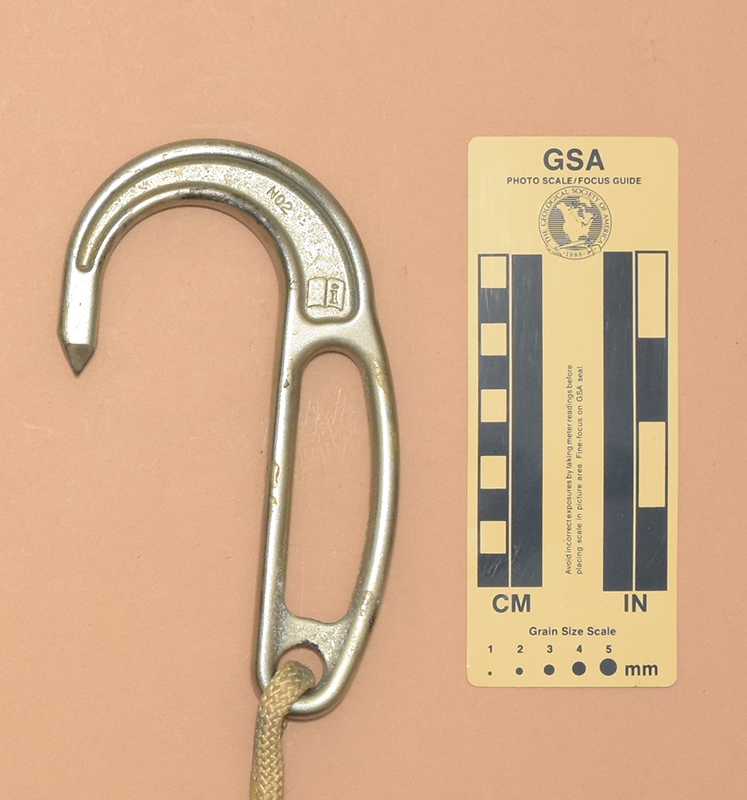
This kit contains an Exo that is essentially identical to the one in kit Version A. The attachment carabiner is black instead of silver, but of the same design. The 15 m. rope appears to be softer and slightly thicker, but I believe that this is the result of extensive use. The sewn loop attaching the rope to the hook has had the end taped. This appears to have been done by a previous owner. The hook has a different design and is plated, not painted. It has the Petzl logo on one side and a book-with-an-"i" logo as raised parts of the forging. It is also stamped "NO2" on the rear side.
The carabiner is permanently attached to the Exo, making it unreasonable difficult to use the device more than once. Trying to back-thread the rope through the device is maddening. For my purposes, this "feature" earns it a Lemon Award .
[ Top | Exo | Escape v. A | Escape v. B | Return to Lever Boxes ]
|
|
 |
 |
| Front View | Rear View | Side View |
I acquired my Petzl Exo Tactical from On Rope 1 in 2010.
The Petzl Exo Tactical is 117 mm. tall, 68 mm. wide, 55 mm. thick, and weighs 255 g.
The Exo consists of a spring-loaded cam assembly mounted between a back plate and a swinging front plate. The two plates are stamped from 3.1 mm. aluminum alloy and then anodized. The plates are shaped roughly like a mirror-image "D." The two plates are loosely riveted together near the top, with a 16.5 mm. stamped stainless steel anvil that serves as spacer between the two. The front plate could rotate about 135° clockwise with respect to the rear plate and spacer, allowing one to open the Exo for rigging, but the carabiner supplied with the Exo permanently prevents this. The two plates have inward dog-leg bends near the bottom, where 14.4 mm. attachment holes are punched through the sloping portion of the dog-leg. The front plate has a slot for capturing the head of the cam axle, and an arch to the right of the slot to provide support. The upper left half of the front plate is bent forward to provide a 10.4 mm. diameter curved surface for the rope to run over. A 5.8 mm. U-shaped rod attached to the front plate provides a fixed rope guide. A plastic spine fills the right side of the device between the plates.
The cam is cast from stainless steel. The cam can rotate about 135° clockwise with respect to the rear plate, but a strong spring opposes this rotation. When loaded, the cam rotates clockwise, and the top surface of the cam squeezes the rope against the anvil. A spring-loaded aluminum handle on the rear of cam gives the user more leverage to release the cam.
The front plate is printed with "CE0197," "EN341: 1993/D," "15 m - Max 136 kg," FOR SINGLE USE ONLY," and "Exo." The spine is printed with the Petzl logo. The rear plate is printed with "08333FR0676," an inventory code block, "USE ONLY APPROVED ROPE," and "SEE INSTRUCTIONS."
The Exo is basically a modified Grigri. Mine came in a kit that had 15 m. of 8 mm. rope pre-rigged. The upper end was sewn to a hook with a double action safety gate.
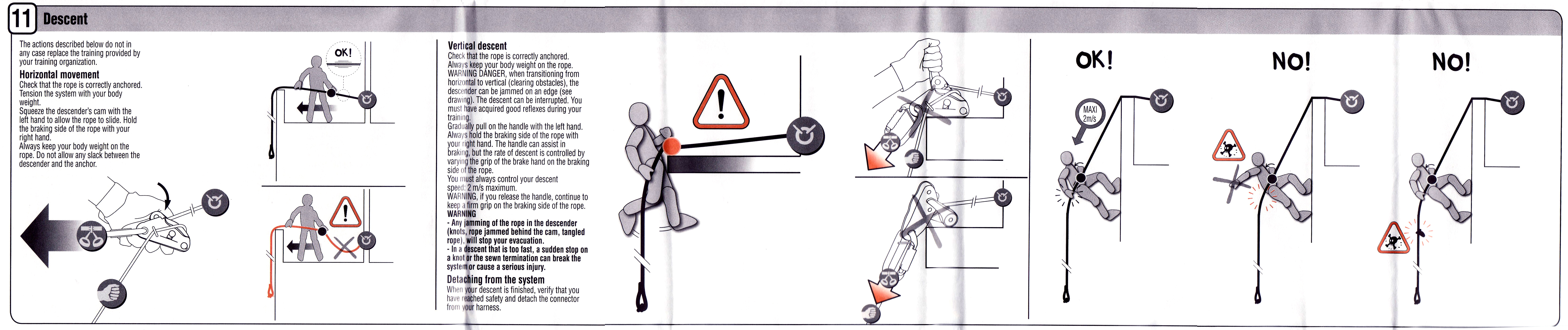
Labeling the device "FOR SINGLE USE ONLY" implies that it is only usable once. This alone is reason to avoid the Exo.
The carabiner is permanently attached to the Exo, making it unreasonable difficult to use the device more than once. Trying to back-thread the rope through the device is maddening. For my purposes, this "feature" earns it a Lemon Award .
I spent a lot of frustrating time trying to get a regular Petzl Exo. Petzl America and its US distributors refused to let me have one without me attending an expensive training course on the other side of the country. On Rope 1 tried to get one for me, but Laurel Smith, Regional Sales & Support Representative of Petzl America wrote the following (email dated September 3, 2008, quoting Michel Goulet, Manager - Work and Rescue Division):
"We can send an Exo descender (only) free of charge, but we need a letter addressed to Petzl America stating that the device will not be used, that it is intended for exhibit purpose only and when it will be returned to us."
I declined for the obvious reasons. Imagine my surprise when I was able to buy the tactical version without interference.
 |
 |
 |
 |
 |
 |
 |
 |
 |
[ Top | Exo | Escape v. A | Escape v. B | Tactical ]