

This page will not fit into a tiny viewport. Please choose a full-size monitor with a full-width window or select the abridged New Wave pages.

|
|
 |
 |
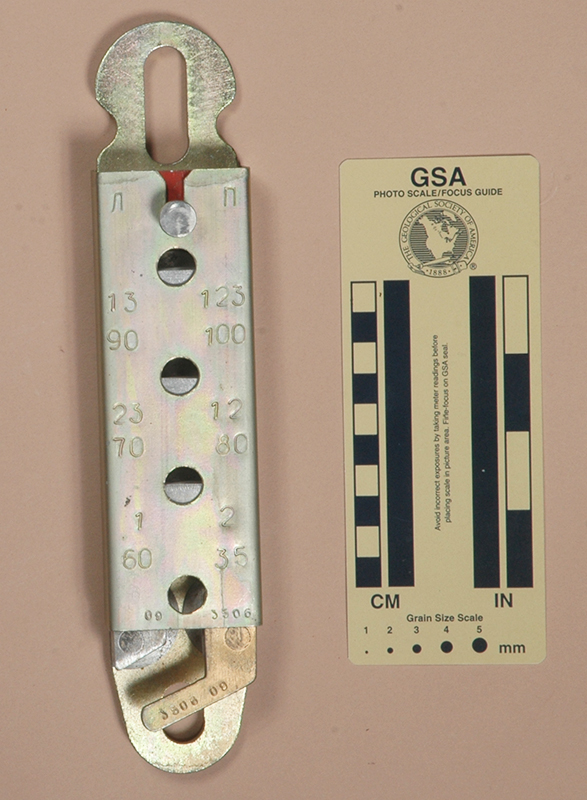
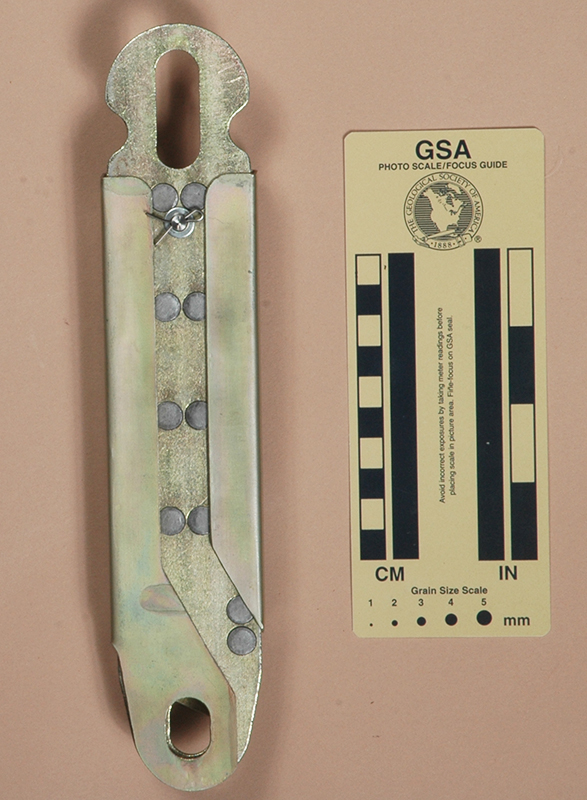
| Front | Rear | Open for Rigging |
I acquired this descender from Gear4Rocks in 2013. Gear4Rocks was the same company as Krok, the only difference was that the Krok trademark sold gear only inside Ukraine, and the Gear4Rocks trademark was created to spread Ukrainian gear around the world.
The SUR is 244 mm. tall, 50 mm. wide, 37 mm. thick, and weighs 561 g.
The SUR disassembles into two pieces. The body consists of a 3.15 mm. galvanized steel plate with a 38 mm. tall, 138 mm. wide punched oval top hole and a 19.8 mm. tall, 138 mm. wide punched oval bottom hole. The top has two shallow rope notches in the sides of the plate to facilitate tie-offs. The bottom is slightly tapered. There are four aluminum bollards and two half-bollards riveted to the plate, each with two 5 mm. steel rivets. The top bollards are 33 mm. diameter and 16.2 mm. thick. Each one has a 12.7 mm. wide U-groove that gives the bollards a 21.2 mm. minor diameter. The groove is off-centered so that the edge is only 1 mm. from the back plate. The front of each bollard is cut away along horizontal chord lines so that the front height is 21.5 mm., giving room to rig the rope. The two half-bollards have similar dimensions as the top four, but are cut away on the sides and bottom, and mounted side-by-side near the edge of the plate, giving a central rope channel. The right bollard has a 3.15 mm. steel guide sharing the rivets holding it to the main plate.
The cover is a galvanized rectangular channel stamped from 1 mm. steel plate with an open rope channel in the back and four holes in front. It slides over the main assembly from the bottom. When in place, the front holes are aligned with the space between the bollards, allowing one to see how many bollards are actively rigged. A 7.7 mm. spring-loaded stainless steel pin fitting through a hole in the top bollard acts as a cover retainer. This pin has a 12 mm. head and a 5 mm. groove for the cover. It is held in place with a washer and cotter pin on the rear of the main plate. The pin engages a slot in the top of the cover. Pushing the pin in allows attaching or detaching the cover. The slot is 5.6 mm wide and terminates in an 8.3 mm. circle.
The rope guide is stamped "3506 09." The front cover is stamped with "Л," "П," "13," "123," "90," "100," "23," "12 "70," "80," "1," "2," "60," "65," "09," and "3506."
As with any enclosed device, heavy mud conditions can pose a problem.
I do not particularly like the cotter pin retaining the cover pin. The cotter pin has sharp ends that can catch on various things in my pack.
One can rig the rope around the upper bollards in various ways. The large numbers stamped on the cover represent relative friction for various rigging combinations, but he instructions did not explain these clearly. The upper number represents which slots between the bollards are used, and the bottom numbers represent the rappeller’s mass in kg. The following illustration, adapted from the Krok web site, provides more clarity:

The SUR was designed "for use by the military when landing from helicopters on rope ropes with a constant descent speed of the paratrooper without using manual braking control. That is: go down and fire at the enemy." For those of us who don't have any surviving enemies, we can consider the SUR’s possible caving and climbing applications. These are not its design purpose, and so it is of no surprise that it is not the optimal choice for either of these.
In the autumn of 1977, in the mountaineering section of the Voroshilovgrad (now Luhansk) engineering institute (WMI), first-year students began their journey into the mountains. Many of them achieved some success in Soviet and post-Soviet mountaineering and rock climbing. Years later, these individuals became key specialists at the manufacturing company KROK. Back then, amidst the chronic shortages of the Soviet era, they had to invent and manufacture mountaineering gear.
In 2004, when an opportunity came to establish his own manufacturing operations, Kostromitinov Alexei Dmitrievich began mass producing equipment for mountaineering, industrial rope access, and outdoor activities. He registered the Krok trademark that year, with the firm headquartered in Stakhanov, in the Luhansk region (Donbass). The name of the KROK brand was taken from the word "crows", which in mountaineering and tourism means a step-by-step sketch of the route to the goal. Production of Krok-branded products began in Russia and Ukraine.
Over years of dynamic growth, Krok developed and launched the production of over four hundred items of gear, hardware, and soft goods for mountaineering, outdoor activities, and industrial rope access. The company mastered the manufacture of personal protective equipment (PPE) against falls from heights, as well as equipment for working at heights and in confined spaces, and devices for rescue and evacuation operations. In addition, products are manufactured for sports and outdoor activities—including fitness and slacklining—as well as equipment for adventure parks, zip lines, and children's sports and playgrounds, along with gear for arboriculture.
Krok did not market directly in the U.S.A. They operated the eBay stores PetrenkoWorld in 2007 and Gear4Rocks from 2010 to 2013, making their products conveniently available to U.S. customers for a brief time.
In October 2020, founder and unchanged head of the company Kostromitinov Alexei Dmitrievich passed away, but the company continued to work under the leadership of his wife Oksana Valerievna. In 2022 Russia invaded Ukraine and working became even harder. There were no new developments and Krok gradually removed items from production. The situation worsened in 2024 and Krok decided to suspend operations. Production stopped in November, and the sales of the remaining inventory began.