

This page will not fit into a tiny viewport. Please choose a full-size monitor with a full-width window or select the abridged New Wave pages.


El Diablo

Rescue 8, Version A

Rescue 8, Version B

Rescue 8, Version C
|
|
|
|
|
| El Diablo | Rescue 8 Version A | Rescue 8 Version B | Rescue 8 Version C |
CMI has been making products for climbers, mountaineers, arborists, ropes course professionals, and fire service and industrial safety experts since 1964.
Minnesota native Gregg Blomberg moved to Denver, Colorado to attend a two-year college to study gunsmithing. He caught the climbing bug and decided to use his knowledge about metalworking to manufacture pitons. Up to that time, a few climber/blacksmiths in America were forging and selling “hard metal” reusable pitons from alloy steels. Gregg thought he could improve on the design of the piton and began manufacturing out of a garage in Denver in 1963. Gregg then designed and manufactured the first American-made piton hammers. He founded Colorado Mountain Industries (CMI) in 1964. After selling about 450 piton hammers, Gregg realized the market in the US was saturated, so he licensed a West German company, Salewa, to manufacture his designs in Europe. In 1966, Gregg decided to sell CMI to Redfield Gunsight Company, also in Denver.[1]
In 1972, CMI was still a division of the Redfield Gunsight Company and was managed by Don Burris. In 1971, he left Redfield to start his own company, Burris Optics, so it was decided to arrange for the sale of the CMI division. Bev Feldstein, an ambitious outdoor enthusiast and owner of The Speleo Alpine Shop in Cincinnati, became excited about acquiring CMI and moving it to Ohio. By early 1973, Bev had formed a corporation of five people: herself, daughter Linda, Joe Day, Todd Tomlinson, and Ethan Becker. Ethan had the financial resources and became the owner. By the summer of 1973 CMI had moved to the eastern Cincinnati suburb of Fairfax. Ken Macke joined the team as a designer and production manager.[1]
In 1975, CMI also began to produce some private label climbing gear for other suppliers. They were approached by Ron Kirk to manufacture a set of five wedge-shaped chocks, like the “Gendarme Nuts.” The relationship between CMI and Ron quickly grew. By 1976, CMI was losing money at a steady pace, and Ethan’s accountant convinced him to scale back operations and to find a buyer for CMI. [1] Ron Kirk purchased CMI in 1978 and moved the company to Franklin West Virginia. It remains there, family owned and operated under Ron Kirk's leadership.
[ Top | Rescue 8 v. A | Rescue 8 v. B | Rescue C v. B | Return to Figure Eights ]
|
|
 |
| Front | Rear |
I acquired my CMI El Diablo from CMI in 2015.
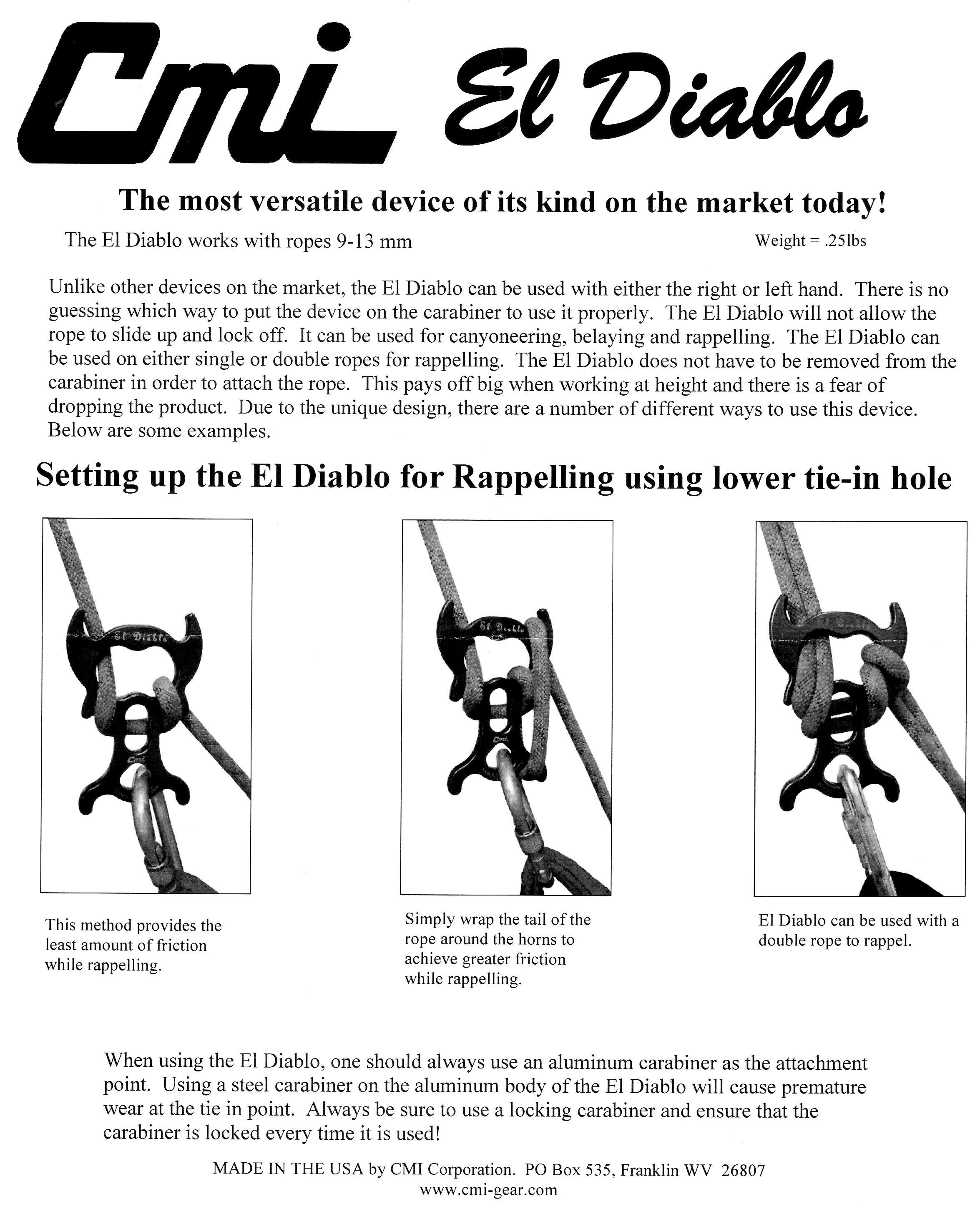
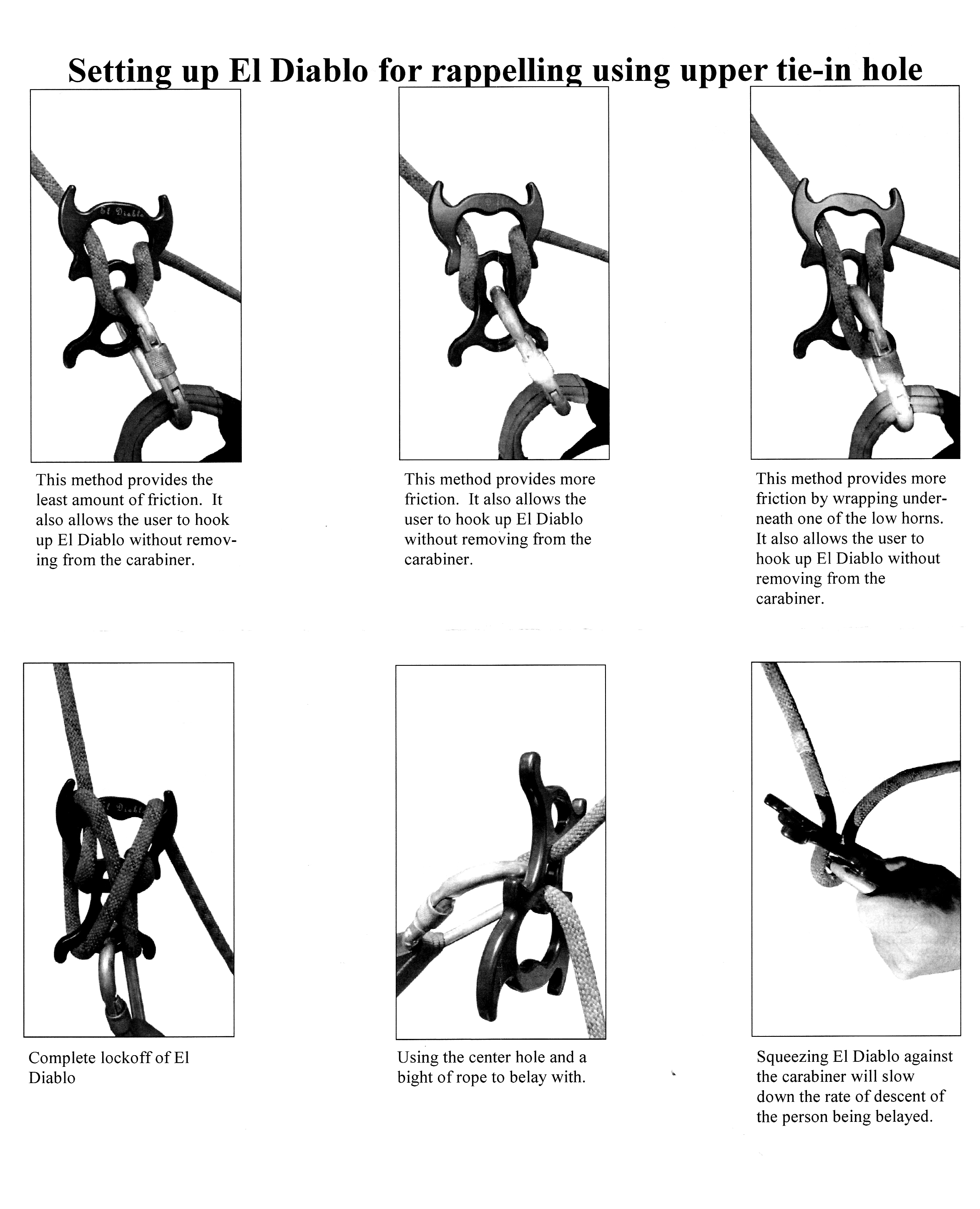
The CMI El Diablo is milled from aluminum alloy and then hard anodized. Mine is 140 mm. tall, 92 mm. wide, and 9 mm. thick. The rope hole is 34 mm. high and 55 mm. wide. The top center thickness is 9 mm. The shaft length and width are 47 mm. and 33 mm., respectively. The auxiliary hole is 20.9 mm. high and 16.5 mm. wide. The eye measures 20 mm. by 24 mm. The ears are 20.9 and 24.7 mm. long. My CMI El Diablo weighs 132 g.
Each side is printed with "El Diablo," "Cmi," and "MBS: 8000 lbs."
The CMI El Diablo falls into my miscellaneous figure eights with ears category. I like the name; it fits the look.
The upper and lower horns facilitate tying off, while the middle horns are in the right place to prevent inadvertent lock-offs. The rope hole is shorter than normal, so El Diablo may provide too much friction on stiff or muddy ropes. The middle hole is suitable for Sticht-type belaying.
 |
 |
[ Top | El Diablo | Rescue 8 v. B | Rescue C v. B | Return to Figure Eights ]
|
|
 |
| Front | Rear |
I do not have a record of when or where I acquired my CMI Rescue 8, but I suspect that I bought it in 1994 (CMI’s engineering drawings for this eight are dated 1994), perhaps from Bob & Bob. I know that I had it before the 1995 NSS Convention. I acquired two more on eBay from Lisa Ward in 2008 (later traded to Bob Elron for a Sky Genie kit), and another on eBay from Sheryle Bauer in 2009. In 2024 I acquired another and gave it to Артём Бабин.
The CMI Rescue 8 is forged from aluminum alloy and then hard anodized. Mine is 167 mm. tall, 151 mm. wide, and 17 mm. thick. The rope hole is 61 mm. high and 76 mm wide. The top center thickness is 14 mm. The shaft length and width are 68 mm. and 37 mm., respectively. The auxiliary hole is 16.4 mm. high and 20.7 mm. wide. The eye measures 17 mm. by 30 mm. The ears are 25.3 mm. long. My CMI Rescue 8 weighs 219 g.
The front of the shaft is forged with "Cmi," "RESCUE, and "’8’" (note the single quotes). The rear of the shaft has "FORGED" in raised letters.
The CMI Rescue 8 is a typical example of a forged aluminum rescue eight. The eye doubles as a belay slot, The auxiliary hole doesn't have an obvious useful function (I don't have much need to clip carabiners there), and one wonders why it couldn't have been made larger by eliminating the logo area. The hard coating wears well. Like all rescue eights, the CMI Rescue 8 is too large and heavy for my taste.
The CMI Rescue 8 is not identical to the BlueWater Rescue 8, but they are obviously closely related. If you compare the two side-by-side, several of the dimensions are rather different. These differences are not significant from a performance perspective.
[ Top | El Diablo | Rescue 8 v. A | Rescue C v. B | Return to Figure Eights ]
|
|
 |
| Front | Rear |
Sam Johnson sent me this CMI Rescue 8 in 2023.
Version B is forged from aluminum alloy and then hard anodized. Mine is 172 mm. tall, 152 mm. wide, and 16 mm. thick. The rope hole is 60 mm. high and 76 mm. wide. The top center thickness is 13 mm. The shaft length and width are 66 mm. and 39 mm., respectively. The auxiliary hole is 16.7 mm. high and 20.3 mm. wide. The eye measures 21 mm. by 32 mm. The ears are 23.1 mm. long. My CMI Rescue 8, Version B weighs 218 g.
The front of the shaft is forged with "Cmi," "RESCUE, and "8" (without the single quotes found on Version A). The rear of the shaft has "FORGED" in raised letters.
My versions differ only in their markings.
[ Top | El Diablo | Rescue 8 v. A | Rescue B v. B | Return to Figure Eights ]
|
|
 |
| Front | Rear |
I acquired one CMI Rescue 8, Version C from Oregon Cash Company and a second from Mike Ventrella, both on eBay in 2022. Sam Johnson sent me a third in 2023.
Version C is forged from aluminum alloy and then hard anodized. Mine is 171 mm. tall, 152 mm. wide, and 16 mm. thick. The rope hole is 62 mm. high and 77 mm. wide. The top center thickness is 13 mm. The shaft length and width are 65 mm. and 38 mm., respectively. The auxiliary hole is 17.1 mm. high and 20.6 mm. wide. The eye measures 20 mm. by 33 mm. The ears are 24 mm. long. My CMI Rescue 8, Version B weighs 214 g.
The front of the shaft is forged with "Cmi," "RESCUE, and "8." The rear the shaft is forged with "10,000 lb.," "44.5 KN," "M.B.S.," and "FORGED."
My versions differ only in their markings.
[ Top | El Diablo | Rescue 8 v. A | Rescue 8 v. B | Rescue C v. B ]