

This page will not fit into a tiny viewport. Please choose a full-size monitor with a full-width window or select the abridged New Wave pages.


Version A

Version B
|
|
|
| Version A | Version B |
Joseph Charlet designed his first ice axe in 1880. Joseph's nephew Germain Charlet succeeded him. Germain worked with Gerald Moser of Simond, and stamped their axes with "Charlet Moser." One of them was a woodworker and the other a smith, but I've read conflicting accounts of who was which. Simond issued identical axes under their name. In 1960 Gerald Moser joined existing chief Germain Charlet to formally form the firm Charlet Moser.
The Charlet Moser firm grew, and branched out into producing and distributing other climbing equipment.
Charlet Moser ceased operations in the 1980s, as both Charlet and Moser retired due to advancing age. The company was acquired by an agricultural equipment manufacturer based in Grenoble, and the production of ice axes and crampons continued at that company's factory. Petzl acquired Charlet Moser in 2000.
In 1971, Charlet Moser took over the design of the 1969 Guido Magnone descender. They heavily modified the design, and this descender is the result. It is a lightweight but bulky brake bar specifically designed for use with their triangular security carabiners.
Stéphane Pennequin sent me this photograph of the Charlet Moser descender from their 1981 catalog:

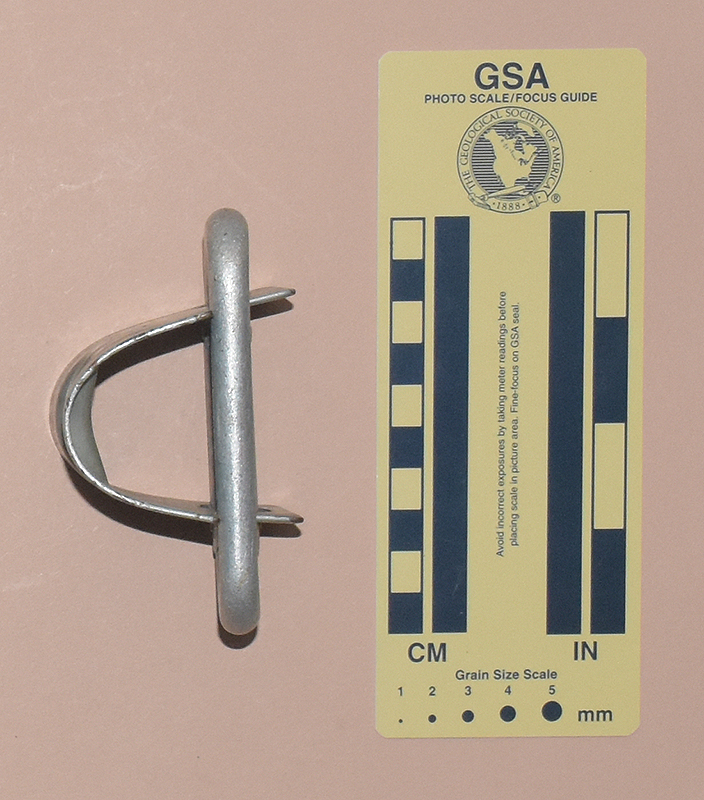
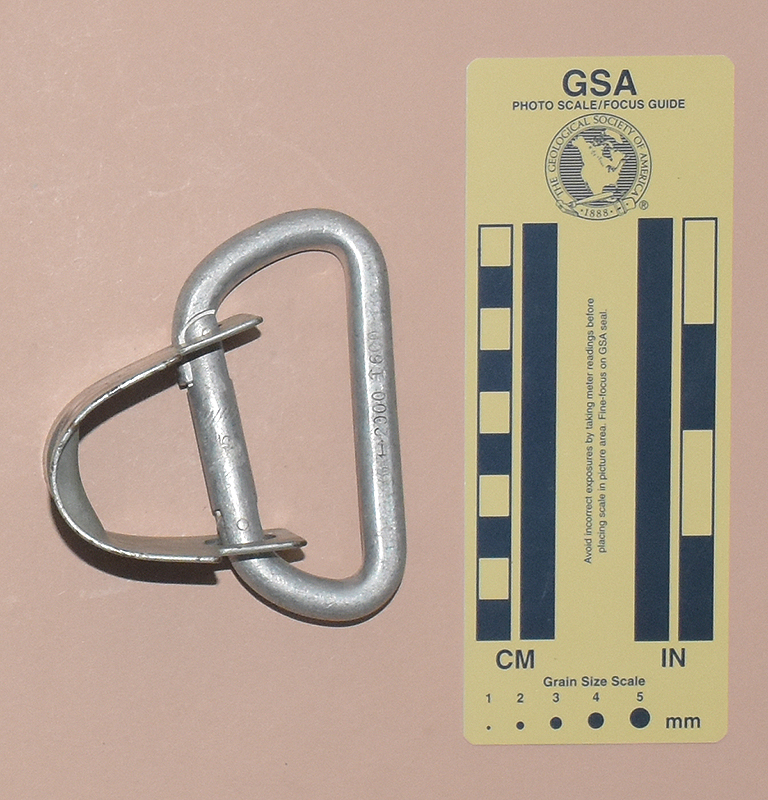
He suggested that I show the Charlet Moser with a locking carabiner as the catalog suggests. Once I acquired some Charlet Moser carabiners, I tried them with this descender. Neither version fit any of my Charlet Moser carabiners very well, locking or not. These are the main issues:
These photographs show how the Descenders sit on what I believe is the "preferred" carabiner. As you can see, it does not fit very well::
 |
 |
 |
 |
| Version A, Front | Version A, Right | Version A, Rear | Version A, Left |
 |
 |
 |
 |
| Version B, Front | Version B, Right | Version B, Rear | Version B, Left |
[ Top | Version B | Return to Brake Bar Descenders ]
|
|
 |
 |
| Front View | Side View | Open for Rigging |
 |
 |
 |
| Front | Rear | Top |
 |
 |
 |
| Left | Right | Bottom |
I acquired my Charlet Moser, Version A from Stéphane Pennequin in 2014.
Version A is 54 mm. tall, 61 mm. wide, 55 mm. thick, and weighs 76 g.
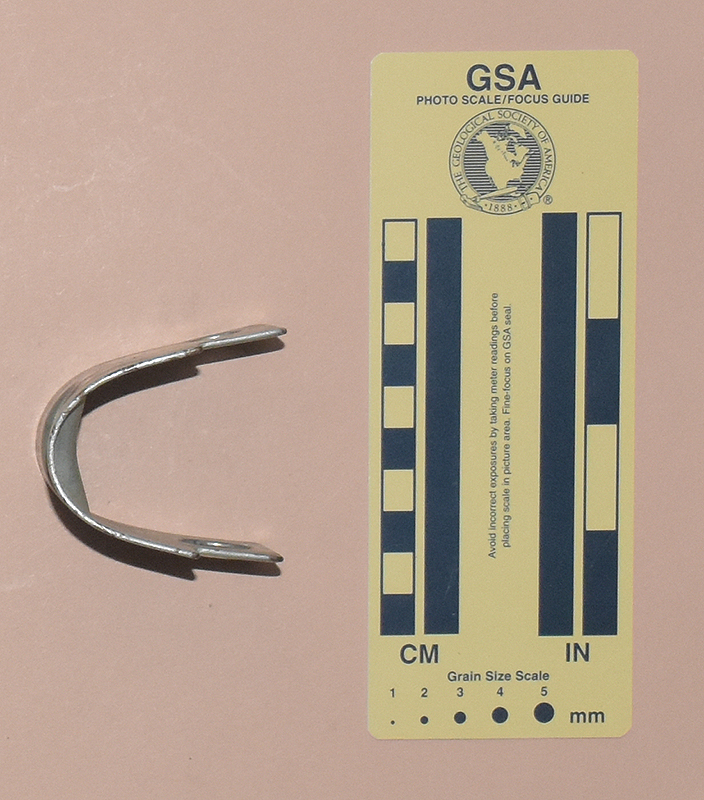
The Charlet Moser is essentially a large brake bar stamped from 1.3 mm. plated steel. There are two holes on one end. The upper hole is 12.6 mm. diameter, the other is 16.9 mm. The other end is notched so that the face sits parallel to the carabiner. There are two dimples that act as rope grooves. The center dimple is about 5.8 mm. deep, the outer 5.2 mm., and the ridge between them is 3 mm. high.
The top is stamped "CHARLET-MOSER" and "MADE IN FRANCE."
The slots are angled to the axis connecting the two holes, so this descender does not work well on oval or D carabiners, nor does it seem to fit most HMS carabiners. I was able to find a Bonaiti that works, but not very well.
The large surface area helps dissipate heat effectively. With the large depth, it provides more friction than a standard brake bar.
[ Top | Version A | Return to Brake Bar Descenders ]
|
|
 |
 |
| Front View | Side View | Open for Rigging |
 |
 |
 |
| Front | Rear | Top |
 |
 |
|
| Left | Right | Bottom |
I acquired my Charlet Moser, Version B from Marty Karabin in 2021.
Version B is 53 mm. tall, 66 mm. wide, 58 mm. thick, and weighs 86 g.
The Charlet Moser is essentially a large brake bar stamped from 1.3 mm. plated steel. There are two holes on one end. The upper hole is 12.6 mm. diameter, the other is 17.1 mm. The other end is notched so that the face sits parallel to the carabiner. There are two dimples that act as rope grooves. Each dimple is about 4.9 mm. deep, and the ridge between them is 4 mm. high.
The bottom is stamped "CHARLET-MOSER" and "MADE IN FRANCE."
Version B looks like a mirror image of Version A. It matches the one shown in the 1981 catalog. When looking at the convex side of Version B sitting upright on a carabiner, the carabiner gate is to the right, while for Version A it is to the left.
Version B also has a small dimple behind the upper hole that makes it slightly easier to place it on the carabiner.
There are not many carabiners that fit Version B. The small Bonaiti-Cassin in the photos works better than any others in my collection.
[ Top | Version A | Version B ]