

This page will not fit into a tiny viewport. Please choose a full-size monitor with a full-width window or select the abridged New Wave pages.


Cable Lock
Rope Lock Lite

Bark-A

Brig-A

GAL-15
|
|
|
| Cable Lock | Rope Lock Lite |
|
|
|
|
| Bark-A (Барк-А) |
Brig-A (Бриг-А) |
GAL-15 (ГАЛ-15) |
In the autumn of 1977, in the mountaineering section of the Voroshilovgrad (now Luhansk) engineering institute (WMI), first-year students began their journey into the mountains. Many of them achieved some success in Soviet and post-Soviet mountaineering and rock climbing. Years later, these individuals became key specialists at the manufacturing company KROK. Back then, amidst the chronic shortages of the Soviet era, they had to invent and manufacture mountaineering gear.
In 2004, when an opportunity came to establish his own manufacturing operations, Kostromitinov Alexei Dmitrievich began mass producing equipment for mountaineering, industrial rope access, and outdoor activities. He registered the Krok trademark that year, with the firm headquartered in Stakhanov, in the Luhansk region (Donbass). The name of the KROK brand was taken from the word "crows", which in mountaineering and tourism means a step-by-step sketch of the route to the goal. Production of Krok-branded products began in Russia and Ukraine.
Over years of dynamic growth, Krok developed and launched the production of over four hundred items of gear, hardware, and soft goods for mountaineering, outdoor activities, and industrial rope access. The company mastered the manufacture of personal protective equipment (PPE) against falls from heights, as well as equipment for working at heights and in confined spaces, and devices for rescue and evacuation operations. In addition, products are manufactured for sports and outdoor activities—including fitness and slacklining—as well as equipment for adventure parks, zip lines, and children's sports and playgrounds, along with gear for arboriculture.
Krok did not market directly in the U.S.A. They operated the eBay stores PetrenkoWorld in 2007 and Gear4Rocks from 2010 to 2013, making their products conveniently available to U.S. customers for a brief time.
In October 2020, founder and unchanged head of the company Kostromitinov Alexei Dmitrievich passed away, but the company continued to work under the leadership of his wife Oksana Valerievna. In 2022 Russia invaded Ukraine and working became even harder. There were no new developments and Krok gradually removed items from production. The situation worsened in 2024 and Krok decided to suspend operations. Production stopped in November, and the sales of the remaining inventory began.
[ Top | Rope Lock Lite | Bark-A | Brig-A | GAL-15 | Return to Rope Grabs ]
|
|
 |
 |
| Front View | Rear View | Side View |
I acquired my Krok Cable Lock from Gear4Rocks in 2012. Gear4Rocks was the same company as Krok, the only difference was that the Krok trademark sold gear only inside Ukraine, and the Gear4Rocks trademark was created to spread Ukrainian gear around the world.
The Krok Cable Lock is 130 mm. tall, 78 mm. wide, 19 mm. thick, and weighs 487 g.
The Cable Lock consists of two connected cams mounted in a steel shell. The unique shell grooves allow the unit to be attached to a cable without opening or disassembling the unit.
There are no markings on this device.
The Cable Lock is designed to be used on 8 mm. wire cable. It appears to be a copy of the Protecta International AC350 Cabloc.
[ Top | Cable Lock | Bark-A | Brig-A | GAL-15 | Return to Rope Grabs ]
|
|
 |
| Front | Rear |
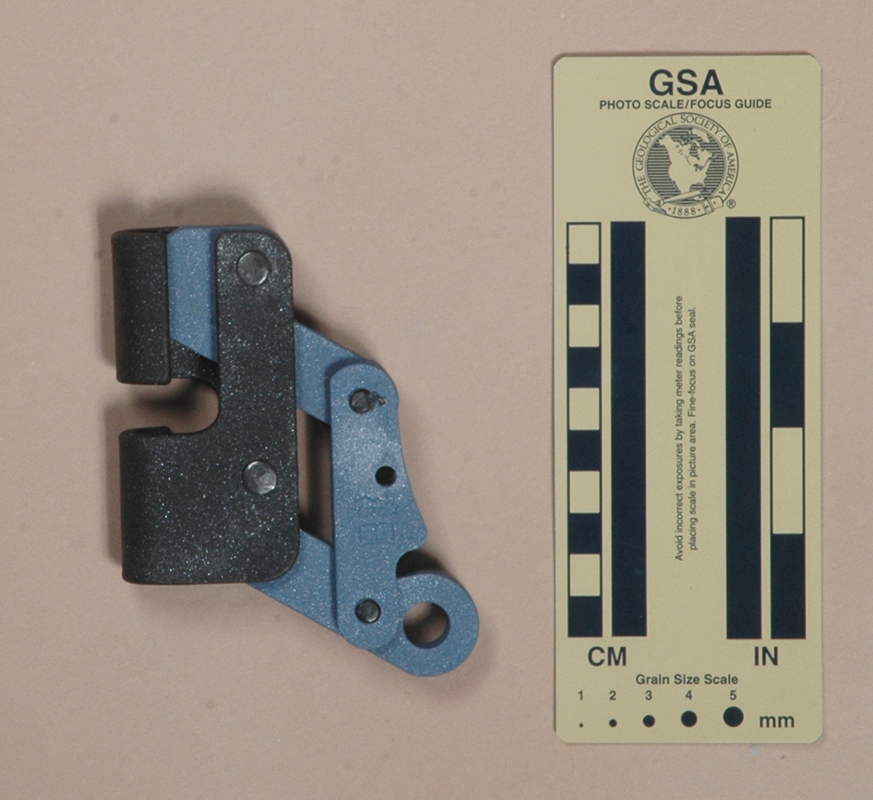
I acquired my Krok Rope Lock Lite from Gear4Rocks in 2013.
My Krok Rope Lock Lite is 85 mm. long, 108 mm. wide, 23 mm. high, and weighs 307 g. It is similar to the Cable Lock, but smaller, and has a painted finish.
The front connecting arm is stamped with the Krok logo and a book-with-an-"i" icon.
I don't like painted devices because paint tends to wear off, leaving a mess on my ropes.
[ Top | Cable Lock | Rope Lock Lite | Brig-A | GAL-15 | Return to Rope Grabs ]
|
|
 |
 |
| Front | Rear | Top |
 Technical Details
I acquired my Bark-A from Krok in 2021.
My Bark-A is 68 mm. long, 75 mm. wide, 33 mm. high, and weighs 133 g.
The front is printed with the Krok logo, a hollow up-pointing arrow with "WLL 12 kN" inside, ’"Барк-А",’ "8<Ø<13," a book-with-an-"i" icon, and "1803.1605."
The Bark-A is a manual positioning device that falls under EN 12841 Type B. EN 12841 techniques are not normally used by cavers, who long ago tried and abandoned those ideas as impractical and creating greater hazards than they address. The differences between Type A (safety line adjustment), Type B (working line ascender) and Type C (working line descender) rope adjustment device terminologies in EN 12841 do not translate well into my caver/climber-oriented classification, so I'm just calling this a rope grab.
Using a bolt as the cam axle greatly reduces the likelihood of the device inadvertently coming off rope. The shield around the nut interferes with using a normal wrench (one needs a socket), which helps keep the user from putting the device on rope or taking it off. This makes the Bark-A impractical as a sporting ascender, but that is not its intended use.
The "-A in "Барк-А" refers to the aluminum shell version. There is also a steel-shell Барк-Ст.
[ Top | Cable Lock | Rope Lock Lite | Bark-A | GAL-15 | Return to Rope Grabs ]
|
|
 |
 |
| Front | Rear | Top |
 Technical Details
I acquired my Brig-A from Krok in 2021.
My Krok Brig-A 3606_2772.59 (Бриг) is 81 mm. long, 73 mm. wide, 37 mm. high, and weighs 168 g.
The front is printed with the Krok logo, a hollow up-pointing arrow with "WLL 12 kN" inside, ’"Барк-А",’ "10<Ø<18," and "1803.1605." The rear is printed with "TP TC 019/2011," "EAC," a book-with-an-"i" icon, and "ГОСТ EN 12841-2014."
I'm calling the Brig-A a rope grab for the same reason I gave for the Bark-A.
The Brig-A is a larger version of the Bark-A, suitable for the "bigger-is-better" crowd. Like the Bark-A, the Brig-A is impractical as a sporting ascender, but that is not its intended use.
The "-A in "Бриг-А" refers to the aluminum shell version. There is also a steel-shell "Бриг-Ст"
[ Top | Cable Lock | Rope Lock Lite | Bark-A | Brig-A | Return to Rope Grabs ]
|
|
 |
 |
| Front | Rear | Top |
 Technical Details
I acquired my GAL-15 from Krok in 2021.
My GAL-15 is 90 mm. long, 110 mm. wide, 36 mm. high, and weighs 392 g.
In addition to the axle bolt, the GAL-15 has two 5 mm. shoulder bolts through the shell from rear to front, where they are secured by 5 mm. nylon lock nuts. The top bolt passes through a 17.8 mm. o. d. roller. The lower bolt limits how far the cam can open.
The rear is printed with the Krok logo, a hollow up-pointing arrow with "MBS 15 kN" inside, ’СУ "ГАЛ-15",’ "EN 12841/B," "Мах 600 кг", 12<Ø<16," "TP TC 019/2011," "EAC," a book-with-an-"i" icon, the Ukrainian Conformity Mark, and "20.10.09.01."
"ГАЛ" stands for "гибкая анкерная линия" (flexible anchor line), which is unfortunate since it overlooks the nautical theme that a Barque-Brig-Galley naming sequence would provide. "СУ" stands for "Спусковое Устройство" meaning "descender device," which is rather odd for a "working line ascender" as defined by EN 12841/B. I'm calling this a rope grab like the other non-nautical devices.
The roller is opposite the spine of the shell, and so its only apparent function is to help guide the GAL-15 on the rope. It does not reduce friction under load; for that it would have to be placed on the shell side of the rope (e.g., see the Gibbs roller cam modifications).
The cam limiter is also unnecessary, since anything tied or clipped to the cam will limit the cam motion equally well.
The GAL-15 is impractical as a sporting ascender, but that is not its intended use.
[ Top | Cable Lock | Rope Lock Lite | Bark-A | Brig-A | GAL-15 ]