

This page will not fit into a tiny viewport. Please choose a full-size monitor with a full-width window or select the abridged New Wave pages.


Model 1

Model 2

Model 3
|
|
|
|
| Model 1 | Model 2 | Model 3 |
 |
 |
 |
| Model 4 | Model 5 | ST |
In the autumn of 1977, in the mountaineering section of the Voroshilovgrad (now Luhansk) engineering institute (WMI), first-year students began their journey into the mountains. Many of them achieved some success in Soviet and post-Soviet mountaineering and rock climbing. Years later, these individuals became key specialists at the manufacturing company KROK. Back then, amidst the chronic shortages of the Soviet era, they had to invent and manufacture mountaineering gear.
In 2004, when an opportunity came to establish his own manufacturing operations, Kostromitinov Alexei Dmitrievich began mass producing equipment for mountaineering, industrial rope access, and outdoor activities. He registered the Krok trademark that year, with the firm headquartered in Stakhanov, in the Luhansk region (Donbass). The name of the KROK brand was taken from the word "crows", which in mountaineering and tourism means a step-by-step sketch of the route to the goal. Production of Krok-branded products began in Russia and Ukraine.
Over years of dynamic growth, Krok developed and launched the production of over four hundred items of gear, hardware, and soft goods for mountaineering, outdoor activities, and industrial rope access. The company mastered the manufacture of personal protective equipment (PPE) against falls from heights, as well as equipment for working at heights and in confined spaces, and devices for rescue and evacuation operations. In addition, products are manufactured for sports and outdoor activities—including fitness and slacklining—as well as equipment for adventure parks, zip lines, and children's sports and playgrounds, along with gear for arboriculture.
Krok did not market directly in the U.S.A. They operated the eBay stores PetrenkoWorld in 2007 and Gear4Rocks from 2010 to 2013, making their products conveniently available to U.S. customers for a brief time.
In October 2020, founder and unchanged head of the company Kostromitinov Alexei Dmitrievich passed away, but the company continued to work under the leadership of his wife Oksana Valerievna. In 2022 Russia invaded Ukraine and working became even harder. There were no new developments and Krok gradually removed items from production. The situation worsened in 2024 and Krok decided to suspend operations. Production stopped in November, and the sales of the remaining inventory began.
"Drop" (Капля) means a drop of liquid, not a vertical drop, and refers to the shape of the device.
[ Top | Model 2 | Model 3 | Model 4 | Model 5 | ST | Return to Rope Grabs ]
|
|
 |
 |
| Front View | Rear View | Side View |
 |
 |
| Front View: Open for Rigging | Rear View: Open for Rigging |
I acquired my Krok Drop, Model 1 in 2012 when Alex Dniprovsky sent me a box of donations originating from Alex Kostromitinov, CEO of Krok.
Model 1 is 80 mm. tall, 67 mm. wide, 29 mm. thick, and weighs 157 g.
Model 1 consists of a spring-loaded pivoting steel lever and a fixed anvil mounted between two aluminum side plates. One side plate is stationary, while the other pivots on the lever axle so that it may be opened to admit the rope. The anvil is attached to the rear face plate with two rivets, one of which is extended to engage a notch in the front face plate. Each slide plate has a l4 mm. attachment hole and a 20 mm. lightening hole.
The pivoting side plate is stamped with the Krok logo and a book-with-an-"i" icon.
The drop is similar to the Camp Lift, Russian Versions A and B, and various Ural–Alp ascenders, but I placed it here with the Rope Grabs because of the specification sheet on the Krok web site that when translated states, "The Drop is designed to ensure safety and fall protection at the height of a man."
All five models are rated at a maximum 4 kN working load and have a minimum 12 kn breaking load.
The Rescue Grip is 30% lighter than the steel Model 2.
[ Top | Model 1 | Model 3 | Model 4 | Model 5 | ST | Return to Rope Grabs ]
|
|
 |
 |
| Front View | Rear View | Side View |
 |
 |
| Front View: Open for Rigging | Rear View: Open for Rigging |
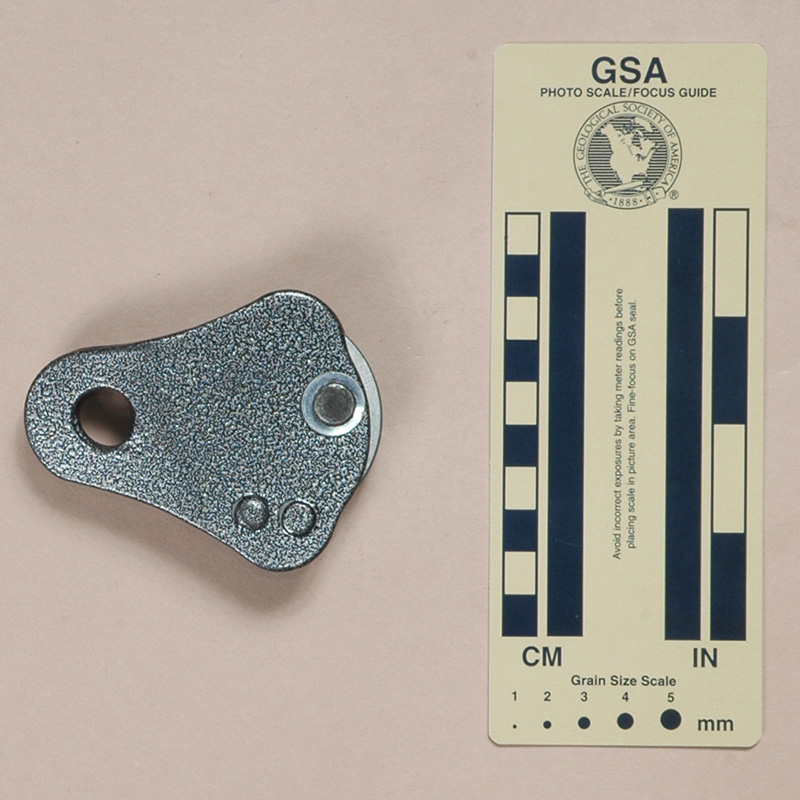
I acquired my Krok Drop, Model 2 from PetrenkoWorld (now Gear4Rocks) in 2007. Gear4Rocks was the same company as Krok, the only difference was that the Krok trademark sold gear only inside Ukraine, and the Gear4Rocks trademark was created to spread Ukrainian gear around the world.
Model 2 is 83 mm. tall, 66 mm. wide, 29 mm. thick, and weighs 225 g.
Model 2 is similar to Model 1, but has steel side plates. The My Model 2 is an older model that does not have a lightening hole in either side plate. The pivoting lever is not spring loaded.
Model 2 is painted with the same mottled paint used on the Krok Bug, Half Crab, and Fish. There are no markings on the Drop.
Model 2 was sold as an ascender, and in that capacity it is small and reliable, but inefficient. It operates on the same principles as the Camp Lift, Russian Versions A and B, and various Ural–Alp ascenders. To rig it as an ascender, follow the instructions given for the Camp Lift. As with all ascenders of this type, there is a significant lost motion with each step. I wouldn't choose the Drop for a long climb, but it’s small size makes it attractive for short, remote drops. Model 1 is 30% lighter.
[ Top | Model 1 | Model 2 | Model 4 | Model 5 | ST | Return to Rope Grabs ]
|
|
 |
 |
| Front View | Rear View | Side View |
 |
 |
| Front View: Open for Rigging | Rear View: Open for Rigging |
I acquired my Krok Drop, Model 3 from Gear4Rocks in 2012.
My Krok Drop, Model 3 (a.k.a. Rescue Grip Double) is 65 mm. long, 80 mm. wide, 51 mm. high, and weighs 303 g.
Model 3 is a double rope model. The side plates are aluminum, like those on Model 1. The pivoting lever is not spring loaded.
Model 3 is painted with a mottled copper-colored paint. There are no markings on Model 3.
The primary reason for spring-loading the lever is to keep the unloaded rope grab from sliding down the rope. The specification sheet on the Krok web site indicates that the extra friction provided by doubled ropes eliminates the need for spring-loading the lever, but my tests show that this depends on what ropes I'm using. The sheet also warns that a spring is a must for single ropes, which I interpret to be a somewhat concealed warning against using Model 3 on single ropes.
[ Top | Model 1 | Model 2 | Model 3 | Model 5 | ST | Return to Rope Grabs ]
|
|
 |
 |
| Front View | Rear View | Side View |
 |
 |
| Front View: Open for Rigging | Rear View: Open for Rigging |
I acquired my Krok Drop, Model 4 from Gear4Rocks in 2012.
Model 4 is 74 mm. long, 91 mm. wide, 30 mm. high, and weighs 191 g.
Model 4 is more complicated than Model 1. It still consists of a pivoting steel lever and a fixed anvil mounted between two aluminum side plates, but it adds an additional lever. The lever is mounted so that the the lever's eye aligns with slots in the side plates, allowing the attachment carabiner to pass through all three. This lever replaces the function of the spring, allowing the user to trail the Model 4 up a rope.
The rear of the fixed plate is stamped with the Krok logo, a book-with-an-"i" icon, and the month of manufacture, "10 11."
Many standard carabiners will not fi4 through the eye of the small lever. I have several Krok carabiners, and these are small enough to fit.
[ Top | Model 1 | Model 2 | Model 3 | Model 4 | Model 5 | Return to Rope Grabs ]
|
|
 |
 |
| Front View | Rear View | Side View |
 |
 |
| Front View: Open for Rigging | Rear View: Open for Rigging |
I acquired my Krok Model 5 from Gear4Rocks in 2012. Immediately thereafter, I received a second one when Alex Dniprovsky sent me a box of donations originating from Alex Kostromitinov, the CEO of Krok. Gear4Rocks was the same company as Krok, the only difference was that the Krok trademark sold gear only inside Ukraine, and the Gear4Rocks trademark was created to spread Ukrainian gear around the world.
Model 5 is 65 mm. tall, 80 mm. wide, 27 mm. thick, and weighs 254 g.
Model 5 has steel side plates, a second lever similar in purpose to Model 4’s, and a rotating tab that can be used to "set" the device so that it will not slide down a rope under its own weight.
There are no markings on either of my Advanced Rescue Grips.
The additional features clearly make the Model 5 more of a rope grab than an ascender, although it can still be used as one. Like Model 4, the carabiner openings are too small for many carabiners.
[ Top | Model 1 | Model 2 | Model 3 | Model 4 | Model 5 | Return to Rope Grabs ]
|
|
 |
 |
| Front View | Rear View | Top View |
 |
 |
 |
| Bottom View | Front View: Open for Rigging | Rear View: Open for Rigging |
I acquired my Krok Drop ST 3605_45.33 from Krok in 2021.
My Krok Drop ST 3605_45.33 (Капля "ST") is 68 mm. long, 81 mm. wide, 30 mm. high, and weighs 211 g.
The ST is similar to Model 2, with steel side plates and a similar anvil. The rocker arm is made of steel and spring-loaded. The side plates and anvil are powder-coated blue, and the rocker-arm is powder-coated black.
The swinging plate is etched with the Krok logo, ’Капля "ST",’ "Max 400 кг," "2001.0316," a book-with-an-"i" icon, and a rigging illustration."
The spring-loaded rocker arm allows the user to place the Drop on rope without it sliding down under its own weight.
While I don't like the powder-coat paint, it is better than the thick mottled paint on the other versions.
Krok’s web site states that the Drop meets the requirements of EN 353/2, EN 358, EN 12841/B.
[ Top | Model 1 | Model 2 | Model 3 | Model 4 | Model 5 | ST ]