

This page will not fit into a tiny viewport. Please choose a full-size monitor with a full-width window or select the abridged New Wave pages.


|
|
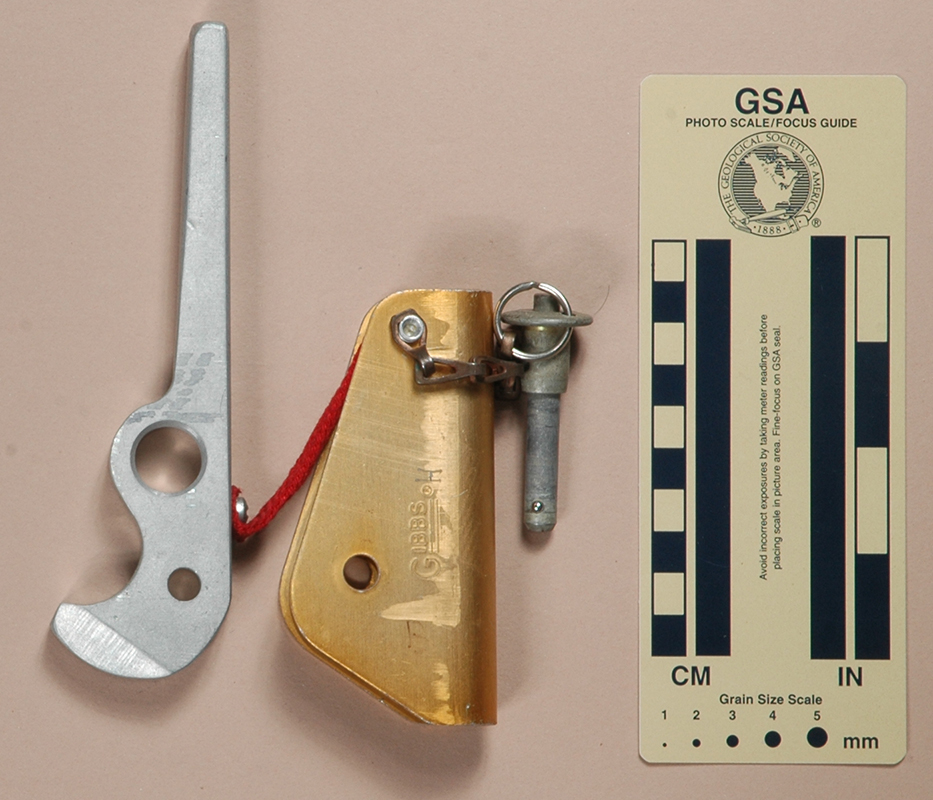 |
| Mounted on Gibbs Ascender | Open for Rigging Side View of Cam |
 |
 |
| Open for Rigging Top View of Cam |
Open for Rigging Bottom View of Cam |
Jim Charlton described his lever cam in the January 1978 NSS News. I made my Charlton Lever Cam in 2008.
I made my cam by milling a piece of 6061-T6 aluminum plate. This Charlton lever cam is 43 mm. tall, 156 mm. wide, 15 mm. thick, and weighs 102 g. I used Figure 41 from Bob Thrun’s book Prusiking as a pattern for the cam face, following the R=0.75+0.0075Ø [inches] formula given in the caption as the later Gibbs cam formula. I scaled the handle dimensions from photographs in Charlton’s article.
The cam face on the Charlton Lever Cam is smooth with a groove running down the center.
Charlton describes his cam as having an involute surface. Whether this is technically accurate or not, the spiral I used is a close approximation. Charlton discusses how this allows "short creeping rappels into the primary rappel device," but warns about scenarios that can cause "total catastrophic release." I agree completely: do not even think about using this as a rappel device.
What do I think of it as a rappel safety? Anyone reading my site long enough knows that I dislike rappel safeties for a variety of reasons. I'll pass on the Charlton Lever Cam as anything more than a historical curiosity, but in that regard, it (or something very similar) inspired the IMO (American Rescue) Shunt Bar.
James P. Charlton was a Virginia caver who joined the National Speleological Society in 1964. He developed his lever cam and used it for several years before describing it in 1978.[1]
-----Gary Storrick made a copy of the Charlton lever cam in 2008.
Gary Storrick, NSS 12967 FE CM, began caving, climbing, and collecting vertical equipment in 1971. He created this web site in 1999, and earned an NSS Certificate of Merit in 2024 for his work. Back in the day, his father Robert had some small equipment made for him in the shops that he managed. Gary now makes samples in his home machine and wood shops to aid his research. He suggests, "I may have tried more devices than the average caver."