

This page will not fit into a tiny viewport. Please choose a full-size monitor with a full-width window or select the abridged New Wave pages.


|
|
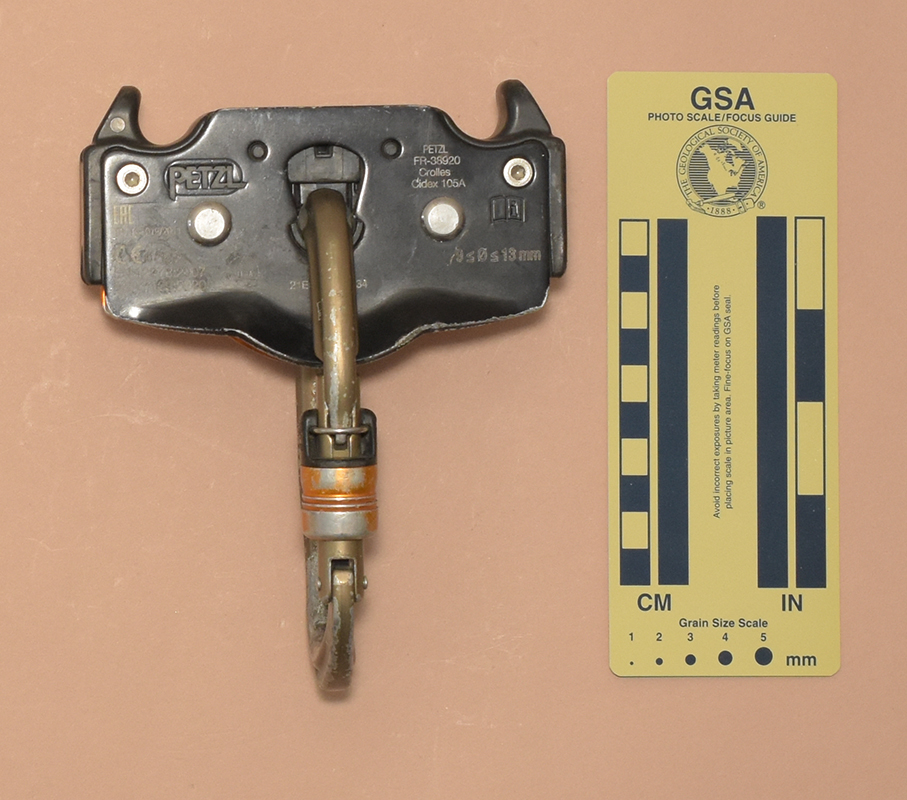 |
| Front View | Rear View |
 |
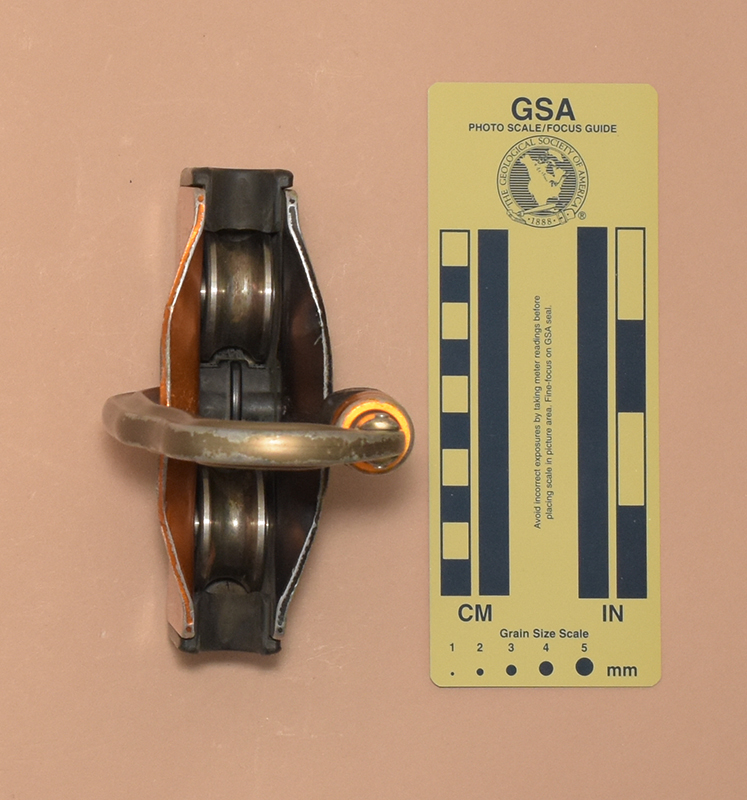 |
| Side View | Bottom View |
I acquired this Petzl Trac Guide from Austin Rose in 2024.
My Petzl Trac Guide is 159 mm. long, 127 mm. wide, 75 mm. high, and weighs 432 g.
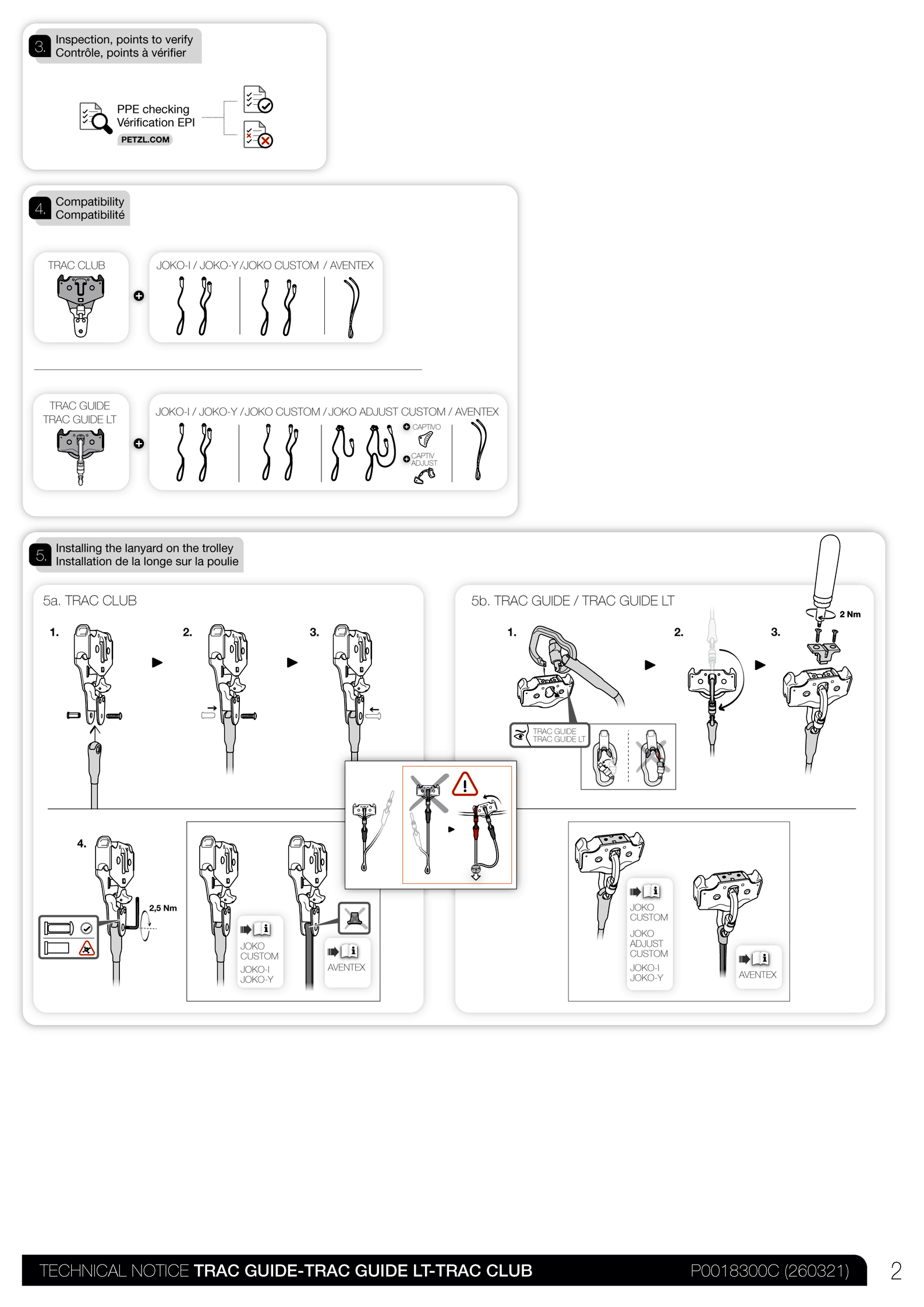
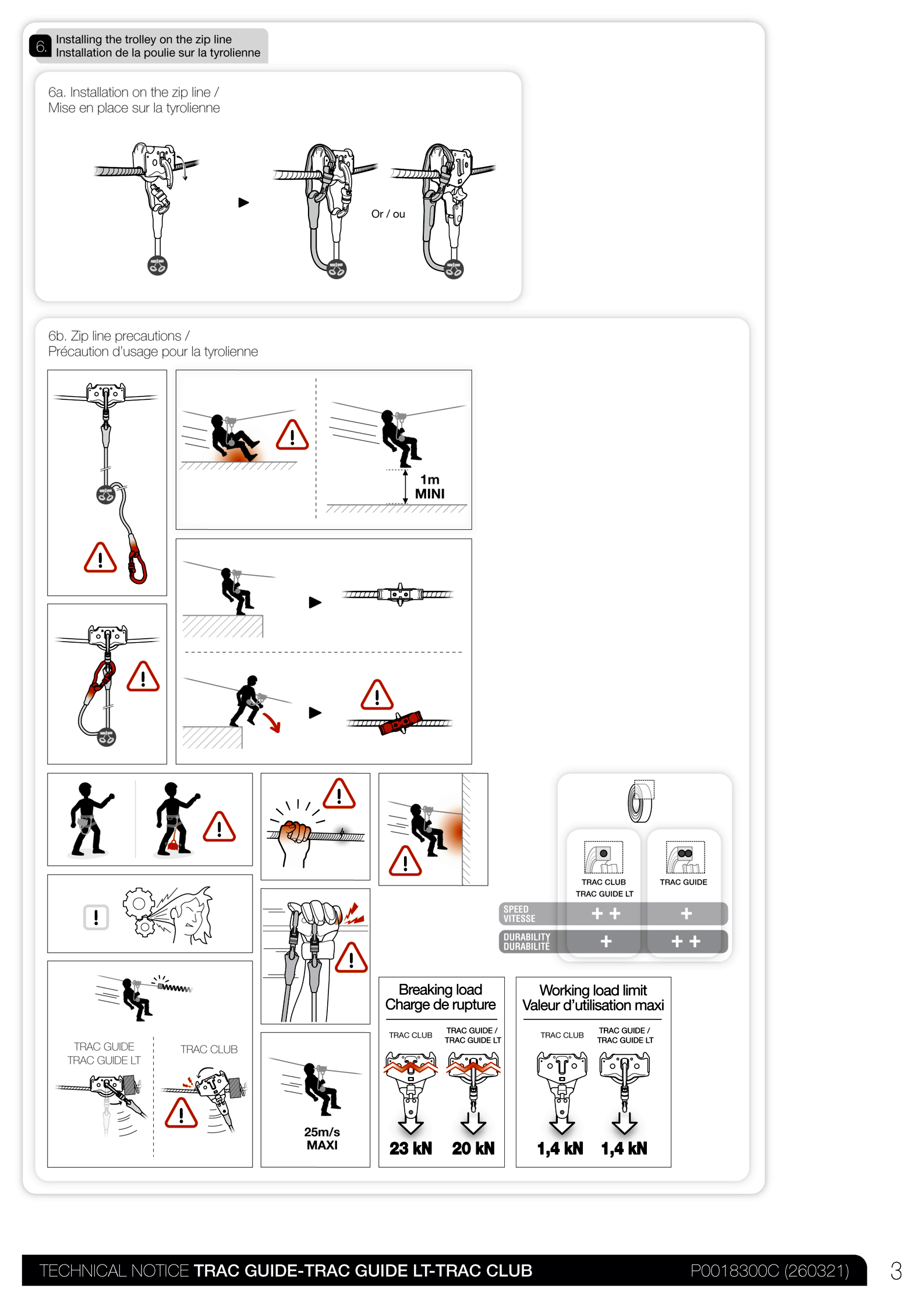
The Trac Guide is a zip line trolley designed for 9-13 mm. wire rope. The front and rear plates are stamped from 4.4 mm. aluminum. They are separated by a multi-piece plastic assembly riveted to the plates at each end. The central portion of the assembly supports a spring-loaded plunger that holds the carabiner vertical but allows the carabiner to rotate about 40°forward and backward. The carabiner is specifically designed for use with the Trac Guide and is not designed for climbing. It features a pull-to-open locking mechanism.
Two 34 mm. diameter, 16 mm. thick steel sheaves rotate on axles riveted between the front and rear plates. The sheaves have 12 mm. wide, 4.2 mm. deep U-shaped grooves on the rim.
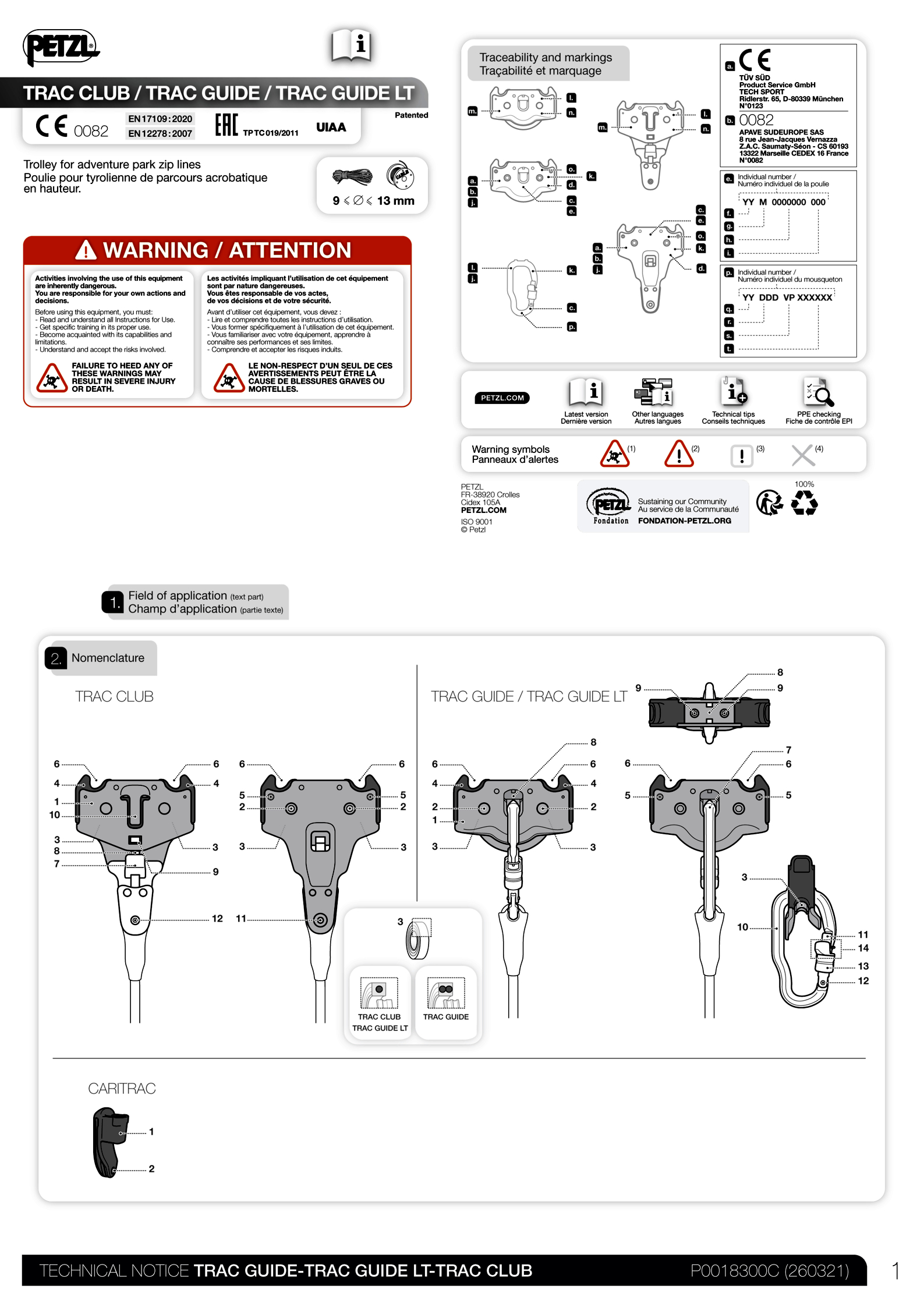
The front plate is printed with the Petal logo, "TRAC GUIDE," an illustration of a zipper colliding with a cliff face with a"!" inside a triangle beside it, a loading illustration, "MBS=20kN," and "WLL=1,4kN." The rear p[late is stamped with the Petal logo and a book-with-an-"i" icon. It is printed with "PETZL," "FR–38920," "EAC,"TP/TC 019/2011, "CE0082," "EN 12278:2007," "EN 17109:2020, the UIAA logo, "21E033128034, an IQR code, and "9 ≤ Ø ≤ 13 mm."
The Trac Guide is solidly made. I don't run zip-line courses and the Track Guide has no special braking features, so I don't have much to say about it. For me, the most interesting part is the carabiner.
 |
 |
 |
 |
 |
In 1930, Fernand Petzl discovered caving at the age of 17. Back at his workshop after each excursion to the depths, Fernand imagined new tools for exploring darkness and heights. With his inventions taking up more and more space, he decided to create his own workshop, sparking the growth of his small business. Working together brought Fernand closer to his son, Paul, who was determined to grow the business. From the beginning, Paul's wife Catherine took care of the accounting.
Paul Petzl, a mechanical engineering student, had already been thinking about creating a real company and began to plan out his first investments. In 1970, the Petzl brand was created. Five years later, the first company headquarters was established at the foot of the Dent de Crolles. In the years that followed, the number of employees increased as the company experienced local and international growth.
Petzl is a family business that, over the years, has become the largest European manufacturer of personal protective equipment for those who work and play in darkness or at height. All Petzl products are invented and developed at their headquarters in the heart of the French Alps.
The Petzl brand is present in over 55 countries with 85% of their sales made internationally. More than 9 million products are sold every year, and 10 million people use Petzl personal protective equipment every day.