

This page will not fit into a tiny viewport. Please choose a full-size monitor with a full-width window or select the abridged New Wave pages.

|
|
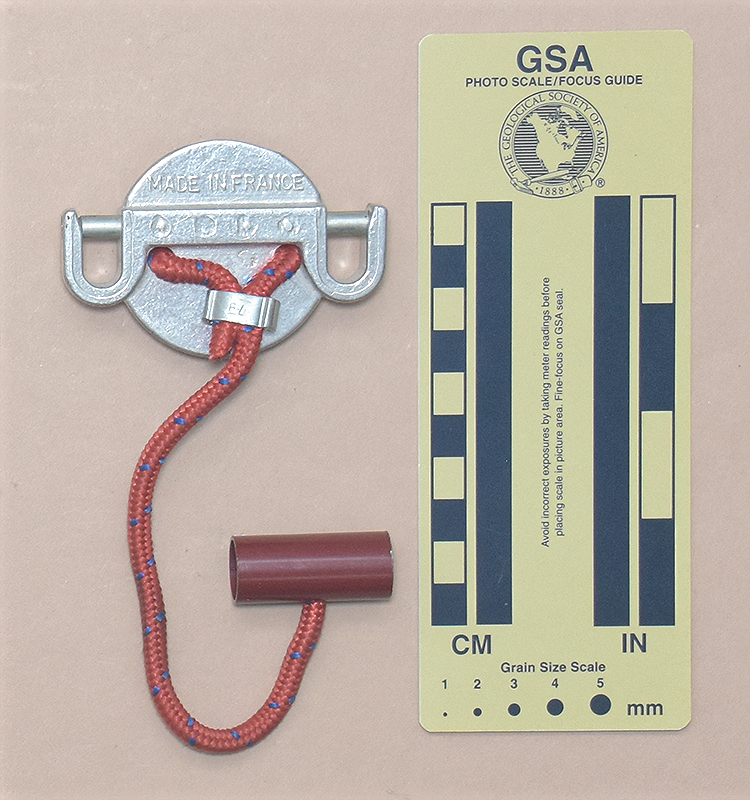 |
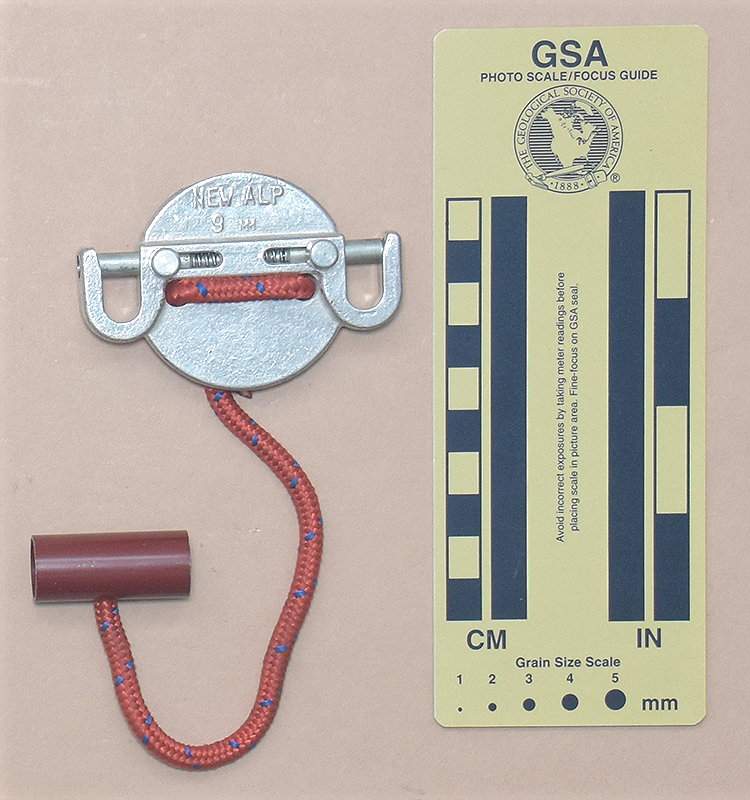
| Top View | Bottom View |
 Denis Pivot sent me this New Alp Stopper in 2022.
My New Alp Stopper is 51 mm. tall, 76 mm. wide, 16 mm. thick, and weighs 49 g.
The Stopper consists of a cast aluminum plate with a hook on each side. The hooks are closed by a spring-loaded steel plunger that retracts into a holes in a rib cast into the plate, with small buttons protruding through slots i the top of the plate to allow retracting the plungers. A 5 mm. accessory cord passes through two holes in the plate and is crimped below the plate to form a loop. The cord extends 190 mm. below the plate, where is passes through a hole in the side of a 36 mm. long, 16 mm. diameter plastic tube that serves as a toggle grip.
The top has "NEW ALP" and "9 MM" in cast raised letters. The bottom has "MADE IN FRANCE," also in raise cast letters. The crimp is stamped "79" on one side and "ŒC" on the other.
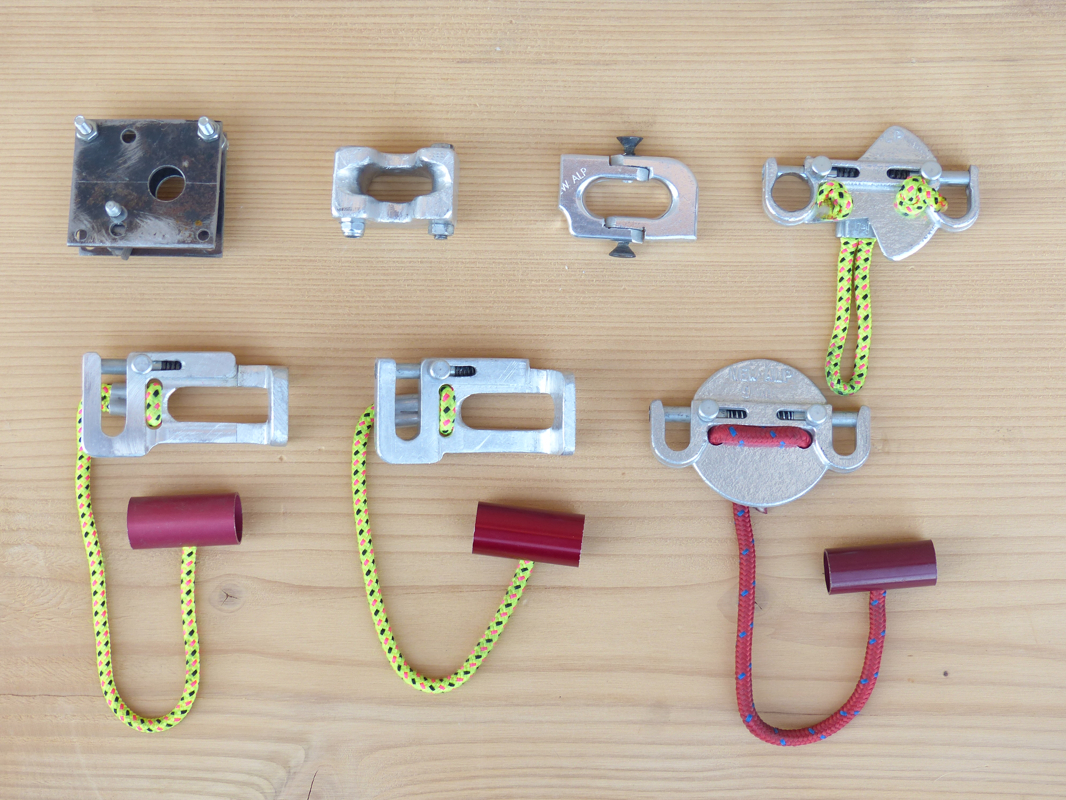
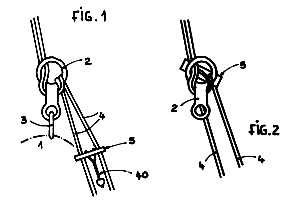 The Stopper was based on French Patent #2,553,667, which was applied for on October 21, 1983. The Stopper was available by 1984, and the patent was issued in 1985. The production model differs from the patented design in some ways, but functions in the same manner. French Patent #2,673,543 from 1991 covers several variations on the earlier design. Denis kindly sent me this photo showing several prototypes:
The Stopper was designed as a "security accessory" for alpinists and cavers to use when rappelling with a Figure Eight descender on a traditional doubled rope. The rappeller passes the trailing lines from the device through the hooks (one line per hook). They then descend in the normal manner while holding the toggle in the braking hand, keeping the stopper well below the eight. Releasing the toggle allows the Stopper to stop, and the descending eight catches the stopper. Since the stopper keeps the trailing lines separated, they wedge between the stopper and the eight, ideally providing enough friction to stop the rappeller. It works surprisingly well, but like all safety devices, should never be fully trusted. Personally, I don't recommend letting go of the trailing lines on any rappel, and I certainly don't advocate losing control. Don't do that.
 |
Jean-Paul Fréchin [1940-2022], a mountain guide and Arts et Métiers engineer, worked for Salomon and later for Ludger Simond. In 1984, he founded New Alp in Chamonix and imported Italian-made Grivel equipment. He achieved success with three inventions. The patent for the Antibott (1979), a latex device designed to prevent snow buildup under crampons, earned him royalties from major crampon manufacturers. The patent for the Key Lock (1985), a snag-free carabiner gate closure system manufactured by Kong (and under license by Kong, Petzl, and Black Diamond), became the industry standard for climbing carabiners after entering the public domain. In 1989, the New Alp multi-purpose Plaquette (belay plate) enabled the belaying of a lead climber and one or two followers, as well as rappelling; it foreshadowed the belay plates of the 2000s. New Alp ceased operations in 1999, and Jean-Paul subsequently served for a time as president of the Compagnie des Guides de Chamonix.[1]