

This page will not fit into a tiny viewport. Please choose a full-size monitor with a full-width window or select the abridged New Wave pages.

|
|
 |
| Front | Rear |
 |
 |
 |
| Left | Right | Open for Rigging |
I acquired my Pierre Allain Décrocheur from Speleoshoppe around 1980.
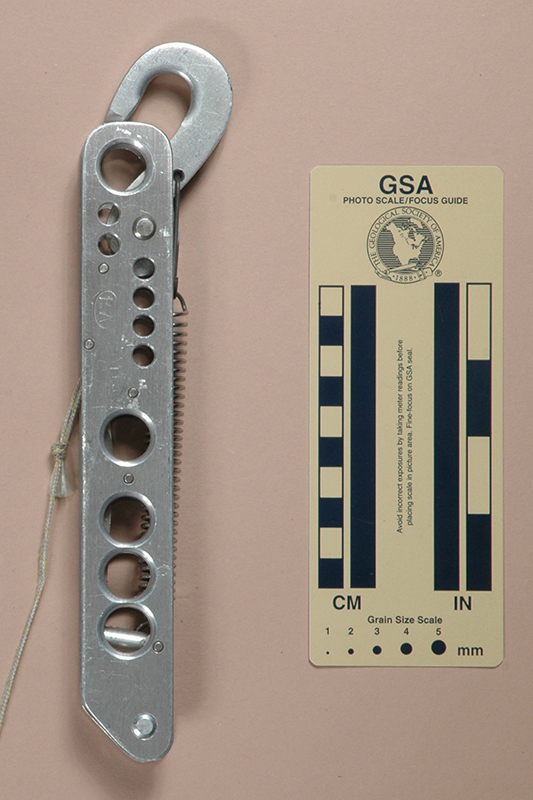
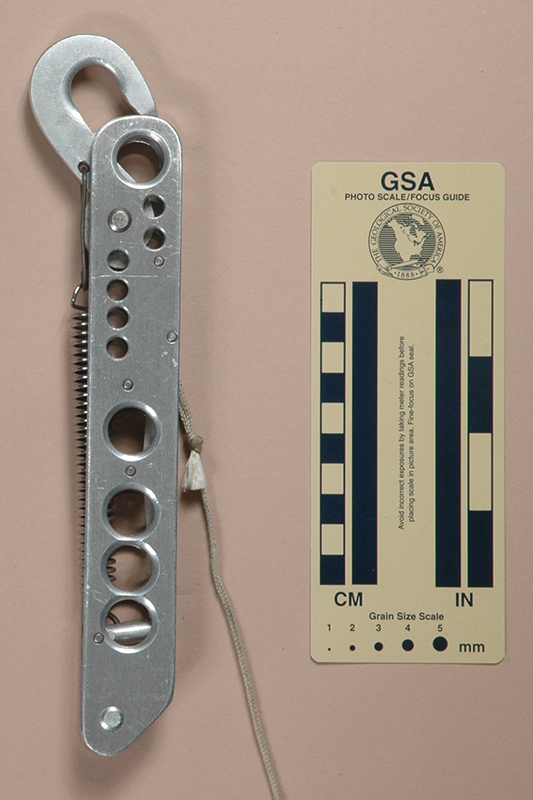
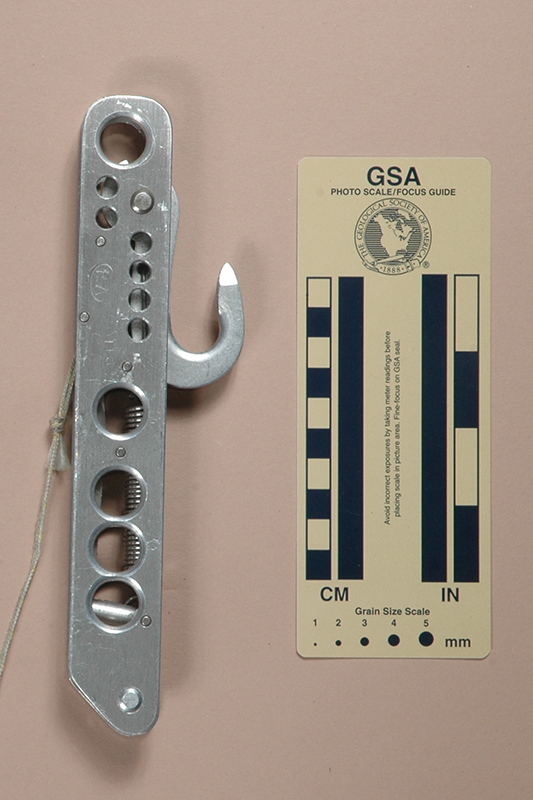
My Pierre Allain Décrocheur is 55 mm. long, 208 mm. wide, 22 mm. high, and weighs 154 g.
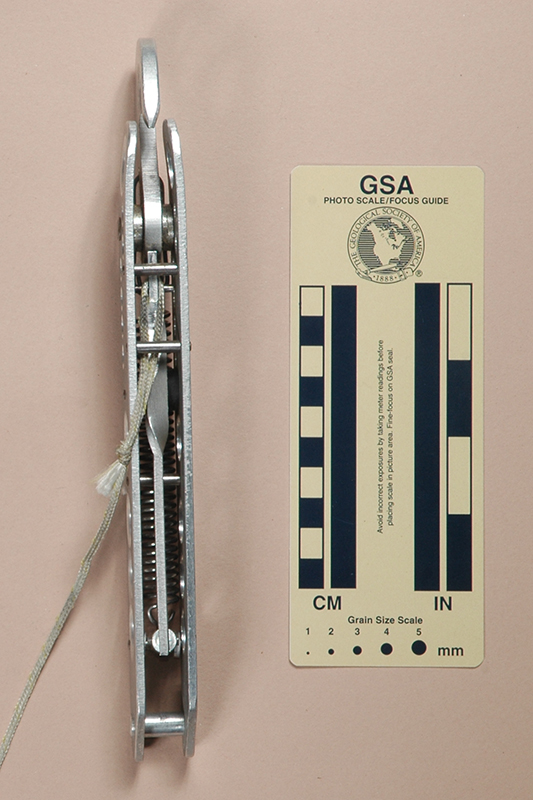
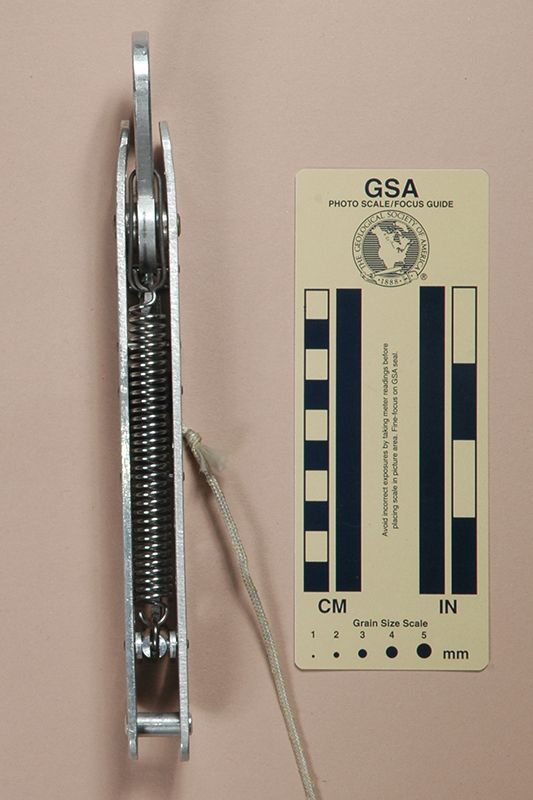
This décrocheur consists of a spring-loaded hook mounted between two side plates. The front and rear plates are made from 3 mm. aluminum alloy. Each side plate has one 15.2 mm. carabiner eye, four 15.2 mm. and six 7.2 mm. lightening holes. Five 3.9 mm. stainless steel pins, one 8.1 mm. aluminum pin, and one 7 mm. steel rivet hold the plates separated by 13.9 mm. The tops of the plates close together slightly at the eye. The inner mechanism consists of a hook made from 5.8 mm. aluminum alloy, a stainless steel spring, a stainless steel sear, and a sear/spring mounting lever.
The front plate is stamped with "P.A" inside an ellipse.
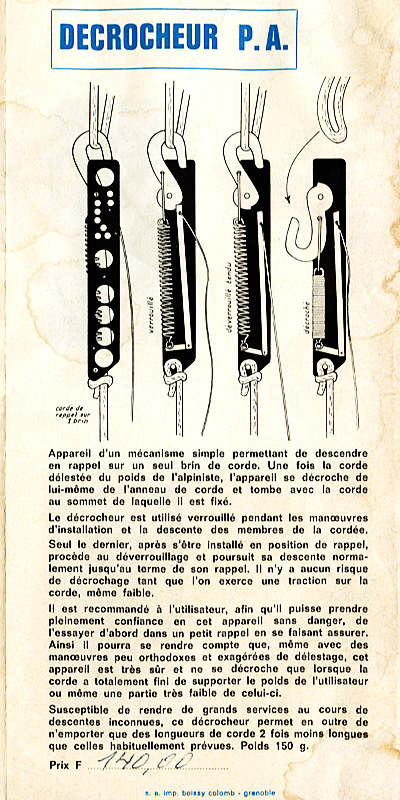
 Despite rumors that it is a medieval torture device, its intended purpose is to allow one to rappel down a drop on a single rope, then recover the rope by pulling on a thin cord. The device is rigged by attaching the lower bar. The hook is then set over the anchor carabiner, and a long thin cord is run through the anchor carabiner as well. After the rappel, a good hard tug on the thin cord releases a sear, the spring retracts the hook, and assuming that the thin cord is twice the length of the drop, the rope can be lowered to the ground. If the cord is left in place, the rope can be returned to service by other techniques (which make this device superfluous, since they could have been used in the first place), and one can ascend.
A much bolder (and not recommended) approach is to have the last person down unlock the décrocheur before descending. As soon as they take their weight off the rope, the spring unhooks the décrocheur hook, and the rope and décrocheur fall and hit the last one down on the helmet. Hopefully, they are at the bottom and not just resting on a thin ledge partway down.
Dave Elliot (Advanced caving Techniques, No. 1 - The Cord Technique, Sep./Oct. 1980, Descent 46, pp. 30-34) recommends adding a small pulley to make the Décrocheur easier to disengage.
 |
Pierre Allain [1904-2000] was a French alpinist and an innovator of climbing equipment. Allain began climbing in the 1920s. In 1935 he made the first ascent of the north face of the Petit Dru with Raymond Leininger. Their climbing equipment included a 7 mm. hemp rope, six carabiners, no crampons and only one ice axe.[1]
Allain developed the first rubber-soled, soft shoes specifically engineered for serious rock work in the 1930s. These shoes, known as "PAs," became the model for future generations of climbing footwear. Allain opened a mountaineering store in Paris, where he offered the first carabiners made using modern lightweight alloys. His other innovations included rappel devices, decrocheurs, and down jackets.[1]
Allain always favored a lightweight nature for the climbing gear he invented and manufactured. His favorite materials were high-strength aluminum alloys. His carabiners, descenders, and even some of his pitons were made of aluminum alloys.
Edmond Bourdonneau purchased the store from him in 1950.[1] Allain continued producing climbing hardware for many decades, including a carabiner that he made specially for a visiting friend of mine in 1992.