

This page will not fit into a tiny viewport. Please choose a full-size monitor with a full-width window or select the abridged New Wave pages.

Version A

Version B
Version C
|
|
|
|
| Version A | Version B | Version C |
I have no further information about the origin of these items.
[ Top | Version B | Version C | Return to Misc. Belay ]
|
|
 |
 |
| Front View | Rear View | Bottom View |
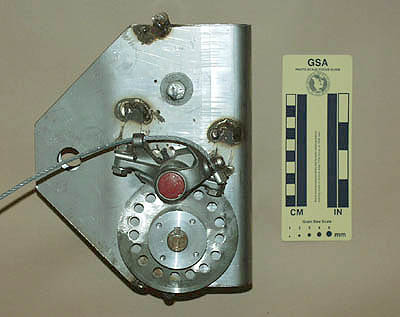
I acquired Version A used on eBay from Dawn Kordek in 2008.
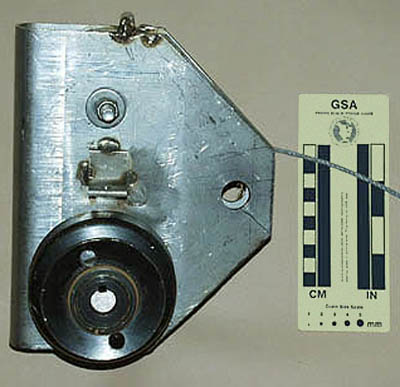
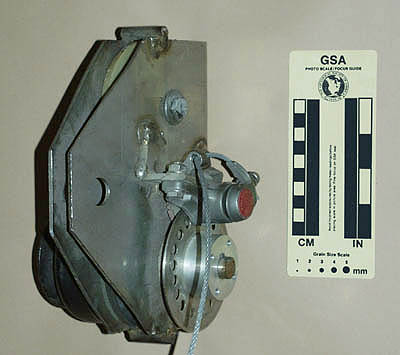
Version A is 225 mm. tall, 170 mm. wide, 160 mm. thick, and weighs 3810 g.
The body is made from 1/8" (3.2 mm.) stainless steel sheet bent to form a U-shaped channel. The internal width of the channel is 28 mm., but near the attachment holes this tapers to 14 mm. The holes themselves are 19 mm. in diameter. 9.5 mm. stainless steel rods welded at the top, center, and bottom provide additional rigidity. Inside the channel are two pulley wheels made from a soft rubbery material. The wheels are 95 mm. in diameter and 24 mm. thick, with a 14.5 mm. wide rope channel cut to a depth of 14 mm.
One side of the device has brackets that support an Avia disc brake assembly that acts on a disc attached to one of the pulleys with a keyed aluminum block. A 3.2 mm. steel cable with a loop in the end activates the disc brake.
On the other side of the device is another brake assembly that appears to be inertially activated. There was obviously a piece missing since the drum is free to turn. To make it work properly, I needed to fabricated something similar to what is on Version B. I took the photos before fabricating that piece.
I tried to get more information from Dawn, but she had acquired these indirectly and couldn't provide any details on their origins. She wrote:
These were bought from a rock climbing business by an auctioneer. Sadly, I don't have any other information on them except for them being repaired and in working condition. Sorry I can't be of more help.
What can I say? At first it was by no means obvious exactly what these were or designer had in mind for rigging these, and there aren't any wear marks to guide me. Then it happened: in a momentary cessation of stupidity, I realized that these were not belay devices at all; they are trolley pulleys for timid people to use on zip lines. I discussed this idea with numerous experts at the 2009 International Congress of Speleology, and we all seemed to agree. When I returned home, I found an email from Eric Schmidt, who had the same idea.
I can hardly give them a lemon award. Maybe I need a different award?
[ Top | Version A | Version C | Return to Misc. Belay ]
|
|
 |
 |
| Front View | Rear View | Bottom View |
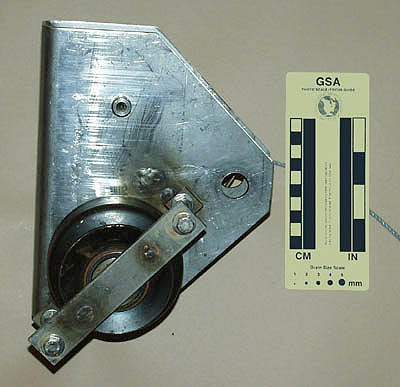
I acquired Version B used on eBay from Dawn Kordek in 2008.
Version B is 210 mm. tall, 167 mm. wide, 174 mm. thick, and weighs 4445 g. The shell does not taper toward the attachment holes as the Version A shell does, and the top and bottom support pins are omitted. There are minor differences in the brake disc assembly. A bar with two pins supports the brake drum assembly.
This one had a working support for the inertia brake.
[ Top | Version A | Version B | Return to Misc. Belay ]
|
|
 |
| Front | Side |
 |
 |
| Open for Rigging | Disassembled |
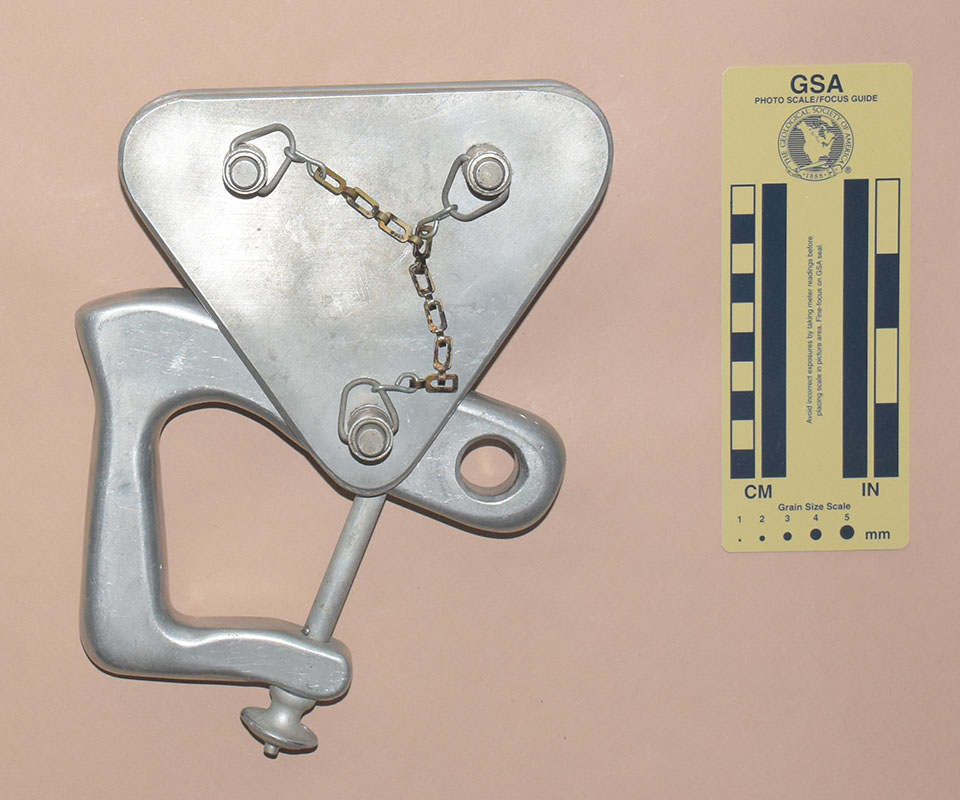
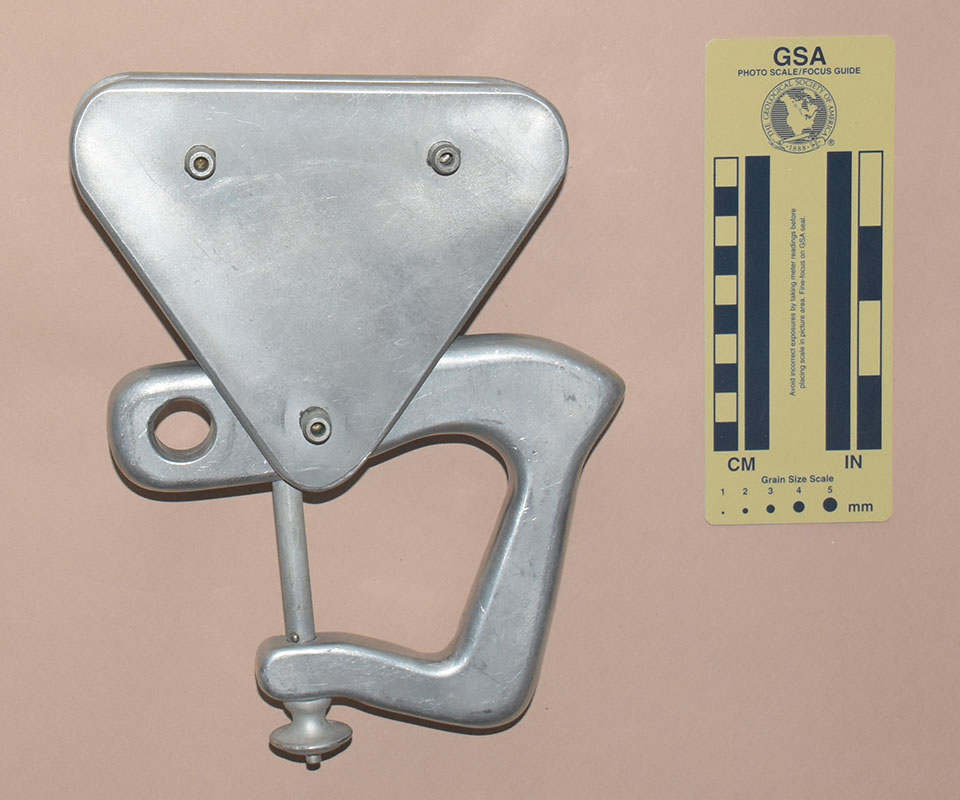
I acquired this Zipline Trolley from E. M. Grillos in 2020.
This Zipline Trolley is 200 mm. long, 203 mm. wide, 72 mm. high, and weighs 1361 g.
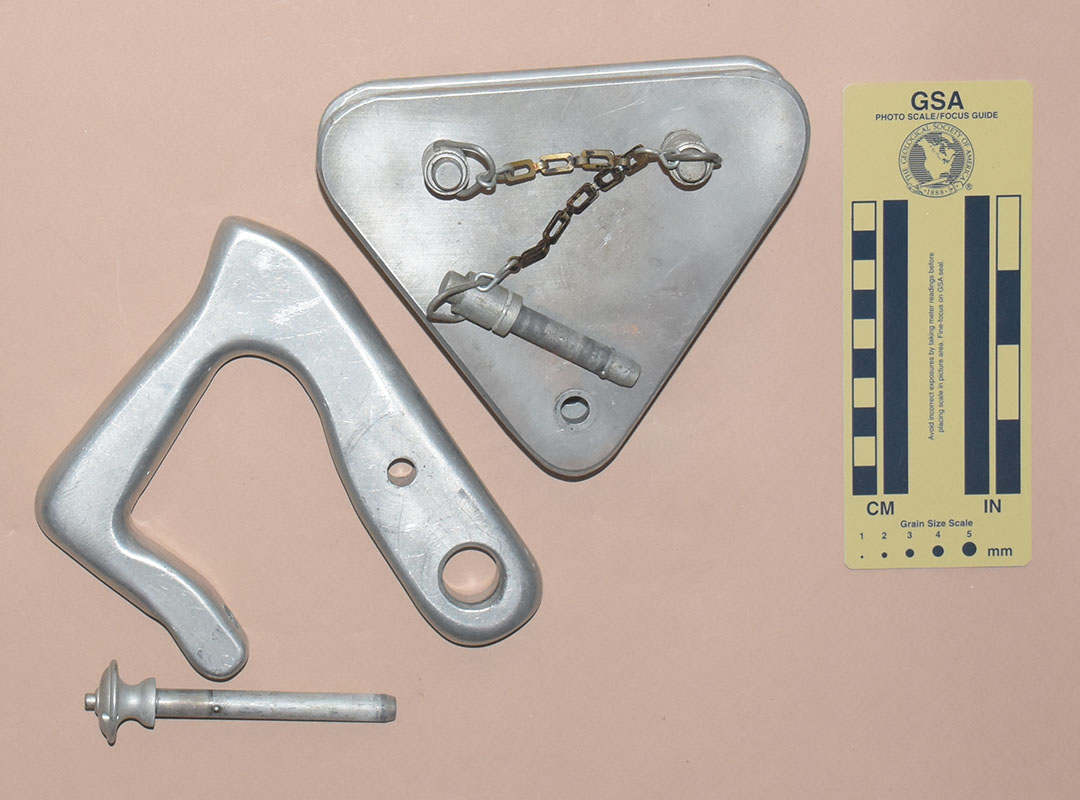
This trolley consists of two rollers and a brake fitted between two side plates. Three quick-release pins hold the assembly together. Each side plate is subtriangular, 160 mm. wide, 134 mm tall, and 6.5 mm. thick, and made from aluminum alloy (perhaps 6061?). The corners are rounded with about a 20 mm. diameter for the upper two and 14 mm. for the lower one. There are three 9.7 mm. holes in each plate. The upper holes are countersunk on the inside to clear a boss on the bearings.
Each roller is a Norma XF-94 sealed bearing aluminum roller. These are 17.4 mm wide and 40 mm. in diameter, with a shallow 1 mm. deep U-shaped peripheral groove. The inner bearing is 14.5 mm. in diameter and 22 mm. long. When the trolley is assembled, these extensions fit into the countersunk upper side-plate holes, helping to prevent racking.
The brake is an irregular shape cut from 19 mm. aluminum alloy (again, perhaps 6061). The shape provides a hand grip at one end and a 19 mm tie-in hole at the other. A 106 mm. long, 9.4 mm. diameter quick-release pin passes through a hole in the lower end of the hand grip and into an opposing hole drilled into the upper portion of the arm.
The rollers are stamped with "NORMA," "XF 94," and "MADE IN USA." The three upper quick-release pins are stamped "6F3A6-1.312" (the distance from the shoulder to the retaining balls is 1.312 inches, or 33.3 mm.). The long QR pin is printed with "9042," although this is faded and hard to read.
I bought this device on eBay. The seller described the device as follows:
Vintage 1960’s Mountaineering Climbing Trolley -Zip Line Applicable. Never actually used, great condition, only listing it as used as it has years of shelf wear.
All locking pins work as they should. The ball bearing rope rollers are tight and right. Machined aircraft aluminum and handle designed to act as brake.
This looks like it is a well-made home-built item rather than a commercial product.
When the user is supported by the eye, the brake rotates, and the upper surface squeezes the rope between the upper surface of the brake and one of the rollers. Pulling down on the handle reduces he breaking force. There are too many variables that affect how well this works to make a general statement about its effectiveness. The most important are how steep the zipline is rigged, the user’s body build, and where the user’s body is balanced in their harness.
While the upper QR pins allow one to quickly disassemble the device, there should not normally be a need to do so in the field. These pins could be replaced by bolts if one prefers to do so.
I'm not sure what purpose is served by the QR pin in the handle. I would not recommend attaching a chest harness to the handle, since leaning back would fully defeat the braking action.
[ Top | Version A | Version B | Version C ]