

This page will not fit into a tiny viewport. Please choose a full-size monitor with a full-width window or select the abridged New Wave pages.

|
|
 I acquired my Mammut Klettersteigset from Inner Mountain Outfitters in 2003.
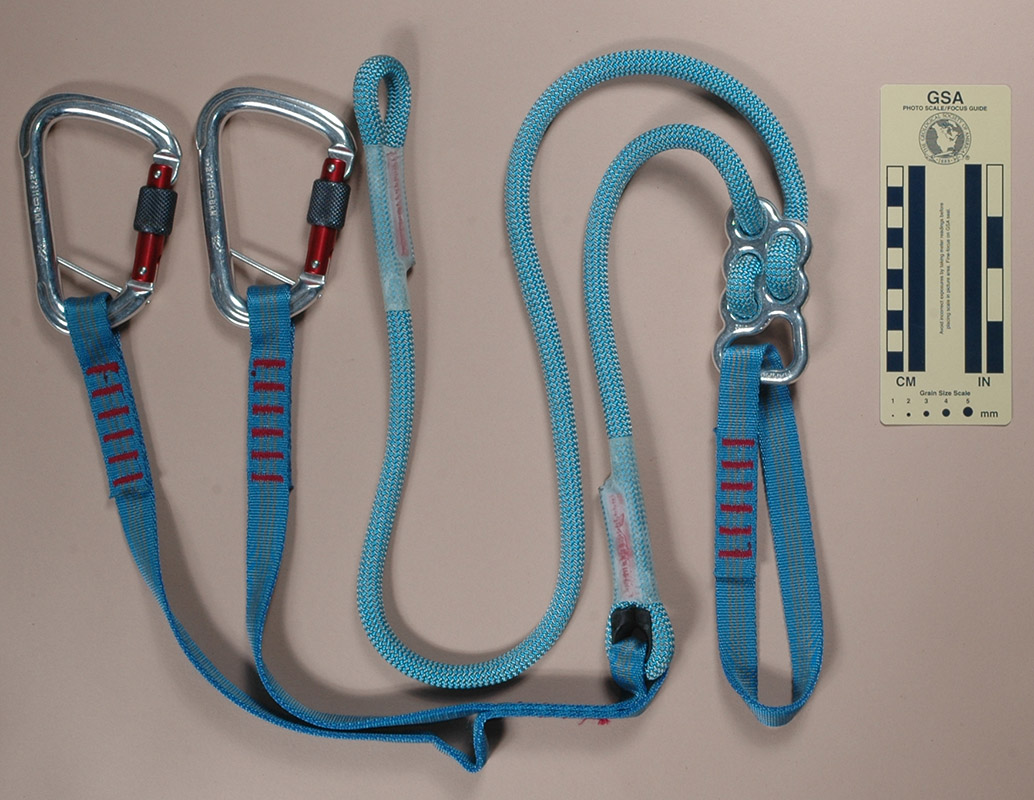
My Mammut Klettersteigset kit weighs 437 g. The braking plate is essentially the same as the Climbing Technology anchor brake, but its markings are different. The 11.5 mm. diameter cord supplied with the Klettersteigset was sewn into a loop at each end, with about 115 cm. between loops. The stitching was plastic covered. One end (shown) was free, the other had a plastic ferrule with a sewn bight of 19.5 mm. chain-stitched webbing passed through it. A locking carabiner was sewn at each end of the webbing. One end of the webbing is 40 cm. long, the other 46 cm. Finally, a 20 cm. loop of 19.5 mm. webbing is sewn to the brake plate.
The front of the brake plate is stamped "MAMMUT CE 0639" and "0102." The rear is stamped "USE ROPE | UIAA ø10.4" with a circle around the "|."
The Mammut Klettersteig is designed as a dynamic cow’s tail for use on via ferrata.
Kaspar Tanner founded a rope-making business in the small town of Dintikon in Switzerland. He initially produced mainly for the agricultural sector, but the company's focus shifted to mountain sports by the 1950s.
In 1952 the company began trading under the name Mammut and its focus shifted to ropes made specifically for mountaineering and sailing. By the 1980s, Mammut’s range had expanded into the hardware, apparel and footwear markets.
In 2003, the company was renamed Mammut Sports Group AG. Mammut acquired Norwegian sleeping bag manufacturer Ajungilak and mountain boot specialist Raichle. Mammut now operates in over 35 countries, employing over 850 outdoor enthusiasts worldwide.