

This page will not fit into a tiny viewport. Please choose a full-size monitor with a full-width window or select the abridged New Wave pages.

|
|
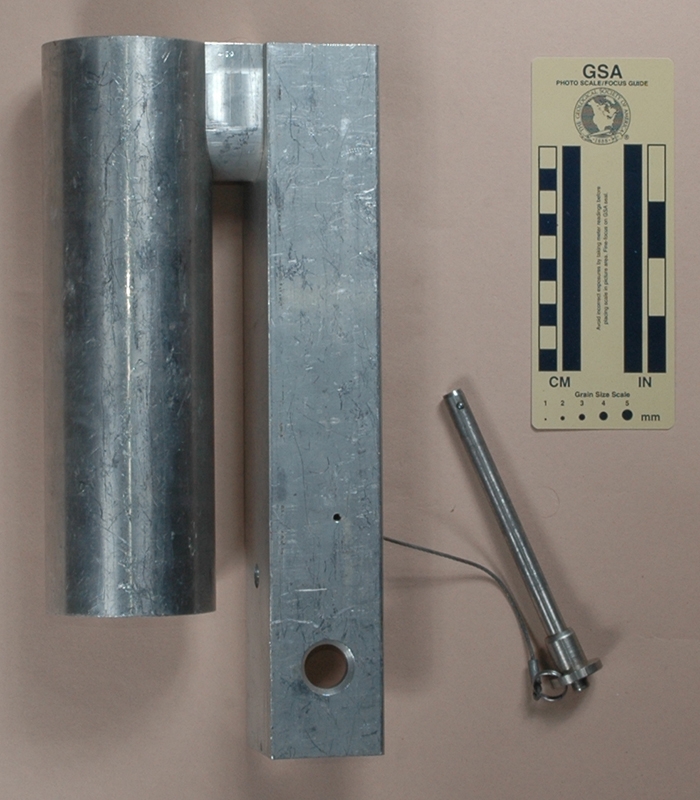 |
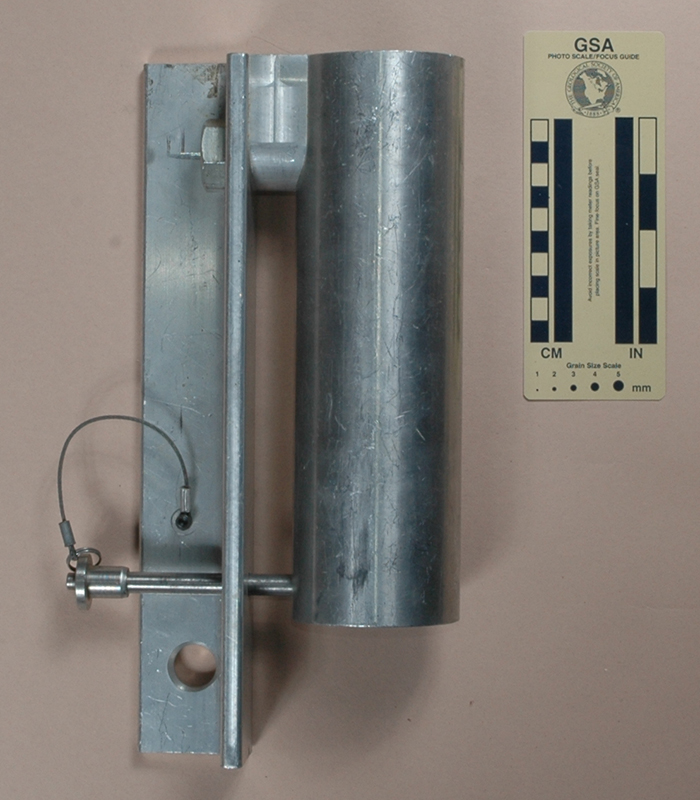
| Front View | Rear View: Open for Rigging |
I acquired my Forrest Wonder Bar from John E. Weinel, Inc. in 1985.
The Forrest Wonder Bar consists of an aluminum tube bolted to a machined spacer and an aluminum angle with a 5/8-in bolt. A steel roll pin is added to keep the bar from rotating. The angle is drilled to provide an eye for attaching the Wonder Bar to an anchor. A long quick-release pin keeps the tag end of the rope from coming out of the device. My Forrest Wonder Bar is 305 mm. tall, 146 mm. wide, 74 mm. thick, and weighs 1833 g.
There are no markings on my Wonder Bar.
Large-diameter spools provide some of the smoothest control of any device, and the Wonder Bar is no exception; however, since the spool is oriented in line with the rope, it tends to induce some rope twisting.
Bill Forrest [1939–2012] started Forrest Mountaineering in 1968, initially operating from a basement in Denver, Colorado. Bill sold the company to Olsen Industries in 1985.[1]
Forrest created a fiberglass wall hammer and ice tools with interchangeable picks, the swami belt with adjustable leg loops, the daisy chain and shock-absorbing quickdraws, copperheads, Titons, and the Triton, an all-in-one piece for belaying, rappelling, and protection.[2]