

This page will not fit into a tiny viewport. Please choose a full-size monitor with a full-width window or select the abridged New Wave pages.

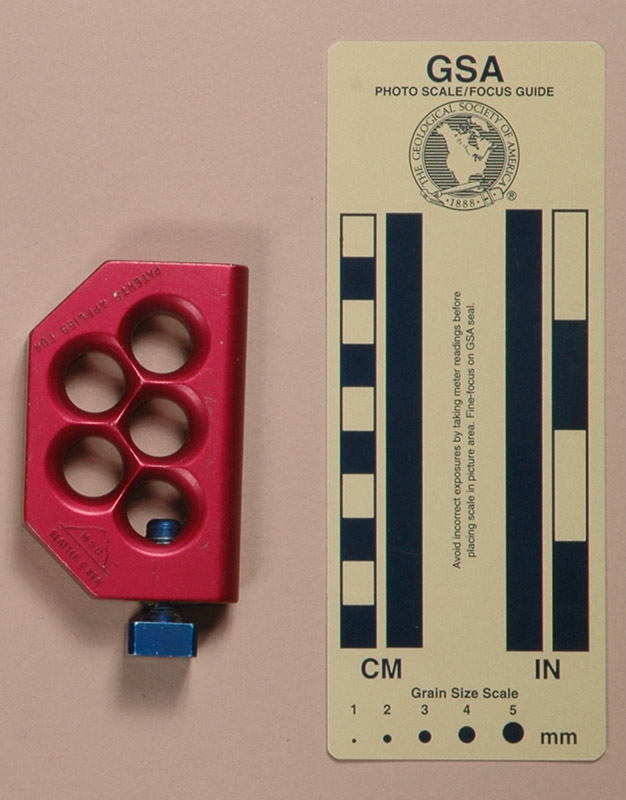
Version A
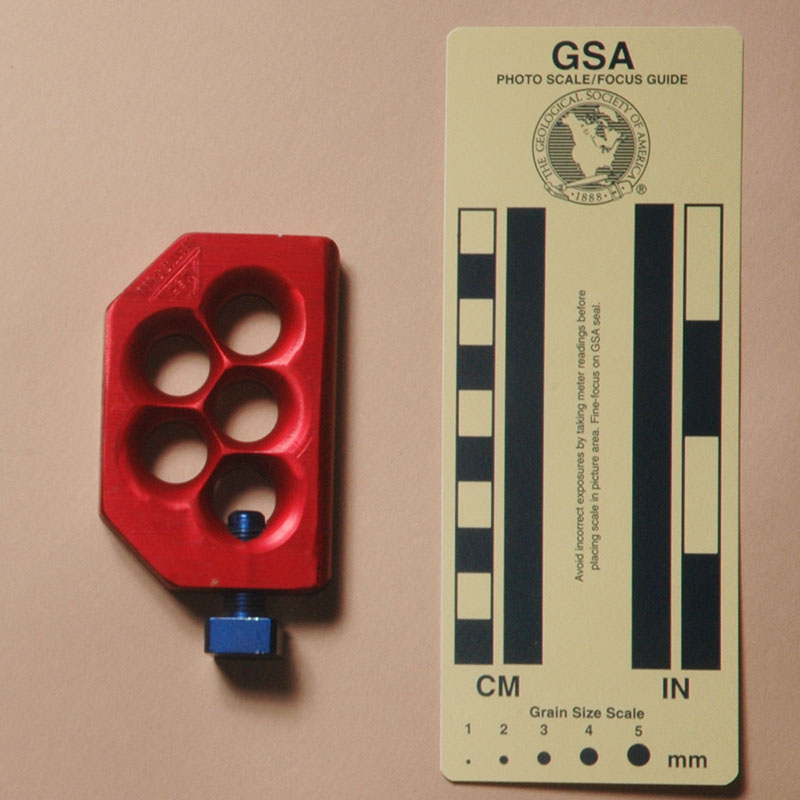
Version B

Version C

Version D
|
|
|
|
|
| Version A | Version B | Version C | Version D |
Larry Penberthy founded MSR in 1969. From 1969 through 1977 MSR issued booklets (variously called a Newsletter, then a Newsletter and Catalog, and finally a Catalog and Newsletter) that provided equipment requirements, analysis, and testing results (not limited to MSR brands) and also a catalog of MSR gear. Starting in 1978, these took on a more traditional catalog format without the more general equipment discussions.
Larry sold MSR to REI in 1981. In August 2001, REI sold MSR to Cascade Designs.
MSR first describes their Auto-Belayer in their November 1960 Newsletter #1. It was last mentioned in their March 1976 Newsletter #11. None of the newsletters mention any design or finish changes.
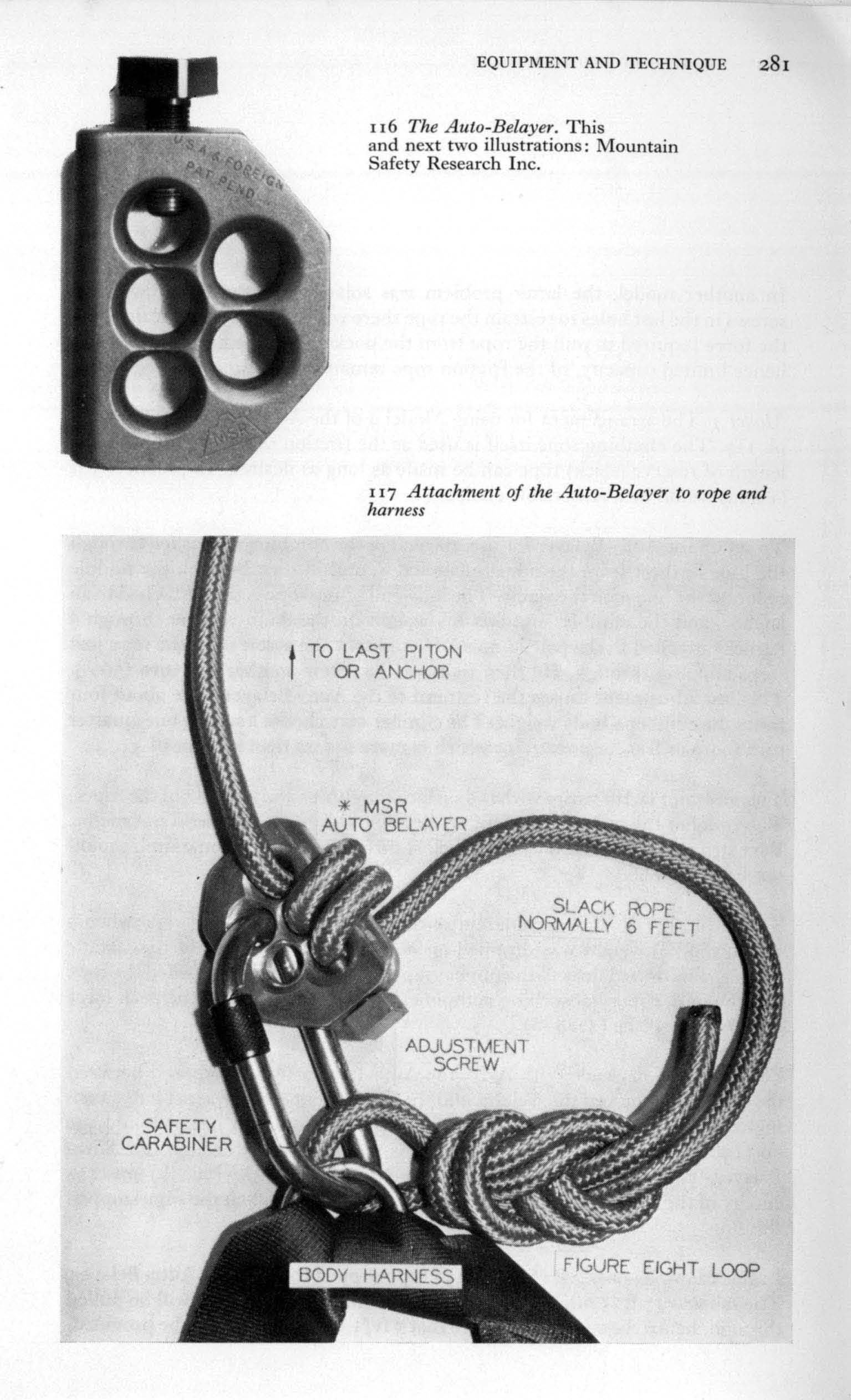
Larry Penberthy described the development history in the Alpine Journal.[1] Here are the relevant pages:
 |
 |
 |
 |
 |
[ Top | Version B | Version C | Version D | Return to Anchor Brakes ]
|
|
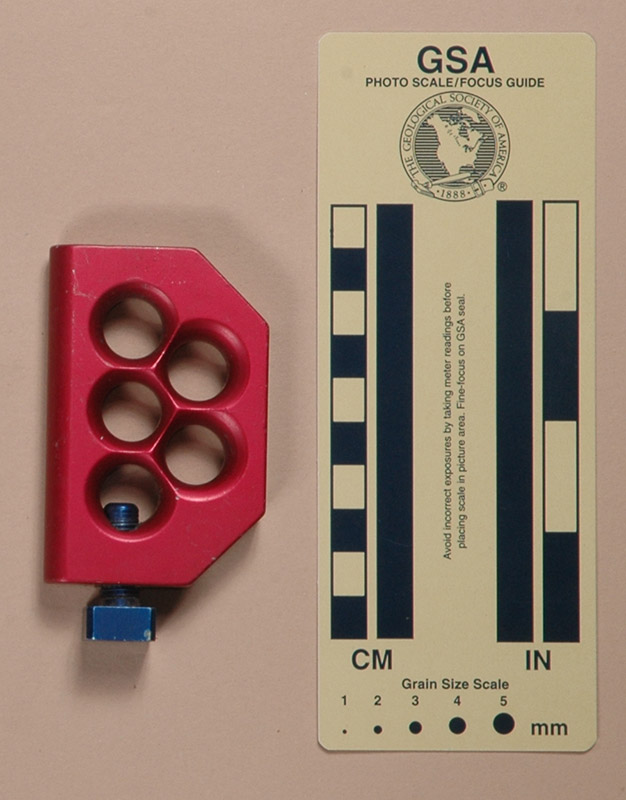 |
| Front | Rear |
I acquired my MSR Auto Belayer from Bill Ivanoff in 2007, but it dates from about 1969. I acquired another in 2017 as part of Bob Thrun’s collection.
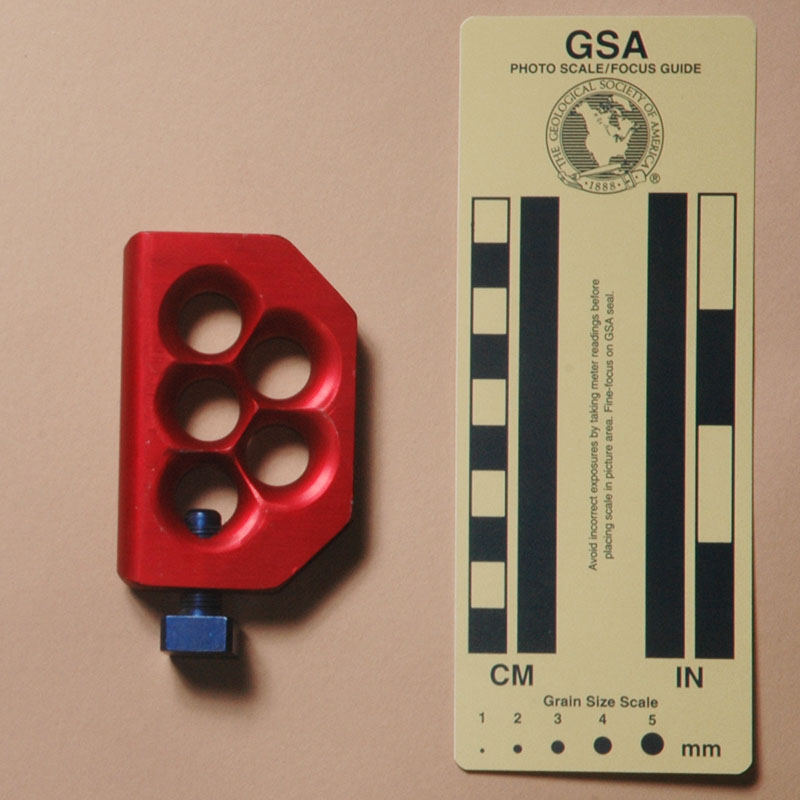
The MSR Auto Belayer is 92 mm. tall (78 mm. for the red block), 50 mm. wide, and 16 mm. thick. Mine weighs 93 g.
The main body is a block of anodized aluminum plate, shaped like a rectangle with two corners removed to make pentagon. The long side is rounded to form a semicircular edge. There are five 14 mm. holes drilled through the plate, each well-rounded. The holes are evenly spaced in two staggered rows, with adjacent holes on 19.2 mm. centers. A threaded hole in one end of the block accepts a 9.4 mm. square-head anodized aluminum screw that extends through to an end hole in the three-hole row.
One side of the Auto Belayer is stamped with the MSR logo, "SEATTLE 8 USA," and "PATENTS APPLIED FOR."
The MSR Auto Belayer was marketed as an Auto Belayer, not for making dynamic cows tails, but is so similar to the anchor brakes that I grouped it with them. It also closely resembles many of the dynamic cow’s tails. The unique feature is the adjustment screw.
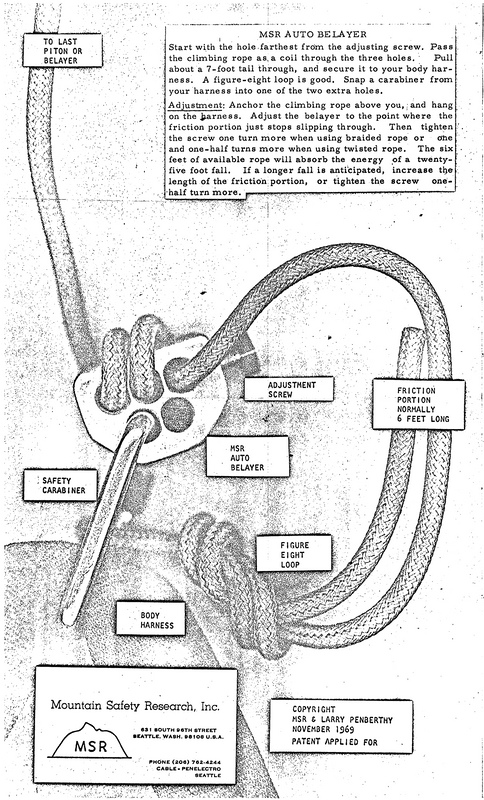
To rig the Auto Belayer, pass a little more than 2 m. of the climbing rope through the hole farthest from the screw, around the side and through the middle hole in the row (in the same direction), and then again around the side and through the hole with the screw. Leave 1.8 m. of rope and then tie the free end to your harness. Clip into either hole in the two-hole row. According to the instructions,
Anchor the climbing rope above you and then hang in the harness. Adjust the belayer to the point where the friction portion just stops slipping through. Then tighten the screw one more turn when using braided rope or one and one-half turns when using twisted rope [this refers to Goldline, which was going out of favor in the 1970s - gds]. The six feet of available rope will absorb the energy of a twenty-five foot fall. If a longer fall is anticipated, increase the length of the friction portion, or tighten the screw one-half turn more.
 I'm not going to go out and take 25-foot screamers just to test these instructions.
Do not assume that the screw is a typical screw with a cup point - it is not. MSR rounded the end of the screw, undoubtedly to address concerns over a normal cup point damaging the rope. They also removed the two end threads (the remnants in the photo are shallow traces and have no sharp edge).
Since I started climbing in the 1960s, I've never felt that I needed an Auto Belayer (or an anchor brake). The Auto Belayer has a nice adjustment feature, but that is something that can be adjusted improperly.
[ Top | Version A | Version C | Version D | Return to Anchor Brakes ]
|
|
 |
 |
| Front | Rear | Side |
I acquired my MSR Auto Belayer, Version B from Carol Jo Rushin-Elron at the 2016 NSS Convention. I obtained a second one with original instructions from Russell Norton in 2026.
Version B is 94 mm. tall, 51 mm. wide, 16 mm. thick, and weighs 90 g.
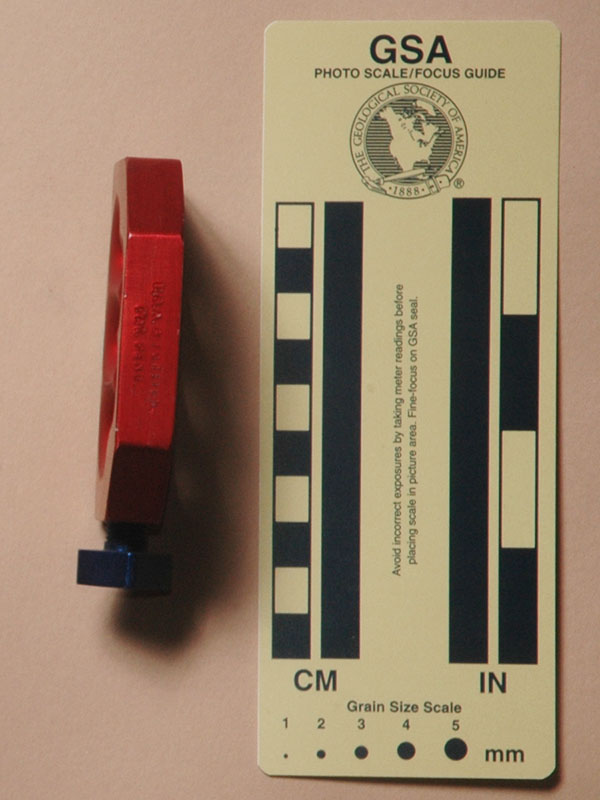
One side of the Auto Belayer is stamped with the MSR logo and "SEATTLE 0 USA." The short side edge is stamped with "USA AND FOREIGN PAT. PEND."
Since the only differences between Version A and Version B are the markings, their performances are equivalent.
[ Top | Version A | Version B | Version D | Return to Anchor Brakes ]
|
|
 |
| Front | Rear |
I acquired this MSR Auto Belayer from Todd R Lindell in 2022.
Version C is 79 mm. tall, 51 mm. wide, 16 mm. thick, and weighs 80 g.
One side of the Auto Belayer is stamped with the MSR logo. The other side is stamped with "USA AND FOREIGN PAT. PEND."
 Comments
Does size matter? Not for everything, it doesn't.
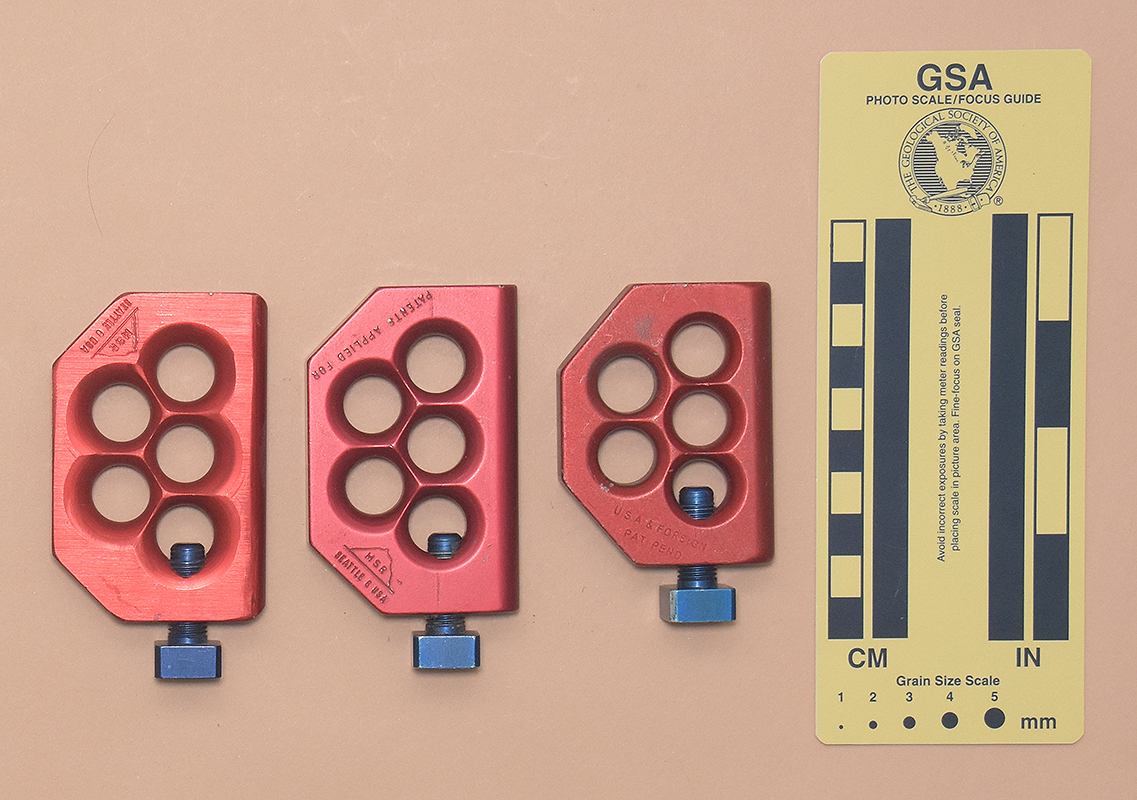
Version C is noticeably smaller than Version A or Version B. Four of the holes are the same size, but the one with the screw is 1 mm. smaller. The diagonal spacing is a bit larger, but the axial spacing is less. The rope should run between diagonal holes so it is the former that could have an effect, but the difference is minimal. The only differences a user likely would notice are the slightly more than ten percent reduction in weight and length.
[ Top | Version A | Version B | Version C | Return to Anchor Brakes ]
|
|
 |
| Front | Rear |
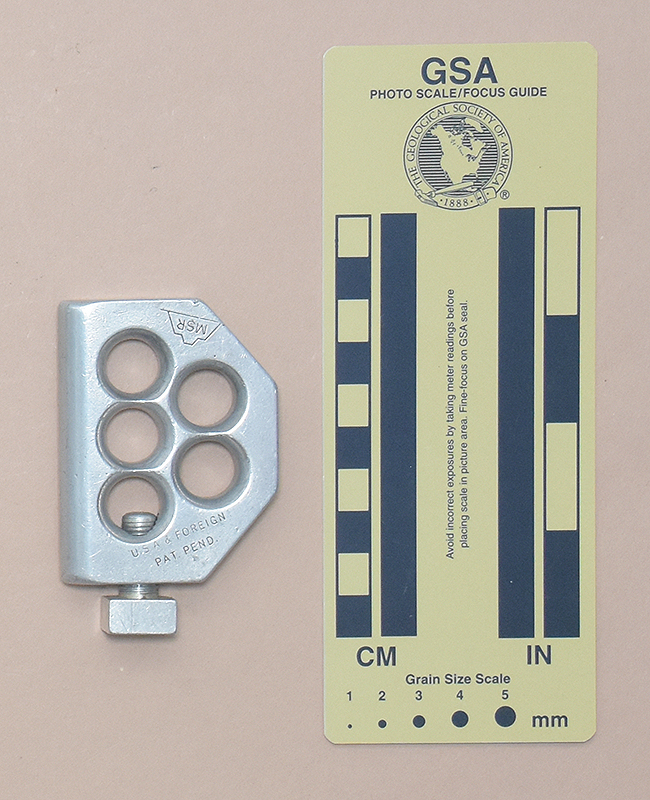
I acquired this MSR Auto Belayer from L. E. Bibb in 2022.
Version C is 79 mm. tall, 51 mm. wide, 16 mm. thick, and weighs 80 g.
One side of the Auto Belayer is stamped with the MSR logo and "USA AND FOREIGN PAT. PEND."
Version D is similar to Version C but not anodized. The screw is 3.5 mm. shorter.
The lack of anodizing may indicate that Version D is the earliest, followed by C, A, and B in that order.
[ Top | Version A | Version B | Version C | Version D ]