

This page will not fit into a tiny viewport. Please choose a full-size monitor with a full-width window or select the abridged New Wave pages.


Rock Exotica Silent Partner

Wren Industries Silent Partner

SoloAid Prototype #1

SoloAid Prototype #2

Rock Exotica SoloAid

Wren SoloAid

Soloist Prototype
Wren Soloist
|
|
|
|
|
| c Silent Partner |
Wren Industries Silent Partner |
Rock Exotica Soloist Prototype |
Wren Industries Soloist |
|
|
|
|
|
| Rock Exotica SoloAid Prototype #1 |
Rock Exotica SoloAid Prototype #2 |
Rock Exotica SoloAid |
Wren SoloAid |
 |
DO NOT CLIMB SOLO! Nothing can make solo climbing safe. |
|
||
|
If you are reading this then you do not have the necessary expertise. |
|
||
|
Do not even think about learning anything about anything from an internet web site. |
|
Rock Thompson founded Rock Exotica in 1987. He was always interested in solo climbing, so he started by making a variety solo climbing devices. He then branched out into other climbing devices. In 1990, Petzl approached Rock about making carabiners for them. They started another company, Thompson Manufacturing, Inc. (TMI). Meanwhile,Rock Exotica products continued to gain popularity. Eventually Petzl wanted them, so Rock made most of them under the Petzl brand and Petzl distributed them. This was the period when Rock Exotica as a brand "disappeared." Eventually Rock wanted to work new products of his own choosing, so he bought the others' shares so TMI could become independent and he could bring back Rock Exotica. Rock Exotica is based in Utah.
The Silent Partner was developed by Mark Blanchard. Mark started solo climbing in 1975. He started thinking about a better device after soloing Zodiac in 1984, developed a prototype around 1987, filed the paperwork, and received U.S. Patent 4,941,548 in 1989. He planned to manufacture the Silent Partner himself and developed plans and tooling, but changed his mind in 1995 due to liability concerns. He met with Rock Thompson of Rock Exotica in 1996, and reached an agreement to license the patent. Around the same time, Rock Exotica started working with Petzl, who wanted nothing to do with solo belay devices. Rock had a machinist friend in Colorado, Wren Franklin, who started producing the Silent Partner, along with the Soloist and Soloaid.[1]
Wren's Silent Partner became available in 1999. I bought my first one at that time after having been on the waiting list for two years. Production continued until 2008. Mike and Shannon Sneddon of S Gang Enterprises purchased Wren Industries in 2008 and organized Wren Industries, Ltd under the laws of the State of Colorado. The business was filed on January 2, 2008.[2][3] Wren discontinued the Silent Partner that year. Rock explained the termination as follows:[4]
Silent Partner sales were down to around 100 a year. Although we realized we were not making any money with it, we kept it in production for some years anyway just because we liked it and we liked the climbers who used it. But in the end it was a necessary financial decision to discontinue it.
Rock Exotica listed the Silent Partner in their catalogs through 2015 when the final units sold.
Some of the devices sold with Rock Exotica manuals and some with Wren manuals. If I know that a Silent Partner was originaly sold after 1999, I list it here as Wren. For the others, if I have the original manual, I list it according to the manual's information
In October 2025, Bliss Climbing Tech announced that they had licensed the Silent Partner design.[5] As of June 2026, this is on hold pending market evaluation of other products.[6] At this time, the Silent Partner is no longer manufactured, but is readily available on eBay, sometimes for an insane amount of money.
[ Top | Wren Silent Partner | SoloAid Prototype #1 | SoloAid Prototype #2 | Rock Exotica SoloAid | Wren SoloAid | Soloist Prototype | Wren Soloist | Return to Self Belay ]
|
|
 |
 |
 |
| Front | Rear | Left Side | Right Side |
 |
 |
| Front: Open for Rigging | Rear: Open for Rigging |
I acquired my Rock Exotica Silent Partner from Greg Bumb / Santa Cruz Pawn in 2021.
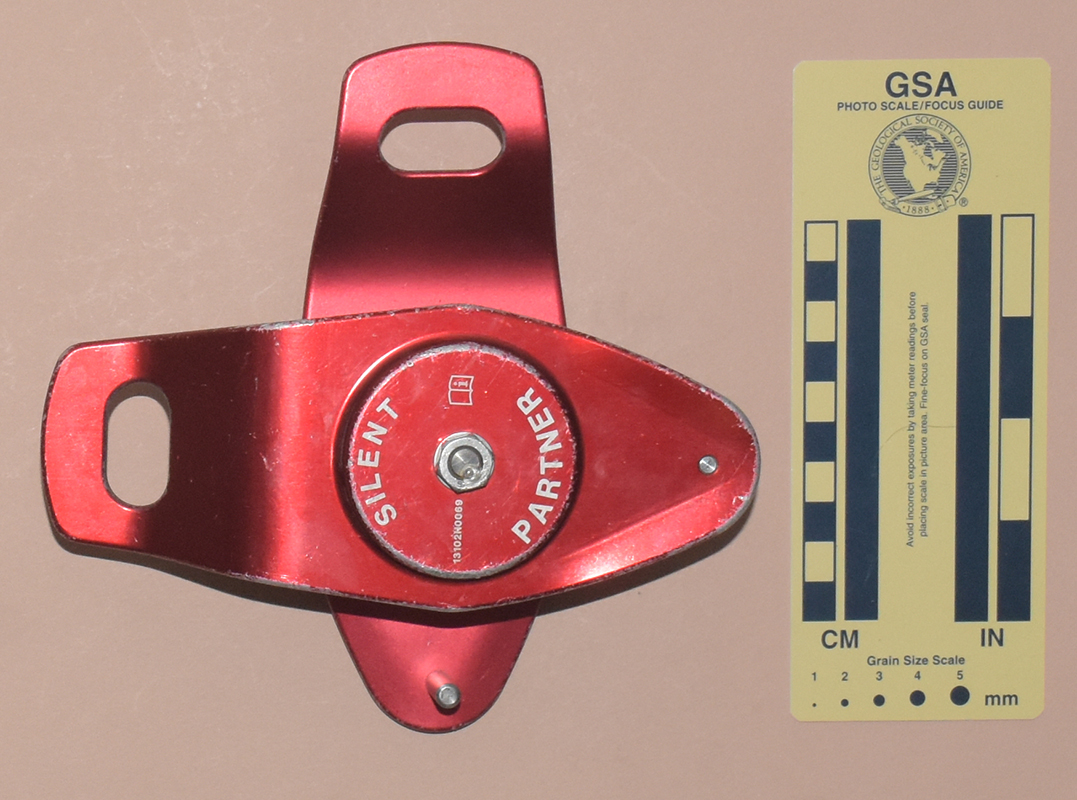
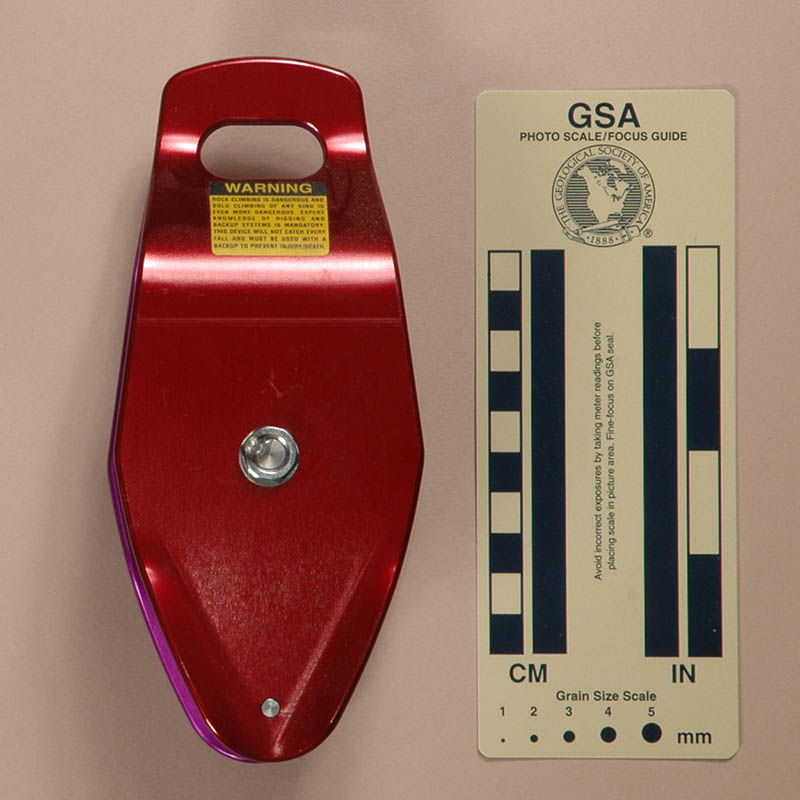
The Rock Exotica Silent Partner is 73 mm. long, 171 mm. wide, 71 mm. high, and weighs 421 g.
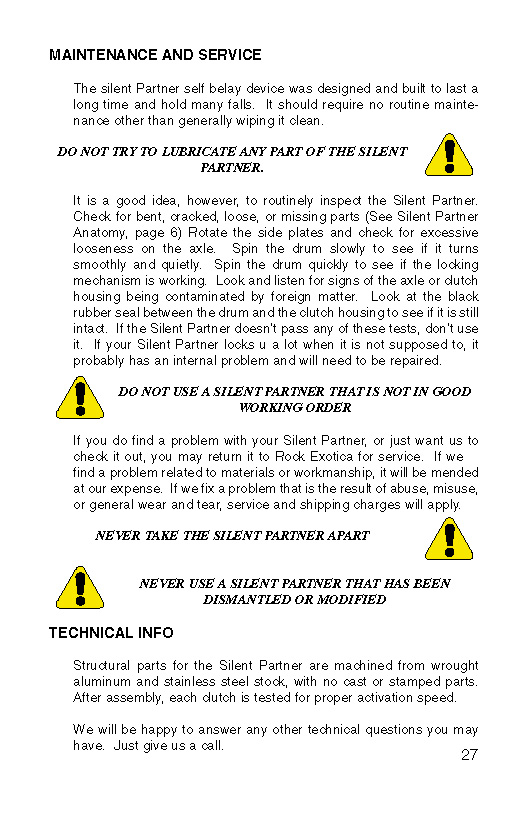
The Rock Exotica Silent Partner consists of two stamped aluminum alloy side plates surrounding a roller with an integral centrifugal clutch. The plates are 3 mm. thick and are bent to meet at the top, where each has a 29.7 by 15.3 mm. attachment eye. The roller assembly is 44 mm. long with a 16.4 mm. central rib. The roller is 44.4 mm. in diameter at each side of the rope grooves, 42.mm at the center of the U-shaped grooves, and 59.3 mm. at the central rib. For details of the internal clutch, please refer to U.S. Patent 4,941,548. Each plate supports a 6.4mm pin at the bottom that acts to jeep the rope ends separated.
The front of my Rock Exotica Silent Partner is printed with "SILENT," "13102H0069," a book-with-an-"i" icon, and "PARTNER." The rear is printed with "WARNING," "ROCK CLIMBING IS DANGEROUS AND SOLO CLIMBING OF ANY KIND IS EVEN MORE DANGEROUS. EXPERT KNOWLEDGE OF RIGGING AND BACKUP SYSTEMS IS MANDATORY. THIS DEVICE WILL NOT CATCH EVERY FALL AND MUST BE USED WITH A BACKUP TO PREVENT INJURY AND DEATH," "WARNING," and "FOR DANGEROUS ACTIVITIES - RISK OF INJURY/DEATH CANNOT BE ELIMINATED. DO NOT USE UNLESS YOU HAVE READ ALL INSTRUCTIONS* RECEIVED SUITABLE TRAINING*CHECKED GEAR BEFORE EACH USE* ACCEPTED TOTAL RESPONSIBILITY FOR YOUR SAFETY AND GEAR SUITABILITY. ALWAYS USE A BACKUP - NEVER TRUST A LIFE TO A SINGLE TOOL!"


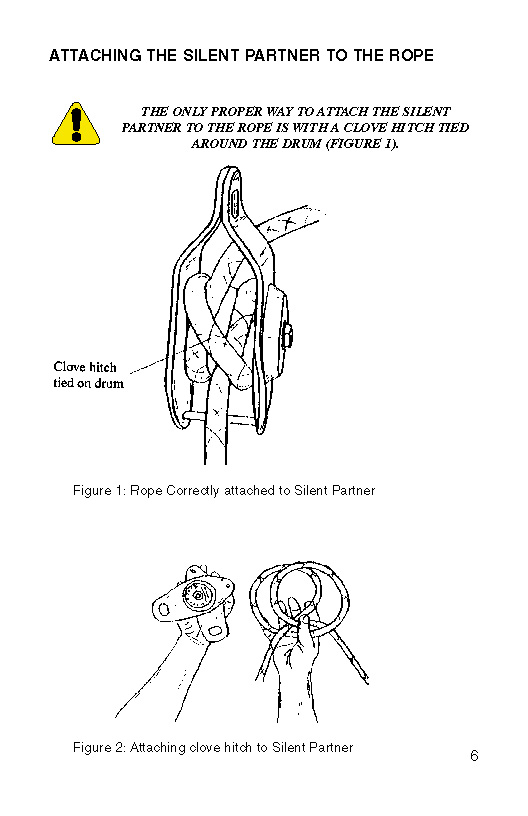
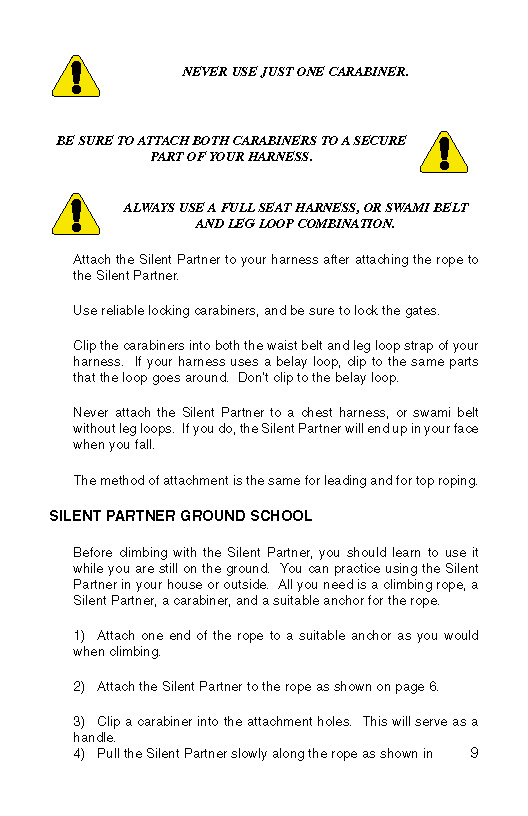
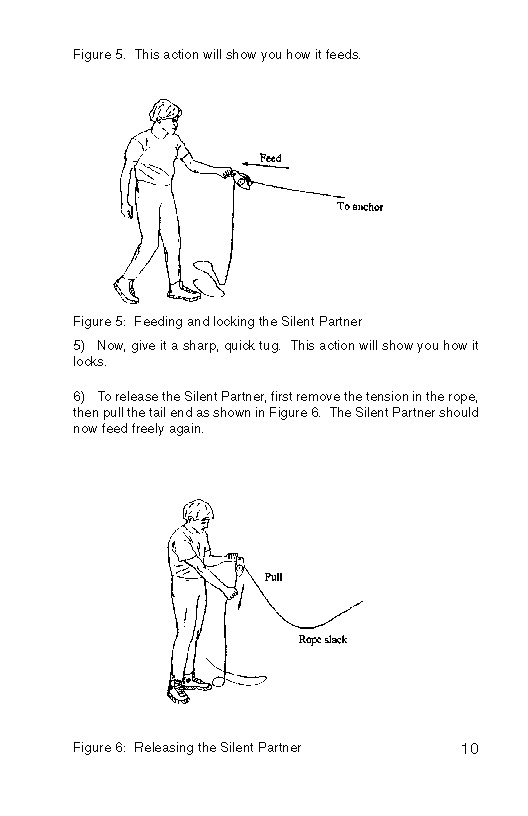
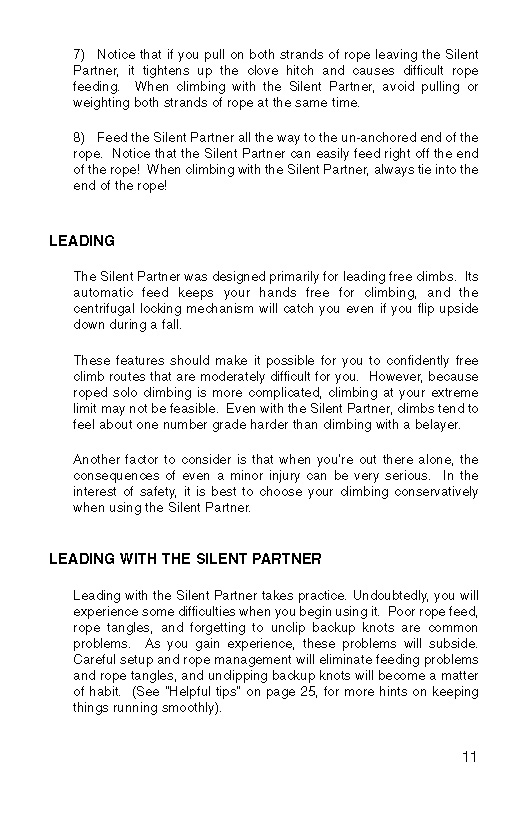
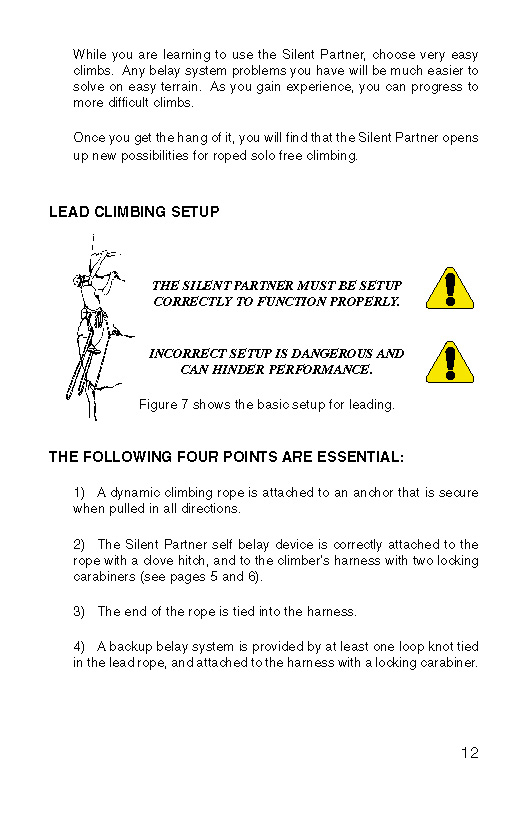
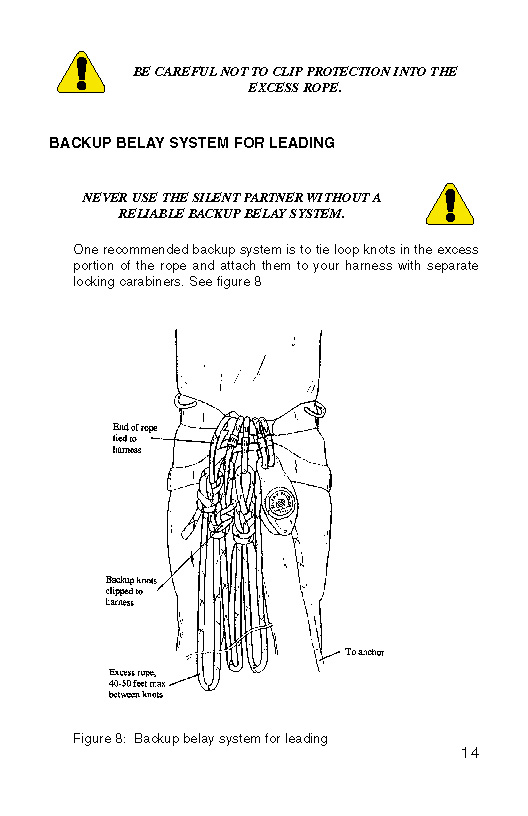
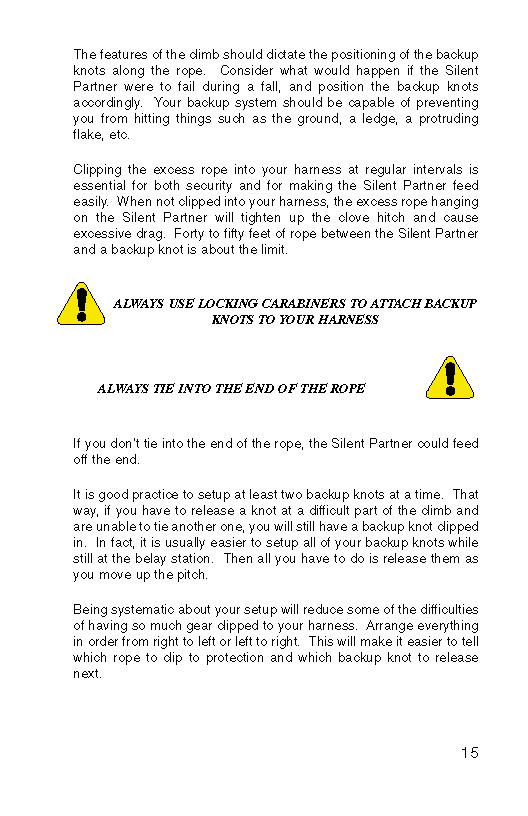
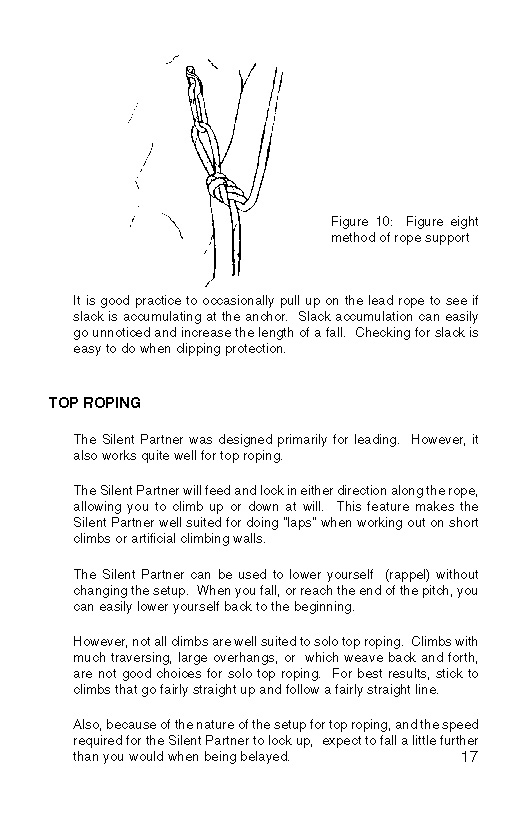
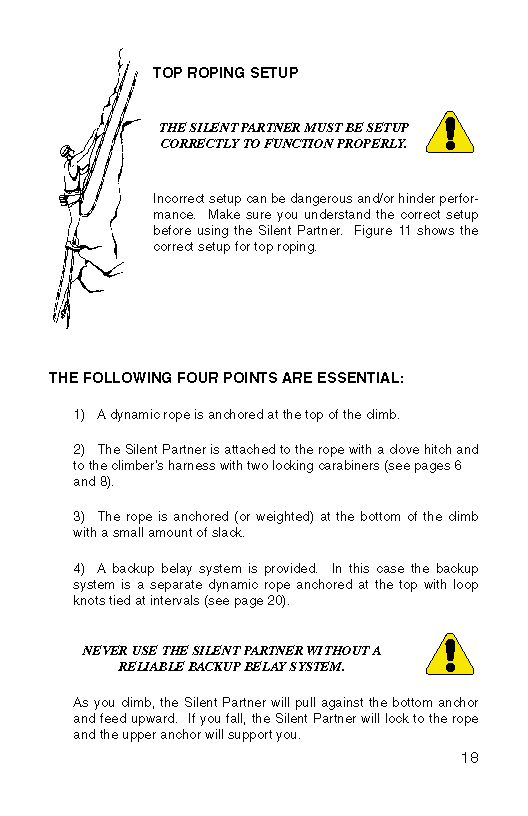
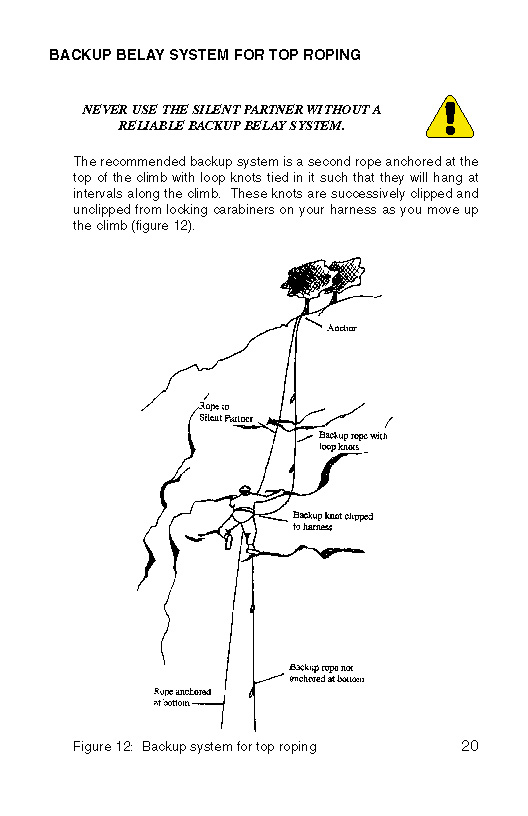
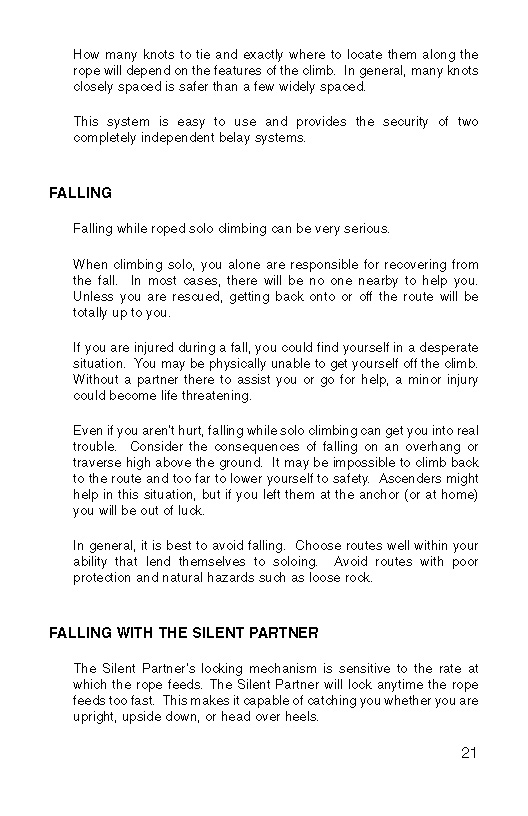
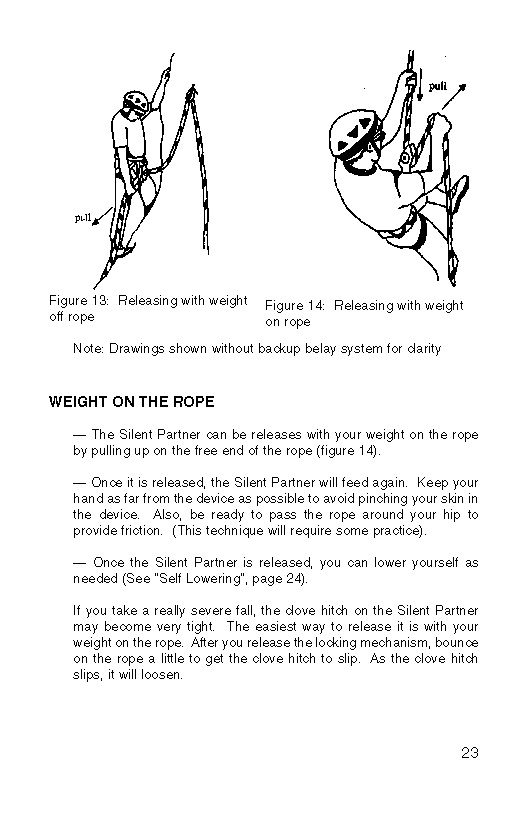
 This is the device for roped solo. The climber ties a clove hitch around the spool in a specific fashion, and then climbs. The rope feeds smoothly, but if the climber falls, a centrifugal clutch engages and keeps the spool from rotating. I was on a waiting list for two years before I got my Silent Partner, and since testing it I've given up on using anything else.
This device works very well, but one must thoroughly review and know everything in the manual before using it. I mean the entire manual! Don't forget backup knots!! Remember, one mistake and the life you lose will be your own.
|
DO NOT CLIMB SOLO! Nothing can make solo climbing safe. |
|
 |
 |
 |
 |
 |
 |
 |
 |
 |
 |
 |
 |
 |
 |
 |
 |
 |
 |
 |
 |
 |
 |
 |
 |
 |
 |
 |
 |
 |
 |
[ Top | Rock Exotica Silent Partner | SoloAid Prototype #1 | SoloAid Prototype #2 | Rock Exotica SoloAid | Wren SoloAid | Soloist Prototype | Wren Soloist | Return to Self Belay ]
|
|
 |
| Front | Rear |
 |
 |
| Side | Open for Rigging |
|
DO NOT CLIMB SOLO! Nothing can make solo climbing safe. |
|
||
|
If you are reading this then you do not have the necessary expertise. |
|
||
|
Do not even think about learning anything about anything from an internet web site. |
|
I acquired my Wren Industries Silent Partner from Mountain Tools in 1999. I acquired a second from John Foley in 2026.
My Silent Partner is 73 mm. long, 165 mm. wide, 70 mm. high, and weighs 430 g.
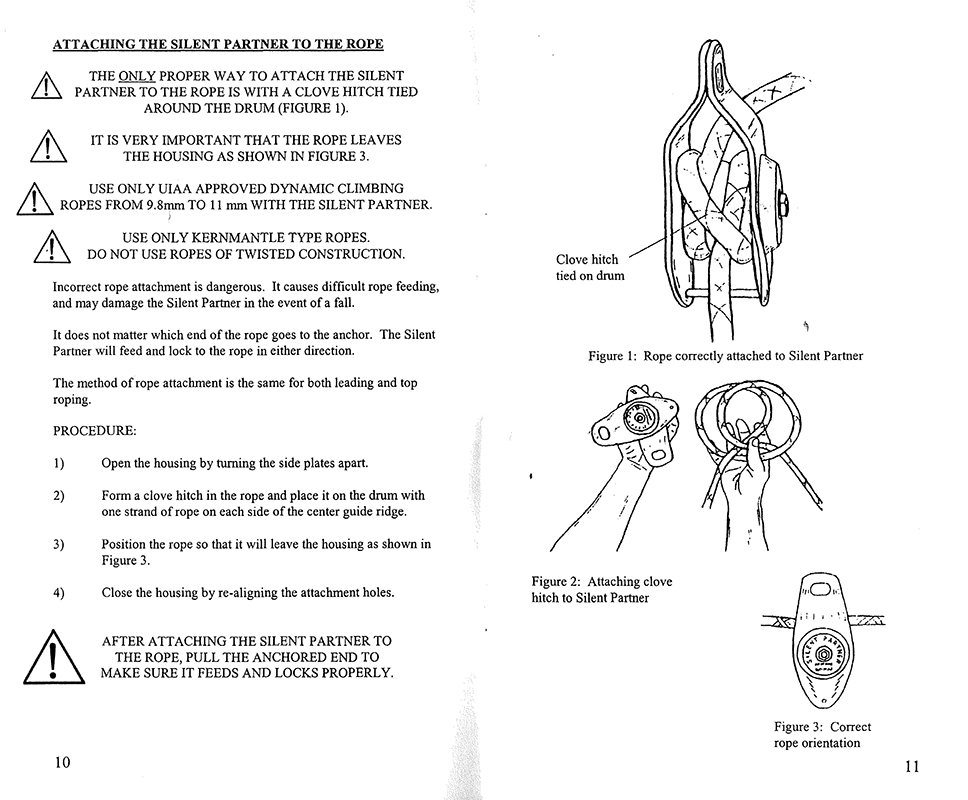
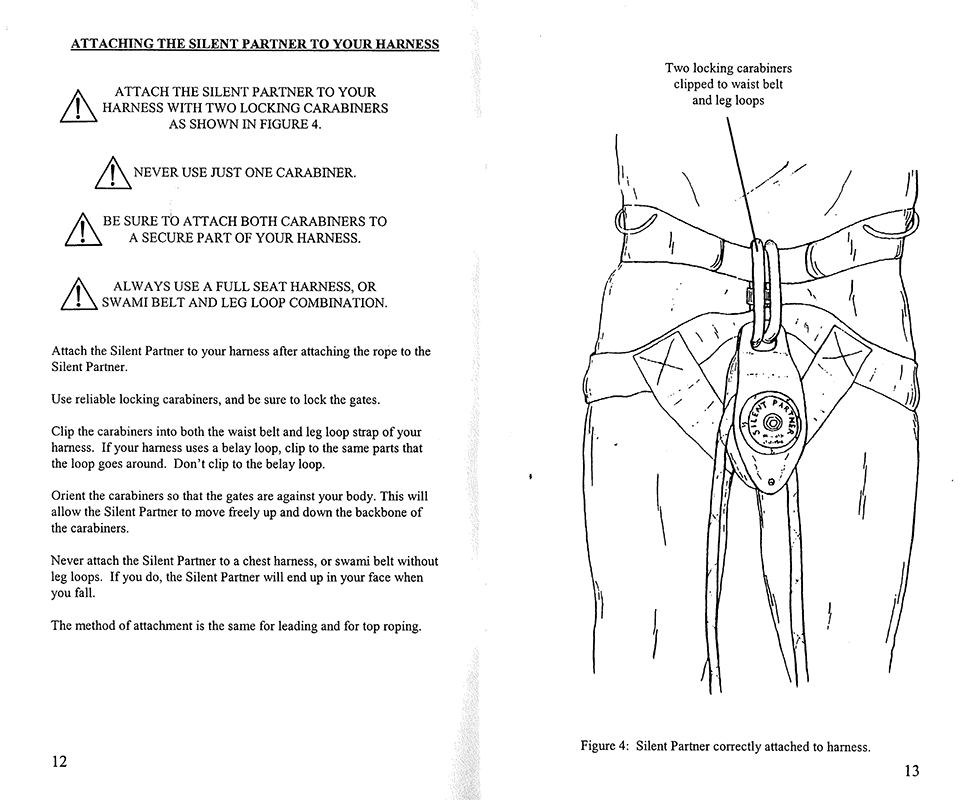
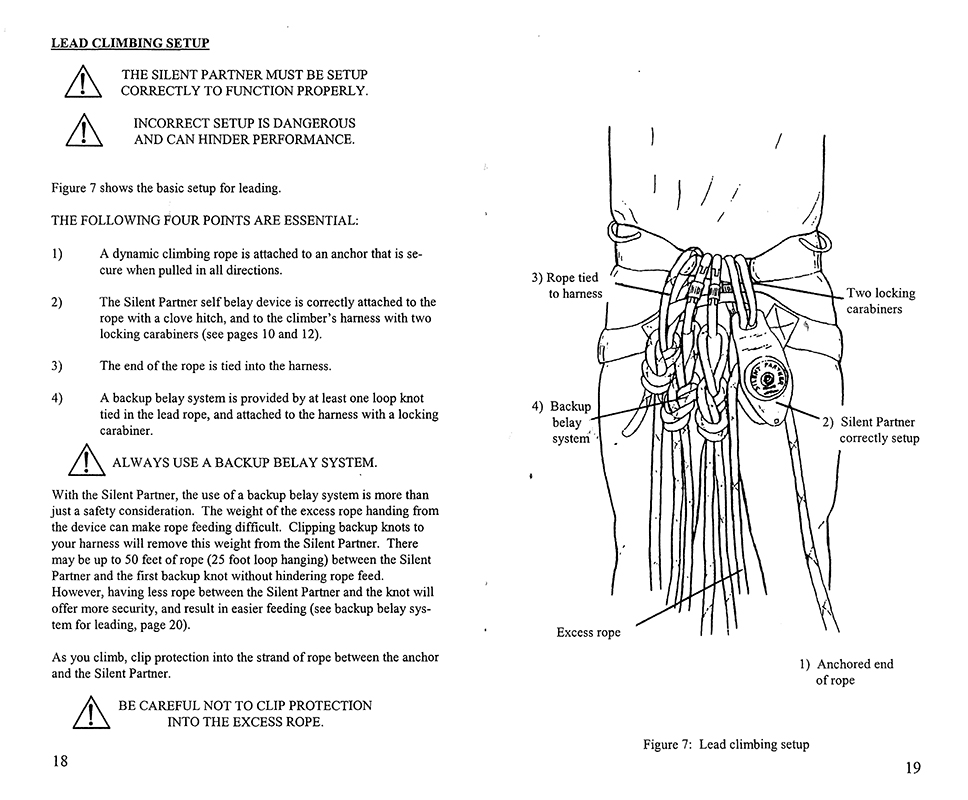
The Wren Industries Silent Partner consists of two stamped aluminum alloy side plates surrounding a roller with an integral centrifugal clutch. The plates are 3.1 mm. thick and are bent to meet at the top, where each has a 29.7 by 15.3 mm. attachment eye. The roller assembly is 44 mm. long with a 16.4 mm. central rib. The roller is 44.4 mm. in diameter at each side of the rope grooves, 42.mm at the center of the U-shaped grooves, and 59.3 mm. at the central rib. For details of the internal clutch, please refer to U.S. Patent 4,941,548. Each plate supports a 6.4mm pin at the bottom that acts to keep the rope ends separated.
My first Wren Silent Partner has "SILENT PARTNER" printed on one plate. The second one also has "09/03-073" printed on the plate. Each has a warning sticker attached to each plate (different stickers on each plate).
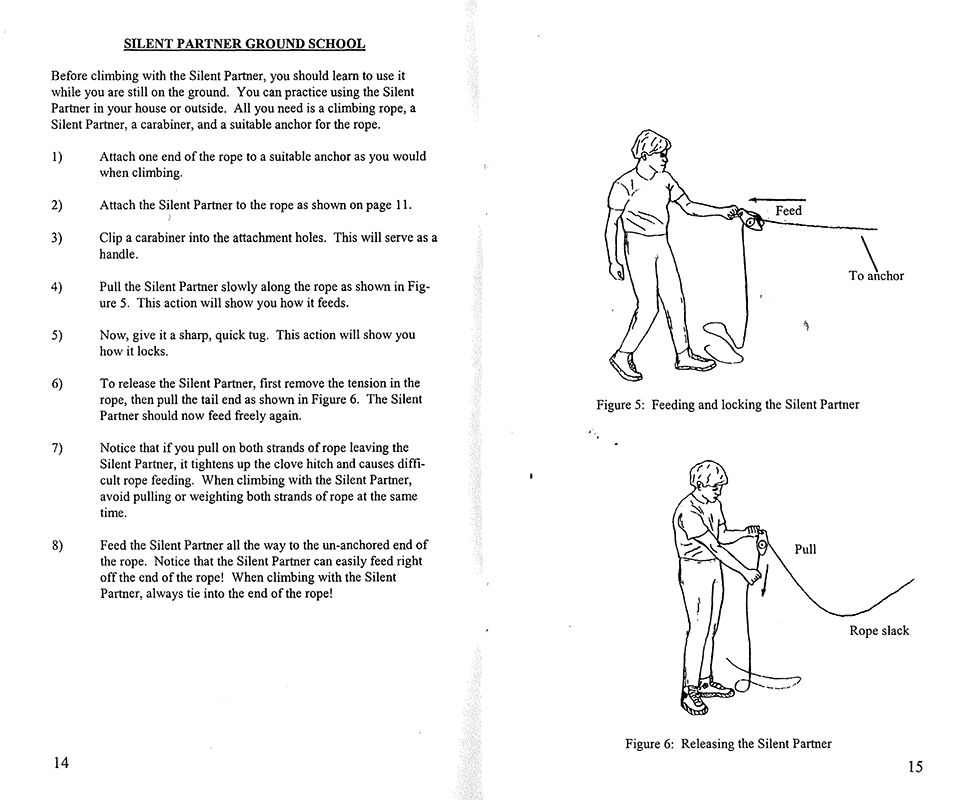
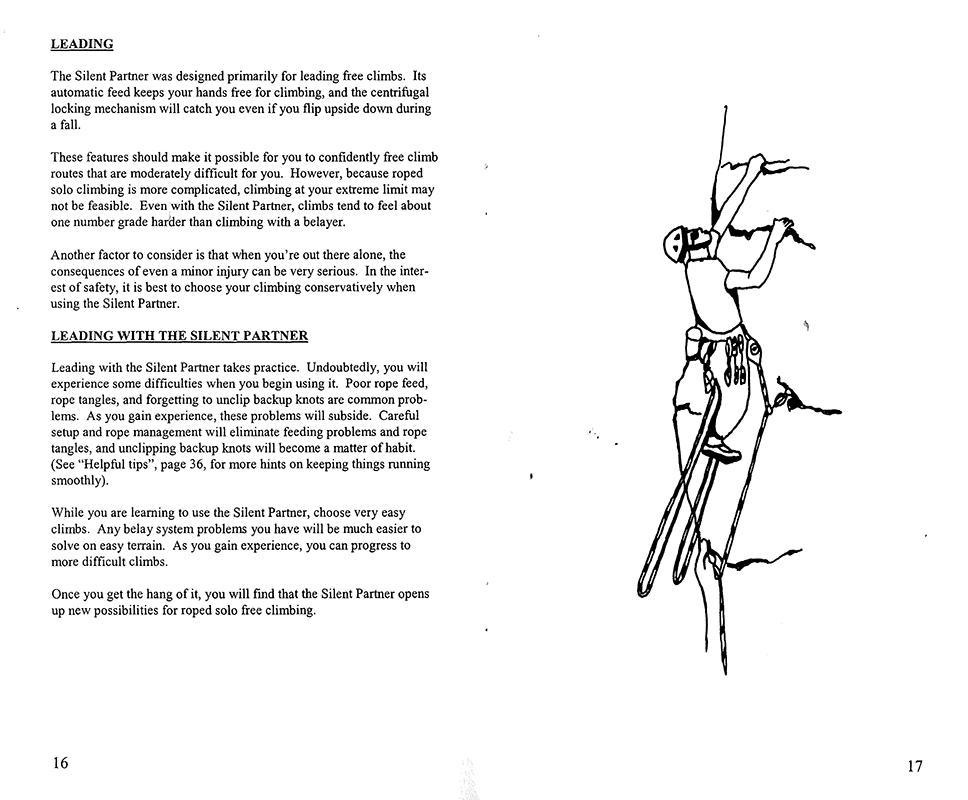
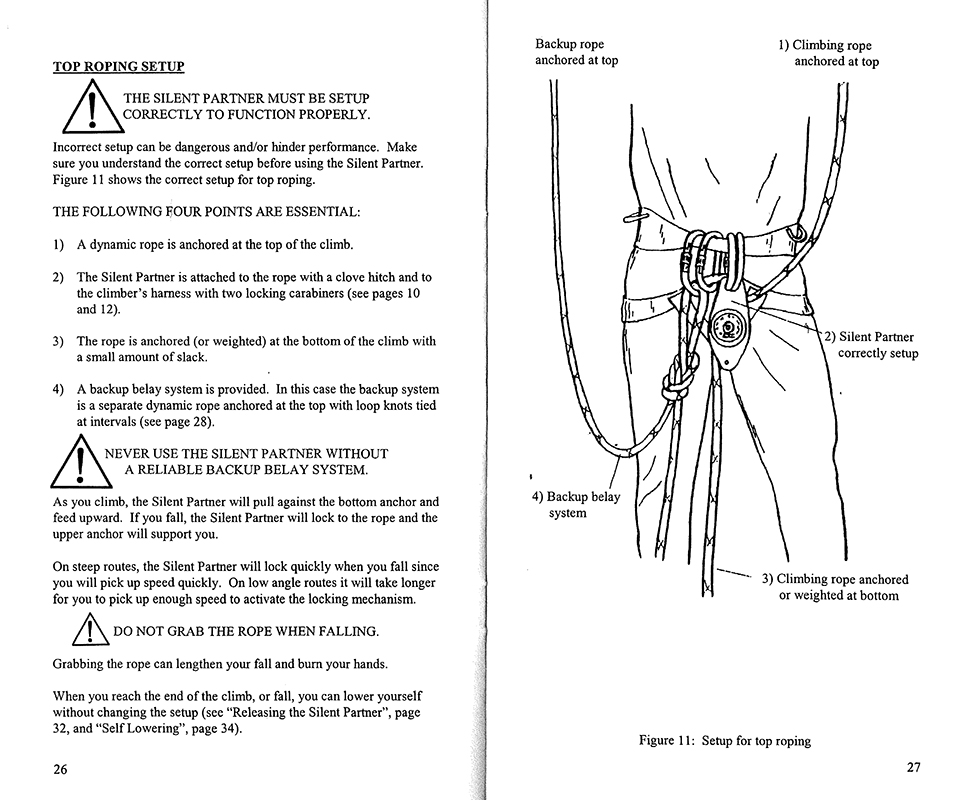
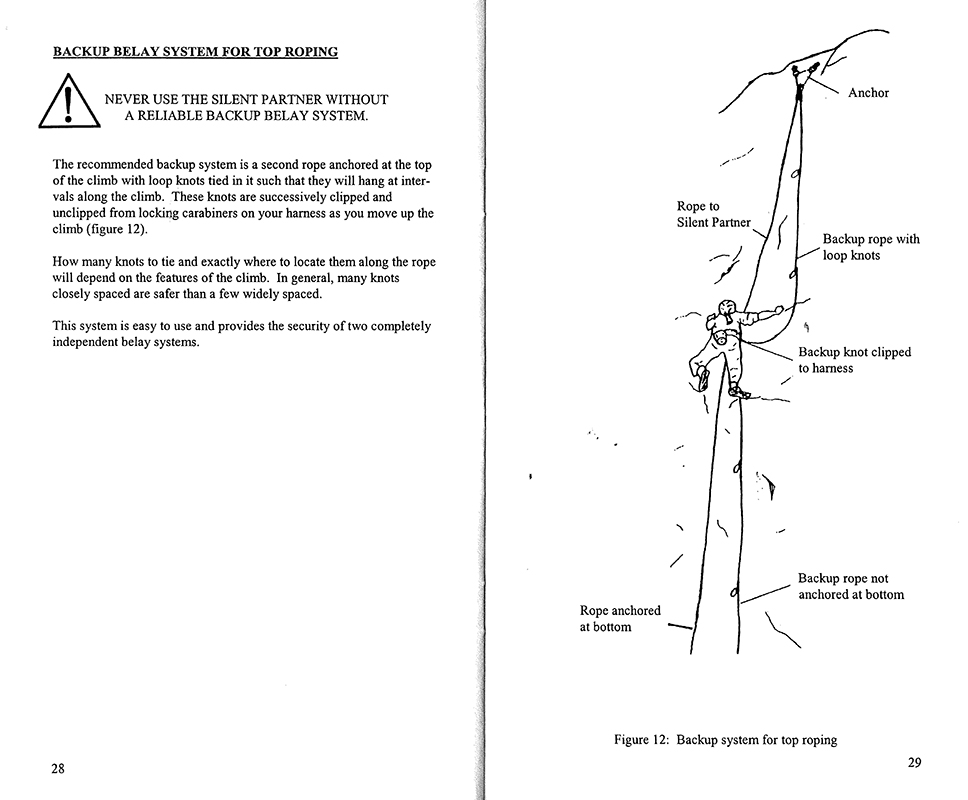
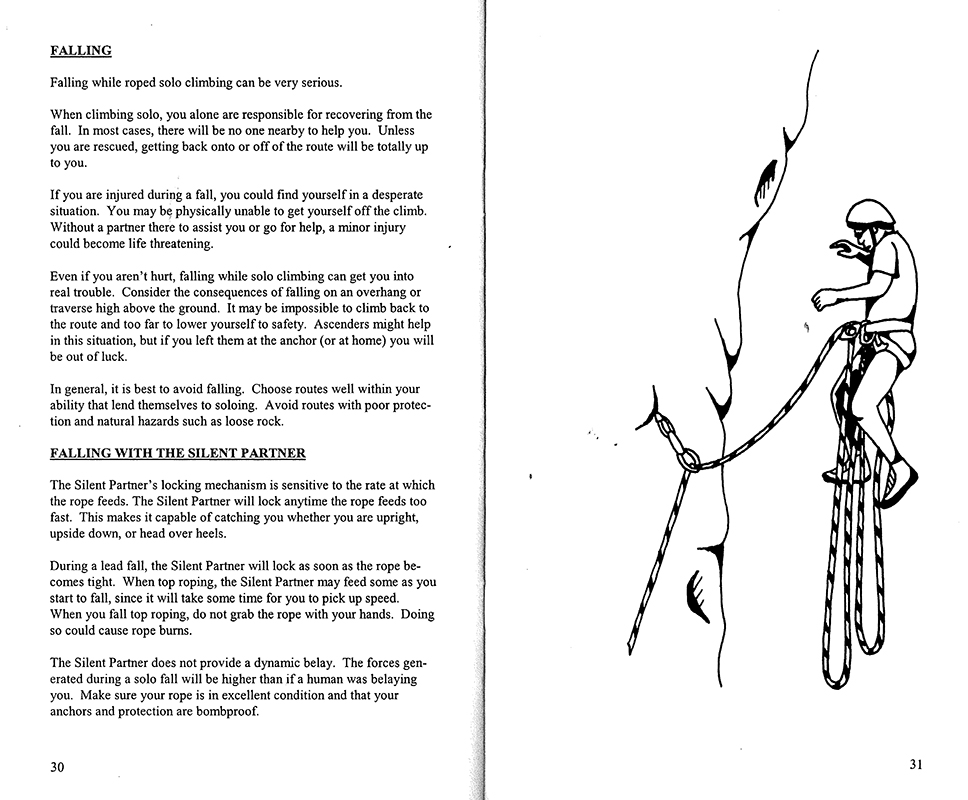
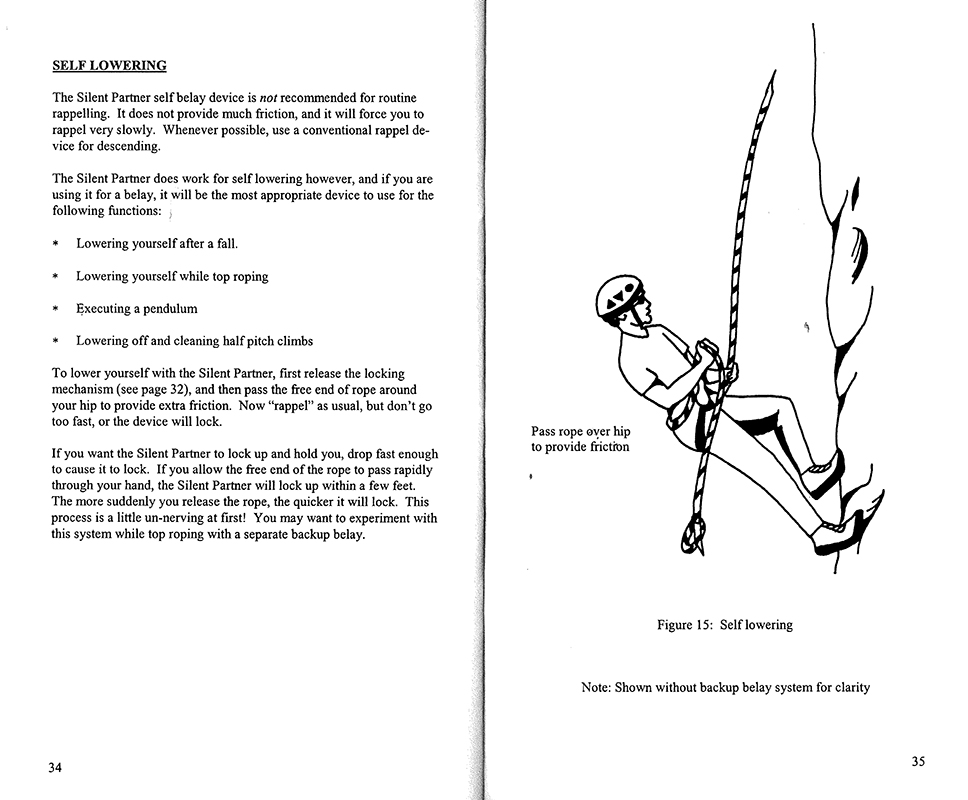
This is the device for roped solo. The climber ties a clove hitch around the spool in a specific fashion, and then climbs. The rope feeds smoothly, but if the climber falls, a centrifugal clutch engages and keeps the spool from rotating. I was on a waiting list for two years before I got my Silent Partner, and since testing it I've given up on using anything else.
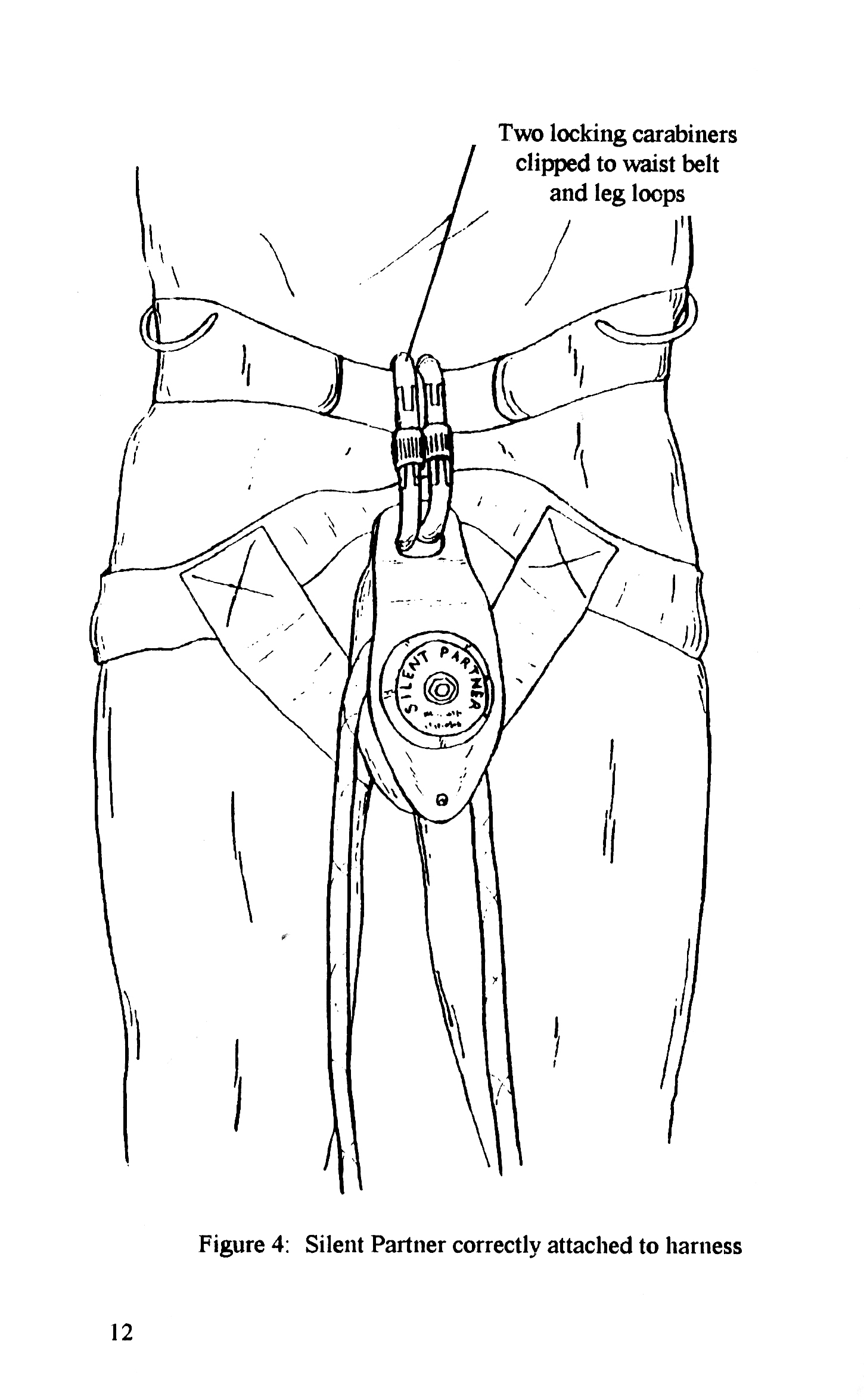
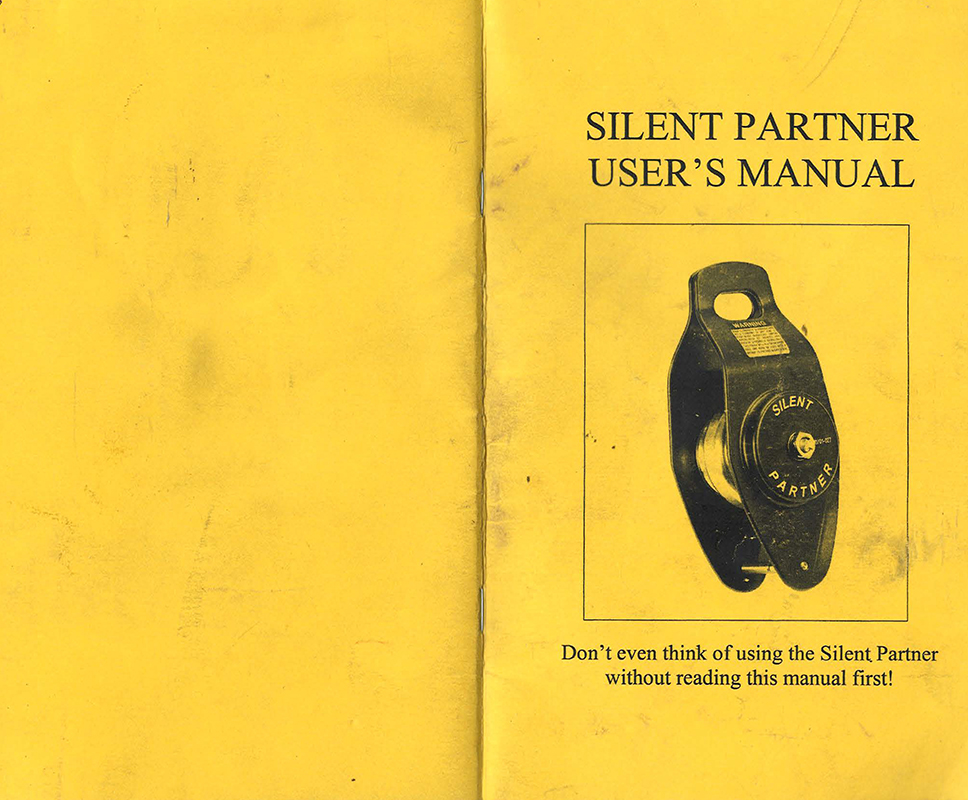
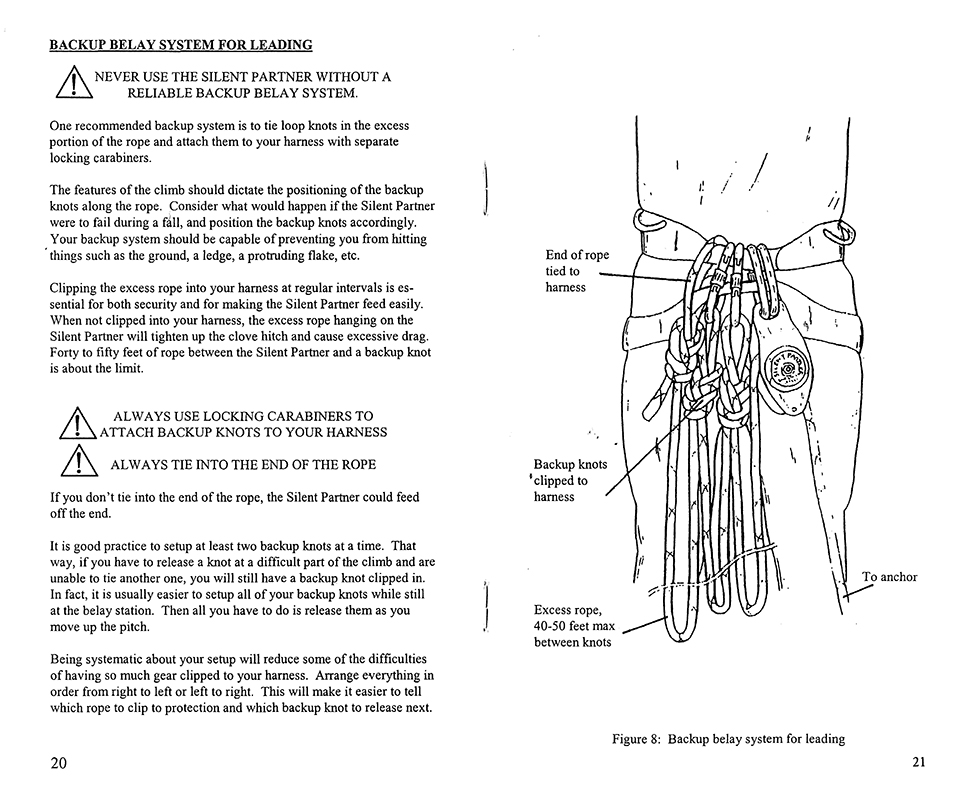
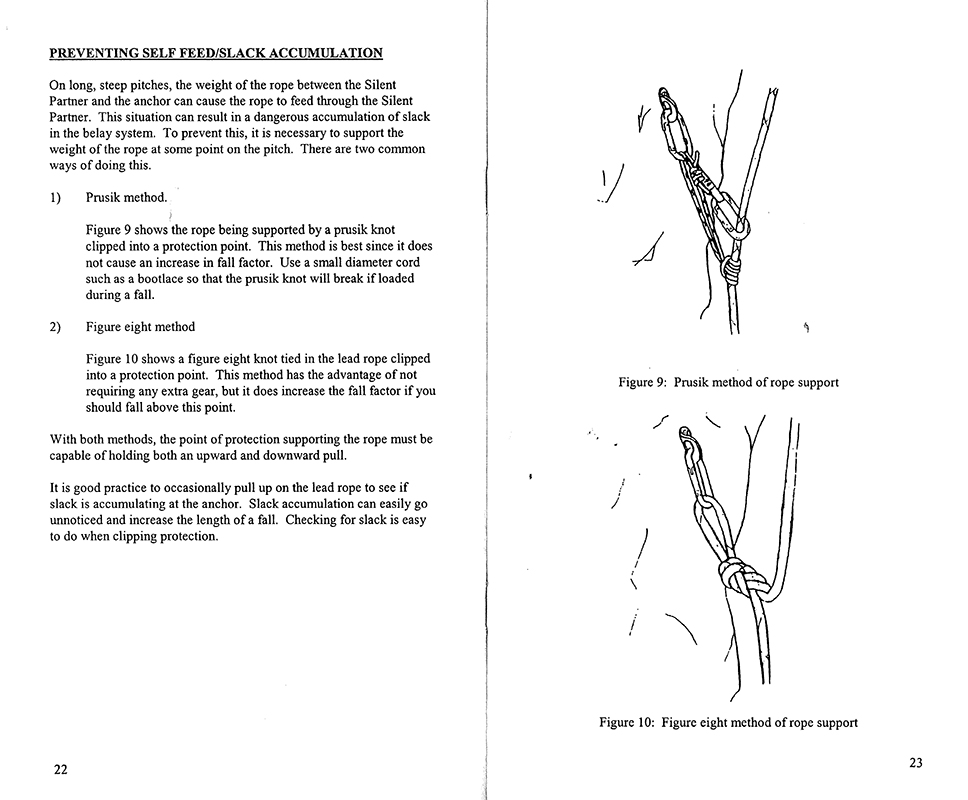
This device works very well, but one must thoroughly review the manual before using it. I mean the entire manual, not just the few excerpts available below. Don't forget backup knots!! Remember, one mistake and the life you lose will be your own.
|
DO NOT CLIMB SOLO! Nothing can make solo climbing safe. |
|
 |
 |
 |
 |
 |
 |
 |
 |
 |
 |
 |
 |
 |
 |
 |
 |
 |
 |
 |
 |
 |
 |
 |
 |
 |
 |
 |
|
[ Top | Rock Exotica Silent Partner | Wren Silent Partner | SoloAid Prototype #2 | Rock Exotica SoloAid | Wren SoloAid | Soloist Prototype | Wren Soloist | Return to Self Belay ]
|
|
 |
| Front | Rear |
 |
 |
 |
| Left | Right | Open for Rigging |
I acquired my Rock Exotica SoloAid Prototype #1 from John Middendorf in 2005.
Prototype #1 is milled from aluminum alloy and unfinished. Mine is 39 mm. long, 112 mm. wide, 38 mm. high, and weighs 181 g.
There are no markings on this prototype.
In 2005, John Middendorf placed two SoloAid prototypes up for sale on eBay, and I purchased both of them. John wrote:
This is one of two SoloAids Rock made for me. They were the first two he made and do not have the engraved sketches on the side.
This prototype has a rougher finish than the other, and appears to have been made by manually-operated (not CNC) machinery, so I presume it is the first. The cam teeth differ from the second prototype and production model: they are "steps" that appear to have been cut with an end mill.
|
DO NOT CLIMB SOLO! Nothing can make solo climbing safe. |
|
[ Top | Rock Exotica Silent Partner | Wren Silent Partner | SoloAid Prototype #1 | Rock Exotica SoloAid | Wren SoloAid | Soloist Prototype | Wren Soloist | Return to Self Belay ]
|
|
 |
| Front | Rear |
 |
 |
 |
| Left | Right | Open for Rigging |
I acquired my Rock Exotica SoloAid Prototype #2 from John Middendorf in 2005.
This prototype is 39 mm. long, 113 mm. wide, 38 mm. high, and weighs 184 g. The cam is different than the one on Prototype #1, having four shallow U-shaped grooves that form five teeth.
There are no markings on this prototype.
The second prototype appears to have been made with CNC machinery, or at least well-finished if done manually. The cam teeth follow the same pattern as on the production model.
|
DO NOT CLIMB SOLO! Nothing can make solo climbing safe. |
|
[ Top | Rock Exotica Silent Partner | Wren Silent Partner | SoloAid Prototype #1 | SoloAid Prototype #2 | Wren SoloAid | Soloist Prototype | Wren Soloist | Return to Self Belay ]
|
|
 |
| Front | Rear |
 |
 |
 |
| Left | Right | Open for Rigging |
 Technical Details
I acquired this SoloAid from John E. Weinel, Inc. in 1994. I acquired another in 2017 as part of Bob Thrun's collection.
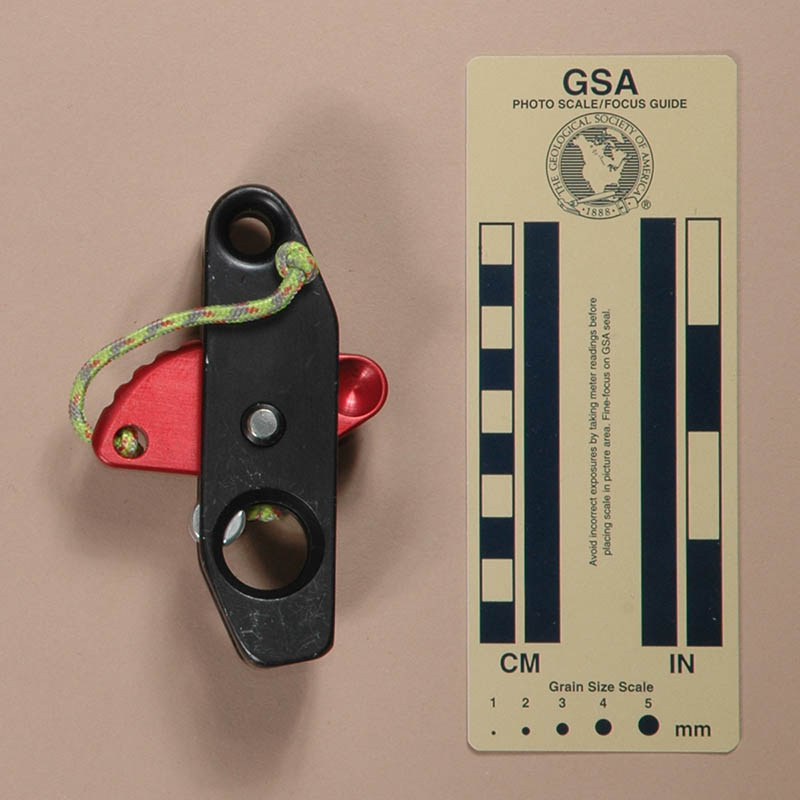
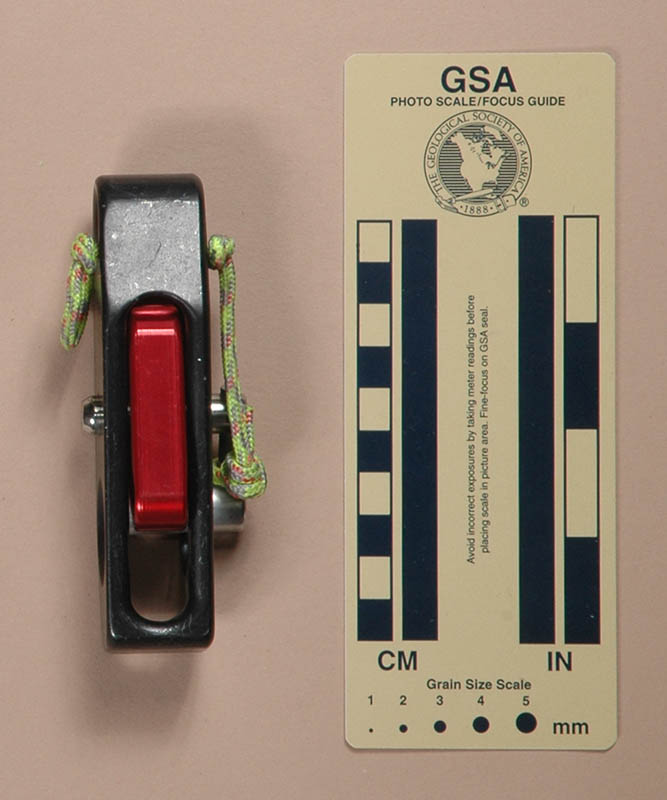
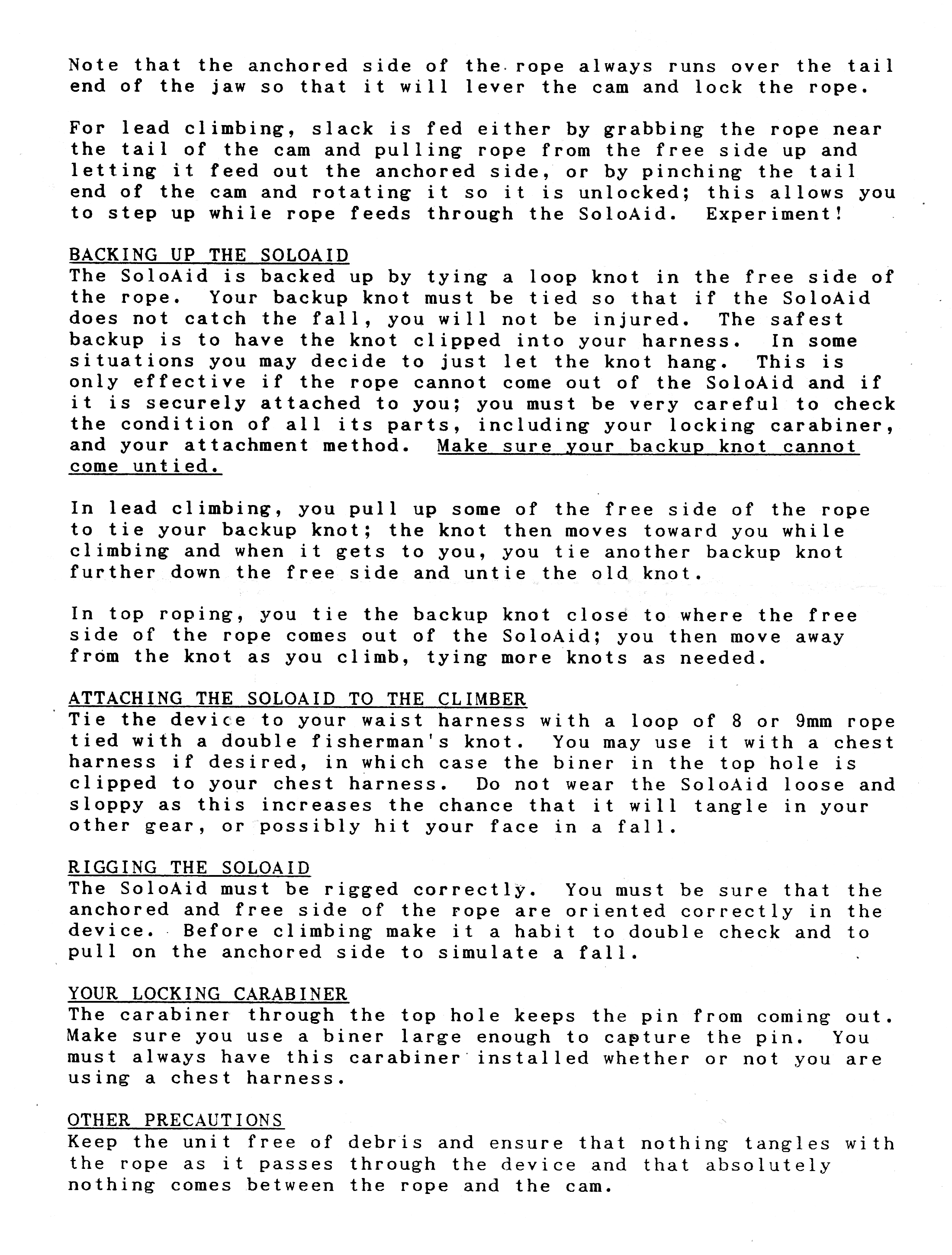
The Rock Exotica SoloAid is milled from aluminum alloy and then hard anodized. Mine is 38 mm. long, 113 mm. wide, 34 mm. high, and weighs 182 g. The shell has a 20.7 mm. carabiner eye and a 10.4 mm. upper eye. The cam has four shallow U-shaped grooves, forming five teeth. The cam axle assembly has the axle itself, a notched locking piece that fits into the carabiner hole, and a cross bar connecting the two.
The front of the SoloAid is engraved with a left-pointing arrow labeled "AN.," an image of the cam, and a left-pointing arrow labeled "Free."
The SoloAid was made for solo aid climbing as its name implies. I've used it for that purpose with some success. It appears to be fairly reliable in catching falls, and does not have the directional problems that the Soloist does. It does not require a chest harness. although it can be used with one (my preference, but to each his own). The rope must be fed by hand, so it is not a practical device for free climbing.
|
DO NOT CLIMB SOLO! Nothing can make solo climbing safe. |
|
 |
 |
 |
 |
 |
 |
[ Top | Rock Exotica Silent Partner | Wren Silent Partner | SoloAid Prototype #1 | SoloAid Prototype #2 | Rock Exotica SoloAid | Soloist Prototype | Wren Soloist | Return to Self Belay ]
|
|
 |
| Front | Rear |
 |
 |
 |
| Left | Right | Open for Rigging |
I acquired my Wren SoloAid in 2017 as part of Bob Thrun’s collection. I acquired a second from jon-ncal on eBay in 2020.
This SoloAid is milled from aluminum alloy and then hard anodized. Mine is 38 mm. long, 113 mm. wide, 34 mm. high, and weighs 184 g. The shell has a 20.7 mm. carabiner eye and a 10.4 mm. upper eye. The cam has four shallow U-shaped grooves, forming five teeth. The cam axle assembly has the axle itself, a notched locking piece that fits into the carabiner hole, and a cross bar connecting the two.
The front of the SoloAid is engraved with a left-pointing arrow labeled "AN.," an image of the cam, and a left-pointing arrow labeled "Free."
The makings on this SoloAid are much finer than those on the Rock Exotica SoloAid. This one's lines are about 0.9 mm. wide and flat-bottomed, while the other's are 1.7 mm. and round-bottomed.
|
DO NOT CLIMB SOLO! Nothing can make solo climbing safe. |
|
[ Top | Rock Exotica Silent Partner | Wren Silent Partner | SoloAid Prototype #1 | SoloAid Prototype #2 | Rock Exotica SoloAid | Wren SoloAid | Wren Soloist | Return to Self Belay ]
|
|
 |
| Front | Rear |
 |
 |
 |
| Left | Right | Open for Rigging |
I acquired my Rock Exotica Soloist Prototype from John Middendorf in 2019.
The prototype is has a milled aluminum alloy shell and milled rope-activated aluminum alloy cam. Mine is 63 mm. long, 150 mm. wide, 38 mm. high, and weighs 283 g. The shell has a 20.7 mm. carabiner eye at the top and a 10.6 mm. lower eye. The cam has a U-shaped face with seven shallow U-shaped grooves, forming eight teeth. The cam axle assembly has the axle itself, a notched locking piece that fits into the carabiner hole, and a cross bar connecting the two.
There are no markings on this prototype.
The prototype has two countersunk 5.7 mm. holes that are not present on the production version. They do not appear to be functional, so I presume that these were used for alignment in the original machining jig. There is also a groove on the inside of the rope channel that indicates that a drill or cutter was not aligned properly. The prototype appears to have been CNC machined, but the alignment holes and the groove may have been made using manual machines.
|
DO NOT CLIMB SOLO! Nothing can make solo climbing safe. |
|
[ Top | Rock Exotica Silent Partner | Wren Silent Partner | SoloAid Prototype #1 | SoloAid Prototype #2 | Rock Exotica SoloAid | Wren SoloAid | Soloist Prototype | Return to Self Belay ]
|
|
 |
| Front | Rear |
 |
 |
 |
| Left | Right | Open for Rigging |

 Technical Details
I acquired one Wren Soloist from The Gendarme in 1989, and a second from Charles Denning in 2009. Michael Oatney gave me a third in 2023.
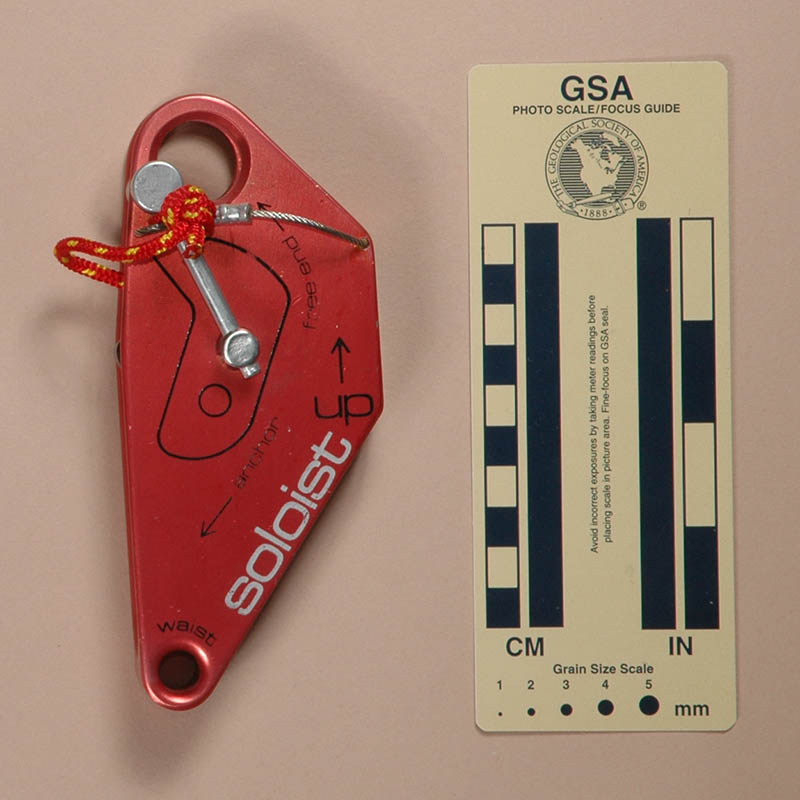
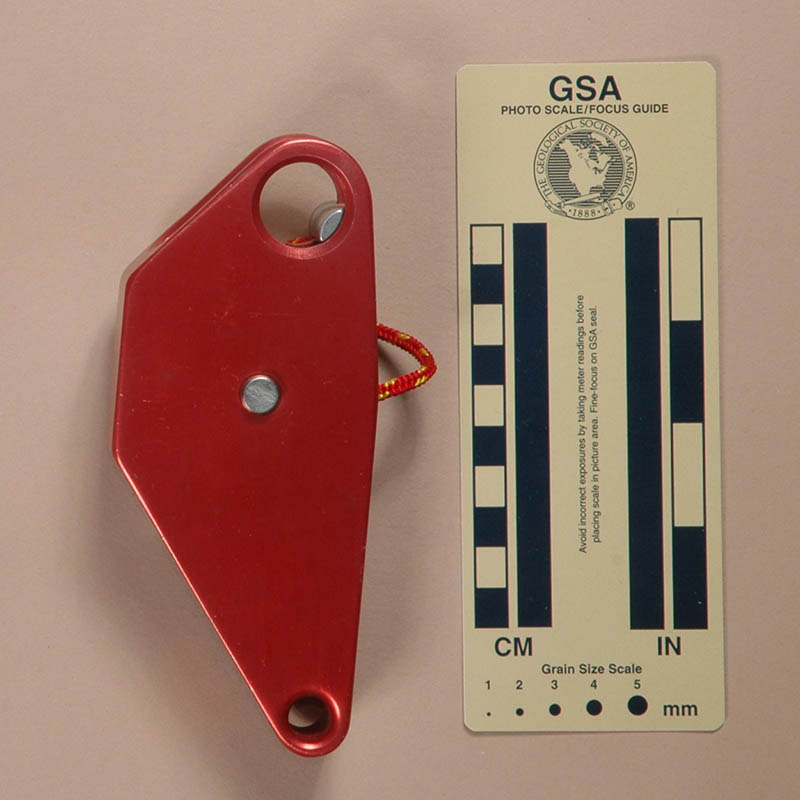
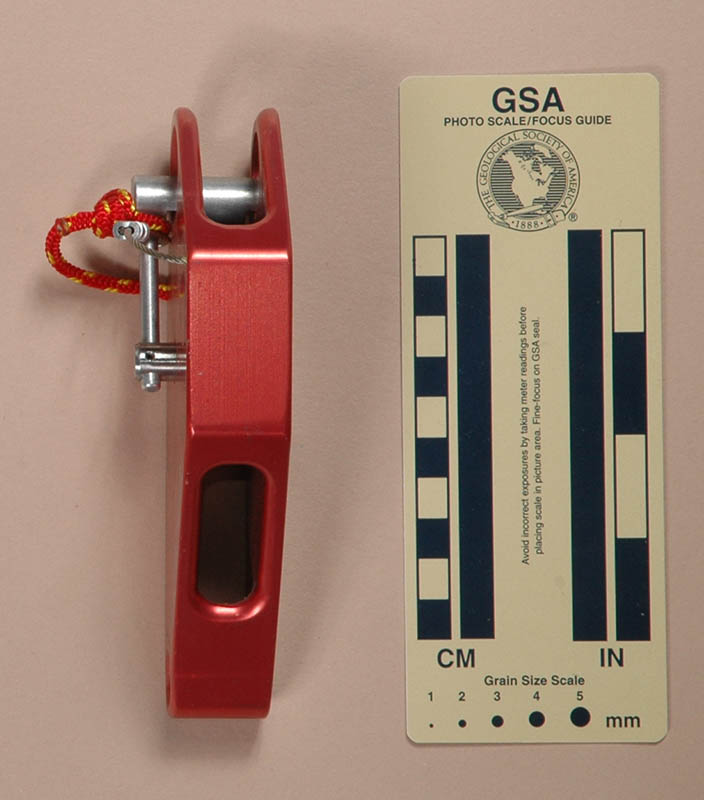
The Soloist is has a milled aluminum alloy shell and milled rope-activated aluminum alloy cam. Mine is 63 mm. long, 148 mm. wide, 38 mm. high, and weighs 281 g. The shell has a 20.6 mm. carabiner eye at the top and a 10.2 mm. lower eye. The cam has a U-shaped face with seven shallow U-shaped grooves, forming eight teeth. The cam axle assembly has the axle itself, a notched locking piece that fits into the carabiner hole, and a cross bar connecting the two.
The front is printed with an image of the cam, an up-pointing arrow labeled "free end," a down-pointing arrow labeled "anchor," an up-pointing arrow labeled "up," "soloist," and "waist."
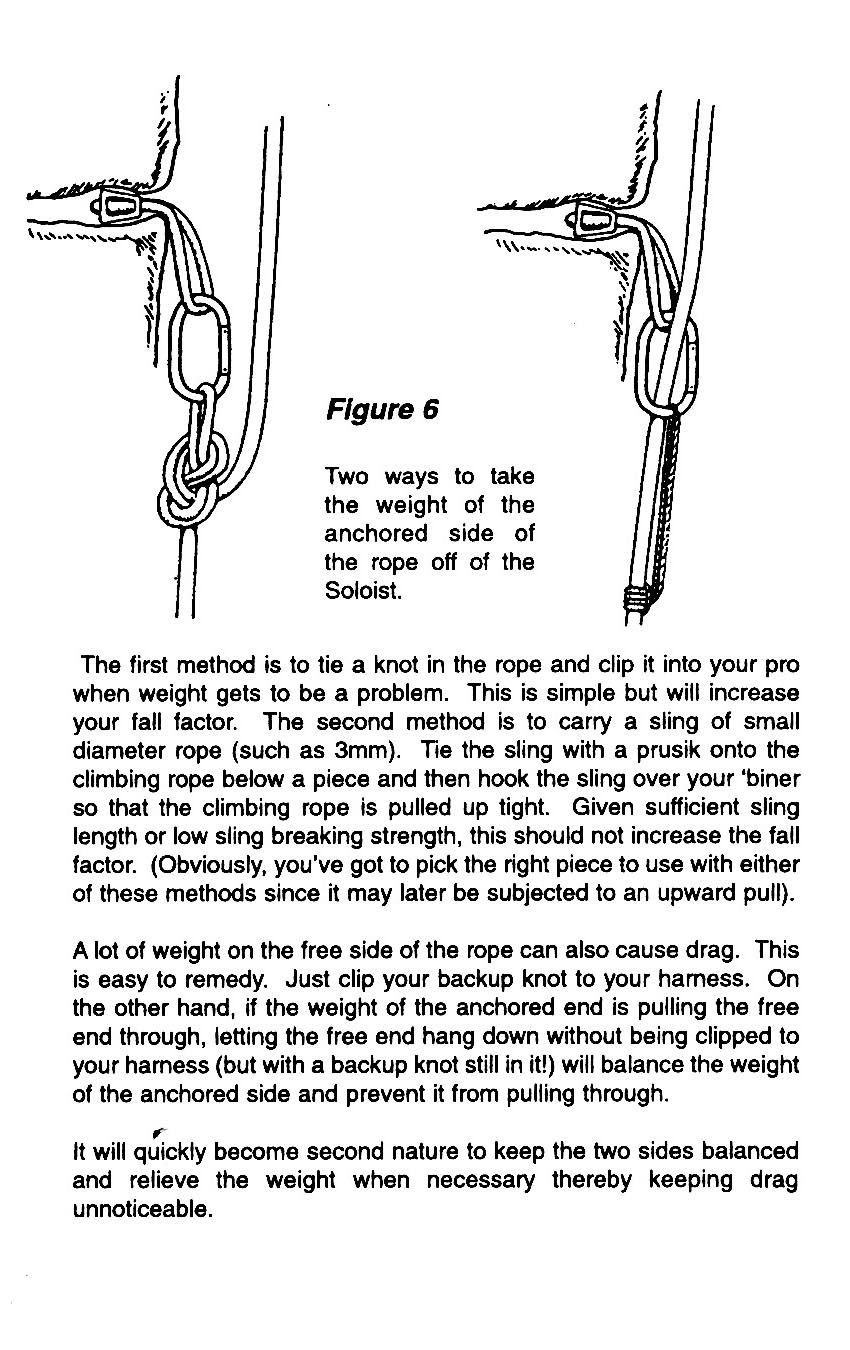
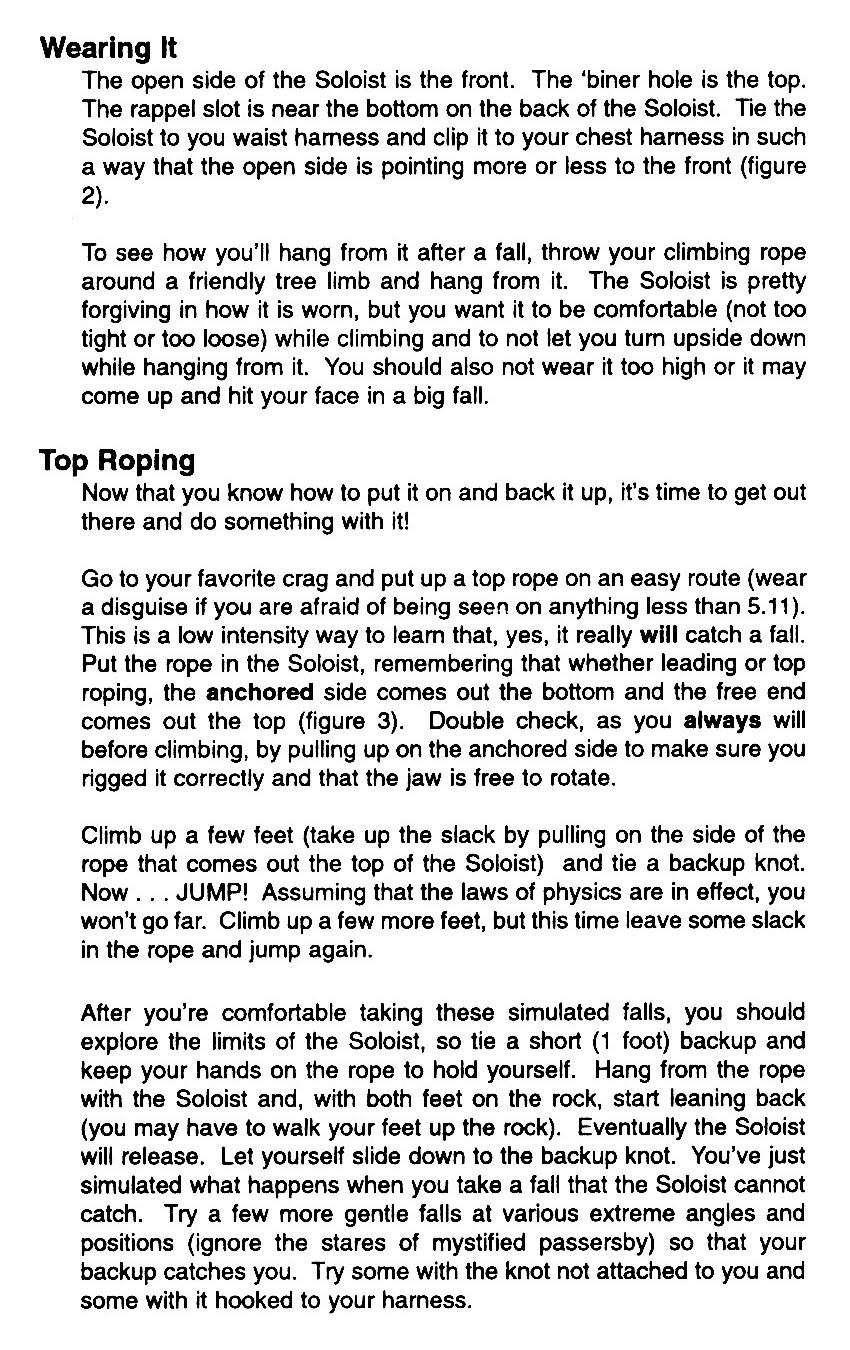
The Soloist was designed for free climbing. It must be used with a chest harness as shown in the figure. The rope feeds smoothly enough for free climbing, but the Soloist has one serious drawback: it will not reliably catch a head-first fall. This means that certain moves, such as heel hooks, should not be attempted if there is any chance of the hands blowing. I don't trust myself enough to guarantee that I won't peel headfirst, so I never use my soloist.
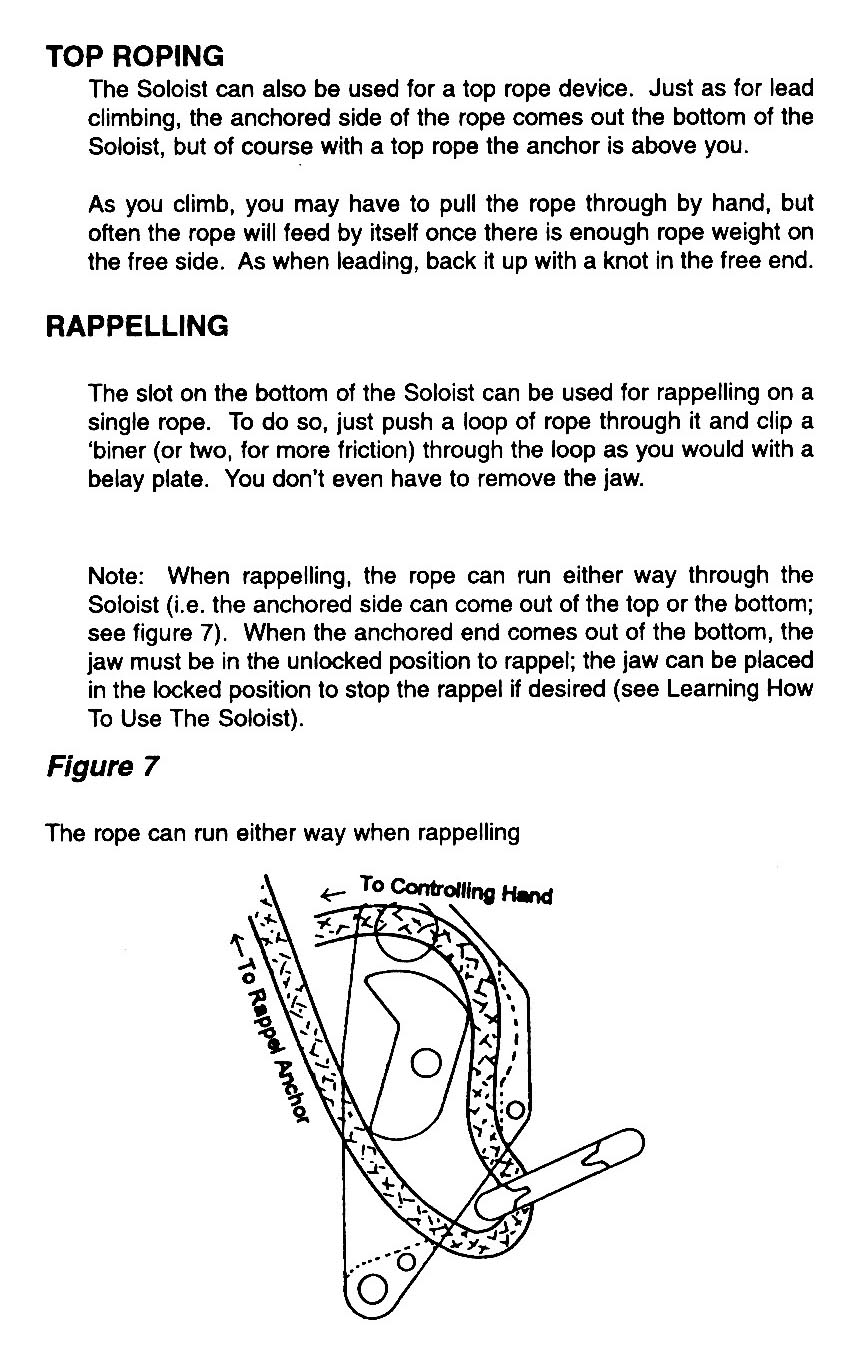
The Soloist has a slot that allows it to be used for rappelling.
|
DO NOT CLIMB SOLO! Nothing can make solo climbing safe. |
|
 |
 |
 |
 |
 |
 |
 |
 |
 |
 |
 |
 |
 |
 |
[ Top | Rock Exotica Silent Partner | Wren Silent Partner | SoloAid Prototype #1 | SoloAid Prototype #2 | Rock Exotica SoloAid | Wren SoloAid | Soloist Prototype | Wren Soloist ]
