

This page will not fit into a tiny viewport. Please choose a full-size monitor with a full-width window or select the abridged New Wave pages.

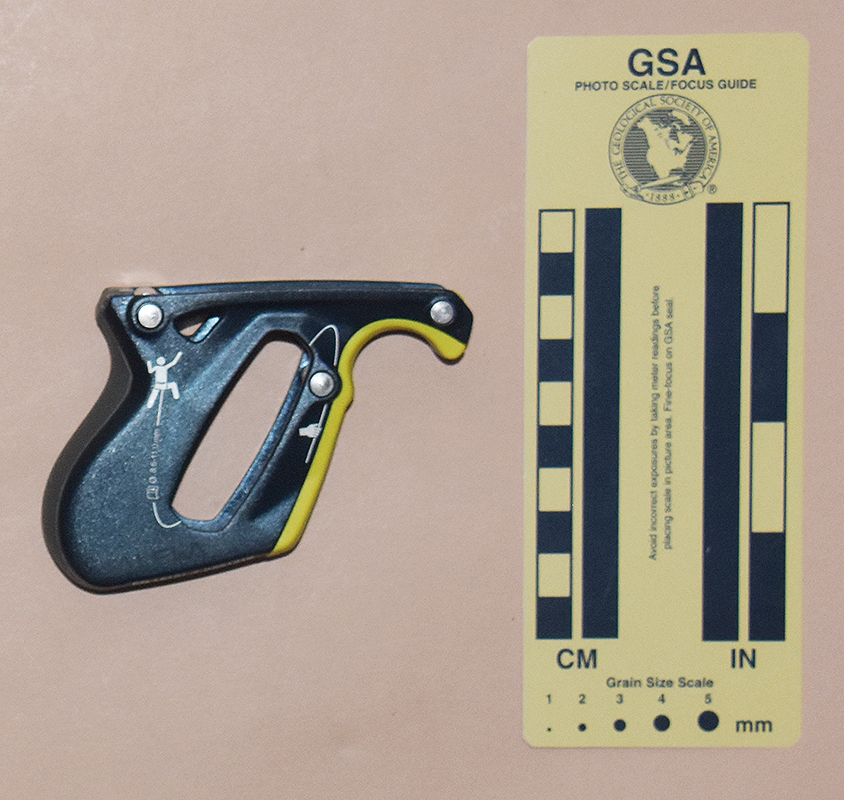
|
|
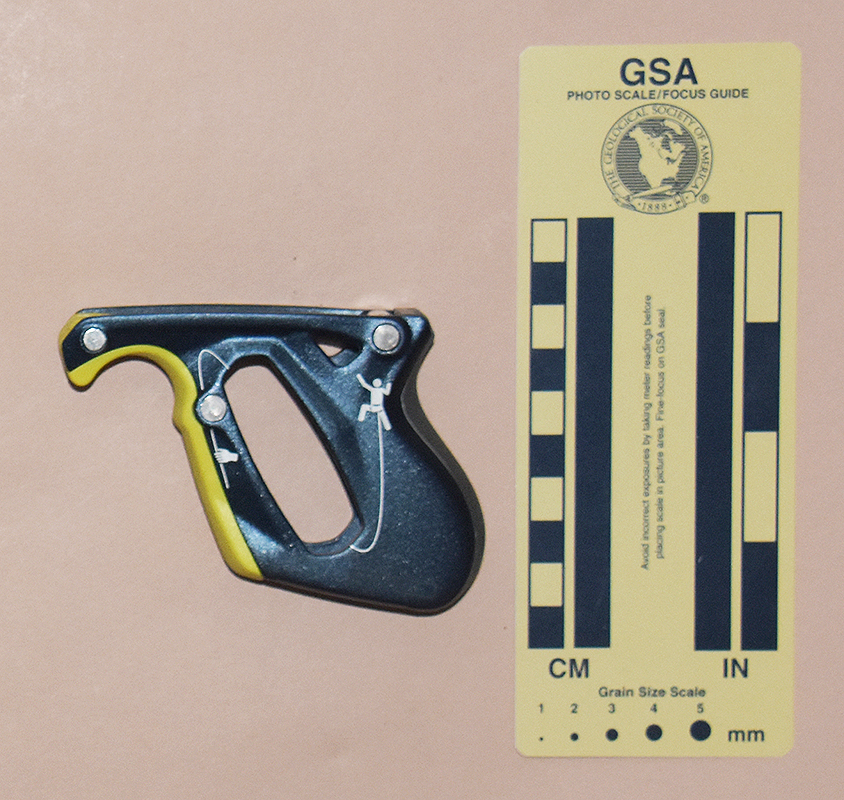 |
 |
| Front | Rear | Top |
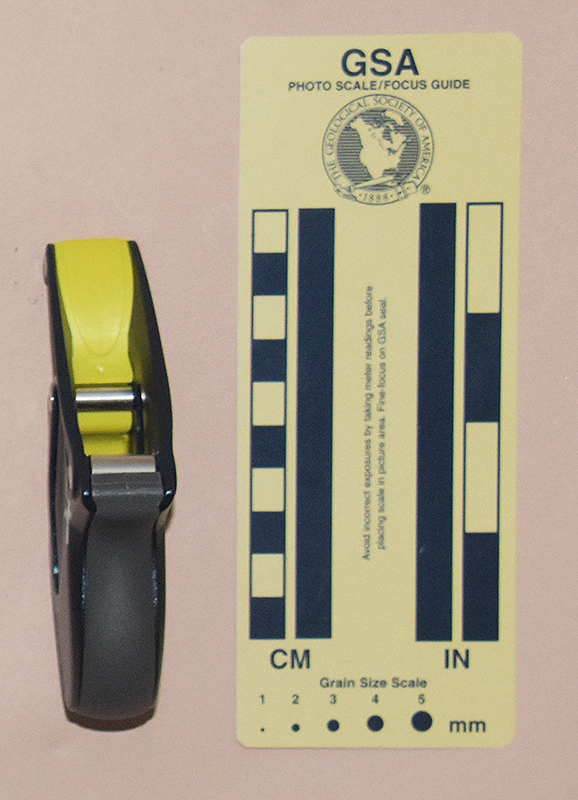 |
 |
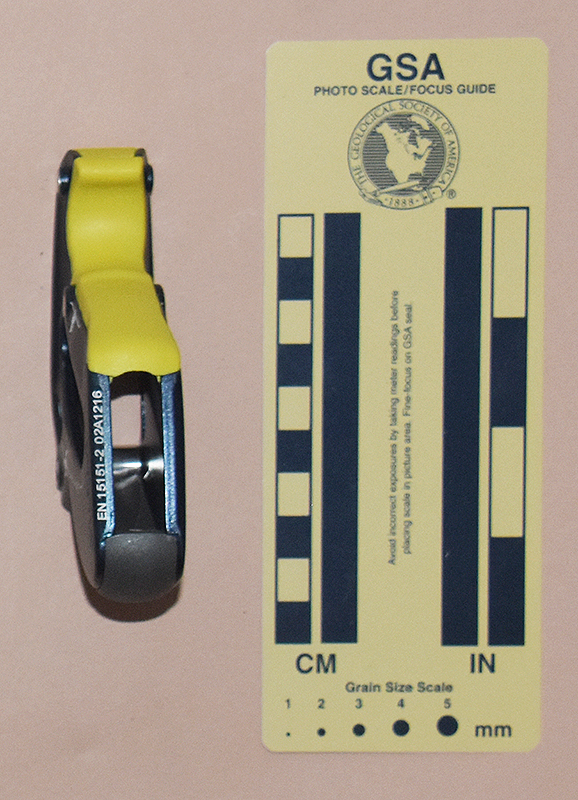 |
| Left | Right | Bottom |
I acquired my Salewa Ergo from Bike Sport Adventure in 2019.
The Salewa Ergo is 99 mm. long, 70 mm. wide, 25 mm. high, and weighs 76 g. It consists of two forged aluminum plates riveted together with plastic grips between. Two of the rivets have enlarged diameters inside that double as braking surfaces. The top of the yellow plastic grip also serves as a braking surface. The rope slot is 34 mm. long and 16 mm. wide. The top of the Omega oval carabiner that I use for comparing belay tubes sits 11 mm. below the ends of the slots.
The front plate is printed with a climber-and-rope icon, "Ø 8.6-11.0mm," a book-with-an-"i" icon. two curve segments representing the rope path, a hand-holding-a-rope icon, "EN 15151-2," and "02A1216.". "SALEWA" appears in impressed letters. The rear is printed with a hand-holding-a-rope icon, two curve segments representing the rope path, and a climber-and-rope icon. "ERGO" appears in impressed letters.
The Ergo is designed for single ropes only. Although this saves weight, it does not compensate for losing the ability to do double-rope rappels.
The Ergo has thick walls and considerable depth, which helps it stay cooler than it would have been if designed for minimum weight. The device is large, making it easy to handle. The resulting friction is lower than what I prefer.
Most of the braking occurs at the rivets (acting as bollards), but the rope also runs over the plastic grip. I do not like this: The grip will wear down, at least until the third rivet slows the wear. The Black Diamond ATC-Pilot is a similar device that runs the rope over a stainless steel surface. While both devices are too specialized for my taste, I prefer the more durable ATC-Pilot.
The Salewa story started on July 8, 1935, when Josef Liebhart, the director of Munich´s Cooperative for Saddlers and Tapestry Handlers registered a sister corporation for saddler and leather wares:
In 1955, Salewa developed the unique Andes backpack and supported the Andes expedition of Hermann Huber, who was to become the managing director of Salewa. In 1960, the fully adjustable Salewa classic light crampon set new standards and became one of Salewa´s most successful products to date. Salewa gained international recognition as a leader in alpine innovation with its invention of the tubular ice screw, which today is an industry standard.
Salewa grew as an Alpine equipment manufacturer. They introduced their Eagle logo in 1979. In 1990, Heiner Oberrauch and his Oberalp Group acquired Salewa and moved the headquarters to Bolzano. Salewa opened its first retail store in Finale Ligure in 2002. 2007 opened a branch in Colorado. 2014 saw a global brand relaunch, a new logo and a new corporate identity. Salewa is now a world leader in alpine products, present in 30 countries and supplier to some 2,500 shops around the globe.