

This page will not fit into a tiny viewport. Please choose a full-size monitor with a full-width window or select the abridged New Wave pages.


Version A
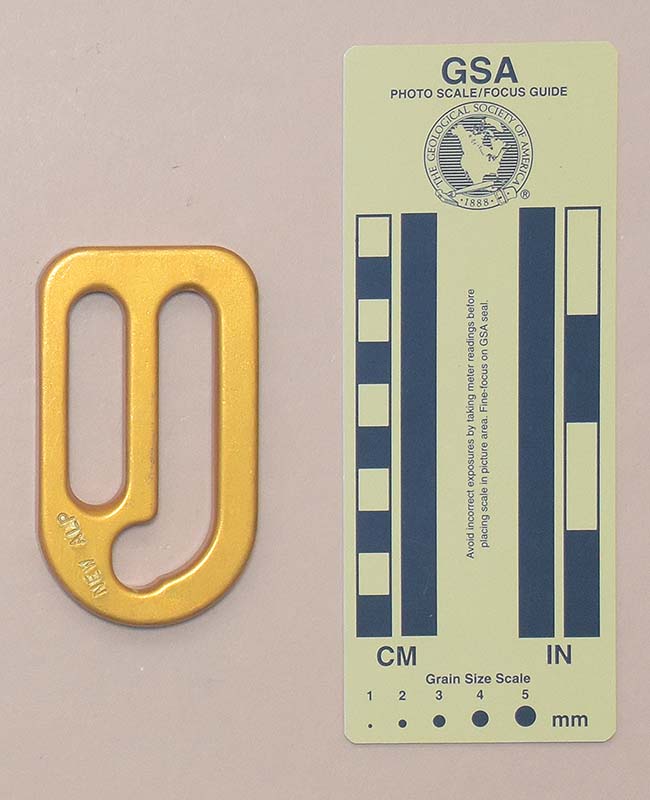
Version B

Version C
|
|
|
|
| Version A | Version B | Version C |
Jean-Paul Fréchin [1940-2022], a mountain guide and Arts et Métiers engineer, worked for Salomon and later for Ludger Simond. In 1984, he founded New Alp in Chamonix and imported Italian-made Grivel equipment. He achieved success with three inventions. The patent for the Antibott (1979), a latex device designed to prevent snow buildup under crampons, earned him royalties from major crampon manufacturers. The patent for the Key Lock (1985), a snag-free carabiner gate closure system manufactured by Kong (and under license by Kong, Petzl, and Black Diamond), became the industry standard for climbing carabiners after entering the public domain. In 1989, the New Alp multi-purpose Plaquette (belay plate) enabled the belaying of a lead climber and one or two followers, as well as rappelling; it foreshadowed the belay plates of the 2000s. New Alp ceased operations in 1999, and Jean-Paul subsequently served for a time as president of the Compagnie des Guides de Chamonix.[1]
[ Top | Version B | Version C | Return to Belay Plates ]
|
|
 |
| Front | Rear |
I acquired my New Alp Magic, Version A from Inner Mountain Outfitters in 1993.
The New Alp Magic, Version A is milled from aluminum alloy and anodized. Mine is 52 mm. long, 90 mm. wide, 10 mm. high, and weighs 64 g. It has two slots. One is is a rounded rectangle, 50 mm. long and 13.2 mm. wide. The other is J-shaped, 71 mm. long overall and also 13.2 mm. wide.
One side of the Magic is stamped "NEW ALP."

 The New Alp Magic can be described as a long-slot "Sticht" plate. It can be used to belay in the standard Sticht configuration, although the instruction manual gives a different, albeit similar method. The device allows rappelling using carabiners as brake bars. I find this to be easier to control than rappelling in the Sticht configuration, and it imparts somewhat less strain on the rope since the sustained bending angle is not so great.
The Magic received French Patent #2,688,142 in September 1993 with the original application dated March 9, 1992. It also received Italian Patent #930,179 in 1994.
 |
 |
[ Top | Version A | Version C | Return to Belay Plates ]
|
|
 |
| Front | Rear |
I acquired Version B from Denis Pivot in 2022. The New Alp Magic, Version B is a belay plate.
This version is 90 mm. tall, 52 mm. wide, 10 mm. thick, and weighs 73 g. It has two slots. One is a rounded rectangle, 52 mm. long and 13 mm. wide. The other is J-shaped, 71 mm. long overall and 13.2 mm. wide.
One side is stamped "NEW ALP."
This version has a harder anodizing with a uniform color. It is 14% heavier than the other two, and the reason is not obvious. Perhaps this is due to manufacturing tolerances, but I don't see where. Another possibility is that it used a different aluminum allow. I don't know.
|
|
|
[ Top | Version A | Version B | Return to Belay Plates ]
|
|
 |
| Front | Rear |
I acquired Version C from John Campbell in 2005.
Version C is 50 mm. long, 90 mm. wide, 10 mm. high, and weighs 64 g.
One side is stamped "NEW ALP."
Version C has a keeper hole at the top. This is a poor position for the keeper hole, since the keeper easily tangles with the ropes. I think that placing the keeper hole at the lower-left would have been a better choice.
|
|
|
[ Top | Version A | Version B | Version C ]