

This page will not fit into a tiny viewport. Please choose a full-size monitor with a full-width window or select the abridged New Wave pages.


Version A

Version B
Version C
|
|
|
|
| Version A | Version B | Version C |
Yvon Chouinard bought a second-hand coal-fired forge in 1957 and started making hardened steel pitons under the Great Pacific Iron Works name. Their success led him to form Chouinard Equipment Ltd. He partnered with Tom Frost, and they moved their operation to Ventura California in 1967. The Chouinard product line expanded into a wide variety of climbing and related outdoor gear. In 1971-1972, they introduced Hexentrics and Stoppers. Frost left the operation in 1977, and his name was removed from ice axes and other products that had born the CBouinard-Frost name.
In 1989, Chouinard Equipment was facing a liability lawsuit. Chouinard had to separate the liability of Chouinard Equipment from the deep pockets of Patagonia, which he had founded in 1973. Chouinard Equipment filed for Chapter 11 bankruptcy to protect the firm's assets. The lawsuit ultimately went nowhere. Peter Metcalf, Maria Cranor, and former Chouinard Equipment employees purchased the company assets in 1989, formed Black Diamond Equipment Ltd., and moved the firm to Salt Lake City Utah.
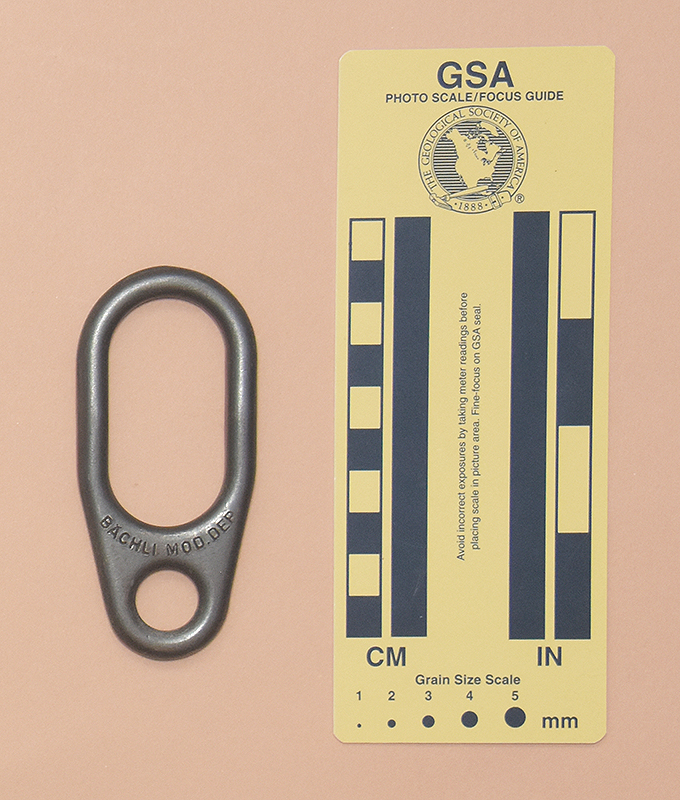
I bought my first Chouinard Bächli Seilbremse in 1983, and immediately noticed a conflict: it was stamped “BAECHLI” but the instructions called it a “Bächli.” OK, we don't use umlauts anymore. Then I got another in 2009, but this one was stamped “BACHLI.” No “E”, no umlaut. Finally, I recently acquired three more, all stamped “BÄCHLI.” Return of the umlaut.
As for the Bächli, it is a nice classic steel rappelling and belaying device. For rappelling, one uses one or two carabiners as brake bars. This works fine on clean ropes, but caving ropes are often muddy, and using carabiners this way can destroy them rather quickly.
The instructions provide an alternate rigging for ski lift rescue using 5 mm. (AAARRRGGGHHH!!!!) to 7 mm. line. The INS folks can read the instructions themselves; I do not want anything to do with the idea of cavers and climbers routinely rappelling on 5 mm. string.
For belaying, the instructions recommend the common free-running belay. Wear your gloves.
Does spelling matter? Of course not, but this is this internet, where some people rappel using brake bars and others prefer repelling break bars. If you are repelling, may your bars break.
[ Top | Version B | Version C | Return to Belay Plates ]
 |
|
 |
| Front View | Rear View | Side View |
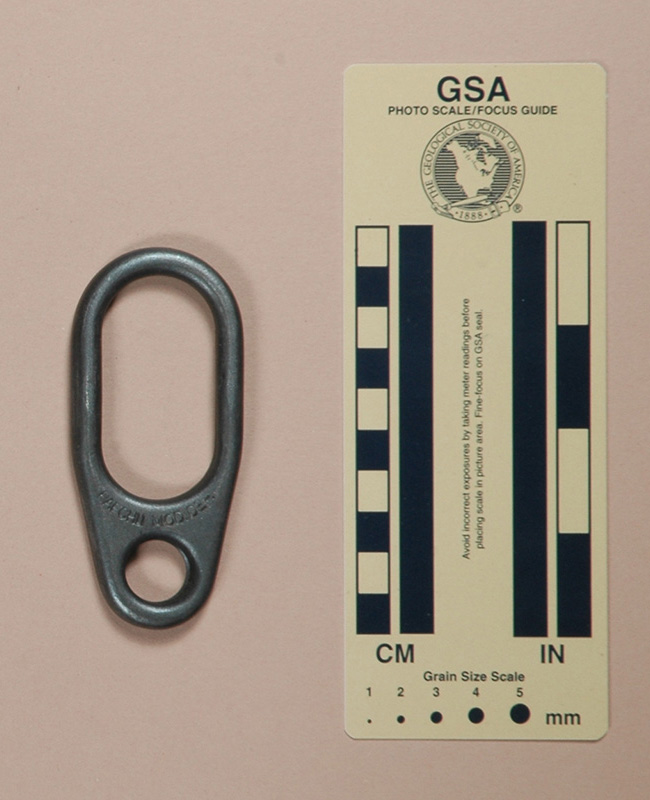
I acquired my Chouinard Baechli, Version A from the Gendarme around 1983. I acquired another in 2017 as part of Bob Thrun’s collection. I acquired two more from Chris Jury in 2020, one of which I gave to Артём Бабин.
My Version A is 43 mm. long, 94 mm. wide, 8 mm. high, and weighs 81 g. It is forged steel and oxide coated. It has a 55 mm. tall, 28 mm. wide oval rope hole and a 15 mm. diameter eye. The Baechli is not flat: the top and bottom are 6.3 and 6.6 mm. thick, respectively, while the sides of the rope hole are 7.9 mm. thick.
The front is stamped "BAECHLI MOD.DEP." The rear is stamped "SWISS MADE."

 The Baechli is a small steel device that can be used for belaying or for rappelling. The belaying configuration is the traditional free running belay, although the Munter configuration could be used as well. Either of these could be used for rappelling, but a better method that gives more friction is to use carabiners as brake bars.
Even though it is made of steel, the Baechli is small and relatively light. Steel is not a good heat conductor, and the Baechli tends to overheat.
 |
 |
[ Top | Version A | Version C | Return to Belay Plates ]
|
|
 |
 |
| Front View | Rear View | Side View |
I do not have a record of where I acquired my Version B, but it likely was from Harald Müller in 2009. I acquired another from Kelley Deem at the 2022 Old timers Reunion.
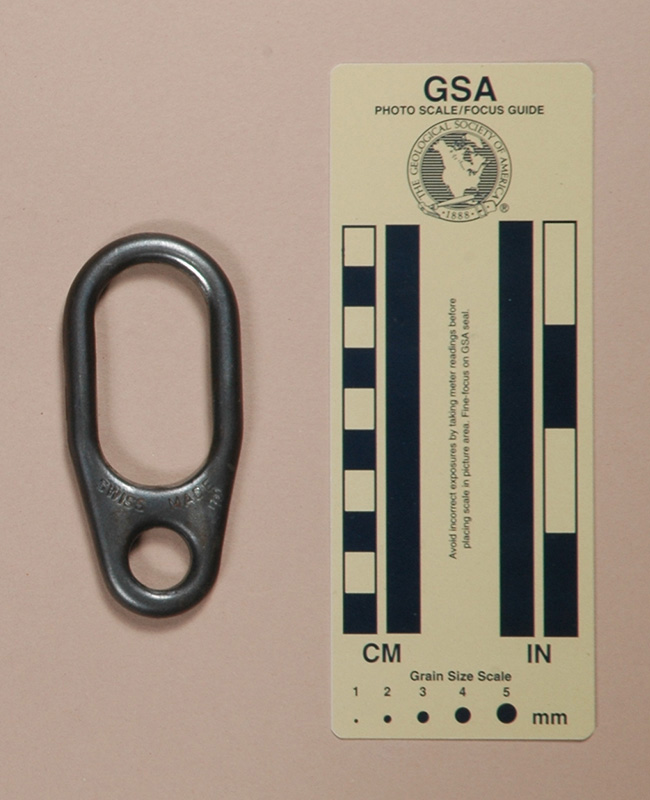
Version B is 44 mm. long, 95 mm. wide, 8 mm. high, and weighs 87 g.
The front is stamped "BACHLI MOD.DEP." The rear is stamped "SWISS MADE."
The only difference between Versions A and B is that Version B spells "BACHLI" without an "E."
|
|
|
[ Top | Version A | Version B | Return to Belay Plates ]
|
|
 |
| Front View | Rear View |
I acquired three of Chouinard Baechli, Version C from Steve Eady in 2021.
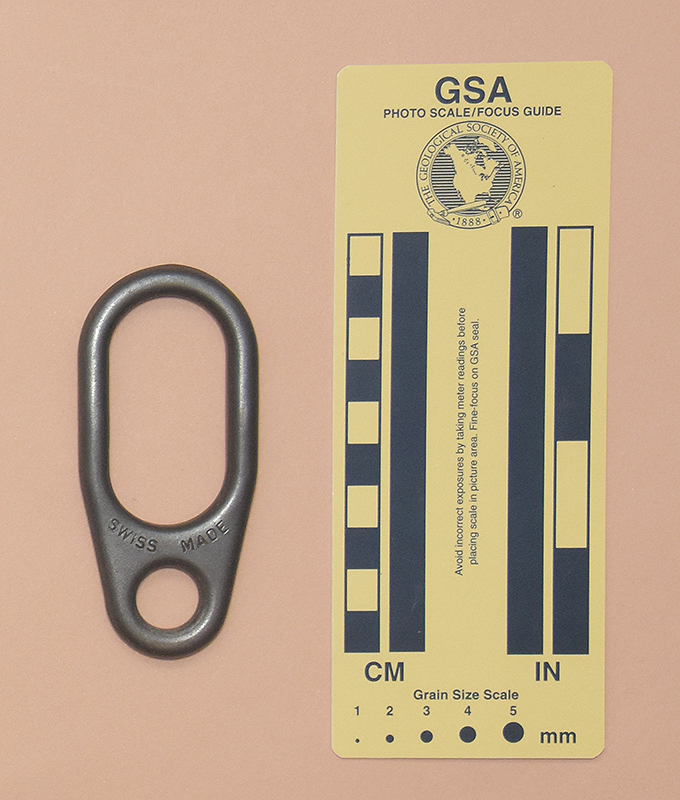
Version C is 94 mm. tall, 43 mm. wide, 9 mm. thick, and weighs 89 g.
The front is stamped "BÄCHLI MOD.DEP." The rear is stamped "SWISS MADE."
Seriously? This version spells it "BÄCHLI," not "BAECHLI" or "BACHLI." How you spell it does not affect how well it works.
|
|
|
[ Top | Version A | Version B | Version C ]