

This page will not fit into a tiny viewport. Please choose a full-size monitor with a full-width window or select the abridged New Wave pages.


|
|
 |
 |
| Front View | Rear View | Top View |
 |
 |
| Front View: Open for Rigging | Rear View: Open for Rigging |
I acquired my Edelrid Zap–O–Mat from Great Outdoors Depot in 2008.
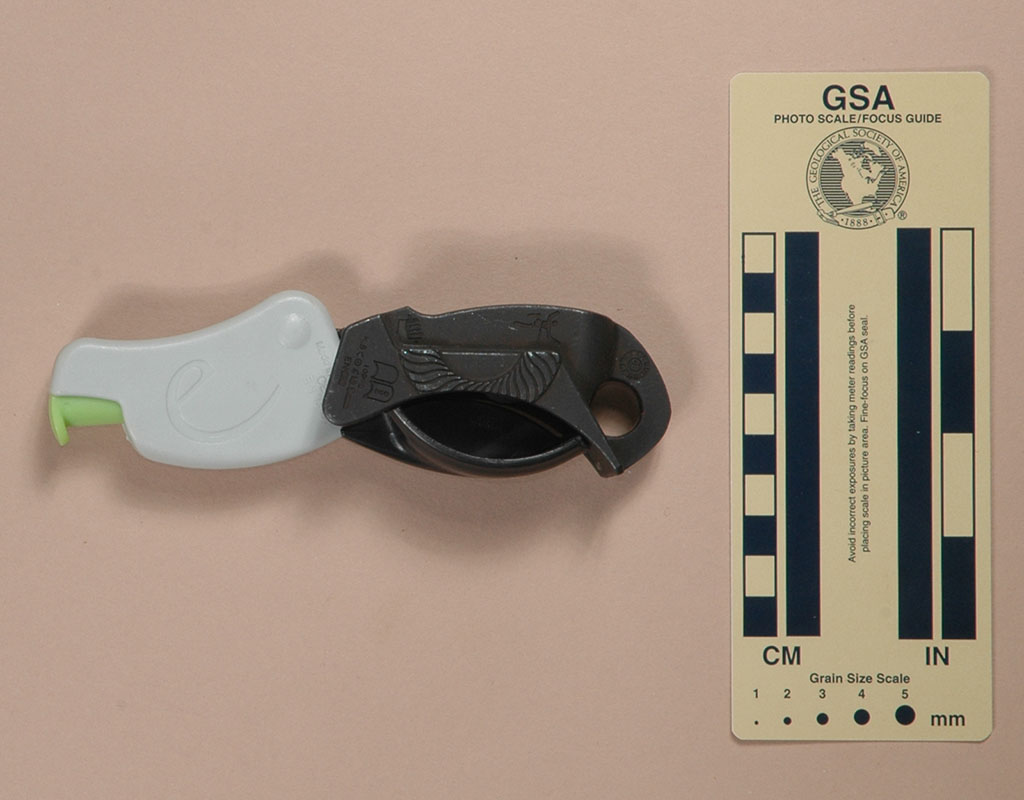
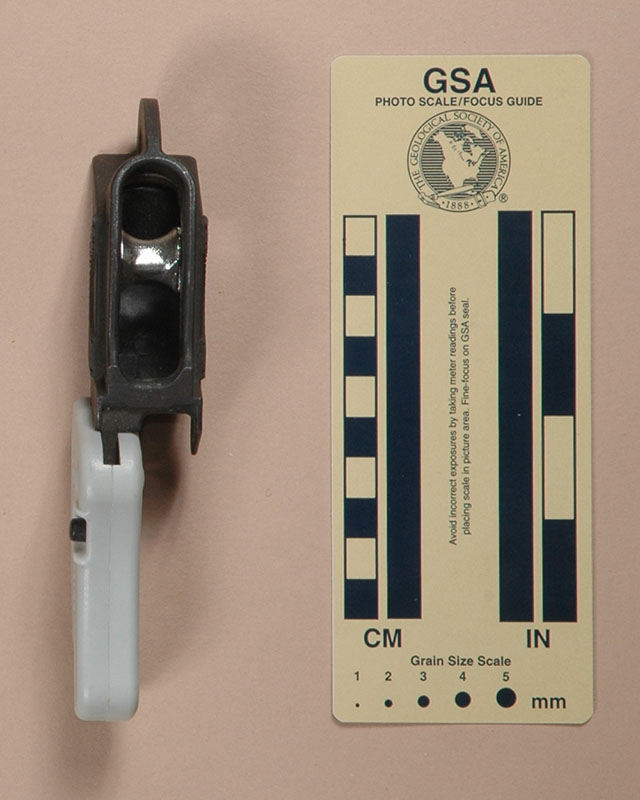
The Zap–O–Mat consists of an oxide-finished steel body, a steel rope pin, a gray plastic handle assembly, and a black plastic cover. The body has A 51 mm. long, 15.1 mm. wide rope slot and a 14 mm. diameter eye. The body pivots on a pin hidden in the handle assembly, where a plastic button releases a hidden locking mechanism, allowing the body to pivot open. The rope pin provides a U-grooved running surface for the rope. This surface is 12.5 mm. wide, 15.7 mm. in diameter at the sides, and 10.7 mm. in diameter at the center. A 4.8 by 3.3 mm. arm extends into the handle, where a spring acts to push the rod outward. A green plastic plunger assembly in the handle can move toward the body and then lock, thereby increasing the force on the spring. The plastic cover is fixed to the handle. The Edelrid Zap–O–Mat is 153 mm. tall, 45 mm. wide, 32 mm. thick, and weighs 162 g.
Each side of the body has a climber icon near the distal end of the rope channel and a hand-holding-a-rope icon near the handle. The rear side also has a book-with-an-"i" icon, "10P**" (*=illegible, perhaps "eS"), "8.9<•<10.5 mm," "EN***" (*=illegible, probably "892"), and an icon consisting of two concentric circles with "08" in the center, 12 radial lines between the two circles, and dots in the sectors from 1:00 to 4:00 (most likely indicating manufacturer in April 2008). The front of the handle has "ZAP-O-MAT" and "Patented" molded into it, and the rear has a large "e." "MADE IN GERMANY," CE 0123," and "EN 15151."
Shake the Zap–O–Mat and it rattles. That alone isn't necessarily bad (racks rattle too), but add the plastic parts and thin rope pin, and the Zap–O–Mat doesn't initially inspire confidence. It works, but I don't like it. The Zap–O–Mat is essentially no more than a bunch of fancy parts that implement a slotted belay tube, and I prefer the simplicity of the latter.
The instructions call the button the "Zap–O–Pen," the eye the "Zap–O–Fix," and the plunger the "Zap–O–Button." Gag me. 
 |
 |
 |
 |
 |
 |
Wilhelm Schachenmayer [1830–1874] registered Schachenmayer & Cie in the Isny commercial register. The company has its beginnings as a braid and cord factory by the Sauweiher. Edelmann & Ridder purchased the company and its eight factory buildings in 1874 and Schachenmayer retired. In 1953 Carl Benk took over the company as general partner. In the same year, Edelmann & Ridder developed the first marketable kernmantle rope for mountain sports.
A major fire destroyed the production facilities in 1959. They set up an emergency facility at the railway station a few days later. A few months on, the company moved into a newly constructed building on Achener Weg.
Edelmann & Ridder registered the Edelrid trademark in 1962. In 1964 they launched the first energy rope, also known as a multi-fall rope. This was the first dynamic mountain rope as we know it today. In 1973, the company burned for a second time, but they rebuilt.
In 2001 the world's then–largest rope manufacturer The Rope Company Ltd. in the UK, purchased Edelmann & Ridder. In 2006, Edelmann & Ridder GmbH was taken over by Albrecht von Dewitz, founder of VauDe. Edelmann & Ridder GmbH was renamed Edelrid GmbH & Co. KG. Edelrid founded a US.S. branch in Redmond OR in 2015. In 2017 Edelrid merged with the climbing shoe brand Red Chili, which continued operation under the Edelrid umbrella.